








After the crypto crash, how are the stocks of DAT companies doing?
TechFlow Selected TechFlow Selected
After the crypto crash, how are the stocks of DAT companies doing?
When a business model itself is questioned, being cheap may not be a reason to buy.
 Navigating Web3 tides with focused insights
Author: David, TechFlow
On the afternoon of the 10th, President Trump announced on Truth Social a 100% tariff on Chinese goods. The news instantly triggered panic across global financial markets.
In the following 24 hours, the cryptocurrency market experienced the largest liquidation event in history, with over $19 billion worth of leveraged positions forcibly closed. Bitcoin plunged from $117,000, briefly dropping below $102,000, marking a single-day decline of more than 12%.
U.S. stock markets were equally hard hit. On October 10, the S&P 500 closed down 2.71%, the Dow Jones Industrial Average fell by 878 points, and the Nasdaq Composite dropped 3.58%, all recording their biggest daily declines since April.
However, the hardest-hit were DAT (Digital Asset Treasury) companies—those holding digital assets as treasury reserves.
MicroStrategy, the largest corporate holder of Bitcoin, saw its stock price plummet as well; other crypto-reserve firms suffered even steeper declines. According to after-hours trading data, investors continue to offload shares.
For companies exposed simultaneously to risks in both crypto and equities markets, has the worst already passed?
Why Did DAT Companies Fall Harder?
DAT firms first face direct balance sheet impacts. Take MicroStrategy: it holds approximately 639,835 bitcoins. A 12% drop in Bitcoin’s price means nearly $10 billion in asset value evaporated overnight.
Under accounting rules, this must be recorded as an “unrealized loss.” While not a real loss unless sold, the numbers on financial statements are very real.
As an investor, you see a company's core assets rapidly devaluing. This also triggers a multiplier effect on market confidence.
In early 2025, MicroStrategy’s stock traded at a net asset value (NAV) premium as high as 2x, but by the end of September, that compressed to 1.44x. Currently, it stands around 1.2x.
For other similar companies, mNAV (market-to-NAV ratio) is converging toward 1, some already below it. These shifts reflect a harsh reality: market confidence in the DAT model is faltering under extreme conditions.
In bull markets, investors grant these companies premiums, framing them as pioneers of crypto innovation. But when sentiment turns, the same narrative becomes unnecessary risk exposure.
Non-Bitcoin cryptocurrencies suffered severe technical damage during this leveraged-driven crash, some crashing to zero instantly; even large-cap altcoins halved or worse due to liquidity shortages.
Companies holding such assets became prime targets for short sellers amid deteriorating market sentiment.
When panic hits, investors need to reduce exposure quickly. Although Bitcoin trades 24/7, large sell orders severely impact prices. In contrast, selling MSTR shares on Nasdaq is far easier.
Selling hundreds of billions in gold won't disrupt markets, but dumping $70 billion in Bitcoin could trigger price collapse and mass liquidations. This liquidity gap makes DAT stocks the preferred channel for rapid capital flight.
Worse, many institutional investors have strict risk control thresholds. Once volatility exceeds certain levels, they must cut positions regardless of preference. DAT companies are among the most volatile instruments.
To make an imperfect analogy: if regular tech companies are on one boat, DAT firms are two boats tied together—one sailing in equities markets, the other struggling in crypto waters.
When both face storms simultaneously, the impact isn’t additive—it’s multiplicative.
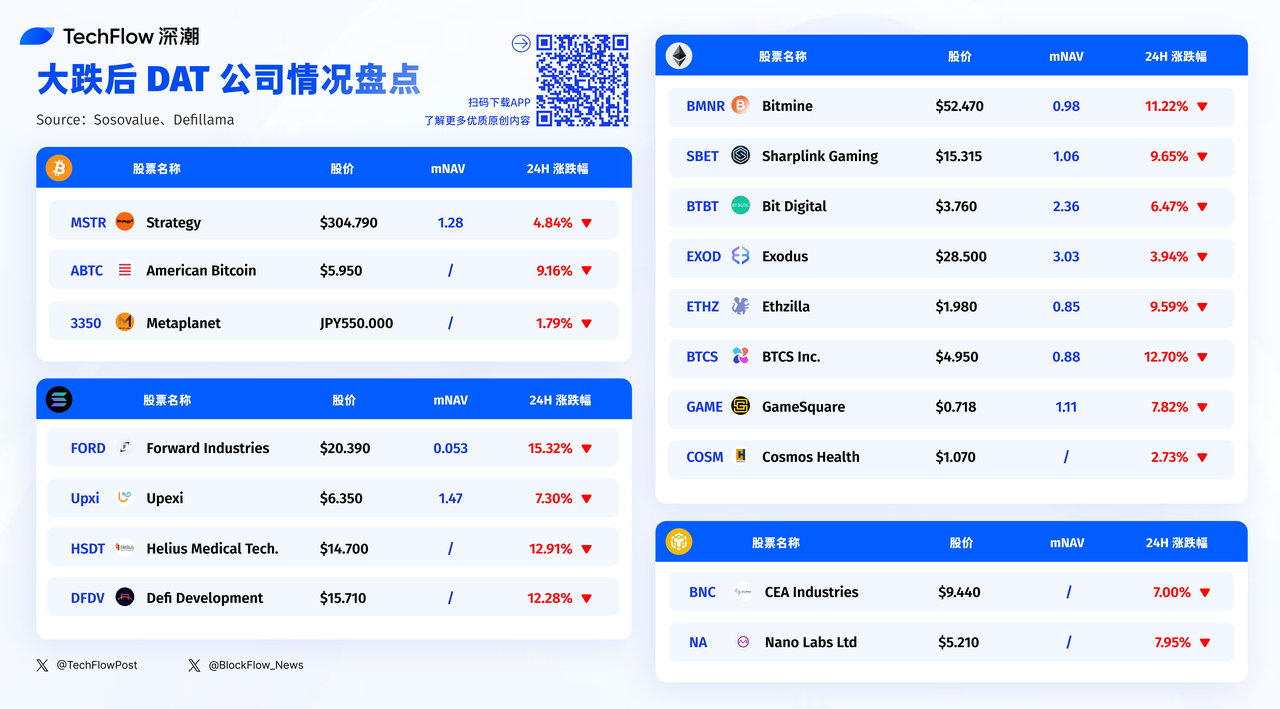
Who Was Hit Hardest, Who Held Up Best?
Looking at the previous trading session's DAT company losses, a clear pattern emerges: the smaller the company, the steeper the fall.
Forward Industries dropped 15.32%, with an mNAV of just 0.053. BTCS Inc. fell 12.70%, Helius Medical Tech dropped 12.91%.
These sub-$100 million market cap firms found almost no buyers during the panic. In contrast, MicroStrategy, despite being the largest Bitcoin holder, declined only 4.84%.
The reason is simple: liquidity.
During panics, bid-ask spreads for small-cap stocks widen sharply; even a modest sell order can crash the price.
For larger DAT firms, MicroStrategy trades at just 1.28x mNAV—almost purely based on coin holdings. The market values these firms essentially at their crypto asset worth plus minimal premium. When crypto crashes, they lack other businesses to absorb the shock.
When a company’s market cap nearly equals its held crypto value (mNAV near 1), it signals the market sees no added value beyond coin accumulation.
Bitmine’s mNAV is 0.98; others without precise mNAV data likely rank similarly low. These firms have effectively become crypto ETFs wrapped in public company shells.
The problem is: now that real Bitcoin and other ETFs exist, why would investors use these vehicles as indirect alternatives?
This may explain why low-mNAV firms fell harder during panic—they bear risks from both crypto and equity markets yet offer no additional value.
U.S. markets will open in a few hours. After a weekend of cooling-off, will sentiment improve? Will small DAT firms that dropped over 10% face continued selling, or see bargain hunters step in?
Data suggests mNAV sub-1 firms might be oversold, but could also be value traps. After all, when the business model itself is questioned, cheap doesn’t necessarily mean buy.
Join TechFlow official community to stay tuned
Telegram:https://t.me/TechFlowDaily
X (Twitter):https://x.com/TechFlowPost
X (Twitter) EN:https://x.com/BlockFlow_News
 深潮TechFlow


