








Crypto moves toward "external circulation," why is RWA the "historic bus" for Web3?
TechFlow Selected TechFlow Selected
Crypto moves toward "external circulation," why is RWA the "historic bus" for Web3?
In the next decade, RWA could become the decisive turning point for Crypto's integration into the real economy and achieving mainstream adoption.
 Navigating Web3 tides with focused insights
Author: imToken
Whether it's PAX Gold or Tether Gold hitting record market caps, or major platforms successively launching stock tokens, real-world assets (RWA) seem to be moving on-chain at an unprecedented pace.
Especially as TradFi institutions begin placing their bets—from the rapidly growing markets for gold and U.S. stock tokens, to trillion-dollar forecasts by financial giants like BlackRock and Citigroup, to Nasdaq's active participation—RWA is not only the next major narrative for DeFi, but could also become the historic bridge connecting Crypto with the real world.
And precisely for this reason, before discussing this trend, we should perhaps return to the starting point and answer one fundamental question:
Why do Web3 and Crypto so urgently need RWA?
01 The Historical Inevitability of DeFi Breaking Through Dimensions
Since Compound and Uniswap ignited the DeFi summer of 2020, the entire Crypto world has seen significant development, achieving rapid cold starts and exponential growth in both the variety and volume of on-chain native assets.
According to DeFiLlama data, at the time of writing, the total value locked (TVL) across all DeFi protocols exceeds $160 billion, approaching the historical peak of around $178 billion reached in November 2022.
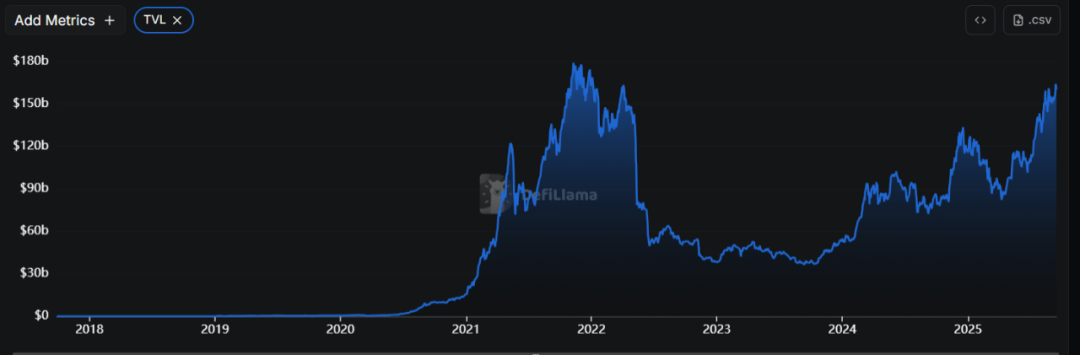
Source: DeFiLlama
Within this hundreds-of-billions-dollar empire, lending and staking protocols represented by Aave, MakerDAO, and Lido not only account for the majority of funds, but have also become critical infrastructure upon which countless DeFi Lego protocols depend. Indeed, most current decentralized trading and derivatives protocols are built atop the credit systems provided by these underlying lending protocols.
In the early stages of DeFi’s development, the “internal circulation” among native assets was undoubtedly a clever design—it not only solved the seed funding needs for ecosystem bootstrapping, but also greatly inspired boundless innovations aimed at improving capital efficiency within the Crypto world. However, the limitations of this “internal circulation” model are becoming increasingly apparent:
First is asset homogenization, with collateral highly concentrated in a few mainstream crypto assets, leading to high systemic risk; once core asset prices fluctuate sharply, cascading liquidations can easily occur;
Second is the ceiling on growth—the scale of DeFi remains constrained by the total market cap and volatility of the native crypto market, making it difficult to break through its own dimensional boundary;
In other words, relying solely on internal circulation of native assets, DeFi can no longer突破 its ceiling. To introduce more stable value anchors, DeFi must look outward, turning its attention toward real-world assets.
It is against this backdrop that the RWA (Real World Assets) narrative emerged. RWA, short for Real World Assets, refers to "bringing real-world assets on-chain," aiming to tokenize assets such as real estate, U.S. Treasuries, consumer credit, U.S. stocks, and artwork, then bring them onto blockchain networks to unlock liquidity and improve transaction efficiency.
Objectively speaking, the current size of the DeFi and Web3 market still lags far behind that of traditional financial markets. Yet the emergence of RWA tokenization brings new hope for Web3 to enter the next trillion-dollar-level market.
This is precisely the inevitable path for DeFi to evolve from “internal circulation” to “external circulation,” and from self-sustained growth within the ecosystem to mainstream adoption.
02 Boiling Oil: RWA Practices from Gold to U.S. Stocks
Now that we understand the necessity of RWA, let’s examine the current market landscape—the RWA market today is experiencing explosive growth, with tokenized gold being the most mature and representative example.
According to Token Terminal data, there is currently approximately $2.4 billion worth of tokenized gold (including XAUT and PAXG) on Ethereum. So far this year, the supply of tokenized gold has grown by about 100%. This reflects not only user demand for on-chain safe-haven assets, but also proves the feasibility of the RWA model.
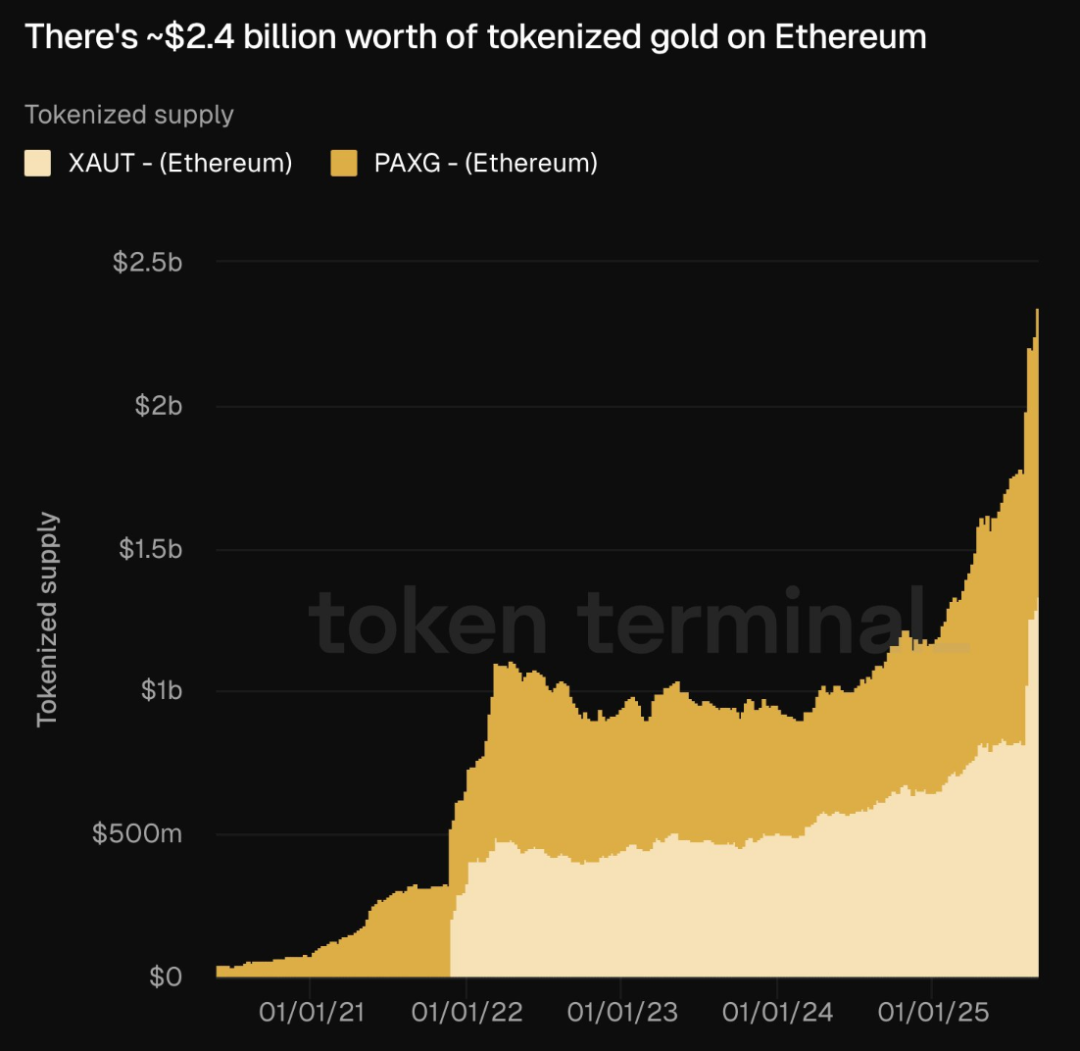
Source: Token Terminal
More notably, traditional financial authorities are now accelerating their moves into RWA tokenization.
As reported by the Financial Times, the World Gold Council (WGC) is actively seeking to launch an officially recognized digital form of gold: "We're trying to build a standardized digital layer for gold so that financial products used in other markets can eventually be applied to the gold market." This initiative could fundamentally transform London's $900 billion physical gold market.
Of course, objectively speaking, compared to the $231 billion gold ETF market or the estimated $27.4 trillion total market value of physical gold, tokenized gold is still in its infancy. But precisely because of this, its future growth potential is immeasurable.
Beyond gold, tokenizing mainstream financial assets such as U.S. Treasuries and U.S. stocks has become the hottest direction in the RWA space. Leading projects like Ondo Finance have already successfully brought yields from short-term U.S. Treasuries on-chain, offering crypto users compliant and stable sources of returns.
Tokenized U.S. stocks, in particular, have recently gained immense popularity, providing global users with a 7x24 channel to participate in the value growth of top global companies. From Ondo Finance to Robinhood再到 MyStonks, an increasing number of institutions are bringing popular stocks like Apple and Tesla on-chain, injecting richer asset types into the DeFi ecosystem.
Currently, mainstream Web3 wallets are also progressively integrating tokenized U.S. stocks, gold, and other RWA assets. For example, imToken now supports holding and managing stock tokens provided by Ondo Finance, such as Apple (AAPL) and Tesla (TSLA), where token values are pegged to their underlying assets and custodied in partnership with top-tier financial institutions like J.P. Morgan, ensuring compliance and security.
Whether it's the surging gold tokens or the upcoming stock tokens, RWA is no longer a marginal experiment—it has become a mainstream narrative stepping from backstage to center stage.
03 RWA: Crypto’s Historic Opportunity
Judging purely from data, the RWA narrative is undoubtedly the clearest Alpha direction for “Blockchain+” over the next decade.
Data from RWA research platform rwa.xyz shows that the current total market size of RWA is nearly $30 billion. BlackRock predicts that by 2030, the market cap of tokenized assets could reach $10 trillion.
In other words, over the next seven years, the potential growth of the RWA narrative could exceed 300-fold.
These figures are not baseless—they stem from a simple fact: the total value of real-world assets globally—including real estate, stocks, bonds, and credit—is in the hundreds of trillions of dollars. Even if only a tiny fraction of these assets get tokenized, it would bring an unprecedented flood of value into the blockchain world.
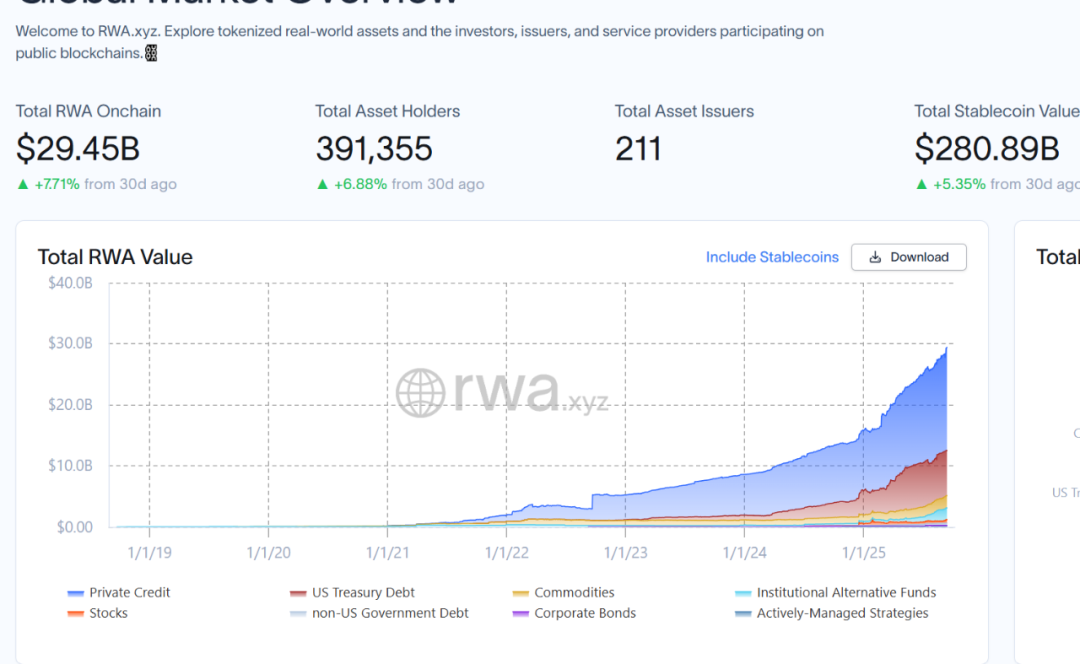
Source: rwa.xyz
Within this transformation of capital flows, Ethereum is undoubtedly the central battlefield—leading all other public chains in technological maturity, asset security, and completeness of DeFi protocol ecosystems. Because of this, even Ethereum co-founder Joseph Lubin has stated outright: RWA will be one of the biggest engines driving Ethereum’s ecosystem growth over the next decade.
Indeed, from tokenized U.S. Treasuries (e.g., Ondo Finance) to on-chain private credit financing (e.g., Centrifuge), various RWA projects are flourishing simultaneously.
The true significance of RWA goes far beyond simply bringing assets on-chain. It marks the formation of a financial paradigm shift that could reshape the foundational structures of both DeFi and traditional finance:
-
For DeFi: RWA introduces high-quality collateral that is stable, low-correlated, and generates consistent cash flow. This not only fundamentally mitigates systemic risks inherent in DeFi’s “internal circulation,” but also brings unprecedented asset diversity and market depth;
-
For traditional finance: RWA can “activate” highly illiquid assets such as real estate and private equity, enabling fractional ownership and efficient transfer via tokenization, greatly enhancing capital efficiency and creating entirely new markets;
-
For the entire ecosystem: Ethereum, as the undisputed core of this revolution, is evolving into a “global unified settlement layer”;
At its core, RWA represents an “incremental capital narrative.” It not only provides DeFi with more stable and less correlated high-quality collateral, but also signifies the first genuine handshake between the blockchain world and the real financial system.
Over the next decade, RWA may become the decisive turning point for Crypto to integrate into the real economy and achieve mainstream adoption.
Join TechFlow official community to stay tuned
Telegram:https://t.me/TechFlowDaily
X (Twitter):https://x.com/TechFlowPost
X (Twitter) EN:https://x.com/BlockFlow_News
 @imTokenOfficial






