Crypto Morning Brief: Native Markets wins USDH stablecoin bid, tokens including OP, FTN, ZRO to undergo large unlocks this week
TechFlow Selected TechFlow Selected
Crypto Morning Brief: Native Markets wins USDH stablecoin bid, tokens including OP, FTN, ZRO to undergo large unlocks this week
Polymarket is planning a return to the U.S. market and seeking new funding at a valuation of up to $10 billion.
 Navigating Web3 tides with focused insights
Author: TechFlow
Yesterday's Market Dynamics
Native Markets wins USDH stablecoin bid, plans token test within days
According to The Block, Native Markets, a team within the Hyperliquid ecosystem, has won the bidding for the USDH token.
Multiple major cryptocurrency companies participated in the bid, including institutional players such as Paxos and BitGo, as well as crypto-native firms like Ethena and Frax. As the first company to submit a proposal, Native Markets received support from two-thirds of staked HYPE tokens and plans to launch the token testing phase "within days."
Per the proposal, Native Markets' USDH will be natively issued on Hyperliquid's HyperEVM network, with reserves managed by both off-chain and on-chain assets. It explicitly outlines plans to allocate reserve earnings toward HYPE buybacks and expanding USDH circulation. The stablecoin will be "initially fully backed by off-chain reserves managed by BlackRock and on-chain reserves managed by Superstate via Bridge, in cash and U.S. Treasury equivalents."
DeFiLlama co-founder questions Figure’s data authenticity, rejects project listing
0xngmi, co-founder of DeFiLlama, responded to the controversy surrounding RWA project Figure. 0xngmi stated that DeFiLlama rejected listing Figure not due to its Twitter follower count, but because of questionable data discovered during due diligence.
0xngmi noted that Figure claims to have $12 billion in on-chain RWA volume, yet DefiLlama found several oddities:
1. Figure holds only $5 million worth of BTC and $4 million worth of ETH within exchanges (with just $2,000 in 24-hour Bitcoin trading volume);
2. Figure’s own stablecoin YLDS has a supply of only 20 million, theoretically serving as the base for all its RWA transactions;
3. Most transactions transferring RWA assets appear to be initiated by accounts other than those holding the assets;
4. The majority of Figure’s loan processes are completed via fiat, with almost no on-chain payments visible.
Tether to launch U.S.-based stablecoin USAT, appoints Bo Hines as CEO
Official sources confirm Tether is launching USAT, a dollar-backed stablecoin intended for issuance under U.S. regulatory frameworks, and has appointed Bo Hines as future CEO of Tether USAT.
USAT will strictly adhere to the U.S. GENIUS Act regulatory standards, backed by transparent reserves, aiming to provide digital alternatives to cash and traditional payment systems for enterprises and institutions. The stablecoin will leverage Tether’s Hadron technology platform, with federally regulated crypto bank Anchorage Digital acting as the compliant issuer and Cantor Fitzgerald serving as designated reserve custodian.
Tether CEO Paolo Ardoino said the launch of USAT is a natural step toward ensuring the U.S. dollar remains dominant in the digital era. Bo Hines previously served as Executive Director of the White House Crypto Council, bringing expertise in law, business, and policy.
Ethereum Foundation unveils end-to-end privacy roadmap covering private writes, reads, and proofs
According to The Block, Ethereum Foundation’s “Privacy & Scaling Explorations” team has rebranded as “Privacy Stewards of Ethereum” (PSE) and released a roadmap on September 12 focused on three key areas:
Private Writes: Make the cost and convenience of private on-chain operations comparable to public ones.
Private Reads: Enable reading information from the blockchain without revealing identity or intent.
Private Proofs: Accelerate proof generation and verification to make them more private and accessible.
The team plans to continue developing the experimental L2 design PlasmaFold to support private transfers, aiming to debut the feature at the Devconnect conference on November 17. Additionally, it will publish a “State of Private Voting 2025” report summarizing progress in private voting.
The team is working on privacy-focused DeFi protocols that could ensure both confidentiality and compliance for institutional clients, while continuing work on privacy computation projects. For private reads, the team is developing privacy-preserving RPC (remote procedure call) services.
Polkadot DAO passes proposal to cap total DOT supply at 2.1 billion
According to Cointelegraph, Polkadot DAO has passed referendum proposal #1710, with 81% voter support, to cap the total supply of DOT tokens at 2.1 billion.
The proposal replaces the previous unlimited issuance model that minted 120 million new DOT annually, and will instead reduce inflation by gradually cutting new DOT emissions every two years.
Yala: Protocol faced an unsuccessful attack attempt, all user assets unaffected
Yala posted an update on X regarding the incident: "Our protocol recently experienced an unsuccessful attack attempt that briefly affected the peg price of YU. Through swift collaboration with SlowMist and our security partners, we have identified the issue and are implementing improvements to further strengthen the system.
All user assets remain secure. We will focus on reinforcing stability and making the protocol more robust. Further updates will be shared soon."
Earlier reports indicated that SlowMist had been contacted by Yala’s official team for assistance in investigation and analysis.
Polymarket plans U.S. market return and seeks up to $10 billion valuation in new funding round
According to Cointelegraph, blockchain prediction market platform Polymarket is planning a return to the U.S. market and is seeking a new funding round. Sources indicate the company’s valuation in this round will be at least $3 billion, with one investor reportedly offering a term sheet valuing the firm as high as $10 billion. The company previously raised $200 million in June, led by Peter Thiel’s Founders Fund.
Polymarket was barred from serving U.S. users in 2022 after reaching a settlement with the U.S. Commodity Futures Trading Commission (CFTC). In July this year, the company acquired Florida-based derivatives exchange QCX, paving the way for its U.S. return. In September, the CFTC issued a no-action letter to QCX, granting regulatory relief for event contracts.
Shanghai Party Secretary Chen Jinlin: Leverage blockchain technology to build financial risk monitoring and early-warning system, encourage more financial institutions to adopt blockchain
According to the PBOC Shanghai Head Office official account, Shanghai Party Secretary Chen Jinlin emphasized during a visit to PBOC Shanghai Head Office the importance of seizing opportunities in digitalization and intelligence to jointly promote financial innovation and transformation. He called for optimizing regulatory frameworks and mechanisms, clarifying risk control requirements and access standards, supporting multi-agent technology development and deep applications. He urged encouraging more financial institutions to adopt blockchain, jointly developing supply chain finance based on secure and trusted credit systems, and leveraging blockchain technology to establish a financial risk monitoring and early-warning system to better prevent and mitigate risks in key areas.
SOL Strategies CEO: Has delegated approximately 3.6 million SOL so far, still at a disadvantage in crypto treasury market
Leah Wald, CEO of Solana treasury firm SOL Strategies, told Decrypt that despite being at a disadvantage in the increasingly crowded crypto and digital asset treasury market, being underestimated can actually be an advantage—because it often means you're doing something right. In the long run, markets value substance over hype.
SOL Strategies holds over 435,000 SOL on its balance sheet and has so far delegated around 3.6 million SOL to validators, representing over $820 million in delegated assets, allowing it to earn a proportional yield from these staked assets regardless of SOL price movements.
Michael Saylor posts Bitcoin Tracker again, likely to accumulate Bitcoin next week
Michael Saylor reposted the Bitcoin Tracker on X, stating, "Bitcoin Deserves Credit."
Based on past patterns, Strategy typically discloses Bitcoin accumulation the day after such announcements.
This week, multiple tokens including OP, FTN, ZRO face large unlocks totaling over $200 million
Data from Token Unlocks shows multiple tokens facing significant unlocks this week, totaling over $200 million. Tokens with unlock values exceeding $1 million include:
-
OP will unlock 116 million tokens on September 21, valued at approximately $91.29 million, accounting for 6.89% of circulating supply;
-
FTN will unlock 20 million tokens on September 18, valued at approximately $89.8 million, accounting for 2.08% of circulating supply;
-
ZRO will unlock 25.71 million tokens on September 20, valued at approximately $51.42 million, accounting for 8.53% of circulating supply;
-
VELO will unlock 3 billion tokens on September 20, valued at approximately $48.22 million, accounting for 13.63% of circulating supply;
-
ARB will unlock 92.65 million tokens on September 16, valued at approximately $47.78 million, accounting for 2.03% of circulating supply;
-
SEI will unlock 55.56 million tokens on September 15, valued at approximately $18.42 million, accounting for 1.18% of circulating supply;
-
ID will unlock 72.65 million tokens on September 22, valued at approximately $11.99 million, accounting for 6.30% of circulating supply;
-
ZK will unlock 173.08 million tokens on September 17, valued at approximately $10.4 million, accounting for 3.61% of circulating supply;
-
KAITO will unlock 8.35 million tokens on September 20, valued at approximately $9.85 million, accounting for 3.15% of circulating supply;
-
APE will unlock 15.6 million tokens on September 17, valued at approximately $9.41 million, accounting for 1.72% of circulating supply;
-
LISTA will unlock 33.44 million tokens on September 20, valued at approximately $8.7 million, accounting for 7.70% of circulating supply;
-
MELANIA will unlock 26.25 million tokens on September 18, valued at approximately $5.29 million, accounting for 5.60% of circulating supply;
-
ZKJ will unlock 15.53 million tokens on September 19, valued at approximately $3.48 million, accounting for 4.37% of circulating supply;
-
PIXEL will unlock 91.18 million tokens on September 19, valued at approximately $3.07 million, accounting for 4.54% of circulating supply;
-
IOTA will unlock 15.16 million tokens on September 17, valued at approximately $2.95 million, accounting for 0.41% of circulating supply;
-
BMT will unlock 3.6 million tokens on September 18, valued at approximately $260,760, accounting for 0.91% of circulating supply;
-
SOLV will unlock 40.14 million tokens on September 17, valued at approximately $1.67 million, accounting for 1.89% of circulating supply;
-
DMC will unlock 387.1 million tokens on September 21, valued at approximately $1.63 million, accounting for 11.34% of circulating supply;
-
CATI will unlock 13.18 million tokens on September 18, valued at approximately $1.19 million, accounting for 3.90% of circulating supply.
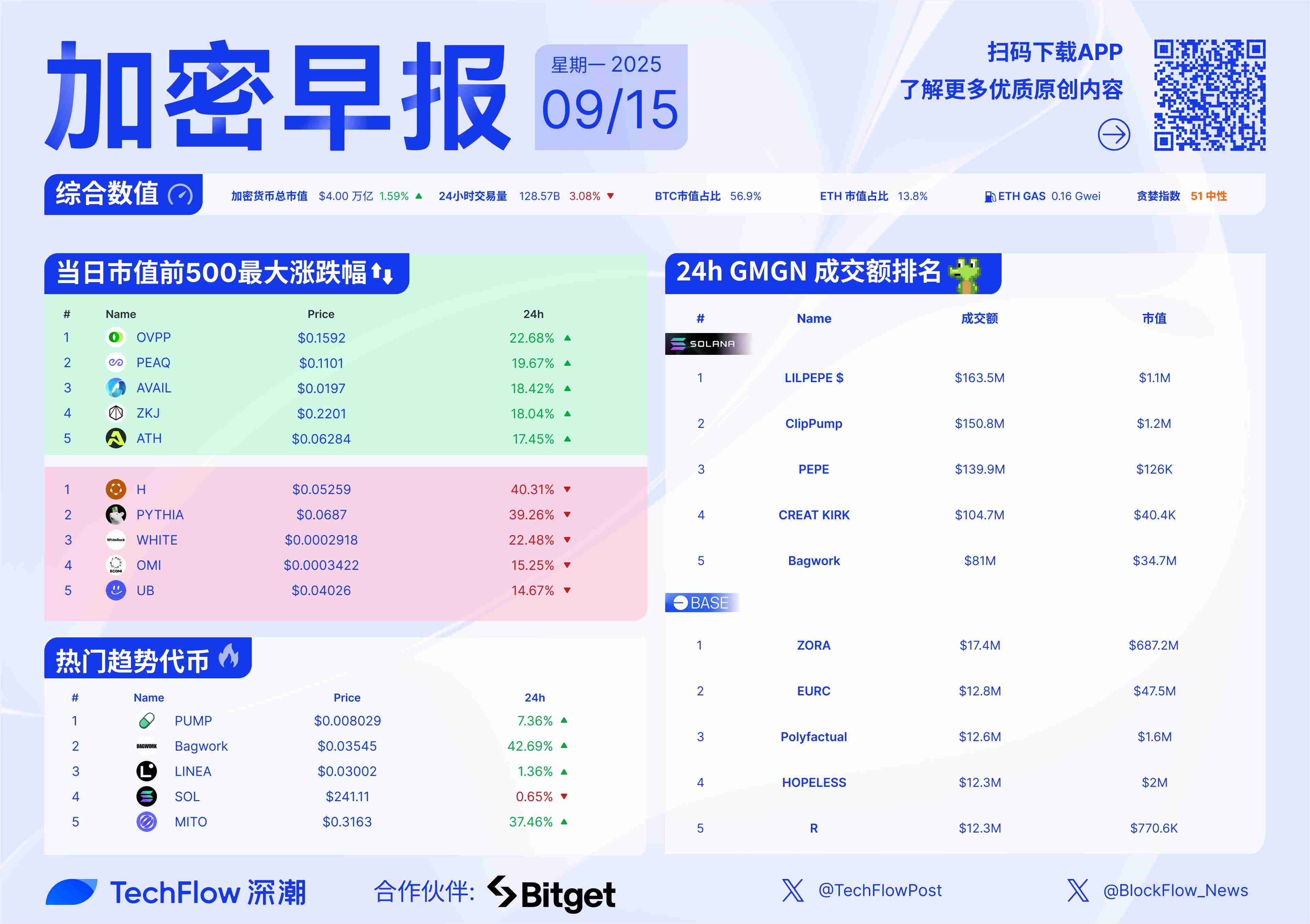
Market Data
Suggested Reading
This article explores the core vision, technical implementation, ecosystem development, and future plans of decentralized AI platform 0G Labs. 0G Labs aims to build a transparent, secure, open, and inclusive ecosystem for public AI goods, driving AI innovation and development through decentralization and challenging the limitations of centralized models.
The Changing of the Guard in Crypto America: Peter Thiel at a Historical Turning Point
This article examines Peter Thiel’s profound influence across technology, finance, and politics. Through venture capital, technological innovation, and political strategy, his reach extends from Silicon Valley to Washington, fueling the rise of right-leaning tech giants and attempting to reshape the core values of Western civilization. The article also analyzes Thiel’s philosophical ideas, investment strategies, and his role in advancing cryptocurrency and artificial intelligence.
This article details money laundering patterns and legal frameworks involving cryptocurrencies, focusing on the central role of stablecoins like USDT. Using the case of Hunan police dismantling a $170 million USDT money laundering ring, it reveals the evolution of money laundering crimes, specific operational methods, legal countermeasures, and offers risk mitigation advice for Web3 practitioners.
a16z Latest Insight: Consumer-Grade AI Companies Will Redefine the Enterprise Software Market
This article discusses how consumer-grade AI companies are achieving growth by redefining the enterprise software market, introducing the concept of the "Great Expansion." AI has fundamentally changed revenue retention models in consumer software, enabling user value to grow over time and blurring the lines between consumer and enterprise software. The article analyzes pricing strategies, shifts in user behavior, and the growing importance of enterprise features in the AI era, highlighting the dual nature of AI products as both opportunity and challenge for the future of the software industry.
Why Perpetual Contracts Belong Inevitably to General-Purpose Blockchains?
This article argues that perpetual contracts and other "killer apps" will further strengthen the dominance of top-tier general-purpose blockchains, as network effects compound. In the debate between app-specific chains and general-purpose chains, historical and economic perspectives show that general-purpose chains hold an edge due to shared infrastructure and efficient settlement mechanisms. Blockchain amplifies the advantages of platform economies through decentralized governance while addressing core drawbacks of traditional platforms.
Join TechFlow official community to stay tuned
Telegram:https://t.me/TechFlowDaily
X (Twitter):https://x.com/TechFlowPost
X (Twitter) EN:https://x.com/BlockFlow_News
 深潮TechFlow