The internet is building a native financial system, and the key to success or failure still lies in user experience
TechFlow Selected TechFlow Selected
The internet is building a native financial system, and the key to success or failure still lies in user experience
Infrastructure enables possibilities, user experience wins everything.
 Navigating Web3 tides with focused insights
Author: Ignas Survila
Translation: AididiaoJP, Foresight News
Currency is experiencing its "internet moment."
The internet long ago acquired communication systems (email), publishing platforms (blogs, social media), and commerce systems (Stripe, Shopify). Now it's building its own financial system. A system that is natively programmable, inherently open, and borderless from day one. This system is being built on stablecoin base protocols.
But here's the catch: while the infrastructure is emerging, we still lack the critical user experience. And history tells us it's precisely here that the biggest winners are crowned.

Infrastructure enables possibility; user experience wins everything
Every exciting technological revolution begins with infrastructure, but no one remembers protocols—everyone remembers the products that made them usable.
In 1982, the Simple Mail Transfer Protocol (SMTP) made email possible. But it wasn't until 2004, when Gmail launched with a clean interface, massive storage, and effective spam filtering, that email truly went mainstream.
Search engines existed before Google. AltaVista, Archie, Lycos. But Google simplified everything—faster, cleaner, smarter.
Skype didn't invent Voice over IP (VoIP), WhatsApp didn't invent instant messaging, but they made these technologies accessible to ordinary people.
We're at the same inflection point in the evolution of money
Stablecoins are helping create an internet-native financial system.
And this isn't theoretical—it's already happening.
-
In 2024, stablecoins settled over $15.6 trillion on-chain.
-
Tether is now the 18th largest holder of U.S. Treasuries globally, surpassing countries like South Korea, the UAE, and even Germany. Put differently, the world's fourth-largest economy now holds less U.S. debt than a single stablecoin issuer.
-
Yet despite this scale, circulating stablecoins amount to just $263 billion—compared to $22 trillion in U.S. M2 money supply, a penetration rate of barely 1%.
-
Today, fewer than 5% of people globally use stablecoins, but adoption is expected to reach 7–10% within five years, unleashing a new wave of mass financial inclusion.
-
In regions like Latin America, the Middle East and North Africa, and Southeast Asia, stablecoins already function as parallel dollar economies, with people relying on them daily to escape inflation, capital controls, or failing local banking systems.

We've never seen financial infrastructure expand this quickly—especially across borders. Stablecoins have already reached millions of users worldwide. There's good reason: they're fast, borderless, dollar-denominated, and run on open protocols. In a world where 1.4 billion people lack adequate financial services—and many more are constrained by capital controls or volatile local currencies—stablecoins offer something revolutionary: access to the global dollar network, available from anywhere with just a smartphone.
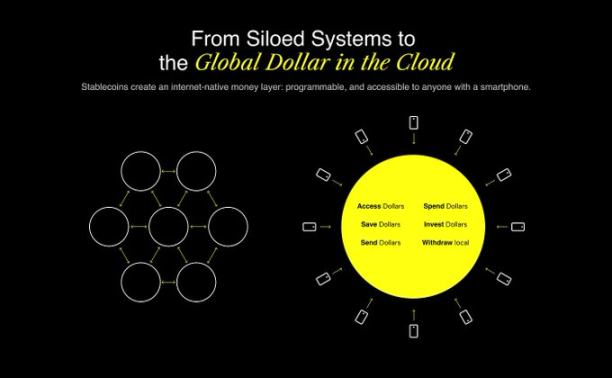
But here's the problem: if you try using stablecoins today, you'll hit a wall quickly. The payment experience is clunky, onboarding is confusing, and everything is wrapped in jargon—wallets, gas fees, networks, cross-chain bridges.
This is the gap. We have a new monetary operating system—the so-called internet-native financial cloud—but most people still can't access it.
It's like receiving a PS2 steering wheel for Christmas but having no PlayStation to plug it into. The massive opportunity lies ahead: making all of this feel normal, invisible, seamless.
Why user experience is the moat
In fintech, whoever owns the user owns the user relationship. Trust is built here, user behavior shaped here, long-term value created here.
User experience may rarely be the strongest argument in strategy meetings, but in fintech, it's everything. Because this isn't just software—it's money. And money requires trust.
Look at the most successful neobanks: Revolut, Cash App, Nubank. They operate in different markets, but all follow the same playbook: deliver world-class user experience.
As stablecoins enter their next phase of adoption, the real winners will be the brands people trust when sending money to family, the card they instinctively use to pay for lunch, the app that quietly replaces their local bank. It will be the experience that makes stablecoins feel invisible—that makes them feel like regular money. Ordinary, yet global.

Why now?
What makes this moment so urgent and exciting is the convergence of three forces:
Infrastructure is ready
-
Stablecoins are liquid and deeply integrated.
-
Wallet-as-a-service platforms (like Privy) and embedded on-ramp solutions (like Bridge) solve technical UX hurdles.
-
Credit card issuance, compliance-as-a-service, and KYC providers—all battle-tested.
Regulation is catching up
-
Hong Kong introduced stablecoin legislation in 2024.
-
The U.S. Treasury's GENIUS Act outlines a future path for regulated, scalable stablecoin use.
User base is growing rapidly
-
In Latin America and Sub-Saharan Africa, stablecoins are leapfrogging traditional banks.
-
There are still 1.4 billion unbanked people globally. But they have smartphones.
-
Gen Z are native to internet finance.
This isn't a speculative hype cycle. This is infrastructure maturing, regulation paving the way, and a massive consumer market waiting to be served. Billions still lack access to modern financial tools and services—but they have smartphones, internet access, and growing familiarity with stablecoins. The base protocols are finally in place. Now it's a race to build the experience layer that brings it all to life.

The stablecoin standard is being written
We believe the most underrated move in fintech today is building a stablecoin experience that feels like Apple Pay—an experience that fades into the background, just works, and wins through obviousness, trustworthiness, and global ubiquity.
Join TechFlow official community to stay tuned
Telegram:https://t.me/TechFlowDaily
X (Twitter):https://x.com/TechFlowPost
X (Twitter) EN:https://x.com/BlockFlow_News
 @isurvila