HTX DAO narrative upgrade: refreshed whitepaper redefining the "CeFi x DeFi" playbook
TechFlow Selected TechFlow Selected
HTX DAO narrative upgrade: refreshed whitepaper redefining the "CeFi x DeFi" playbook
HTX DAO, a new paradigm for building resilient financial infrastructure.
 Navigating Web3 tides with focused insights
In the evolution of crypto assets, we have witnessed the rise of both centralized finance (CeFi) and decentralized finance (DeFi).
The former has long served as the primary hub for liquidity in the crypto market, leveraging centralized platforms' product design, risk control systems, and vast user base. The latter originated from the 2020 "DeFi Summer," when novel protocols such as decentralized lending, DEXs, and liquidity mining rapidly emerged, continuously expanding into more experimental and autonomous financial applications.
With the rise of Ethereum and DeFi, liquidity pools and lending protocols have improved capital efficiency, though assets remained largely concentrated in native cryptocurrencies like BTC and ETH. In this new phase, RWA tokenization introduces broader real-world liquidity to the market, while CeFi, serving as a foundational source of liquidity and user onboarding, is gradually extending onto the blockchain, participating in the decentralized ecosystem in an open manner.
The boundary between on-chain and off-chain finance is dissolving, and the complementary development of CeFi and DeFi is shaping the trajectory of the evolving crypto financial ecosystem. At the heart of this shift lies the transformation of liquidity sources.
New Landscape of Web3 Liquidity
Sustained provision of liquidity in the Web3 market has become a core competitive focus for the industry. Unlike the early days, which relied solely on crypto assets such as BTC and ETH, today’s liquidity sources are becoming increasingly diversified:
● CeFi Platforms: CeFi platforms, primarily exchanges, remain the largest entry points for users and capital. They not only aggregate massive user bases and capital pools but also provide the initial liquidity required for DeFi protocols to launch and scale, functioning as a "water channel."
● Compliant Stablecoins: As anchors for on-chain transactions, payments, and settlements, stablecoins ensure certainty in fund inflows and outflows, providing low-friction infrastructure for cross-border payments and institutional settlements. According to Coingecko, stablecoin market capitalization continued growing in 2025, surpassing $283.5 billion, establishing itself as the "hard currency" of the crypto market.
● RWA Tokenization: By mapping traditional financial assets such as bonds, bills, and real estate onto the blockchain, RWA opens a value conduit between traditional markets and blockchain, unlocking new liquidity from previously illiquid assets. Boston Consulting Group predicts that the RWA market will reach $16 trillion by 2030, with 30%–50% of stablecoin holdings flowing into RWA assets.
● Institutional Capital Influx: As the crypto market matures toward compliance, traditional institutions such as funds and investment banks are entering. They bring not only large-scale capital inflows but also long-term capital stability and momentum driving the entire ecosystem toward healthier, more sustainable development.
It is evident that the convergence of CeFi's user scale, DeFi's governance mechanisms, and traditional finance's involvement is creating a synergistic force—ensuring both capital efficiency and security while expanding the breadth and depth of liquidity. This evolution from "early experimentation" to "multi-dimensional integration" not only reveals the industry's core challenges but also provides a solid practical foundation for the integration of CeFi and DeFi.
Governance: The Engine of Web3 Liquidity
If liquidity is the fuel powering the development of the crypto financial ecosystem, then governance is the engine that regulates this fuel. Whether it’s Aave V4 dynamically adjusting interest rates based on collateral quality and market liquidity to ensure efficient use of capital pools while avoiding systemic risks, or MakerDAO maintaining DAI’s stable peg during market volatility through governance mechanisms such as stability fees and collateral ratios, these examples fundamentally demonstrate the balancing role of decentralized governance between "asset liquidity" and "market stability."
Evidence shows that in a fast-evolving market with highly dynamic risks, DAO governance structures are often more flexible and resilient than traditional CeFi models.
Within today’s macro context, this governance advantage is particularly critical. Uncertainties in the external environment, users’ growing demand for both security and liquidity, and the converging trend of CeFi and DeFi are collectively pushing the market to seek more elastic governance models.
HTX DAO offers a response at this pivotal moment: on one hand, drawing from successful practices like Aave and MakerDAO, it employs on-chain governance to dynamically manage risk and liquidity; on the other, it leverages Huobi HTX to combine CeFi’s advantages in user scale and capital access with DeFi’s open governance and self-evolution capabilities, forming a governance structure that is both robust and efficient.
From Platform Gateway to Ecosystem Co-Governance: HTX DAO's Governance Evolution Path
Recently, HTX DAO completed an upgrade of its whitepaper. The latest version clearly outlines a governance evolution path—from data point to closed loop—transitioning from "platform gateway governance" to "ecosystem financial co-governance," driven by an open "holding tokens means governance" mechanism, combined with behavioral incentives and deflationary mechanisms to encourage user participation.
Under this model, users are no longer just "users" of the platform, but also "builders" and "owners." The scale effects of CeFi and the transparent governance of DeFi are thus meaningfully integrated:
● True Decentralization of Power: Through veHTX (Vote-escrowed HTX) tokens, HTX DAO delegates core operational decision-making power to the community. Users who hold and lock HTX tokens receive veHTX, granting them voting rights over key operational parameters such as listing approvals, trading pair adjustments, fee structures, and incentive weightings. This marks a fundamental shift in exchange operations—from centralized control to on-chain governance.
● Deep Integration of Yield and Governance: veHTX tokens not only confer governance rights but also entitle holders to on-chain dividends. This model tightly aligns users’ economic interests with the long-term growth of the ecosystem, incentivizing active participation in decision-making and collective maintenance of ecosystem health.
● Bridging the Gap Between CeFi and DeFi: HTX DAO’s governance mechanism essentially provides a direct pathway for CeFi’s vast user base to participate in DeFi governance. Without needing to navigate complex on-chain operations, users can enjoy the transparency and fairness of decentralized governance through a familiar platform.
Therefore, from exchange governance to on-chain expansion, from mechanism design to global financial hub, HTX DAO’s governance framework not only addresses traditional DAOs’ shortcomings in efficiency and compliance but also builds a truly user-centric "free financial port" capable of economic value distribution and institutional co-governance.
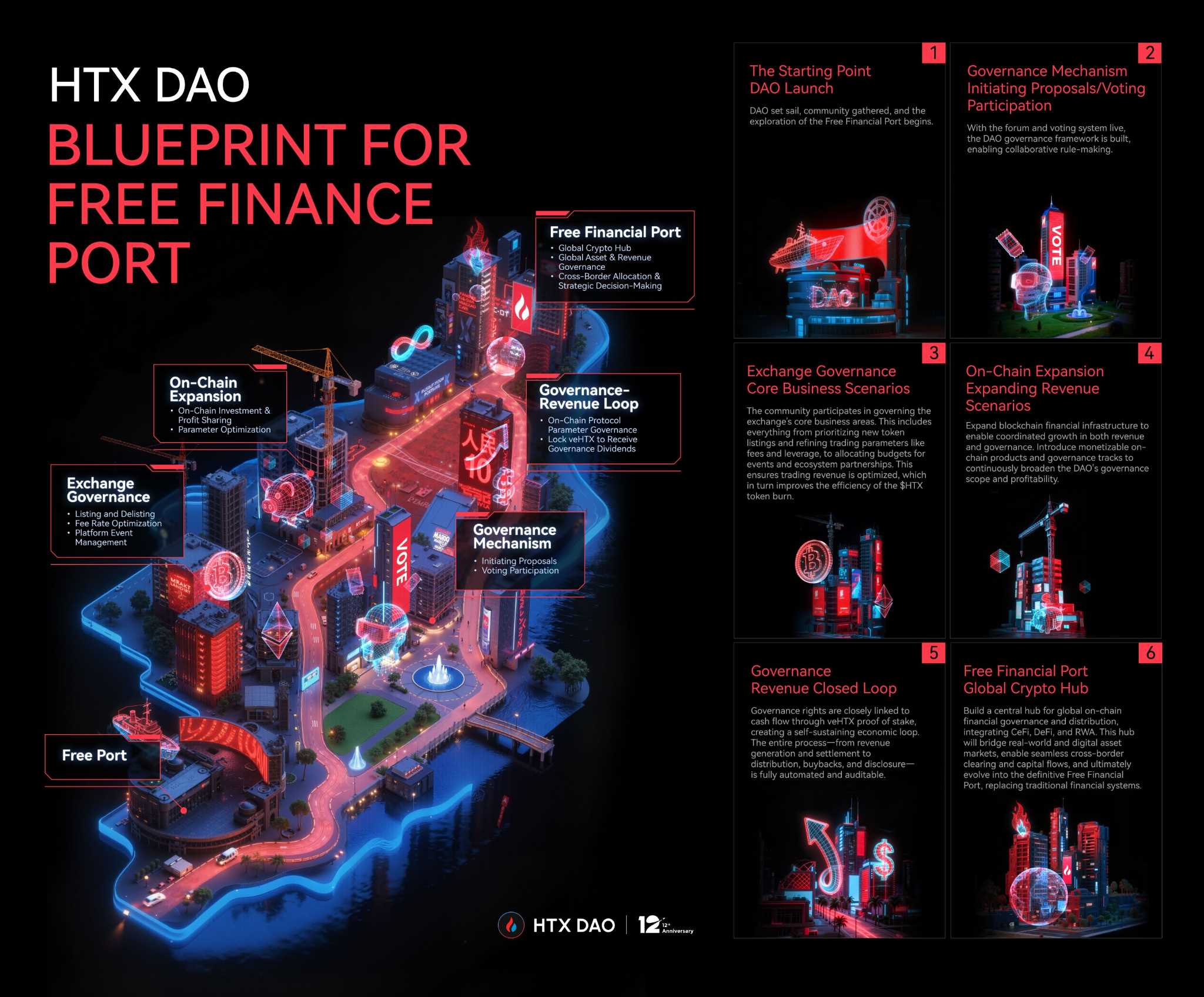
HTX DAO is building the next-generation CeFi × DeFi governance network
HTX DAO: A New Paradigm for Building Resilient Financial Infrastructure
It is foreseeable that future markets will no longer consist of isolated on-chain lending or trading scenarios, but rather form a more complex financial network characterized by cross-chain, multi-asset, and cross-border liquidity. In this context, how to coordinate liquidity through governance and how to maintain the stability and openness of capital pools amid uncertain macro conditions have become long-term challenges that DAOs must address.
HTX DAO aims to play the role of an "on-chain governance hub" within this landscape.
As outlined in its whitepaper, HTX DAO will be more than just a governance platform—it will serve as a nexus connecting CeFi and DeFi, on-chain and off-chain. On one hand, it will continue strengthening on-chain governance capabilities, advancing risk parameter configuration and liquidity management for multi-asset, cross-chain capital pools. On the other, it will explore integration with real-world markets—including governance models for compliant stablecoins, RWA assets, and even on-chain representations of U.S. stocks and bonds. The ultimate goal is to build an open, evolvable, cross-market governance network, transforming DAOs from tools for internal mechanism adjustment into long-term forces reshaping global financial architecture.
This is a grand narrative—not a zero-sum game between centralization and decentralization, but a symbiotic evolution at a higher dimension. We are witnessing the emergence of a new, more resilient financial infrastructure.
Join TechFlow official community to stay tuned
Telegram:https://t.me/TechFlowDaily
X (Twitter):https://x.com/TechFlowPost
X (Twitter) EN:https://x.com/BlockFlow_News