Gas fees drop 60%! DApp interaction costs significantly reduced, accelerating TRON ecosystem growth
TechFlow Selected TechFlow Selected
Gas fees drop 60%! DApp interaction costs significantly reduced, accelerating TRON ecosystem growth
TRON not only achieved a historic reduction of up to 60% in gas fees, but also introduced a quarterly dynamic adjustment mechanism simultaneously.
 Navigating Web3 tides with focused insights
At the end of August, the TRON network reached a significant milestone in its development history: not only achieving a historic 60% reduction in Gas fees, but also introducing a quarterly dynamic adjustment mechanism. This marks the largest-scale fee optimization since TRON's mainnet launch in 2018.
This Gas fee reduction goes beyond a simple parameter adjustment—it represents a deep reform centered on "user inclusivity and ecosystem activation," serving as a key strategic upgrade for the TRON ecosystem.
By lowering fees, TRON has significantly reduced network participation costs, delivering value to both users and developers: For users, the per-transaction cost of blockchain transactions and DApp interactions can drop by nearly 60%, effectively stimulating latent high-frequency trading demand while attracting a massive influx of new users through lower entry barriers. For Web3 developers, the long-term costs of deploying smart contracts and operating DApps will be substantially reduced, creating a more developer-friendly environment thanks to clear cost advantages, encouraging more innovative teams to deploy DApps on the TRON network and explore new frontiers, further enriching the ecosystem's application matrix.
It is foreseeable that this move will bring multiple positive effects to TRON: not only enabling users to genuinely enjoy a "low-cost, highly convenient" network experience, but also injecting fresh growth momentum into the entire ecosystem, driving exponential increases in user activity and transaction volume on TRON, thereby establishing a virtuous cycle of "lowering barriers → increasing engagement → promoting development" and laying the foundation for sustainable ecosystem prosperity.
For the TRON ecosystem, this substantial Gas fee reduction carries profound implications. It will not only immediately benefit existing DApps with tangible cost advantages, but its positive impact will permeate every corner of the ecosystem. All types of DApp applications will gain real benefits from this transformation, gaining more resources and motivation to innovate and grow under reduced costs, collectively accelerating TRON’s pace of innovation and pushing the entire ecosystem toward a more prosperous future.
For example, with significantly lower transaction costs, capital flows within DeFi protocols will become smoother and more efficient, greatly enhancing capital utilization and liquidity. The NFT sector and creator economy will also see new development opportunities, as lower creation, minting, and trading costs stimulate greater creative enthusiasm and unleash continuous waves of innovation. Meanwhile, cutting-edge areas like Meme coins will gain fertile ground for "low-cost experimentation," enabling bolder exploration and accelerating the deployment of novel applications, driving continuous expansion of the user base, and so on.
Double Impact! TRON Gas Fees Slashed by 60%, Quarterly Dynamic Adjustment Mechanism Introduced
"Gas fees on-chain are not only being cut by 60%, but a quarterly dynamic adjustment mechanism will also be introduced"—this is TRON’s latest initiative to optimize its on-chain transaction fee structure. This means TRON will move beyond the era of "fixed" fees, with potential flexible adjustments every quarter based on actual market conditions.
In the blockchain world, Gas fees function like "tolls on a highway," directly influencing users' willingness and frequency to transact: excessively high fees increase user burdens, create entry barriers, deter potential users, and stifle ecosystem innovation; conversely, reasonable and low fees significantly lower participation thresholds, attract more users, and foster a thriving DApp ecosystem.
As the world's largest stablecoin network, TRON has long emphasized "low fees, high security, and high efficiency" as core strengths. However, with the rising price of TRX, actual on-chain transaction costs have gradually increased, leading to higher network fees.
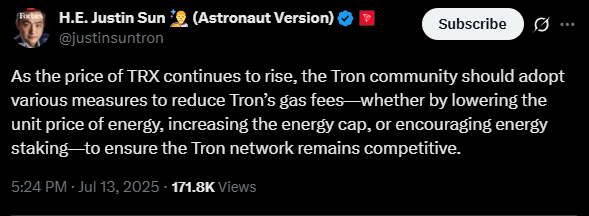
Sun Yuchen, founder of TRON, has consistently prioritized network fee issues. As early as July, he stated on X that as TRX prices continued to rise, the TRON community would adopt various measures to reduce network Gas fees—whether by lowering energy unit prices, raising energy caps, or encouraging energy staking. On August 21, he reiterated: TRON Super Representatives had noted the issue of rising transaction fees accompanying TRX price increases, and the community would flexibly adjust fees based on actual conditions to maintain network competitiveness.
Soon, this plan became concrete action: On August 26, TRON Super Representative nodes (SR) proposed Proposal #104, suggesting "reducing the network’s energy unit price from 0.00021TRX (210 SUN) to 0.0001TRX (100 SUN)." This change would directly reduce TRX burn costs during transactions by nearly 60%, alleviating financial pressure on users and developers while further boosting ecosystem activity. On August 29, the proposal passed with overwhelming support—25 out of 27 Super Representatives voted in favor. On the same day, the energy unit price on the TRON network was officially lowered, meaning that acquiring one unit of energy previously requiring the burning of 0.00021TRX now requires only 0.0001TRX.
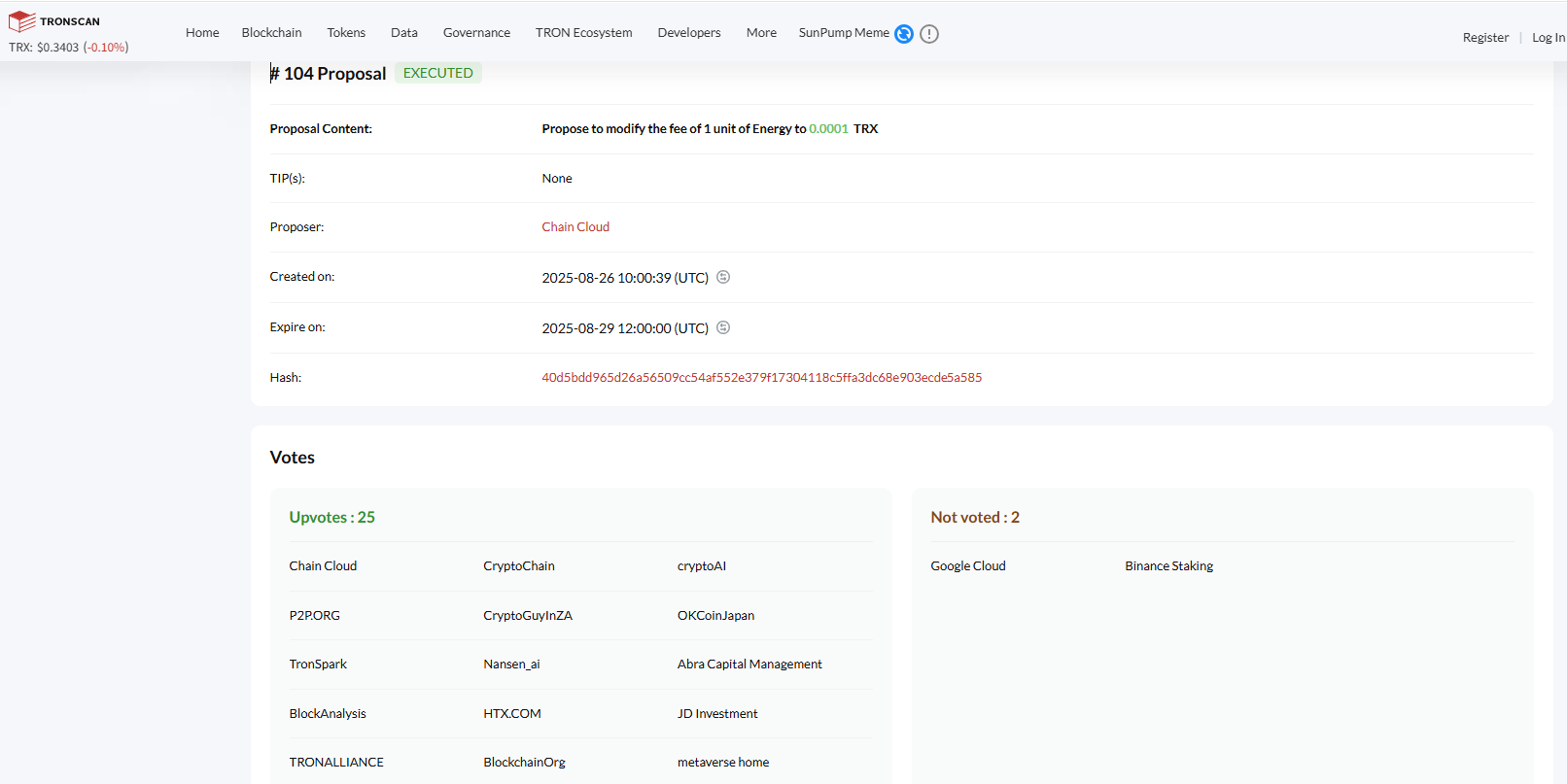
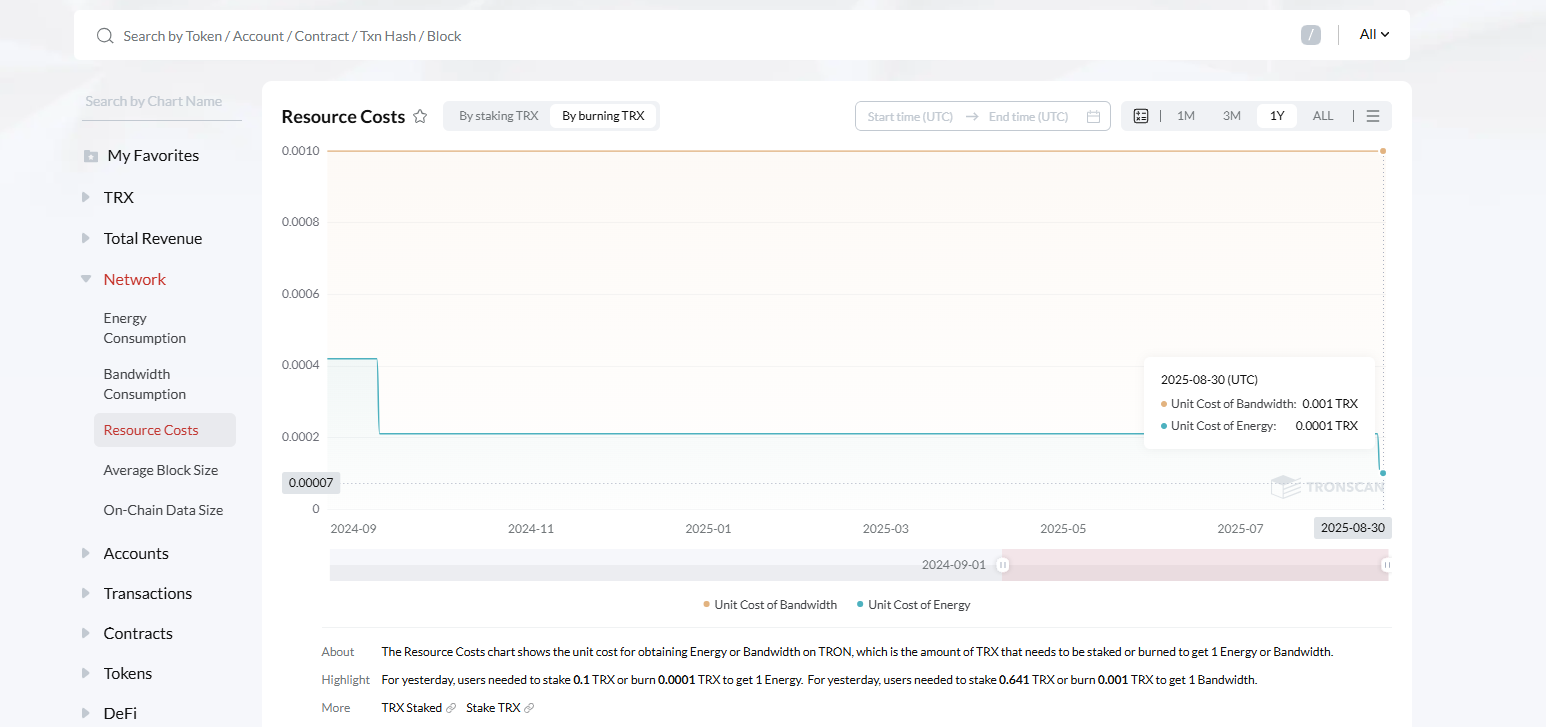
To understand the core value of this adjustment, it's essential to clarify the composition of TRON’s transaction fees: On-chain fees primarily rely on two resources—Bandwidth and Energy. Bandwidth measures storage and network resource usage for transactions, while Energy calculates the computational power required to execute smart contracts (e.g., DeFi logic). Previously, each account on the TRON chain received a daily allocation of free bandwidth priced at 0.001TRX per unit, while Energy prices were dynamic—users could obtain Energy by staking TRX, or burn TRX if their wallet lacked sufficient Energy.
Energy, as the key resource for executing smart contracts and invoking contract logic (such as DeFi lending calculations, NFT minting, and Meme token transfers) on the TRON network, directly determines the cost of user operations on DApps. Reducing the Energy unit price from 0.00021TRX to 0.0001TRX means users now spend nearly 60% less TRX when performing these actions, directly corresponding to a ~60% reduction in core Gas fees—hence the description of a "60% direct Gas fee cut." For instance, in a typical NFT minting transaction, acquiring 10,000 units of Energy previously required burning 0.21TRX, but now only 0.1TRX is needed—a clear cost reduction.
The drop in Energy prices is especially beneficial for two user groups. For high-frequency traders (e.g., those frequently engaging in DeFi arbitrage or GameFi), long-term operational costs can decrease by nearly 60%, allowing them greater freedom in on-chain activities. For small-payment users (e.g., cross-border remittances or daily purchases), they no longer need to hesitate over "fees exceeding transaction amounts," truly enabling "low-cost, high-frequency use" and making on-chain payments more accessible and convenient.
More importantly, a quarterly dynamic observation and adjustment mechanism has been simultaneously introduced for TRON’s on-chain fees. This means TRON transaction fees will no longer be fixed, but instead optimized flexibly each quarter based on core metrics such as TRX market price, network activity, and user growth rate.
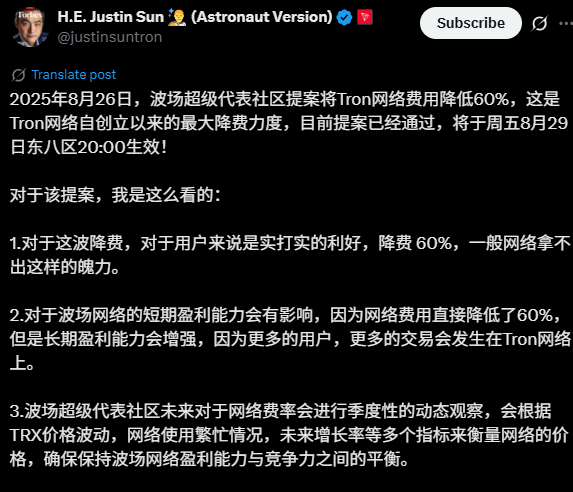
Regarding this adjustment, Sun Yuchen, founder of TRON, commented: A 60% fee reduction is rare in the industry and delivers real benefits to users. While short-term network revenue may be affected, long-term profitability will strengthen due to increased user numbers and transaction volume. Going forward, TRON Super Representatives will conduct quarterly dynamic evaluations of fees, balancing competitiveness and profitability across multiple indicators.
This decision has gained broad recognition within the crypto industry. Experts widely believe the fee cut will reduce TRX burn costs for on-chain transactions by over half, bringing multiple benefits to the ecosystem. For developers, the burden of contract deployment and app operation is significantly lighter; for users, transfer and DApp interaction costs are greatly reduced; in the long run, low fees will attract more new users and further expand TRON’s DeFi, stablecoin, and Meme ecosystems.
Crypto KOL @May posted on X: "For users, costs related to TRON network transfers, contract deployments, and DeFi interactions will all noticeably decline. This proactive fee reduction not only reduces usage burdens but also reinforces TRON’s advantage in high-frequency, small-value payments. Low costs empower developers to boldly explore new applications and encourage users to adopt TRON for everyday scenarios."
Thus, TRON has not only achieved the immediate benefit of "energy unit price down to 0.0001TRX and Gas fees slashed by 60%," but also established a scientific and flexible fee adjustment system, giving TRON’s fee structure long-term adaptability. This dynamic mechanism avoids both the problem of "passively higher fees due to TRX price hikes" and the risk of "unsustainable network operations from excessively low fees," striking an optimal balance between "user inclusivity" and "ecosystem profitability," maintaining TRON’s friendliness to developers and users alike, and fueling sustained ecosystem growth.
DApp Interaction Costs Sharply Reduced, TRON Ecosystem Gains New Opportunities for Comprehensive Growth
The historic reduction in TRON network Gas fees is injecting unprecedented growth momentum into the entire ecosystem. The significant drop in on-chain transaction costs not only activates latent high-frequency trading demand but also attracts a massive influx of new users through lower barriers. Meanwhile, these cost benefits are rapidly spreading across various DApps within the ecosystem—including DeFi, NFTs, stablecoins, and Meme sectors—driving comprehensive growth for the TRON ecosystem.
From the DEX platform SUN.io that meets mainstream trading needs, to the lending hub JustLend DAO enabling capital flow; from the NFT marketplace APENFT supporting digital art circulation, to the community innovation platform SunPump, and the stablecoin payment infrastructure covering daily spending scenarios—none are immune to the benefits of this fee reduction. Nearly all TRON-based applications can leverage lower energy costs to enhance user experience, boost retention and engagement, and deliver tangible convenience and savings, thus fostering a positive cycle of "cost reduction → increased activity → ecosystem prosperity."
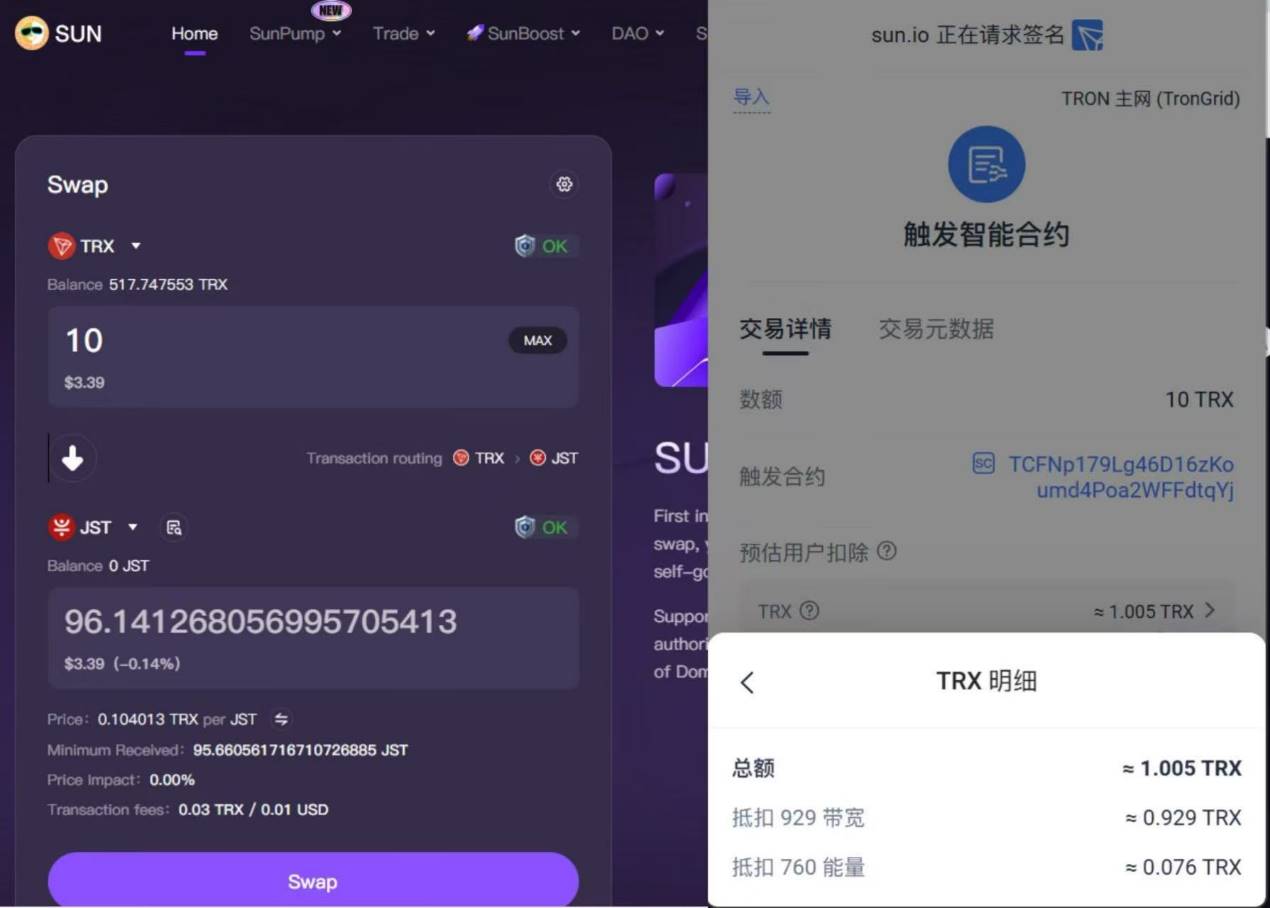
Gas fee per transaction on Sun.io on September 2
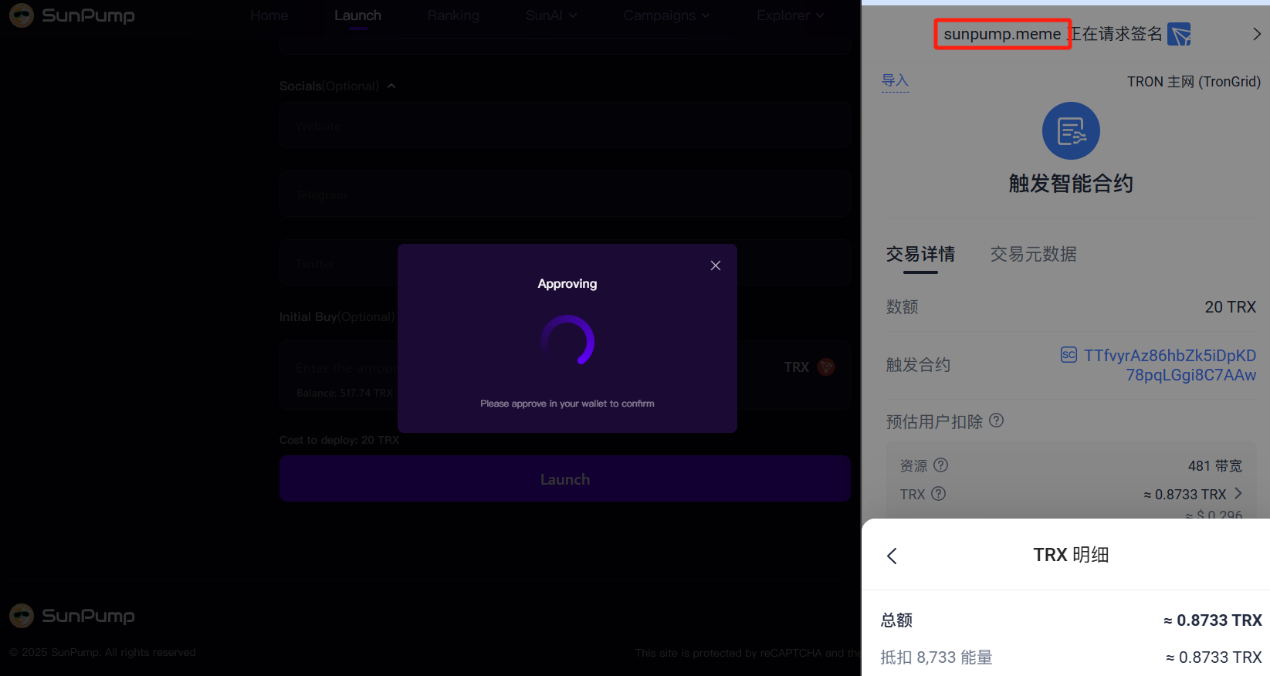
Gas fee to create a Meme coin on SunPump on September 2
The ripple effects of this cost reduction continue to spread. On September 1, the lending platform JustLend DAO led the response by announcing a reduction in its Energy Rental platform’s base rate from 15% to 8%, further lowering user energy acquisition costs and enabling more people to easily participate in on-chain operations. Currently, JustLend DAO’s daily energy price is around 26 sun/day, allowing users to rent 100,000 energy units (equivalent to what can be obtained by staking 9,986 TRX) for just 2.62 TRX—enough for two transactions. This means users renting energy via JustLend DAO’s Energy Rental platform enjoy dual discounts: one from the reduced energy price and another from the rental service itself.
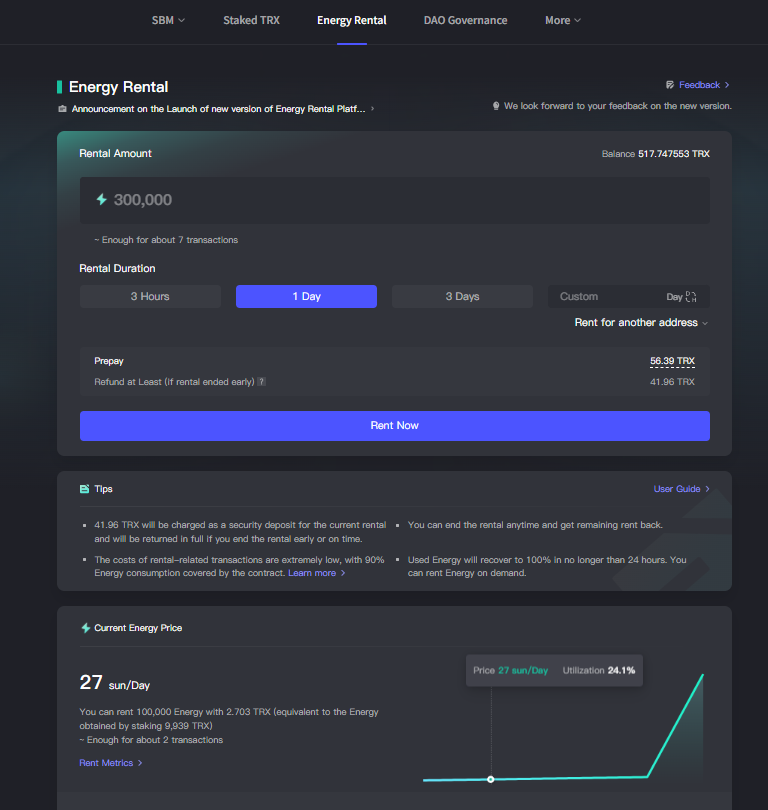
Looking at individual sectors, the logic of benefits and growth potential becomes even clearer.
In stablecoin payments, as TRON hosts the world’s largest USDT circulation network (with over $82.6 billion USDT issued on-chain), the sharp drop in cross-border and micro-transfer costs will drive deeper integration of stablecoins into daily consumption, reinforcing TRON’s position as the "global stablecoin settlement network." For example, Southeast Asian e-commerce merchants receiving TRC20-USDT payments could see transaction fees for a $100 transfer drop from about 0.21TRX to 0.1TRX. Halved costs will encourage more merchants to adopt TRON-based stablecoins, accelerating penetration into real-world economic scenarios and injecting new vitality into the broader economy.
For DeFi protocols within the TRON ecosystem, lower transaction, lending, and staking costs allow users to participate more flexibly in arbitrage and capital strategy adjustments, especially in high-frequency cross-pool arbitrage. With TRON already forming a DeFi matrix centered on the all-in-one DEX SUN.io and the lending platform JustLend DAO, declining transaction costs are expected to directly boost both platforms’ transaction frequency and capital size, driving a more vibrant DeFi ecosystem.
In the NFT space, reduced minting, listing, and trading costs will directly energize both creators and collectors. For creators, lower minting costs lower the barrier to NFT participation, empowering smaller artists to express creativity. For collectors, reduced bidding and resale fees will increase transaction frequency, boosting trading volume on platforms like APENFT and helping the digital art ecosystem transition from niche circles to the mainstream market.
Regarding Meme and creator economies, lower barriers for community projects to issue tokens and for creators to monetize via on-chain tools will spark more innovative use cases. For instance, individual creators can use the SunPump platform to issue personalized Meme tokens at lower cost or launch on-chain crowdfunding campaigns. Communities can implement "token airdrops and community incentives" through low-cost transfers, advancing on-chain cultural dissemination and social economy development, and driving growth in new Meme projects.
Historical data clearly demonstrates the strong catalytic effect of fee reductions on the ecosystem. Last September, after TRON implemented Proposal #95, reducing the energy unit price from 0.00042TRX to 0.00021TRX, TRONSCAN data showed a 27% increase in daily active accounts and a 19% rise in total transaction volume within three months. Subsequently, the newly launched SunPump platform ignited a Meme boom, and TRON surpassed Ethereum in on-chain USDT scale, becoming the world’s largest stablecoin circulation network.
Now, with energy prices dropping another ~60%—the largest adjustment since TRON’s 2018 mainnet launch—the ecosystem’s growth potential is even more promising. Data already shows initial signs of this "immediate effect." According to DeFiLlama, on September 1, TRON recorded 2.48 million daily active addresses—the highest among all public blockchains. TRONSCAN data revealed 9.55 million total transactions and 2.57 million contract calls on the same day, marking the highest levels since June this year, clearly reflecting heightened user willingness to interact with DApps and showcasing a thriving ecosystem.
Meanwhile, the TRON ecosystem continues to make key advances. MetaMask, the world’s most widely used wallet, announced integration support for the TRON network, enabling users to directly trade TRON-based assets or use ecosystem DApps like SUN.io and APENFT through this mainstream wallet—greatly lowering the barrier for cross-ecosystem migration and making it easier for more users to join the TRON ecosystem. The cross-chain protocol DeBrige now supports TRON, connecting value flows with other public chains. Additionally, TRON has partnered with compliant exchange Kraken and tokenization platform BackedFi to integrate the tokenized stock platform xStocks into its network, opening up a new scenario for "on-chain investment in traditional financial assets," expanding the ecosystem’s application boundaries and offering users more diversified investment options.
The combined impact of Gas fee reductions and ecosystem developments creates powerful synergies, building a stronger growth moat for TRON: On one hand, low fees continuously attract users and developers, providing fertile ground for "low-cost experimentation and high innovation" in DeFi, AI, NFTs, Meme, SocialFi, and GameFi. On the other hand, upgrades in wallet integration, cross-chain interoperability, and compliant asset access solve user pain points around "difficulty entering, transferring, and limited use cases," establishing a virtuous cycle of "low-barrier attraction → positive experience retention → multi-scenario conversion," driving sustained and healthy ecosystem development.
Going forward, TRON will continue strengthening its "cost advantage + ecosystem moat," leading the Web3 ecosystem toward a more inclusive, active, and innovative future.
Join TechFlow official community to stay tuned
Telegram:https://t.me/TechFlowDaily
X (Twitter):https://x.com/TechFlowPost
X (Twitter) EN:https://x.com/BlockFlow_News