The Evolution of Monetary Systems: From Gold to Stablecoins
TechFlow Selected TechFlow Selected
The Evolution of Monetary Systems: From Gold to Stablecoins
While stablecoins rely on sovereign credibility similar to traditional fiat currencies, they can separate trust in sovereignty from trust in corporate power.
 Navigating Web3 tides with focused insights
Author: Jacob Wittman, Legal Counsel at Plasma
Translation: AiddiaoJP, Foresight News
What Is Money?
In July 1944, near the end of World War II, representatives from over 40 countries gathered in a small town in New Hampshire to answer a seemingly simple question: What is money, and who controls it? The Bretton Woods Conference was not the first time global leaders had debated this issue, nor would it be the last. Debates over gold, the dollar, and exchange rates shaped the architecture of the modern global financial system.
For thousands of years, every major monetary transformation has centered on one fundamental question: What gives money its value? Discussions about the value of money often involve its sovereignty and scarcity.
Each monetary shift has been less about the physical form of money and more about trust, power, and the rules of the game. Stablecoins represent the latest phase in this evolution, as trust and power become increasingly decentralized. We believe stablecoins are currently the most influential form of money.
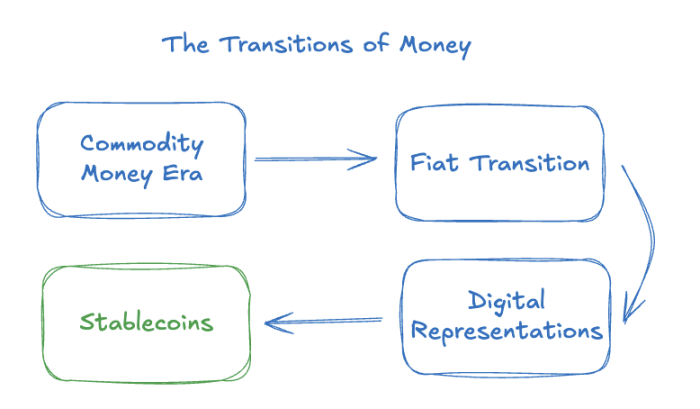
The Commodity Money Era
The earliest known forms of money were commodities such as gold, silver, shells, and salt. These items possessed intrinsic or widely recognized value, derived from their physical scarcity. For example, gold is limited in supply and must be mined—an expensive and difficult process.
Scarcity created credibility. If you held a gold coin, you could trust it as a good "store of value," because no government or banker could simply print more gold out of thin air.

On the Micronesian island of Yap, money took the form of massive limestone discs, some weighing several tons, quarried from Palau. Their value depended on size, difficulty of transport, and origin. Since ownership was tracked through community consensus rather than physical movement, these stones demonstrated that the power of money stems from shared belief, not intrinsic value.
Yet this form also imposed limitations. Commodity money was heavy, hard to transport, and inefficient within a rapidly growing global economy. These physical constraints limited payment efficiency and hindered economic growth. Long-distance trade required a system capable of transcending the weight of metal and limits on capital.
The Shift to Fiat Currency
Ultimately, globalization and industrialization combined to push commodity money toward collapse. Governments stepped in and introduced fiat currency. Paper money, initially redeemable for gold or silver, gradually became widely accepted as money itself. The Bretton Woods system institutionalized this ecosystem by pegging the dollar to gold and other currencies to the dollar.
This monetary system functioned roughly for 25 years. By the late 1960s, however, U.S. gold reserves could no longer support the dollar’s global dominance. In 1971, President Nixon suspended the dollar’s convertibility into gold, ushering in the era of unbacked fiat currency.
In this next stage of money, value came from sovereign credibility, not material scarcity. The dollar holds value because the U.S. government says so, and markets and foreign governments believe it. Trust shifted from being physically backed to being politically and policy-backed.
This profound transformation gave nations powerful tools. Monetary policy became a central lever for economic management and geopolitical strategy. But fiat currency also introduced vulnerabilities like inflation, currency wars, and capital controls. In some cases, flexibility and stability are mutually exclusive. Today, the core question surrounding most modern monetary systems is not who can create money, but whether those in power are trustworthy enough to maintain its value and utility over time.
Digital Representations of Money
The rise of computers and the consumer internet raised an important question at the intersection of electrical engineering and finance: Can money be represented digitally within digital environments?
Projects like Mondex, Digicash, and eGold were early attempts in the 1990s and early 2000s to address this question. They promised new forms of electronic payments and value storage. Ultimately, these projects failed due to regulatory pressure, technical flaws, and a lack of trust and product-market fit.
Meanwhile, electronic banking, credit cards, payment networks, and settlement systems became widespread. Importantly, these are not new assets. They are new representations of fiat currency—more scalable and better suited to the modern world. Yet they still operate under the same institutional trust and policy frameworks, and crucially rely on closed technological systems and operational networks run by rent-seeking intermediaries.
The Rise of Stablecoins
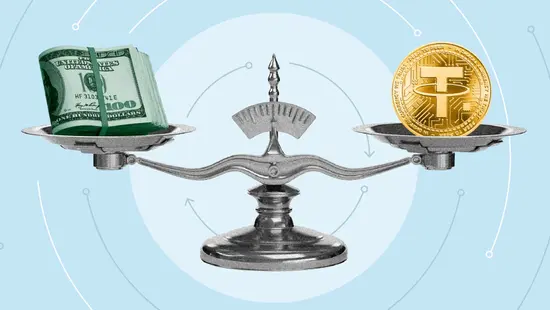
Stablecoins leverage this dynamic but take power away from corporations by using open, permissionless infrastructure. Fiat-backed stablecoins are hybrid by design. They inherit the credibility and efficiency of fiat currency while leveraging programmability and global accessibility.
Tying stablecoins to reserve assets redeemable at par draws on the credibility of sovereign states like the United States to maintain predictable value. Issuing them on public blockchains enables instant settlement, 24/7 operation, and frictionless cross-border transactions.
We believe the emerging regulatory framework for stablecoins—now an intrinsic component of their "moneyness"—should align with our core principles for how stablecoins should serve users:
-
Permissionless: Individuals should control their digital assets without burdensome account restrictions arbitrarily imposed by intermediaries.
-
Borderless: Geography should not determine whether someone can send or receive payments, nor how long those transactions take.
-
Privacy: Consumers should be free to engage in commerce without fear of unwarranted surveillance by governments, private companies, or other individuals.
-
Trust-minimized neutrality: Global fund flows should be free from discrimination, enabling people of all backgrounds to save and spend dollars as they choose.
Conclusion
Stablecoins are the next step in the long evolution of money. Like traditional fiat, they rely on sovereign credibility. But unlike earlier electronic forms of fiat, they separate trust in sovereignty from trust in corporate power. The best monetary assets exist on the best monetary technology and networks.
Join TechFlow official community to stay tuned
Telegram:https://t.me/TechFlowDaily
X (Twitter):https://x.com/TechFlowPost
X (Twitter) EN:https://x.com/BlockFlow_News
 @jakewittman