Solana treasury strategy faces changes, with the foundation purchasing at a 10% discount and multiple crypto VCs proactively organizing deals
TechFlow Selected TechFlow Selected
Solana treasury strategy faces changes, with the foundation purchasing at a 10% discount and multiple crypto VCs proactively organizing deals
Solana is accelerating institutional adoption, with several prominent crypto VCs entering the market with low-cost positions and substantial capital, actively implementing SOL treasury strategies.
 Navigating Web3 tides with focused insights
Author: Nancy, PANews
After Bitcoin and Ethereum pioneered the treasury strategy to kickstart a growth flywheel, numerous altcoins have rushed to follow suit. Now, Solana is also accelerating into the fast lane of institutional adoption. As more crypto giants announce their entry with low-cost holdings and substantial capital, market confidence and capital momentum for Solana could see a new round of amplification.
SOL Treasury Strategy Set for Accelerated Rollout, Buying at a Discount from the Foundation
Over the past year and a half, models led by Bitcoin treasury firms like Strategy and Ethereum reserve companies such as BitMine have been successfully validated in the market, attracting significant capital inflows. This trend is now rapidly extending into the Solana ecosystem, with a wave of emerging SOL DATs (digital asset treasuries) preparing to enter.
On August 25, U.S.-listed Sharps Technology announced the completion of a PIPE private placement raising over $400 million, aiming to build the world's largest Solana digital asset treasury. The funding round attracted participation from well-known institutions including ParaFi, Pantera, Monarq, FalconX, Phoenix Capital, RockawayXa, and Primitive Ventures. Additionally, Sharps signed a letter of intent with the Solana Foundation to purchase $50 million worth of SOL at a 15% discount to the 30-day average price.
Following Sharps’ move, news emerged that Galaxy Digital, Jump Crypto, and Multicoin Capital are negotiating with potential supporters to raise approximately $1 billion to buy SOL, planning to establish a digital asset fund management company through acquiring an undisclosed listed entity. According to Bloomberg, these firms have hired Cantor Fitzgerald as the lead underwriter, with the deal expected to close by early September.
Notably, Galaxy Digital was among the first buyers of FTX-locked SOL, having raised $620 million last year to set up a dedicated fund for acquiring SOL tokens sold from FTX’s bankruptcy estate. It conducted a major asset swap this year, converting over $100 million worth of ETH into SOL. Jump Crypto and Multicoin Capital are also key supporters of the Solana ecosystem—Jump actively participates in liquidity programs, while Multicoin, as an early institutional investor, holds deep exposure across Solana-based projects.
Meanwhile, Pantera Capital is planning a $1.25 billion initiative to transform a public company into a Solana investment vehicle, completing fundraising in two phases: first raising $500 million, followed by a $750 million warrant offering.
As an early investor in Solana, Pantera holds a large amount of low-cost SOL. It previously disclosed investing $250 million in 2024 to acquire a substantial amount of SOL from FTX Estate at a discounted price of $59.95 per token (subject to a four-year vesting period), and also purchased around 2,000 SOL tokens at $64 each during FTX’s bankruptcy auction. Prior to this, Pantera revealed it had invested over $300 million in DAT companies, including Sharplink Gaming, Twenty One Capital, DeFi Development Corp, and Sharps Technology.
It is evident that these key institutional backers of Solana are making concentrated moves—not only deploying considerable capital but also leveraging their cost advantages and official support from the Solana Foundation. This enables them strategic flexibility amid market volatility, drives ecosystem expansion, attracts new capital, and further enhances Solana’s liquidity and market recognition. However, given these institutions hold large amounts of locked-up SOL, there remains potential market risk if they seek liquidity or stock-price appreciation through DAT structures.
Lackluster Stock and Token Performance, Limited Buy-Side Scale and Influence
Fueled by the "coin-stock" concept, many reserve-backed public companies saw sharp surges in both stock and cryptocurrency prices. Yet, leading Solana reserve companies have shown relatively muted performance. Over the past month, Upexi’s stock rose 29.25%, DeFi Development fell 12.59%, Phoenix Group increased by about 6.63%, while SOL Strategies dropped 29.25%.
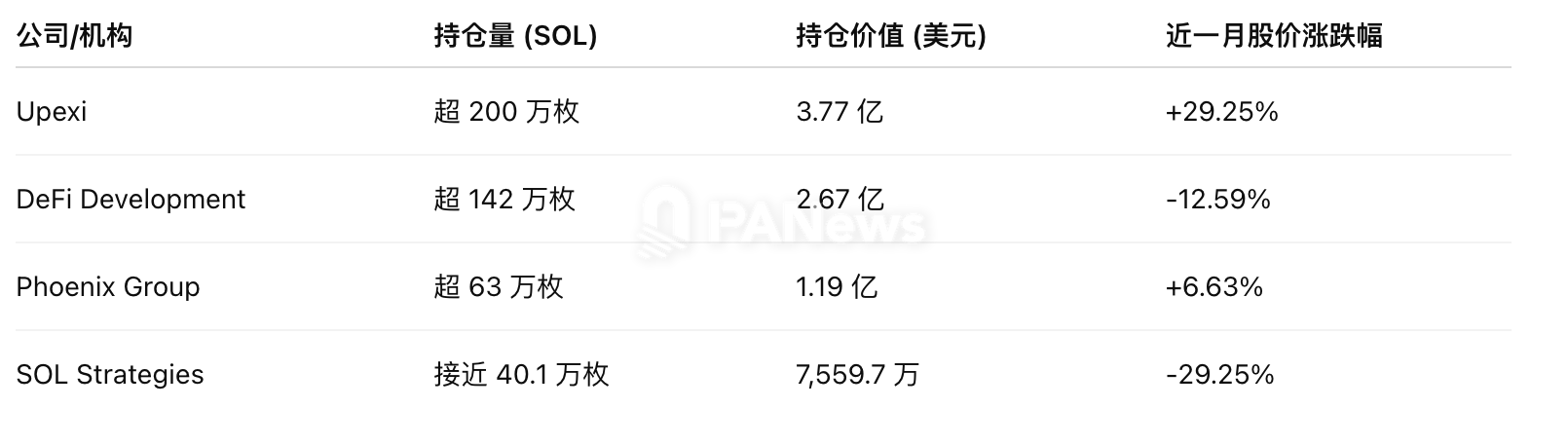
At the same time, SOL’s price performance has also been weak. Over the past year, SOL has risen only 17.9%, far below Bitcoin’s 73.2% and Ethereum’s 62.3% gains during the same period, and significantly trailing its performance during previous meme-driven market frenzies. This suggests that current Solana reserve companies have limited impact on boosting SOL’s price.
The main reasons stem from constrained scale of增持 and lack of market influence.
On one hand, the增持规模 of existing Solana reserve companies remain relatively small, and most are emerging players. Although several listed firms have begun establishing Solana strategic reserves, very few hold positions exceeding tens of millions of dollars. Public data shows Upexi holds over 2 million SOL, valued at over $377 million; DeFi Development holds over 1.42 million SOL, worth over $267 million; Phoenix Group holds over 630,000 SOL, valued near $119 million; SOL Strategies holds nearly 401,000 SOL, worth over $75.6 million. Large-scale增持 actions and endorsements from renowned institutions typically send strong market signals, amplifying investor expectations. In other words, the larger the capital size and the higher the visibility, the greater the market impact and ability to drive token price performance.
Secondly, Solana lacks influential figures comparable to Michael Saylor of Strategy in the Bitcoin space or Tom Lee, chairman of BitMine, in the Ethereum realm. Saylor and Lee not only possess financial strength but also convert institutional strategies into market confidence through public speaking, media presence, and personal branding, creating replicable investment effects.
Currently, Solana reserve companies lack individuals or institutional brands with similar influence and authority, making it difficult to generate confidence premiums. Upexi attempted to boost its profile by appointing Arthur Hayes, founder of BitMEX, to its advisory board, leveraging his reputation in the crypto community. However, Hayes’ influence remains largely confined to crypto trading circles, with limited credibility and resources in traditional capital markets, preventing cross-market leadership effects. In contrast, Galaxy CEO Novogratz, who successfully listed Galaxy on Nasdaq, is seen as a more ideal candidate—he has over three decades of experience in traditional finance, formerly working at Goldman Sachs and Fortress, accumulating extensive expertise and broad networks.
Nonetheless, the Solana reserve market has yet to produce a “MicroStrategy” leader, meaning the ecosystem still holds significant narrative potential, possibly attracting more institutional investors. Moreover, rising odds of a Solana spot ETF approval will likely strengthen market confidence in SOL and related reserve companies, amplifying the positive effect of incoming capital.
Join TechFlow official community to stay tuned
Telegram:https://t.me/TechFlowDaily
X (Twitter):https://x.com/TechFlowPost
X (Twitter) EN:https://x.com/BlockFlow_News
 PANews