Manus Full Transcript of Latest Conversation: Attempting Agent Payments, Company RRR Nearly $100 Million
TechFlow Selected TechFlow Selected
Manus Full Transcript of Latest Conversation: Attempting Agent Payments, Company RRR Nearly $100 Million
The era of universal agents has arrived, and Manus has taken the lead once again.
 Navigating Web3 tides with focused insights
Author | Li Yuan
Editor | Jingyu
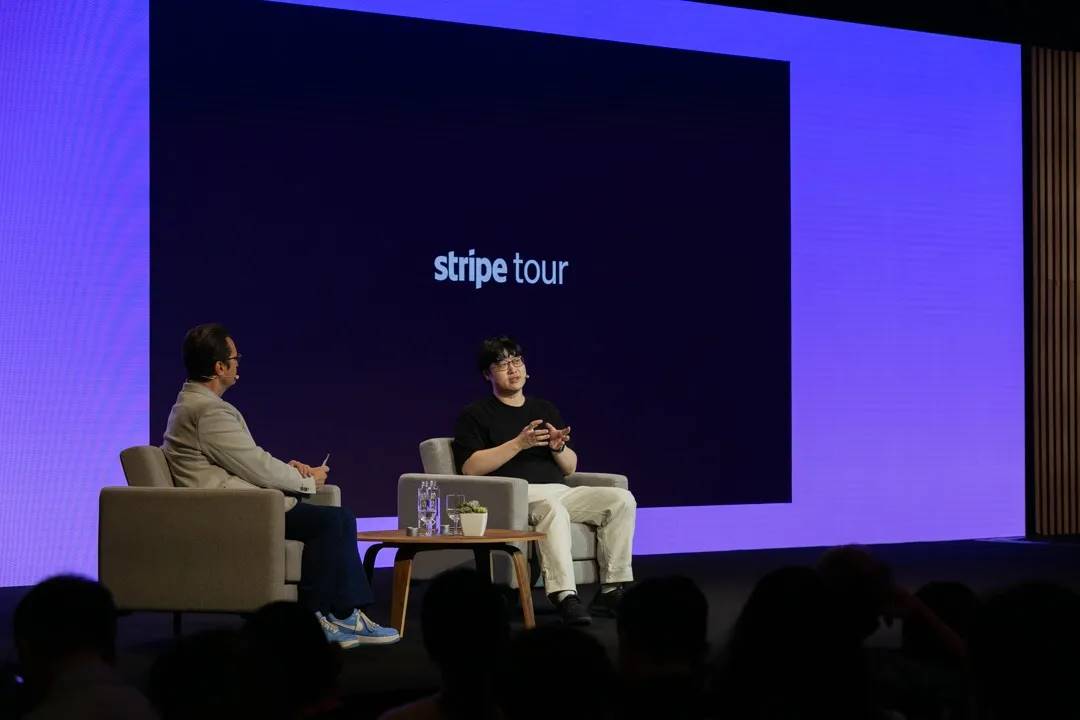
Manus, now relocated to Singapore, hasn't stopped thinking about general-purpose AI Agents.
At today's Stripe Tour event in Singapore, Ji Yichao (Peak), co-founder and chief scientist of Manus, sat down for a conversation with Paul Harapin, Stripe’s Chief Revenue Officer for Asia Pacific and Japan.
During the discussion, Manus AI revealed its latest business metrics: the company has achieved a Revenue Run Rate (RRR) of $90 million and is rapidly approaching the $100 million mark.
Xiao Hong from Manus AI also clarified on Jike that RRR refers to monthly revenue multiplied by 12, not actual cash income. Many AI products offer annual subscriptions, which count as prepaid deposits rather than recognized revenue. "If we disclosed using this [incorrect method], we could come up with a number larger than $120 million," Xiao Hong noted.
Beyond business figures, Ji Yichao shared insights into how the Manus team envisions the next steps for general-purpose Agents and the fundamental differences between AI Agents and AGI.
"Nowadays, people call almost everything an Agent—like a microphone being called an 'environment-aware audio recording Agent,'" joked Ji Yichao.
He outlined two main directions for advancing general-purpose Agent capabilities: first, scaling execution through multi-Agent collaboration (e.g., spawning hundreds of parallel sub-Agents during large-scale research); second, expanding the "tool surface" available to Agents—not limiting them to a few preset APIs, but enabling them to use open-source ecosystems like programmers do, install libraries, and even visually inspect outputs and self-correct.
Ji Yichao also pointed out that today’s digital world is still built around human users—with non-API web interfaces, CAPTCHAs, and gamified processes creating friction. The bottleneck lies more in ecosystem and institutional constraints than in model intelligence.
This is one reason Manus is collaborating with Stripe: both are working toward enabling payments within Agents, closing the loop from "research → decision → order/payment" and reducing real-world friction through infrastructural cooperation.
Below is an edited transcript of the conversation, compiled by GeekPark:
Q: Could you introduce yourself briefly to the audience? Your recent blog post on "context engineering" was incredibly inspiring—I think it’s required reading for anyone here building AI Agents. Every time I go to lunch with engineers, they’re all talking about it, so now I have to sit somewhere else (laughs). But for those who may not be familiar with Manus, could you share your background and vision?
A: Thank you, Paul. Great to be here. Manus is building a general-purpose AI Agent.
Many research institutions and companies are trying to build a brain—a large language model. But from the consumer perspective, that’s actually not ideal. AI should be able to take real actions and get things done—that’s why we built Manus.
Our approach is to let AI use one of humanity’s greatest inventions: the general-purpose computer. Give AI a computer, and it can do anything humans can do. Manus can truly complete tasks—like creating presentations, planning trips, or even managing social media (though I wouldn’t recommend doing that).
Our users really love Manus. We launched in March and already have a Revenue Run Rate (RRR) of about $90 million, soon to break $100 million.
I think that’s huge for a small startup. More importantly, it shows AI Agents are no longer just a buzzword in research—they’re being adopted and taking root in real applications.
Let me share a small story from our journey building Manus.
We drew a lot of inspiration from Agent coding tools. Products like Cursor, an AI programming assistant, had already gained attention.
As engineers, we naturally used Cursor. But surprisingly, many non-engineer colleagues in the company were using it too. Of course, they weren’t writing software—they were using it for data visualization or even drafting articles. They ignored the code pane on the left and simply conversed with the AI to get work done.
That made us realize: we should generalize this approach to empower non-programmers. That’s a real use case for AI.
Q: We're hearing more and more about AI Agents and AGI. Can you help clarify the distinction between these two concepts? What do AI Agent and AGI mean to you and to Manus?
A: We think this is an excellent question.
Right now, people call almost everything an "Agent." For example, someone might call a microphone an "environment-perceiving audio capture Agent."
But we believe Agent should be a subset of applied AI. Let’s step back and look at common categories of AI applications.
Most people are familiar with two types: chatbots like ChatGPT, and generative tools like MidJourney or Sora. In these systems, there are typically only two roles: user and model. You interact with the model and get output. The key difference with an Agent is the introduction of a third element: environment.
The concept of "environment" varies by Agent type. For a design Agent, it might be a canvas or a codebase; for Manus, our goal is for the Agent to operate within virtual machines or even across the entire internet. This allows the Agent to observe the environment, decide what to do next, and act to change it—making it far more powerful.
For example, with Manus, you express a need, and it opens a browser, publishes a webpage, books a flight. I love this example because while booking a flight sounds simple, it represents AI directly changing the real world—the output isn’t just text, it’s a ticket in your hand. AI actively intervenes in your life. That’s what we mean by Agent.
In short, an Agent is an AI system that acts on behalf of the user to interact with an environment.
As for AGI, the term is often mentioned, sometimes equated with superintelligence. We see AGI as a system that leverages the general capabilities of AI models to perform diverse tasks without specialized design.
We believe "Agent coding" is actually a path toward AGI. It’s not about excelling in a narrow domain, but if given access to a computer, being able to do nearly anything on it. So for us, achieving AGI requires building a sufficiently rich environment where such capabilities can manifest.
Q: Where is AI truly making an impact today? Where will it make a difference in the future? When will the "iPhone moment" arrive?
A: In terms of Agent capabilities, flagship models today are already astonishing—almost "superhuman." They can outperform most of us in math competitions or logical reasoning.
But I think models are still like "brains in a bottle." To truly unleash their power, they must interact with and reach into the real world. Unfortunately, that’s exactly where problems begin.
For instance, when you ask an AI to perform routine tasks, it excels at repetitive work. Tools like Deep Research aggregate information and return a result—the output just appears.
But almost everything today is designed for humans, not just in the physical world but in the digital realm too. Web tools are like mini-games, lacking APIs or standard interfaces. CAPTCHAs are everywhere, blocking Agents at every turn.
So I believe AI performs well in self-contained, closed tasks, but hits barriers when engaging with the real world.
When will the "iPhone moment" happen? I don’t think it’s a technical issue—it’s more like an institutional constraint. It’s not something Agent startups like ours can solve alone.
I believe it requires a gradual shift, with the entire ecosystem evolving together. This also needs players like Stripe to drive infrastructure-level innovation. For example, we’re integrating Stripe’s new Agentic payment API. It takes collective effort.
Q: Can we dive into some typical user scenarios with Manus? How do people use it, and what power does it unlock?
A: Yes, although we’re part of this current generation of Agents, we’ve already seen many compelling use cases.
For example, we just moved to Singapore and needed to hire real estate agents to find housing. Human agents (laughs).
And now, those agents are using Manus: they input client requirements, and Manus analyzes company locations, preferred residential areas, and generates recommendations.
I find this interesting because it addresses "long-tail" needs. Typically, there aren’t dedicated AI products for such specific scenarios, but since Manus is a general-purpose Agent, it can fulfill them. We believe long-tail demands are highly valuable.
Macroscopically, it may seem niche, but for individual users, this is their daily reality. These scenarios are especially meaningful.
It’s similar to today’s search engine landscape. If you search for common topics, Google or Bing give similar results. Why would someone pick one over the other? Probably because one delivered a better result at a critical moment. And for highly personalized or specialized queries, the difference becomes clear. That’s where general-purpose Agents shine.
How can we improve further? We’ve thought deeply about this because we believe everything comes back to programming. If you give AI a computer, its way of interacting with the environment is essentially programming.
We see two paths forward. First, scale. What if you could amplify an Agent’s capability a hundredfold?
Recently, Manus launched a new feature called Wide Research. The core idea is allowing one Agent to spawn hundreds of others to work in parallel on a task. If an AI helps you with small tasks, you might do them yourself. But for massive tasks—like large-scale research—you couldn’t possibly finish alone. Having hundreds of Agents working simultaneously becomes incredibly powerful.
Second, we need Agents to use computers more flexibly. If an AI Agent only has preset tools, its action space is limited. But imagine being a programmer with access to the entire open-source ecosystem.
For example, adjusting parameters in 3D printing can be hard, but finding the right library on GitHub and installing it solves the problem instantly. At Manus, we’re optimizing for generality and introduced a concept we call "network effects of tools."
Here’s an interesting example: many users use Manus for data visualization. In Asia, you sometimes run into issues—like Chinese characters rendering incorrectly in charts. Some expert users might hardcode rules, like specifying fonts for Korean output. But this makes the system rigid.
Our solution was simple: give the system the ability to view images. The result was surprising—today’s models are smart enough to check their own visualizations after generating them, notice errors, and automatically correct them. We found that increasing tool flexibility solves more problems than hardcoding rules.
Q: It’s an exciting time. I’m thrilled—wish I were thirty again (laughs). Speaking of medical research, I know Manus is strong here too. Have you observed users applying Manus to medical research?
A: Many people are already using Manus for research, not just in medicine. We find this fascinating because there are already many so-called "deep research" tools that collect information and do some analysis, then deliver a markdown file or document. But that’s not enough.
Often, researchers need deliverables they can directly present to their boss or team. So we’ve enhanced Manus’s output capabilities. In medical research, for example, formal reports—like slide decks—are often required. We must optimize AI’s output to meet researcher needs. This is a "toolized" experience.
Now, many users conduct research with Manus and then directly generate a website. It feels completely different from traditional website building.
Building a website isn’t inherently hard—the challenge is ensuring data reliability and accuracy. So we believe the best approach is completing the entire process in one session, within a shared context. That way, your research and insights seamlessly become the final product. That’s what we’re doing with Manus.
Q: Many countries are discussing a big topic: the future of humanity and economic impacts in the AI era. What’s your take on job displacement? And what new opportunities might emerge?
A: Friends and investors often ask us this. When we launched Manus, we initially thought such an Agent would save people time and help them earn money easily.
But in reality, that vision hasn’t fully materialized. Through extensive user research, we found that after using Manus, people actually work more. Because they’ve become more efficient, they end up doing more of what they were already good at. That’s point one.
Second, we believe Manus opens up a whole new space. We talk a lot about virtual machines and cloud computing. We see Manus as a kind of "personal cloud computing platform." Cloud computing has existed for decades, but it’s mostly been an engineer’s privilege—only we can harness the cloud through code. Ordinary knowledge workers couldn’t access it.
Now, with AI Agents like Manus, people can issue commands in natural language and let AI execute them. This unlocks a new form of productivity. That’s what we’re delivering.
Finally, regarding "replacement," I think it’s actually difficult. Real estate agents, for example, use Manus daily for routine tasks. But you know, AI can never replace the way an agent communicates with clients. We’re an AI company—our launch video script was even written by Manus—but I still appear in the video, because it’s about trust. And trust cannot be fully delegated to AI.
Join TechFlow official community to stay tuned
Telegram:https://t.me/TechFlowDaily
X (Twitter):https://x.com/TechFlowPost
X (Twitter) EN:https://x.com/BlockFlow_News
 极客公园
极客公园