








Interview with BTC Inc Chief of Staff Brandon Green: Accumulating Bitcoin is the Best Retirement Plan
TechFlow Selected TechFlow Selected
Interview with BTC Inc Chief of Staff Brandon Green: Accumulating Bitcoin is the Best Retirement Plan
"National-level adoption will be the main theme of the next cycle."
 Navigating Web3 tides with focused insights
Compiled & Translated: TechFlow
Guest: Brandon Green, Chief of Staff at BTC Inc
Host: Bonnie
Podcast Source: Bonnie Blockchain
Original Title: Market Dips! Major Events About to Boost Bitcoin! The Trump Family and BTC! Brandon Green [Bonnie Blockchain]
Release Date: August 18, 2025
Key Takeaways
This episode features Brandon Green, Chief of Staff at BTC Inc and a key organizer of the Bitcoin Conference, discussing future trends in Bitcoin.
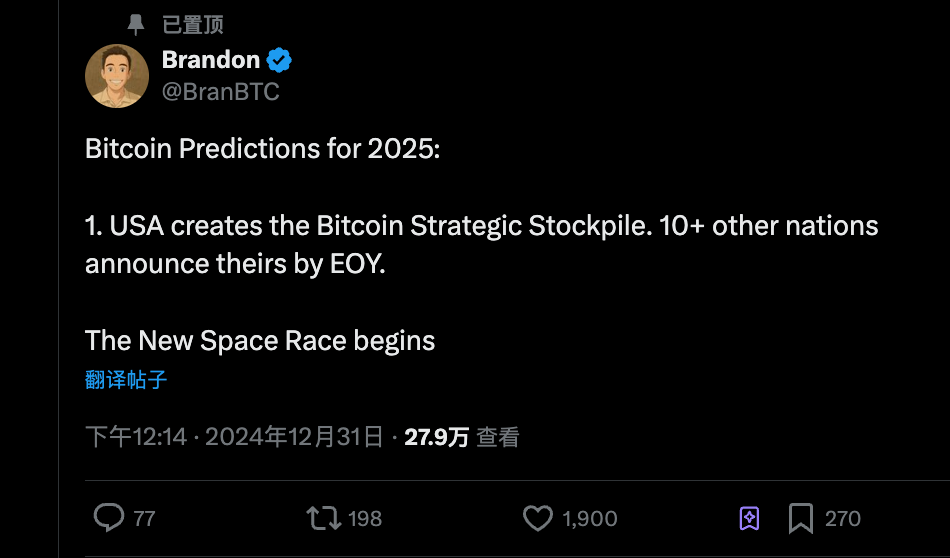
Brandon is best known for publishing on social media, on the last day of last year, 10 predictions about Bitcoin’s development in 2025—of which the first has already largely come true and significantly influenced the direction of the crypto industry this year:
The U.S. will establish a strategic Bitcoin reserve. Over ten other countries will also announce their own strategic reserves by year-end, kicking off a new race.
In this podcast, Brandon discusses the next key force that could drive Bitcoin’s price higher—potentially still MicroStrategy. But the truly significant signal goes beyond Michael Saylor buying more Bitcoin; it lies in strategic moves at critical moments. The discussion also covers how much the Trump family understands Bitcoin and how much Bitcoin one might need to hold to be considered truly wealthy in the future.
Highlights of Key Insights
-
Bitcoin is currently one of the world’s best savings tools; if you can invest part of your salary into Bitcoin and leave it untouched long-term, you’ll be amazed at the wealth you accumulate by retirement.
-
The U.S. has already announced its strategic reserve. I boldly predict national adoption will be the dominant theme of the next cycle.
-
We won’t just see companies holding Bitcoin passively in the future, but excellent businesses that make Bitcoin a core strategy. These companies will earn massive market returns by allocating profits into Bitcoin. This behavior will create a “flywheel effect,” further driving up Bitcoin’s price.
-
MicroStrategy's inclusion into the S&P 500 will be a pivotal moment—one that could happen soon—and would mean all passive funds investing in the S&P 500 must allocate capital to MicroStrategy, potentially becoming a major driver for Bitcoin’s price increase.
-
Buying Bitcoin in bear markets and selling in bull markets is like picking up pennies in front of a speeding bulldozer—it may end up costing more than it gains.
-
By 2032, owning 0.01 Bitcoin might be enough to make someone a millionaire. Over time, Bitcoin’s value relative to the dollar could keep rising.
-
In the past, many people searched basic questions like “what is Bitcoin?” Now their searches are more specific, so declining Google Trends search volume doesn’t necessarily reflect waning interest.
-
The earliest Bitcoin community actually originated in Asia. Some early Bitcoin veterans and whales remain active in Hong Kong, Shenzhen, Shanghai, and Tokyo.
How Much Bitcoin Makes You Rich?
Bonnie:
For people aged 20, 30, and 40, how much Bitcoin should they accumulate now to become millionaires by retirement?
Brandon:
A few years ago, I answered a similar question: “How much Bitcoin will someone need to own in 2032 to be a millionaire?” My answer then was 0.01 Bitcoin.
I believe by 2032, Bitcoin may reach a new peak. Of course, this forecast must consider inflation—the definition of a millionaire may differ from today. But overall, owning 0.01 Bitcoin might be sufficient to achieve millionaire status. While this sounds like an optimistic estimate typical of a bull market, Bitcoin’s value relative to the dollar could continue rising over time.
Most people entering crypto today may not afford a full Bitcoin, but that doesn’t matter. Bitcoin is divisible—1 Bitcoin equals 100 million satoshis. Even owning 1 million satoshis could have substantial value in the future. The key is developing sound financial habits, such as saving small amounts of Bitcoin daily and holding them long-term. If you stick to this approach, it becomes a healthy financial practice. Bitcoin is currently one of the world’s best savings tools. If you can invest part of your salary into Bitcoin and leave it untouched long-term, you’ll be surprised at the wealth you accumulate by retirement. That’s my advice.
I feel incredibly lucky to live in this unique era, witnessing Bitcoin’s gradual evolution. There won’t be another opportunity like this in the future, so don’t miss it.
Bonnie:
When you mention this “unique era,” do you mean the early stage of Bitcoin’s development?
Brandon:
Yes, exactly the early stage. Frankly, there may come a time when people can no longer exchange dollars for Bitcoin—such transactions could be banned or no longer accepted. We’re seeing this unfold step by step every day. How exciting. Future history books will surely try to look back and understand how Bitcoin succeeded. This is a significant moment in human history, and we happen to be living through it.
Bitcoin Asset Companies
Bonnie:
After Michael Saylor implemented his Bitcoin strategy, his company’s stock price surged rapidly, and many view it as a perfect case study. Then we saw companies like Meta Planet and other smaller Bitcoin-focused firms. Yet in reality, many of these companies aren’t truly pro-Bitcoin—they simply discovered that adding Bitcoin to their balance sheets effectively boosts their stock prices. What’s your take on these companies?
Brandon:
I believe Bitcoin asset companies are one of the most noteworthy phenomena in crypto today and represent the core narrative of this cycle. I have a theory: usually, before a new cycle begins, we see early signs in small-scale or isolated events. For example, looking back at the Mastercoin ICO and Ethereum ICO in 2014, these foreshadowed the ICO boom of 2017. In 2017, CryptoKitties emerged as the first major NFT project, later making NFTs the hot topic of the 2021 cycle. Similarly, in 2020, Michael Saylor founded a Bitcoin asset company, which I believe marked the beginning of the main narrative for the 2023–2026 cycle.
The U.S. has announced its strategic reserve. I boldly predict national-level adoption will be the dominant theme of the next cycle.
Analyzing current market conditions, we see the stock market rewarding companies that invest in Bitcoin. This isn’t hard to understand—the market is highly enthusiastic about such actions, leading to extreme valuation premiums. Some companies are valued at two or even ten times the actual worth of their Bitcoin holdings, despite having little operational business to justify it.
However, I don’t think this will last long. There’s currently an arbitrage opportunity—profiting by comparing market cap to the real value of a company’s Bitcoin holdings. But this may only last months, or even less. In the future, the companies favored by the market will be those with strong profitability that reinvest earnings into Bitcoin, earning even greater market premiums. This trend will give rise to the so-called “fastest horse”—companies excelling in Bitcoin strategy.
I believe we won’t just see companies merely holding Bitcoin in the future, but outstanding businesses that treat Bitcoin as a core strategy. These companies will gain massive market rewards by allocating profits into Bitcoin. This behavior will create a “flywheel effect,” further pushing up Bitcoin’s price.
Bonnie:
Do you expect this to happen in this cycle or the next?
Brandon:
That’s a great question. To me, it’s just a matter of time. If you had asked me three years ago, I’d have said several major obstacles stood in the way. First, institutional trust in Bitcoin was insufficient. But now that’s changed—we have Bitcoin ETFs, and giants like BlackRock and Bridgewater are involved. That issue is resolved. Second, U.S. accounting rules previously classified Bitcoin as an intangible asset, not a marketable one, meaning companies couldn’t mark their Bitcoin holdings to market value. However, today MicroStrategy has been allowed for the first time to recognize the appreciation of its Bitcoin holdings—a huge breakthrough for public companies, something unseen in the past five years.
The third obstacle was lack of regulatory clarity. But now, regulators in many countries are actively working to attract Bitcoin and crypto companies. So combining these three factors, there are no longer substantive barriers to this trend. It’s now just a matter of how widely and quickly it spreads.
Impact of Accounting Rule Changes on Bitcoin
Bonnie:
Can you elaborate on the recent changes in accounting rules? Michael Saylor mentioned this last year, but we’d like more details. How will this change help more companies buy Bitcoin?
Brandon:
Great question. First, I should clarify—I’m not a CFO or professional accountant, so my explanation may not be comprehensive. Public companies typically follow GAAP (Generally Accepted Accounting Principles), set by the FASB (Financial Accounting Standards Board). Previously, Bitcoin was classified under accounting rules as an “intangible asset.” This meant companies recorded Bitcoin on their balance sheets only at purchase cost. If Bitcoin’s price dropped, they had to mark it to market and recognize losses. But if the price rose, they couldn’t recognize any gains on their balance sheets. This rule was extremely disadvantageous for companies, restricting the ability to reflect Bitcoin’s market value and affecting both financing capacity and market valuation. You could say this rule acted like “handcuffs” on corporate choices for years.
In January this year, that restriction was finally lifted. This change may encourage many previously hesitant companies to consider adding Bitcoin to their balance sheets. A clear consequence is that it could alter the composition of major indices like the S&P 500. Previously, due to accounting constraints, a company like MicroStrategy couldn’t be included in the S&P 500 because it didn’t appear profitable. But with the new rules, MicroStrategy’s book profits can now be recognized, making its inclusion in the S&P 500 highly likely.
Once MicroStrategy joins the S&P 500, the situation changes dramatically. Many index funds—like those from Charles Schwab, Vanguard, and BlackRock—passively invest in all S&P 500 components. This means investor capital will flow indirectly into Bitcoin through MicroStrategy, as the company converts its balance sheet assets into Bitcoin. This passive inflow creates a “flywheel effect,” further boosting Bitcoin’s price. It’s an exciting development that could profoundly impact the entire crypto market.
Bonnie:
So for general viewers, they should closely watch when MicroStrategy gets added to the S&P 500, right?
Brandon:
Exactly—that will be a crucial milestone. I expect this change to happen soon, though the exact timing is uncertain. Once it occurs, you’ll see tens of billions of dollars flow into MicroStrategy and thus into Bitcoin, because all passive funds investing in the S&P 500 must allocate capital to MicroStrategy. This trend could become a major driver for Bitcoin’s price increase.
Bitcoin Google Trends Search Volume
Bonnie:
I just checked Google Trends data and noticed that while Bitcoin search volume is near historical highs, the current interest index is only 25. In contrast, it reached 100 in December 2017 and 69 in February 2022—now it’s only 25. Why has public attention to Bitcoin declined?
Brandon:
In the past, many people searched basic questions like “what is Bitcoin?” Now, searches are more specific and deeper—questions like “how to buy Bitcoin?”, “what is a Bitcoin ETF?”, “who is Michael Saylor?”, “what role does MicroStrategy play?”, or even “why does Trump support Bitcoin?” This shift reflects growing market understanding and suggests that declining search volume may reflect changing search habits rather than fading interest.
Additionally, we’re not currently in a frenzy phase of the Bitcoin market. Recall December 2017, when nearly everyone was talking about Bitcoin—even Uber drivers would bring it up. Today’s market is calmer, far from that level of universal excitement. Still, I believe such enthusiasm may return at some point. As Michael Turpin says, we’re still in the early “summer” phase of the Bitcoin market cycle, and we may see much higher attention and activity levels ahead.
Timing Bitcoin Buys and Sells
Bonnie:
I once spoke with Michael Turpin in Las Vegas. He proposed a “Bitcoin Four Seasons Theory,” suggesting buying during “winter” (bear market) and selling during “summer” (bull market) to accumulate more Bitcoin. That’s his strategy. Others argue Bitcoin should never be sold—once you sell, you may never get it back at a low price. How do you view these opposing perspectives?
Brandon:
It’s a fascinating topic. I’ve been deeply involved in crypto for eight years, but I’ll be honest—I don’t think I can accurately time the market. As someone running the largest crypto media and conference platforms, if anyone should know when to buy or sell, it should be me. But in reality, accurately timing the market is extremely difficult.
Historically, Bitcoin has been one of humanity’s best-performing assets. Therefore, trying to time the market—say, buying in “winter” and selling in “summer—is like picking up pennies in front of a speeding bulldozer. It may end up costing more than it gains.
Bitcoin Originated in Asia [Important]
Bonnie:
If someone wants to join truly unique and inspiring discussions, they should consider attending the upcoming Bitcoin conference in Hong Kong. What can we expect from this event?
Brandon:
First, I’m thrilled to return to Asia. Many may not know that the earliest Bitcoin community actually originated here. When I joined the Bitcoin space in 2017, almost all major events were centered in Shanghai, Japan, and Hong Kong. Many well-known startups—like Bitmax, FTX, and Three Arrows Capital—emerged from Singapore and Hong Kong. It wasn’t until 2021 that Bitcoin events gradually shifted westward, but that doesn’t mean Asia’s influence has faded. In fact, many early Bitcoin veterans and whales remain active in Hong Kong, Shenzhen, Shanghai, and Tokyo.
This conference excites me because it offers OG Bitcoin community members a chance to reunite. Especially miners from China’s Sichuan province, who once dominated global Bitcoin mining thanks to abundant hydropower. This event will focus purely on Bitcoin, without discussing altcoins or tokens. This focus reminds me that Bitcoin remains one of the most exciting innovations today. I feel honored to participate in a platform where we can discuss, learn, and deepen our understanding of Bitcoin.
Currently, Hong Kong’s financial sector is undergoing major transformation, with new companies emerging. Meanwhile, Seoul, Japan, and Thailand are seeing new players like Metaplanet rise in crypto. It’s an electrifying moment—we’re in a Bitcoin bull market, with prices already surpassing $118,000. This will attract many newcomers, many attending their first Bitcoin conference.
Additionally, the event features many high-profile speakers, some yet to be announced. I believe their insights will be eye-opening. This conference is definitely one to watch and not to be missed.
Close Encounter with the Trump Family
Bonnie:
The speaker lineup is truly special—Eric Trump will also attend. Can you share about your conversations with him? How did you convince him to fly to Hong Kong?
Brandon:
Eric is someone we met through our collaboration with President Trump. In 2024, President Trump delivered a speech in Nashville, and we helped shape his Bitcoin policy, which was later incorporated into official government frameworks. During this process, we met not only President Trump but also his son Eric, Donald Trump Jr., and members of their team. Eric, in particular, has deep knowledge of Bitcoin—he’s been engaged with it longer than most people realize.
When I first spoke with Eric, we immediately discussed technical topics: whether his company should use multi-signature wallets (requiring multiple signatures for transactions) instead of third-party custodians. We also weighed risks between self-custody and multisig. I expected to discuss basics like Bitcoin vs. Ethereum, but he already had a solid grasp of the technology.
Recently, he was named an advisor to Metaplanet, further highlighting his expertise in crypto. He not only possesses deep knowledge but can also positively influence the industry through his impact on President Trump’s decisions. He’s a highly influential figure, and we’re delighted to have him at this event.
During our Las Vegas event, we introduced our plans—including the Hong Kong roadshow. He asked if there was an active Bitcoin community in Hong Kong. We said yes—Hong Kong has a large and vibrant Bitcoin community. He was very interested and expressed a desire to engage with global Bitcoin enthusiasts, especially given his role at Metaplanet, hoping to participate in a more meaningful way.
Therefore, this event is the perfect stage for his real debut in Hong Kong. He’s very excited. I believe there will be many interesting interactions—people will have chances to meet Eric, and vice versa.
"Bitcoin Believers" Were Once Seen Negatively
Bonnie:
You’ve been in Bitcoin for a long time. Has the meaning of being a “Bitcoin believer” changed for you? Many people entering crypto first learn about Bitcoin but then get drawn to altcoins or memes with explosive gains—coins that multiply 10x or even 100x in short periods. Are you considered a veteran in the crypto space?
Brandon:
That’s an interesting question. When I entered the space in 2017, Vitalik Buterin wrote for Bitcoin Magazine, and I interacted with him during the magazine’s early days. He coined the term “Bitcoin maximalist,” but back then it was derogatory—used to describe people uninterested in Ethereum. At the time, Ethereum was just starting, and the mainstream Bitcoin view was to focus all attention on Bitcoin. Vitalik used the term to mock those solely focused on Bitcoin.
When I first entered crypto, “Bitcoin maximalist” was indeed a negative label. Whether Bitcoin would dominate crypto wasn’t clear. It wasn’t until the 2018 bear market that views began shifting. Back then, countless ICOs and altcoins launched on Ethereum, but their values collapsed in the bear market. Bitcoin, while down 75%–80%, fared far better—many other projects went nearly to zero. This led people to rethink what the safest asset was during downturns.
I believe it was in 2018 that Bitcoin truly demonstrated its value as a safe-haven asset. From then on, the “Bitcoin maximalist” view gained wider acceptance. Bitcoin maximalism recognizes that while there are many different projects and coins in crypto, Bitcoin’s goal—to build a global, decentralized monetary system—is unique. Therefore, Bitcoin deserves to be viewed separately. While there are other interesting projects in crypto, none are as important to me as Bitcoin. That’s my perspective.
The Most Mind-Blowing Bitcoin Theory
Bonnie:
You’ve met many people in the Bitcoin community and heard various unique theories. What’s your favorite one? Or has anything recently shocked or amazed you about Bitcoin?
I can share an example. Michael Turpin once mentioned that over the next 40 years, only 2.5 new Bitcoins will be mined globally. When I first heard that, I was stunned—only 2.5 Bitcoins in 40 years! The timeframe is so vast it’s almost unimaginable. That was my recent “mind-blown” moment.
Brandon:
Yes, let’s look at Bitcoin’s total supply—about 19.9 million have already been mined. The last Bitcoin will be mined in 2140, meaning roughly 116 years from now. In the next 116 years, we need to mine the remaining 1.1 million Bitcoins. That alone tells you how little is left.
Join TechFlow official community to stay tuned
Telegram:https://t.me/TechFlowDaily
X (Twitter):https://x.com/TechFlowPost
X (Twitter) EN:https://x.com/BlockFlow_News
 深潮TechFlow


