








From trading gurus to mass coin speculation: What is the South Korean crypto market playing at?
TechFlow Selected TechFlow Selected
From trading gurus to mass coin speculation: What is the South Korean crypto market playing at?
The South Korean crypto market is making a strong comeback from the "Terra shadow," emerging as a force that global investors cannot afford to ignore.
 Navigating Web3 tides with focused insights
By: San
Recently, two traders from South Korea's crypto market have become the focus of discussion in the cryptocurrency community due to their remarkable performance.
The trader known online as Namseokhee placed high-leverage long futures contracts on altcoins via Binance, increasing his positions from 75 to 105 within two weeks, with returns surging from 134x to 1,400x, all starting with an initial margin of less than $3,000.
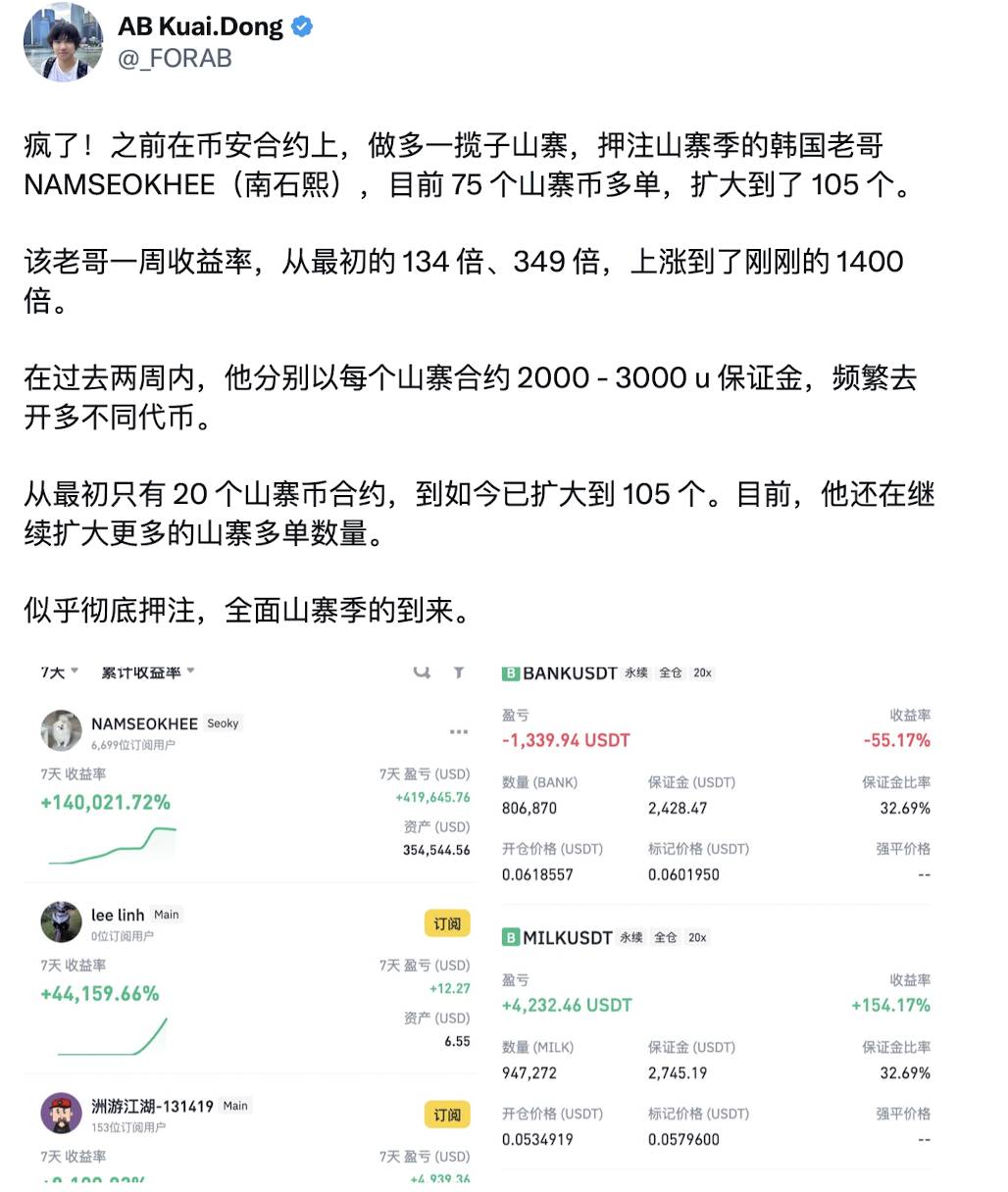
Image source:@_FORAB
Another trader, Ohtanishohei, is a staunch ETH supporter who has consistently increased his long ETH futures positions over the past two weeks, growing profits from $1.57 million to a peak of $3.37 million.
Their impressive performances have not only ignited enthusiasm among South Korean investors but also drawn global attention to this dynamic market.
In the past six months, South Korea has been increasingly mentioned in the crypto space, and its rise is no accident. In 2024, the five major South Korean cryptocurrency exchanges achieved asset management scale exceeding $74.8 billion, with combined assets under management reaching $73 billion—daily trading volume surpassing that of South Korea’s two main securities exchanges.
Upbit, South Korea’s largest cryptocurrency exchange, saw single-day trading volumes exceed $10.2 billion, a year-on-year increase of 94.5%. More notably, the Korean won accounts for 37% of global fiat-to-crypto transactions, second only to the U.S. dollar.
These figures clearly indicate that South Korea is not only a hub for Asian crypto trading but also holds an increasingly significant position in the global market.
Betting on Altcoins, A Nation Trading Crypto
When it comes to South Korea, many crypto investors may initially have a negative impression. In 2022, Terra, a project founded by South Korean trader Do Kwon, reached a market cap of $40 billion before collapsing overnight due to its algorithmic stablecoin failure, causing South Korean investors to lose over $6 billion and dragging BTC down from $40,000 in early May to $17,000 within two months.
This incident caused trading volumes at South Korea’s two largest cryptocurrency exchanges, Upbit and Bithumb, to plummet by 30%, while the Korean won’s share in global crypto trading dropped from 40% to 25%. Alongside this decline came a diminished status for South Korea in the crypto market.
Fast forward to the second half of 2024, multiple altcoins surged in price after listing on South Korean exchanges—a trend that continues today. Just recently, CYBER listed on Upbit, spiking over 130% in one day with trading volume jumping 500%, briefly pushing its market cap above $170 million.
This data suggests that South Korean crypto investors’ enthusiasm may far exceed our imagination, a fact further supported by demographic data on South Korean crypto investors.
According to the latest "Virtual Asset Investment Trends Report for the 20-50 Generation" published by Hana Financial Research Institute, among 1,000 financial investors aged 20–50, 27% hold cryptocurrencies, accounting for 14% of their total financial assets, and a staggering 70% said they are willing to invest in crypto in the future.
South Koreans' obsession with crypto goes even further. Data from the Bank of Korea in 2024 shows that by November 2024, 30% of South Korean residents had opened cryptocurrency exchange accounts, and one in every ten government officials holds crypto.
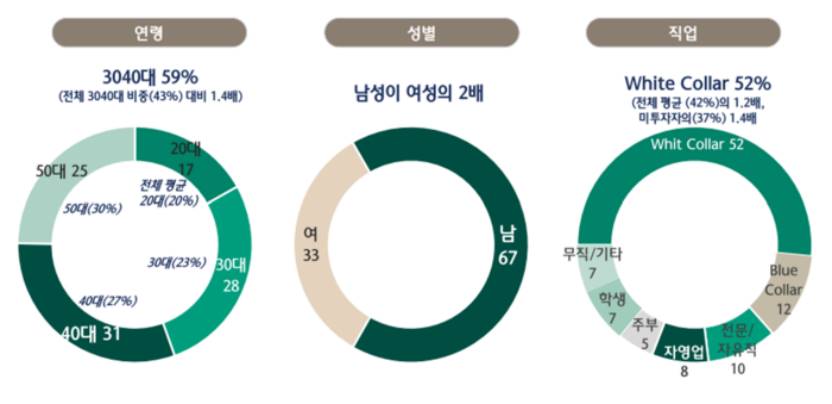
Behind South Korea’s “nationwide crypto trading” phenomenon lies the country’s current social backdrop and shifting government attitudes toward crypto.
Today, South Korean youth face unprecedented social pressures.
According to data released by Statistics Korea, South Korea’s youth unemployment rate reached 5.5% in July 2025. With economic prospects looking bleak and upward mobility nearly impossible, countless young South Koreans see cryptocurrency as their only chance for social advancement.
This also explains why South Korean crypto traders generally favor high-leverage strategies. This societal trend is reflected in popular South Korean films and TV dramas, where certain iconic lines mirror this reality.

Image source: Popular South Korean drama "Squid Game 2"
On the policy front, the biggest recent positive development for South Korean traders was Lee Jae-myung becoming president of South Korea.
Lee Jae-myung is not only a political winner but also one of the most steadfast advocates for crypto policy in South Korea. In his “commitment to South Korea’s crypto industry,” he pledged to legalize spot crypto ETFs, guide large-scale allocations of South Korea’s national pension funds into crypto assets, and develop a Korean won stablecoin.
All these signals point to a shared conclusion: South Korea is making a comeback in the crypto market, and this time the storm could be more intense than ever before.
Tom Lee, Korea’s New Do Kwon?
South Korea’s crypto resurgence isn’t limited to policy statements—it’s evident in actual buying behavior. The following assets frequently appear in South Korean investors’ self-curated portfolios:
ETH
In South Korea’s crypto market, the “digital gold” isn’t BTC—it’s ETH.
Data from South Korea’s two largest crypto exchanges, Upbit and Bithumb, show that over the past 24 hours, ETH/KRW pairs ranked first in trading volume, capturing 18.06% and 12.1% respectively, with total trading value exceeding $1.26 billion. Upbit alone recorded an astonishing $111.1 billion in ETH trading volume in July.
This surge is largely driven by Tom Lee, the Korean-American chairman of BitMine—the institution holding the largest amount of ETH—who has continuously promoted ETH, boosting confidence among South Korean traders.
Fueled by ethnic sentiment, media coverage, and his crypto influencer status, Tom Lee is now seen by South Korean traders as a figure comparable to LUNA founder Do Kwon. Even legendary trader Eugene has mentioned Tom Lee in the community.
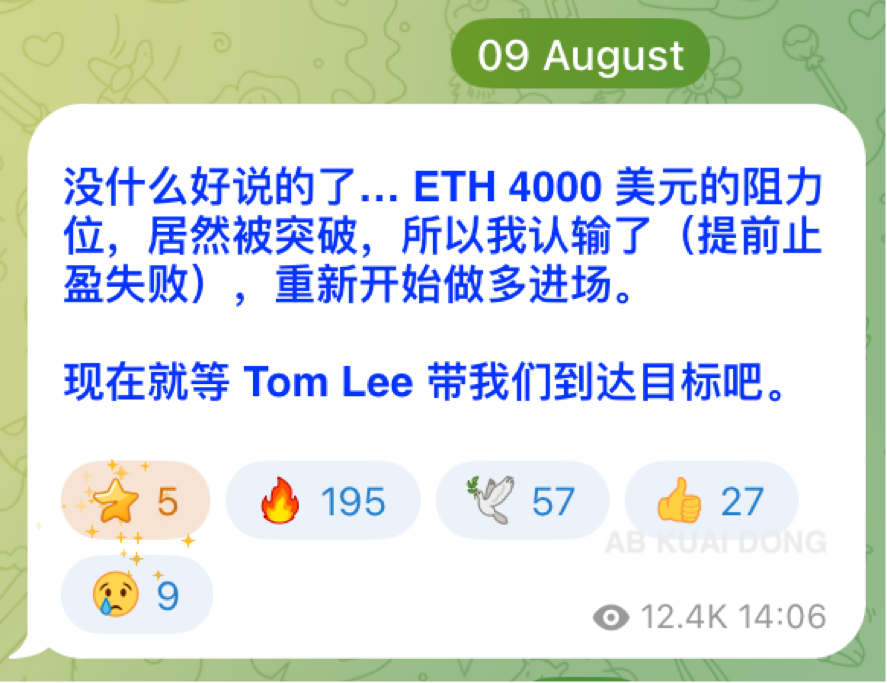
Image source@_FORAB
BMNR
Besides ETH, Tom Lee’s importance to South Korean traders is also reflected in BMNR, the stock of BitMine—an ETH-focused strategy firm.
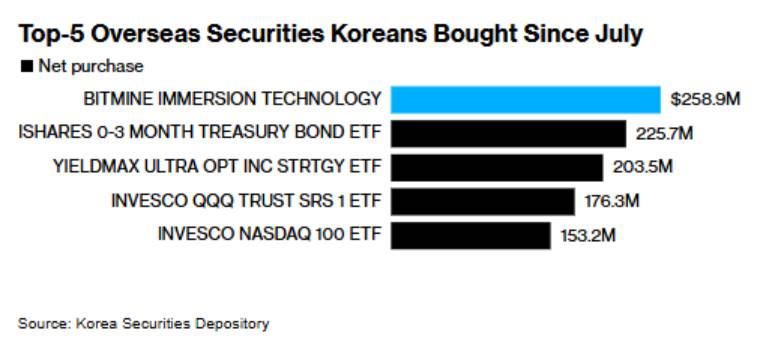
As of August 15, BitMine holds over 1.2 million ETH worth $5.3 billion, more than double the holdings of second-place SharpLink. According to data from the Korea Securities Depository, since July, South Korean retail investors have cumulatively net purchased over $259 million worth of BMNR, making it the most popular foreign security during this period.
To countless South Korean traders, BitMine has become the operator driving ETH’s price increases, and BMNR has effectively become leveraged ETH. Compared to ETH, BMNR’s maximum gain of 66% since July 1 better aligns with South Korean traders’ high-risk appetite.
XRP
Besides ETH, XRP is another major asset favored by South Korean crypto investors. Over the past 24 hours, XRP’s total trading volume on Upbit and Bithumb reached $1.13 billion, just $100 million shy of ETH.
On May 26, the XRP/KRW pair surpassed BTC and ETH to top the Korean won market. More strikingly, XRP prices on Upbit rose to $2.65, 3% higher than international market prices.
Additionally, Upbit, South Korea’s largest crypto exchange, holds over 5.9 billion XRP—nearly twice as much as Binance. Behind this frenzy, the SEC dropping its case against XRP as a security and XRP’s cross-border payment potential have attracted South Korean investors, while the proposed Korean won stablecoin policy further boosts demand. Retail investors widely believe in XRP’s future potential.
Returning to the Crypto Stage
Driven by popular assets like ETH, BMNR, and XRP, South Korea’s crypto market is returning to the global stage at an astonishing pace. From retail to institutional players, from policy shifts to cultural trends, South Koreans appear to view cryptocurrency as a new engine for national development. However, this “nationwide crypto trading” culture and high-leverage strategies are not without risks.
Just yesterday, on August 14, after the U.S. released PPI data, the crypto market plunged. Namseokhee, who had heavily bet on a one-way bullish trend, turned from profit to loss and even suffered his largest historical drawdown. While such extreme trading strategies are not advisable, the passion of South Korean crypto traders cannot be ignored.
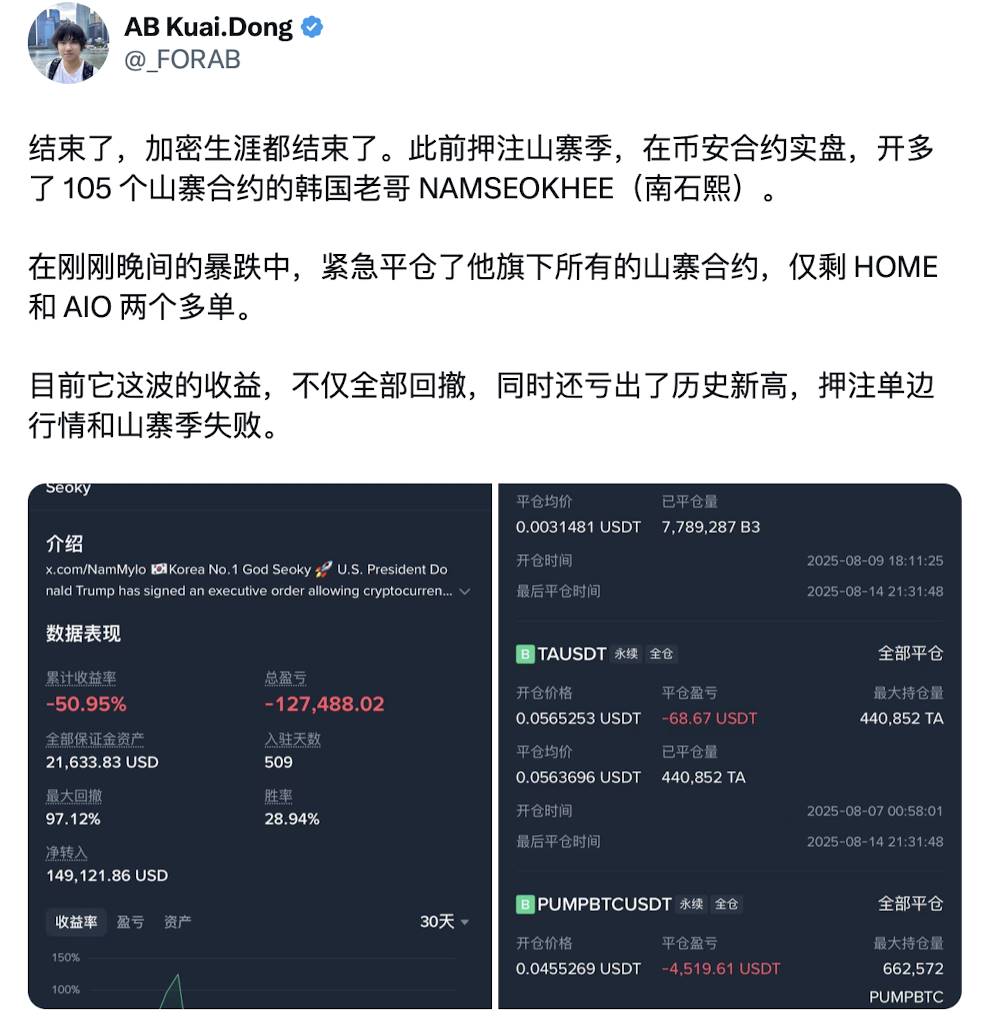
Image source:@_FORAB
In summary, South Korea’s crypto market is making a strong comeback from the “Terra shadow,” emerging as a force global investors can no longer ignore. In the near future, as the Korean won stablecoin gains traction and pro-crypto policies deepen, we may well witness South Korea ascending to the title of “Asia’s crypto capital.”
Join TechFlow official community to stay tuned
Telegram:https://t.me/TechFlowDaily
X (Twitter):https://x.com/TechFlowPost
X (Twitter) EN:https://x.com/BlockFlow_News
 深潮TechFlow






