Why is he the hottest candidate for Fed chair?
TechFlow Selected TechFlow Selected
Why is he the hottest candidate for Fed chair?
What impact would Waller becoming the most favored Federal Reserve chair have on the crypto market?
 Navigating Web3 tides with focused insights
By kkk
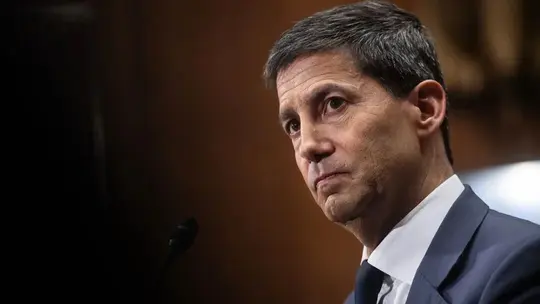
In early August, senior personnel changes at the Federal Reserve, already simmering beneath the surface, suddenly accelerated—Governor Adriana Kugler unexpectedly resigned, and the head of the Bureau of Labor Statistics was personally fired by Trump on the day of the non-farm payroll data release. Before markets could fully absorb the leadership turmoil, the White House stated clearly: "The decision on the next Fed chair will be made by this weekend." On August 7, according to sources, as Trump’s advisers searched for Powell’s successor, Federal Reserve Governor Christopher Waller was emerging as a leading candidate. Advisers were impressed with Waller because he is willing to base policy on forecasts rather than current data, and he possesses deep knowledge of the entire Federal Reserve system.
At a recent FOMC meeting, he joined Governor Michelle Bowman in advocating an immediate 25-basis-point rate cut, becoming one of only two voting members in 32 years to cast a dissenting vote. This stance aligned closely with Trump’s push for lower rates, positioning Waller as a “credible monetary easing ally” in the political tug-of-war between the White House and the Fed.
The Race for Fed Chair
It has been reported that President Trump has officially launched the interview process for the next Fed chair, with three core candidates now in focus: Kevin Hassett, Kevin Warsh, and current Federal Reserve Governor Christopher Waller.
Hassett currently serves as Director of the White House National Economic Council and previously chaired the Council of Economic Advisers during Trump’s first term, making him a staunch advocate of Trump’s economic philosophy. Warsh, a former Fed governor who served from 2006 to 2011, played a role in managing the financial crisis; though generally hawkish, he maintains a long-standing close relationship with Trump and enjoys strong credibility on Wall Street. Waller, however, has emerged as the most watched candidate. As a sitting governor, his recent vote supporting a rate cut aligns closely with Trump’s call for looser monetary policy.
Under Fed appointment rules, the chair must be selected from among current governors. Chair Powell’s term ends in May 2026, while his governorship runs until January 2028—if he chooses to remain on the board after stepping down as chair, Trump’s pool of potential successors would shrink. Thus, Governor Adriana Kugler’s recent resignation is seen as a critical opening. Trump has already nominated Stephen Miran, a White House economic adviser who also advocates rate cuts, to fill the vacant seat. This move not only influences the trajectory of monetary policy but may also reshape the macroeconomic governance direction for the remainder of Trump’s term.
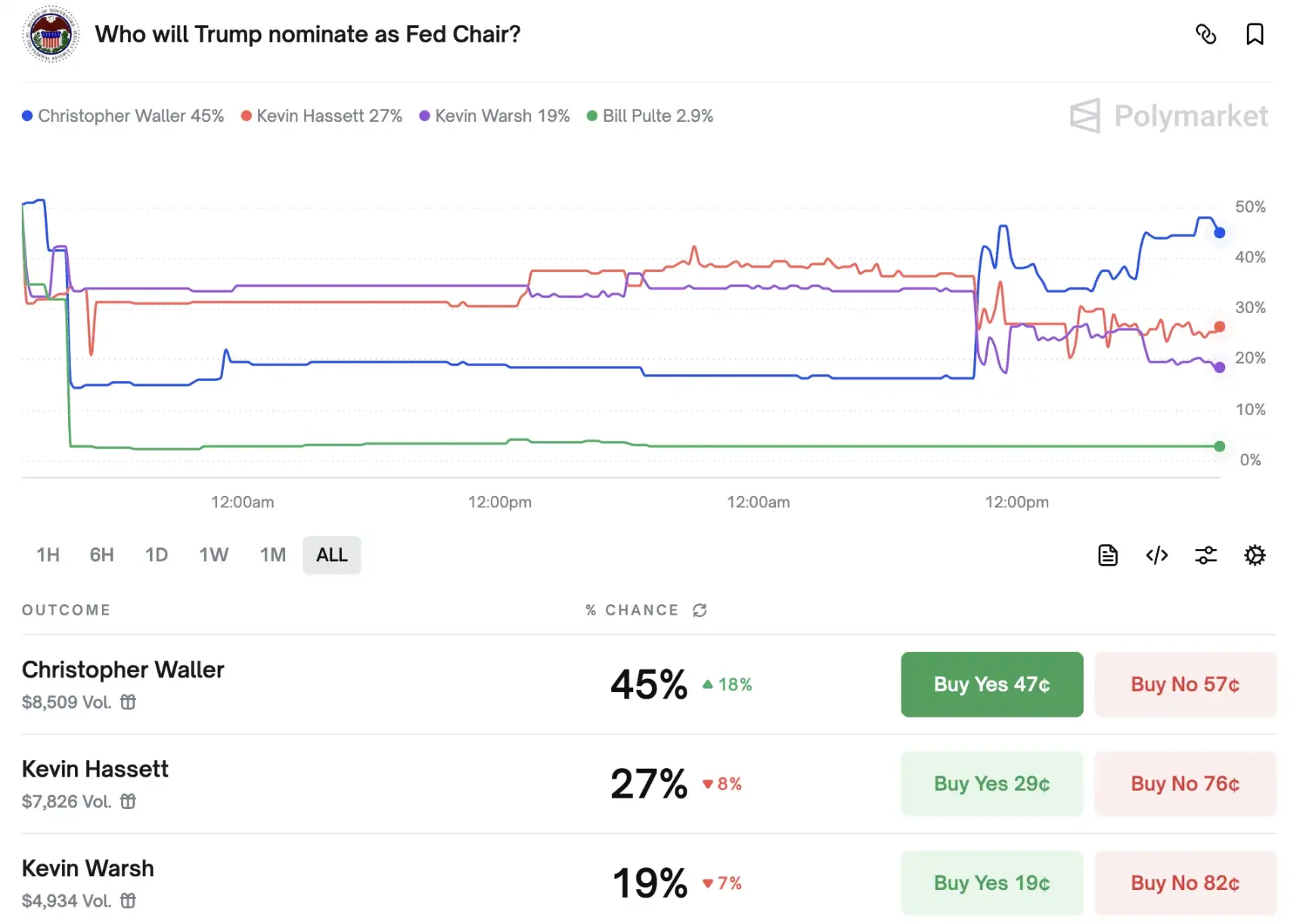
Currently on the decentralized prediction market Polymarket, the odds among the three candidates are diverging: Waller’s probability has risen to 45%, ahead of Hassett (27%) and Warsh (19%). Markets appear to be betting that this “rules-savvy, dovish-leaning” incumbent governor may be Trump’s most trusted successor. Notably, newly nominated Fed Governor Miran has also praised Waller, calling him a suitable choice to succeed Powell.
Christopher Waller: A Crypto-Friendly Fed Governor
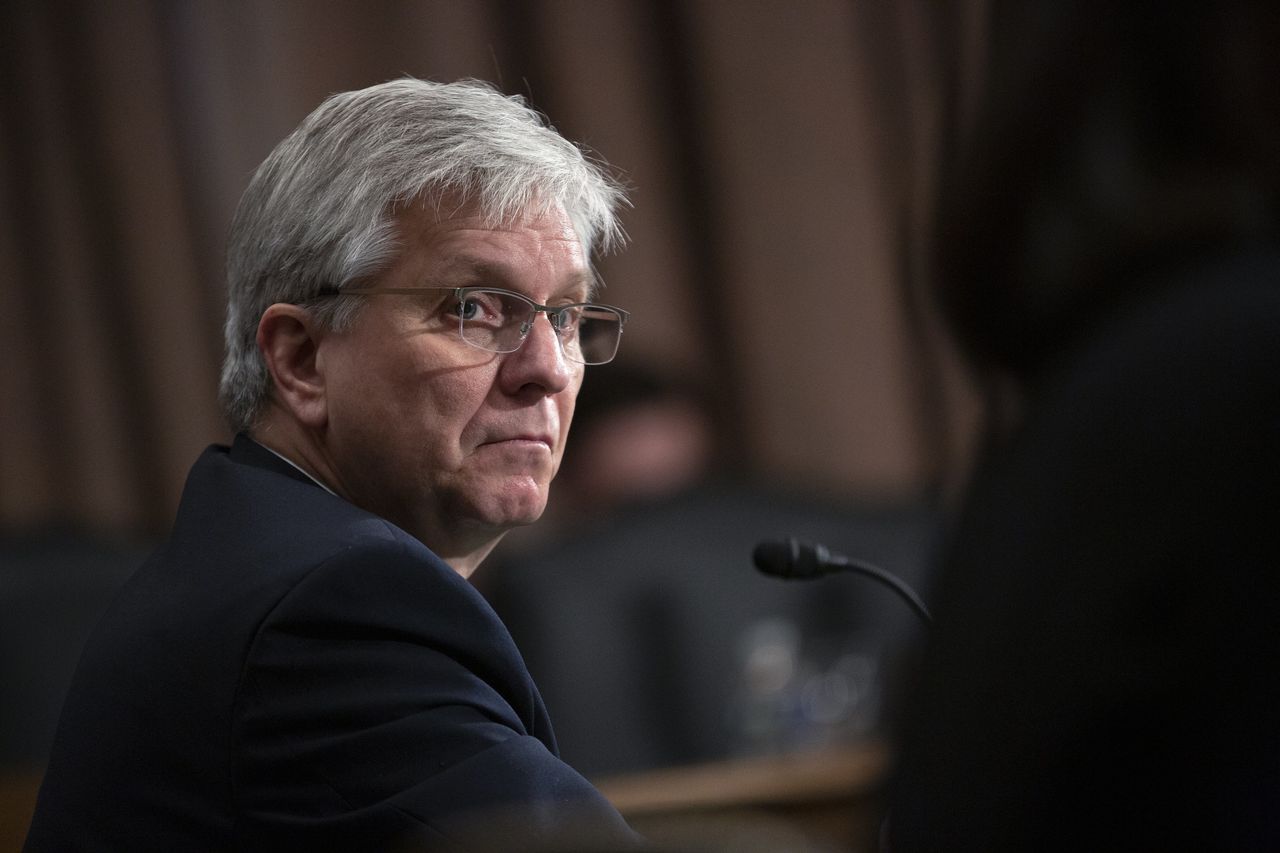
Born in 1959 in Nebraska, Waller earned his bachelor’s degree in economics from Bemidji State University, then went on to complete his PhD at Washington State University. He taught at Indiana University, the University of Kentucky, and the University of Notre Dame, focusing on monetary theory, financial intermediation, and macroeconomic policy, and conducted research on European integration at the University of Bonn in Germany. In 2009, he joined the St. Louis Fed, leading its research division for over a decade and transforming the renowned FRED database into a “toolkit” for economists worldwide. At the end of 2020, he was nominated by Trump to join the Federal Reserve Board and became a voting member of the FOMC, with a term running until 2030.
Waller’s view of crypto assets has been cool to the point of strictness from the start. He once compared most cryptocurrencies to “baseball cards”—lacking intrinsic value, their prices resting on a fragile balance of sentiment and confidence. For such highly volatile speculative assets, he insists on “market accountability,” arguing taxpayers should not bear the cost of investment failures.
Yet when it comes to stablecoins, Waller presents a different face—one of forward-looking, selective support. As early as 2021, he publicly argued that with proper regulation and full reserves, stablecoins could not only reduce payment costs and improve transaction efficiency but also serve as tools to expand the international use of the dollar and reinforce its reserve currency status. At a time when many still saw stablecoins as mere accessories to the crypto market, Waller had already recognized their strategic value within the global payment system. In multiple speeches in 2024 and 2025, he repeatedly urged Congress to pass legislation preventing runs and payment system disruptions, aiming to make stablecoins truly safe “synthetic dollars.”
Moreover, Waller holds a positive view toward decentralized finance (DeFi). At the 2024 Vienna Macroeconomic Symposium, he began with the economic rationale for financial intermediaries—facilitating transactions, reducing costs, and managing risk—then turned to DeFi, a model using blockchain, smart contracts, and distributed ledger technology to enable transactions without traditional intermediaries. He believes DeFi technologies can indeed boost efficiency through 24/7 instant settlement, automated contract execution, and asset tokenization, but their core value lies more in complementing, rather than replacing, traditional finance. Stablecoins, distributed ledger technology (DLT), and smart contracts—tools born from the crypto space—can feed back into centralized systems, enhancing the efficiency and security of traditional markets.
Waller consistently argues that innovation should be driven by the private sector, with the government’s role being to “build the highway”—infrastructure like FedNow provides the lanes, while market competition drives the vehicles. Yet he warns that unregulated non-bank payment providers and decentralized platforms could accumulate leverage and create bubbles, ultimately threatening financial stability.
He is both a skeptic of crypto assets and an early believer in the potential of stablecoins; capable of dissecting the technical and economic logic of DeFi, yet steadfast in upholding the Fed official’s duty to systemic safety. Between innovation and risk, Waller does not seek to let one dominate the other, but instead insists on drawing a clear, enforceable line—leaving room for progress while never relinquishing responsibility for guarding the堤坝.
Will Waller Take Over? The Fed’s Next Move
If Waller ultimately becomes Fed chair, markets may experience a rhythm distinctly different from Powell’s era. While anchoring policy to data, Waller tends to pivot quickly toward growth-supportive stances once inflationary pressures ease. He has repeatedly opposed excessive tightening in the FOMC and been among the first to signal support for rate cuts when economic data weakens. This flexibility could not only align well with the White House’s fiscal stimulus and expansion goals but also allow capital markets to anticipate earlier signs of liquidity recovery during economic slowdowns.
In the realm of crypto and payment innovation, Waller’s ascension could bring clearer, more predictable regulatory pathways. He would likely actively support stablecoin legislation, enabling their integration into payment and financial systems under conditions of safety and compliance. His recognition of DeFi technology suggests Wall Street and crypto platforms may gain greater policy room in areas like tokenization, smart contracts, and 24/7 settlement. In short, a Fed led by Waller might preserve the dollar’s dominance in the global financial system while carving out space for compliant crypto ecosystems to grow.
To investors, this combination reduces policy uncertainty while unlocking potential benefits on two fronts: one from monetary easing boosting asset prices, the other from new market opportunities arising from the convergence of crypto and traditional finance.
Conclusion
However, precisely because Waller appears so closely aligned with the White House, some market participants have expressed concerns about the Federal Reserve’s independence. Critics argue that if monetary policy becomes increasingly influenced by political timing, the Fed may struggle to remain absolutely neutral between inflation pressures and election cycles. These concerns echo not only on Wall Street but also in commentary from parts of academia and former officials—who warn that if markets begin to doubt the Fed’s independence, the credibility cost could rise rapidly, affecting dollar asset pricing and international capital flows.
Procedurally, even if the president makes a nomination, Waller’s appointment would still require Senate review and confirmation—a process that will test his congressional support and serve as a market barometer for future policy direction. Until official news breaks, investors can only price in expectations based on rumors and interpretations, waiting quietly for the next moves from the White House and Congress.
Join TechFlow official community to stay tuned
Telegram:https://t.me/TechFlowDaily
X (Twitter):https://x.com/TechFlowPost
X (Twitter) EN:https://x.com/BlockFlow_News
 BlockBeats