MEME Whale Trading Secrets: High-Frequency Gambling and Covert Manipulation Behind Huge Profits
TechFlow Selected TechFlow Selected
MEME Whale Trading Secrets: High-Frequency Gambling and Covert Manipulation Behind Huge Profits
How do top MEME traders achieve consistent profits?
 Navigating Web3 tides with focused insights
Author: Frank, PANews
The MEME market is always filled with overnight success myths, but very few players can consistently profit. How do top-tier MEME traders achieve stable returns? Is there a so-called "holy grail" in MEME trading? PANews conducted an in-depth analysis of the trading behaviors of the top three most profitable players within OKX wallets over the past three months.
These elite traders' strategies not only demonstrate the diversity of MEME coin trading but also reveal the hidden complexities and potential pitfalls within this high-risk domain.
This analysis will examine several aspects including token purchase preferences, largest single profit, largest single loss, trading frequency, position size, and entry timing.
Cupsey: Finding Diamonds Through High-Frequency Front-Running
Cupsey (suqh5sHtr8HyJ7q8scBimULPkPpA557prMG47xCHQfK, Twitter: @Cupseyy) ranks first on the OKX wallet leaderboard in terms of earnings over the past three months. His earnings during this period amount to approximately $5.14 million, with a win rate of 67.7%. Additionally, Cupsey has around 137,400 followers on Twitter.
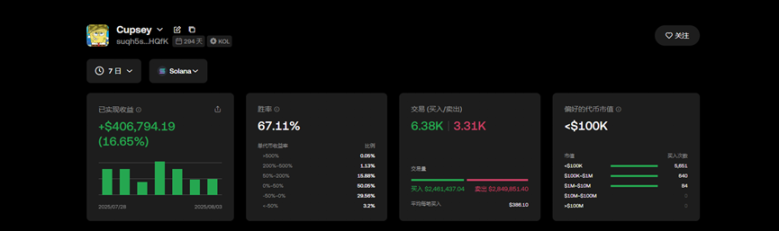
PANews analysis reveals that Cupsey’s typical trading style follows a high-frequency front-running strategy—allocating a certain portion of funds to buy immediately as tokens launch, then liquidating positions within one minute or even tens of seconds. Due to Cupsey’s enormous trading volume—95,000 trades within 30 days—it is impossible to conduct a detailed analysis of his overall trading strategy. Therefore, PANews randomly selected several recent trades, along with his highest-profit and highest-loss transactions, for examination.
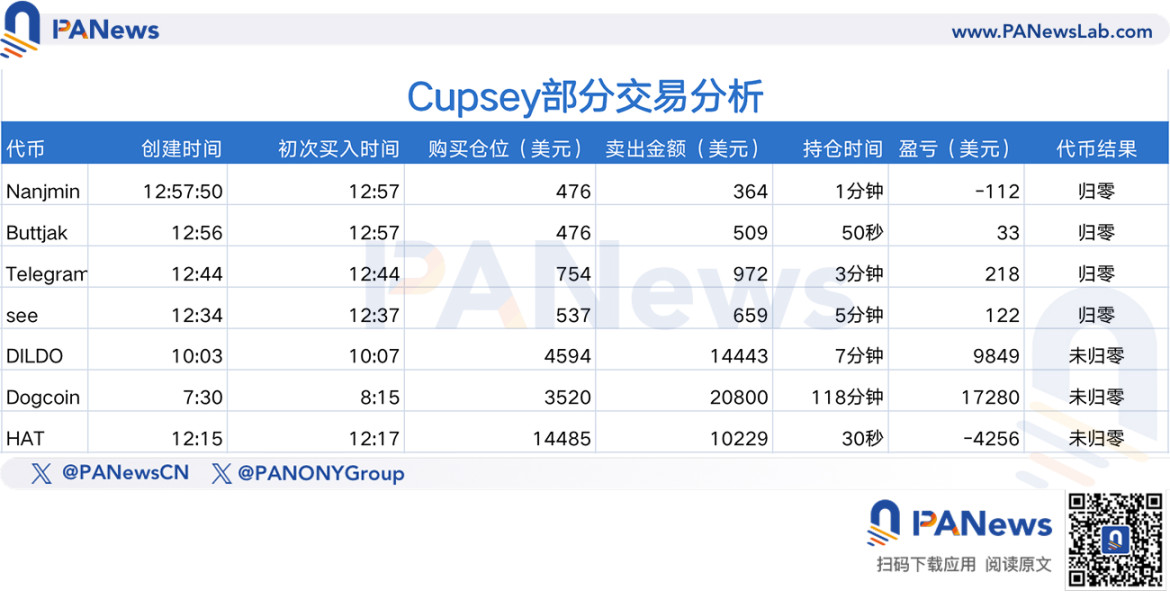
In terms of trading frequency, Cupsey averages about 910 trades per day over the past seven days. Based on his most recent trades, he tends to buy tokens shortly after listing, allocating roughly the same capital each time—typically around 3 SOL. He then makes initial sales within tens of seconds to a few minutes. Moreover, if a token meets certain criteria, Cupsey may add approximately $30 more per trade, usually averaging around 10 additional entries. His profit targets are generally modest, ranging from dozens of dollars up to around $200. Clearly, his exit logic does not rely on fixed profit-loss ratios but instead adapts dynamically based on real-time market movements. Often, the tokens he participates in collapse to zero within minutes; sometimes they crash so quickly that even he cannot fully escape losses. However, judging by his trading speed, he likely uses independently deployed trading APIs, which maximizes his ability to avoid being sandwiched.
According to GMGN data, Cupsey’s single most profitable trade involved a token called Dogcoin. This transaction clearly deviated from his usual approach—he did not enter at launch but instead bought in over 40 minutes after listing, initially committing over $2,000. He then rapidly added multiple positions. After holding for less than two hours, he fully exited, later conducting repeated buy-sell cycles on the same token. The total profit amounted to approximately $17,000.
In contrast, his largest loss occurred while trading the HAT token, where he applied his typical front-running strategy—buying within two minutes of launch and beginning to sell after holding for 30 seconds. However, in this case, his initial investment was significantly higher than normal—over $2,300. After his initial sale, he had already lost $300. Yet, Cupsey appeared unusually confident in this token and immediately increased his position, ultimately exiting one minute later with over $3,000 in losses.
This incident illustrates that even top-tier MEME traders are vulnerable to emotional interference leading to oversized positions. Overall, Cupsey operates under two distinct logics. The first involves rapid buying at launch followed by quick exits, aiming for small profits. While this strategy itself isn't novel, its practical difficulty lies in making accurate token assessments within seconds of launch and completing full buy-sell cycles within tens of seconds—a process undoubtedly supported by sophisticated automated trading tools.
The second logic involves slower, more deliberate trades—identifying promising tokens early and investing thousands of dollars before gradually exiting in batches. Regardless of method, Cupsey is clearly not someone who holds overnight or seeks massive multipliers. His approach exemplifies how professional MEME traders operate today: accumulating gains steadily through solid technical infrastructure and unique decision-making frameworks.
gake: Value Discovery and Swing Mastery
gake (DNfuF1L62WWyW3pNakVkyGGFzVVhj4Yr52jSmdTyeBHm, Twitter: @Ga__ke) ranks second among traders. His trading style differs sharply from Cupsey's. Over the past three months, gake earned approximately $2.48 million with a win rate of about 42%, and individual profits typically range from several thousand to over $10,000. His trading frequency is much lower than Cupsey’s, having executed 2,141 trades in three months—around 23 trades per day on average.
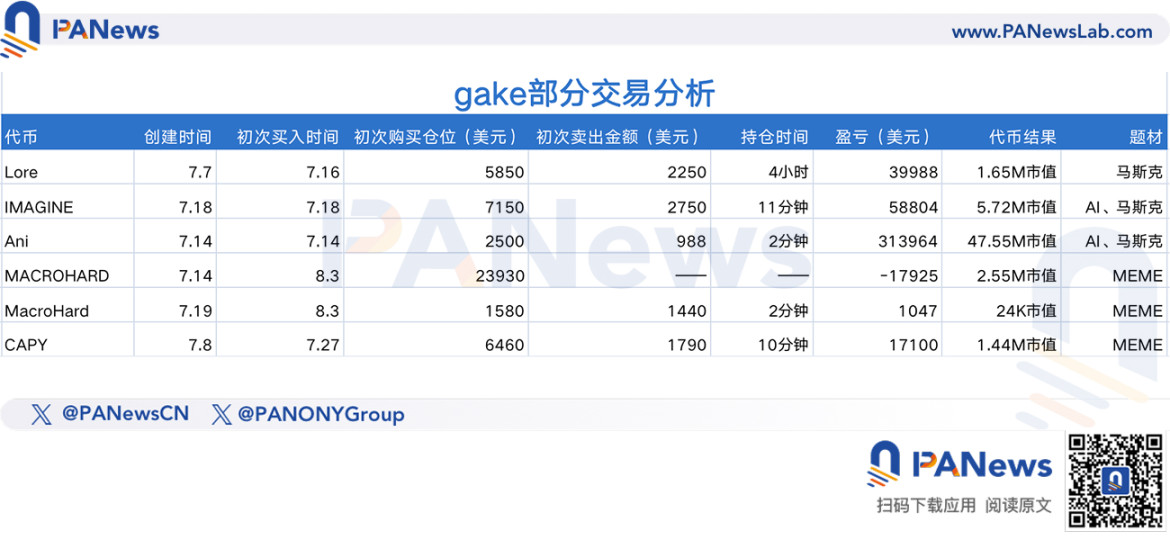
In terms of trading style, gake typically focuses on tokens with market caps above $100,000 and generally does not rush to buy at launch. Although he occasionally purchases tokens shortly after listing, observations suggest he does so primarily to accumulate cheaper positions rather than to front-run exits.
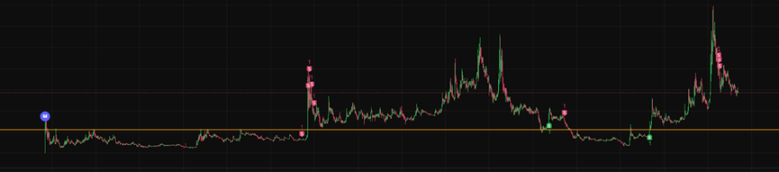
gake’s primary goal is to identify tokens unlikely to collapse immediately while possessing breakout potential on social media. For example, he often favors themes related to AI, Elon Musk, or established meme cultures. Observations indicate that the tokens gake buys typically reach market caps exceeding $1 million.
Secondly, regarding entry points, gake waits for price pullbacks or enters when positive catalysts drive breakouts. After buying, he recovers a small portion of his principal quickly, letting the remainder ride for some time. On particularly trending tokens, gake conducts multiple round-trip trades, resembling swing trading altcoins.
Overall, gake functions as a discerning diamond hand with a distinctive analytical edge. His strength lies in identifying valuable information, frequently spotting emerging topics and meme symbols, then allocating relatively large capital after evaluation.
Cented: The "Smart Money" Trap and Manipulation Warning
Cented (CyaE1VxvBrahnPWkqm5VsdCvyS2QmNht2UFrKJHga54o) ranks third, with earnings of $1.82 million over the past three months. Cented’s trading style closely resembles Cupsey’s, with similar investment amounts and overlapping traded tokens. Like Cupsey, Cented employs a high-frequency, launch-front-running strategy. However, unlike Cupsey who seeks opportunities amid active trading, Cented appears to be a purer bot-driven trader. His holding periods are even shorter—transactions are completed within seconds to tens of seconds—and nearly all buys occur just seconds after launch, clearly indicating a bot-operated address.
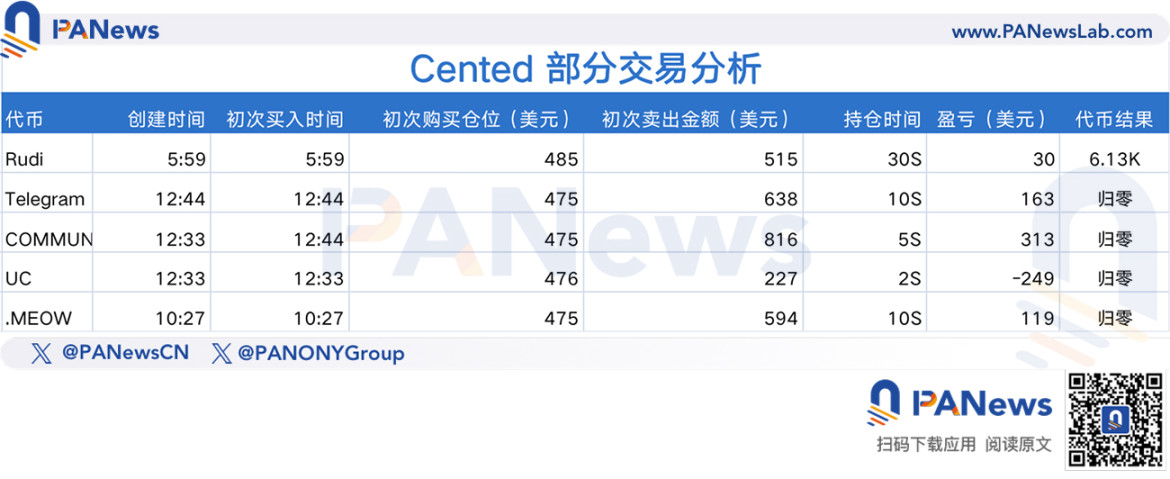
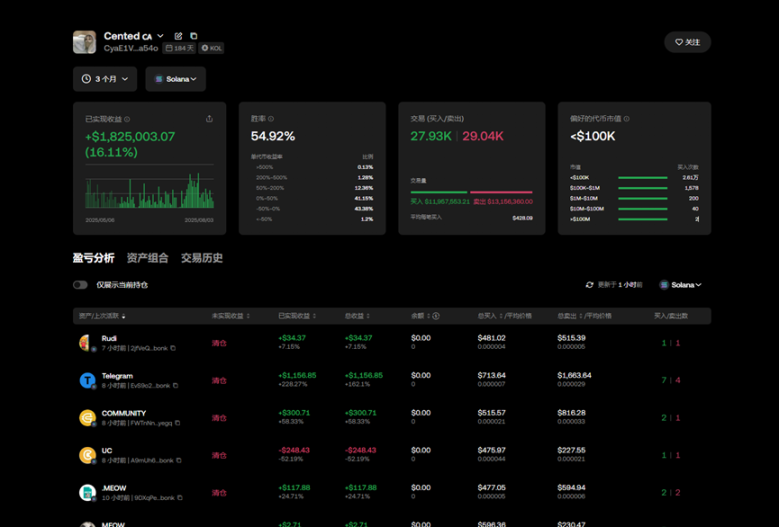
However, it's worth questioning whether Cented’s reported $1.82 million profit reflects actual gains. Newly launched tokens—which constitute all of Cented’s purchases—can only appreciate and generate profits if other buyers participate. Yet, according to Cented’s trade history, more than half of these tokens appear profitable—a success rate inconsistent with typical MEME token issuance patterns. Thus, PANews suspects that Cented’s address may be one of several profit-generating addresses belonging to a coordinated "syndicate." In such cases, apparent profits result from other addresses artificially inflating prices through coordinated purchases—commonly known as wash trading. By maintaining Cented’s address as a long-term profitable record, the group aims to present it as "smart money," attracting followers whose trades become easy prey for the syndicate.
PANews randomly examined several tokens traded by Cented and found their creators were uniformly specialized "scam project" minting addresses. This pattern suggests either that Cented is part of such groups or that he exclusively buys low-quality tokens. Regardless of the truth, following Cented’s trades is not a wise choice for investors.
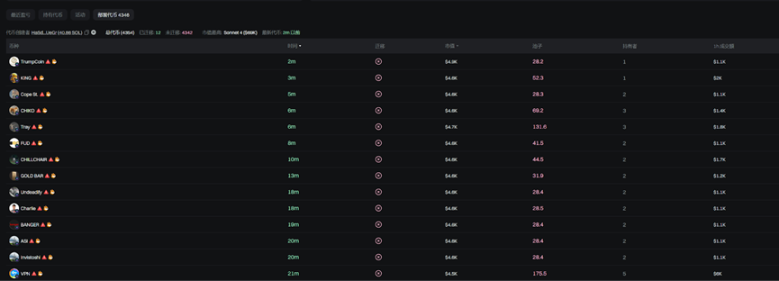
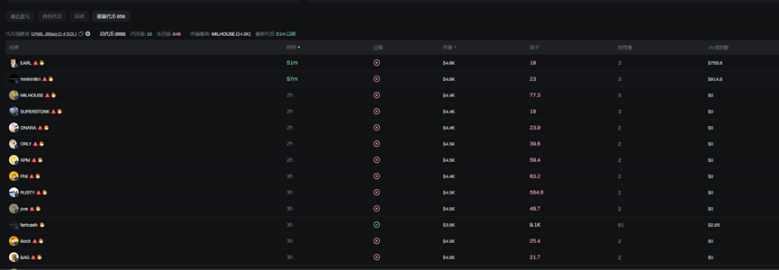
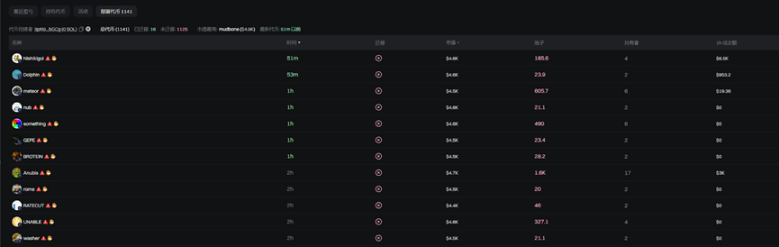
Therefore, investors must remain vigilant when evaluating seemingly "smart money" addresses. Blindly copying trades without scrutiny is dangerous. When analyzing smart money activity, one must constantly assess whether an address’s apparent profitability aligns with actual market dynamics. Otherwise, falling into a rug-pull scheme becomes highly likely.
In summary, examining these top traders’ behaviors reveals that true success stems not from lucky bets but from unique trading logic, robust technical foundations, and strict risk controls. For ordinary investors, blindly copying trades is far less valuable than deeply understanding the underlying logic and risks of these strategies. Before diving into this thrilling wealth game, independent thinking and cautious judgment may be the most precious form of "smart money" strategy.
Join TechFlow official community to stay tuned
Telegram:https://t.me/TechFlowDaily
X (Twitter):https://x.com/TechFlowPost
X (Twitter) EN:https://x.com/BlockFlow_News
 PANews