70x miracle token collapsed—can DeFi's meme IMF make a comeback?
TechFlow Selected TechFlow Selected
70x miracle token collapsed—can DeFi's meme IMF make a comeback?
The "meme flywheel" on Ethereum suddenly collapsed.
 Navigating Web3 tides with focused insights
Author: Cookie,律动
From early June to early July this year, $IMF, a MemeFi project on the Ethereum mainnet, surged nearly 70x. Although $IMF gradually pulled back by 50% after hitting a record high market cap of $70 million, yesterday's sharp drop of nearly 85% shook the market.
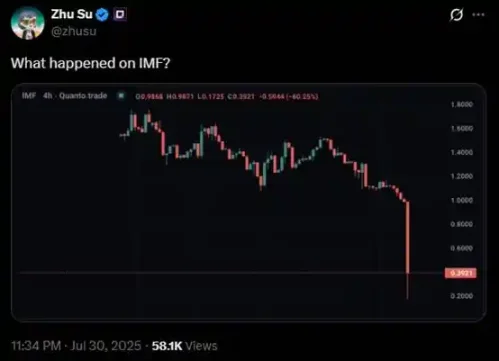
Zhu Su was shocked by IMF's plunge
What exactly happened to cause such a massive decline in $IMF?
What is IMF?
IMF (International Meme Fund) is a decentralized finance platform tailored for mainnet memes, allowing users to collateralize meme coins like $PEPE, $JOE, and $MOG to borrow the stablecoin $USDS without selling their holdings. Additionally, through modules such as Accelerate and Amplify, projects or whales can leveraged pump, engage in circular borrowing to defend prices, and even create artificial "locked-up" appearances while actually exiting positions early and managing shadow funds.
IMF enables circular borrowing of meme coins—essentially "stepping on one's own feet"—for example:
· Buy $10,000 worth of PEPE
· Deposit PEPE into IMF and borrow $5,000 in USDS loan
· Swap USDS back into PEPE
· Deposit the remaining $5,000 worth of PEPE to lower the loan-to-value ratio (LTV)
Currently, IMF's TVL stands at approximately $166.5 million, with about $54 million in $USDS deposited, and collateral including roughly $29.22 million in $PEPE, $20.58 million in $stETH, $44.4 million in $MOG, $5.88 million in $JOE, $4.94 million in $SPX, and $7.5 million in $IMF.
Why did $IMF crash?
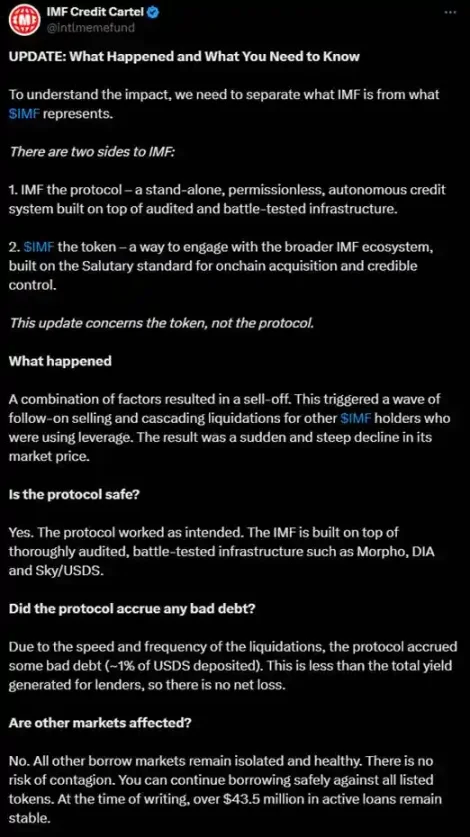
According to IMF's official tweet, this sudden plunge in $IMF was not due to any protocol issue, but rather because the $IMF token itself was dumped, triggering panic selling and cascading liquidations that caused the price to plummet sharply.
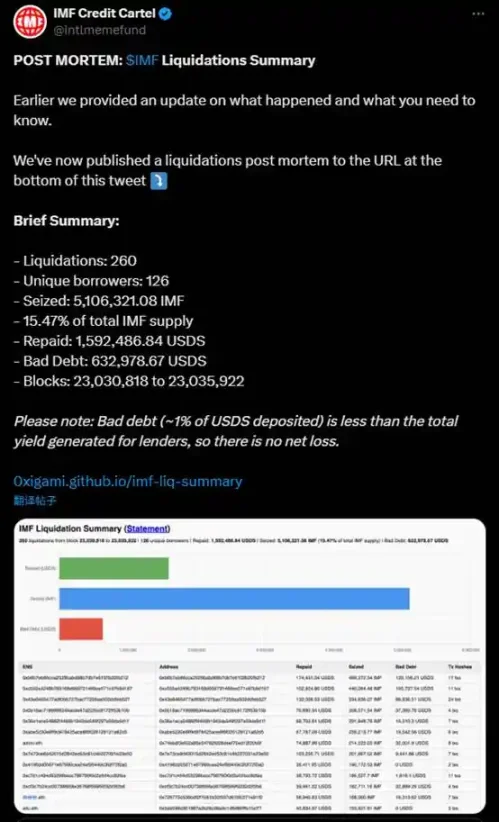
The team also stated in the tweet that due to the speed and frequency of liquidations, some bad debt accumulated (approximately 1% of deposited USDS). However, this is less than the total interest generated by lenders, resulting in no net loss. Furthermore, the issues in the $IMF lending market do not affect other lending pairs on the platform.
@2025Spider tweeted that his friend sold $100,000 worth of $IMF at 1.02U, triggering the cascade of liquidations. He said his friend had no intention of harming the IMF project and suggested the team should close all IMF lending positions immediately, otherwise USDS would face significant risk. He also noted that the team's oracle updates were slow—when most IMF/USDT positions were already insolvent, the oracle still hadn't updated to reflect the latest price.
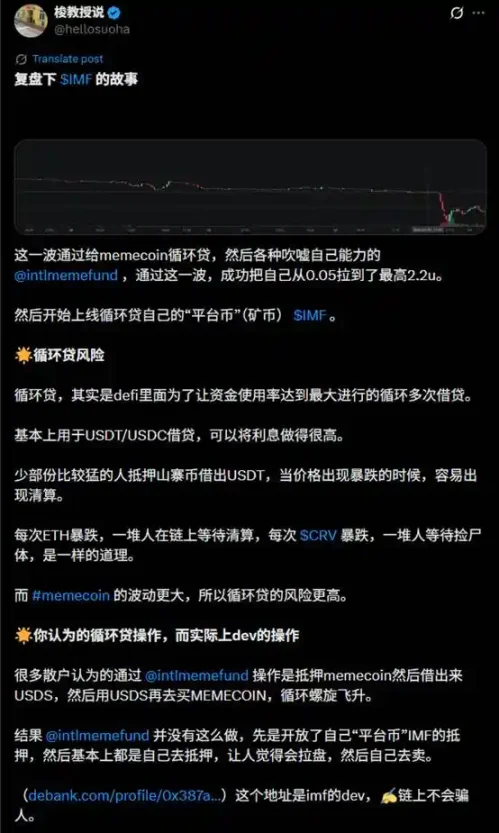
Regarding IMF enabling its own platform token $IMF as collateral, both @2025Spider and Chinese-speaking KOL "Professor Suo" raised concerns:
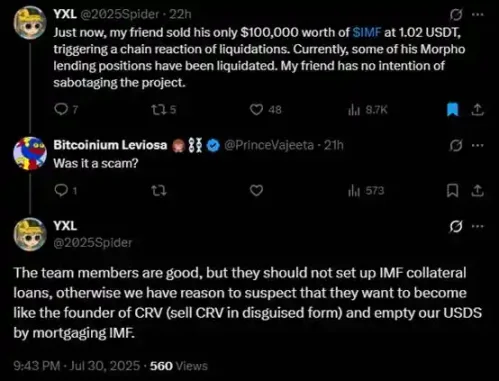
Someone asked @2025Spider in the replies, "Is IMF a scam?" @2025Spider replied that the team members are good, but they shouldn't have enabled $IMF as collateral, otherwise there's reason to suspect they want to cash out their own tokens indirectly, just like CRV's founder. He also pointed out that the credit limit assigned to $IMF exceeded the size of $IMF's Uniswap pool itself, which from a risk management perspective is unacceptable
"Professor Suo" directly questioned whether the IMF team artificially created FOMO by self-collateralizing and then sold off their tokens, based on on-chain evidence:
IMF's official account released a detailed report on the cascade liquidation event this afternoon. There were 260 liquidations in total, involving 126 unique borrowers, with 15.47% of the total $IMF supply being liquidated.
Conclusion
After the incident, $IMF rebounded nearly 4x from its lowest point and currently remains up almost 3x from that low, with market cap recovering to nearly $21 million.
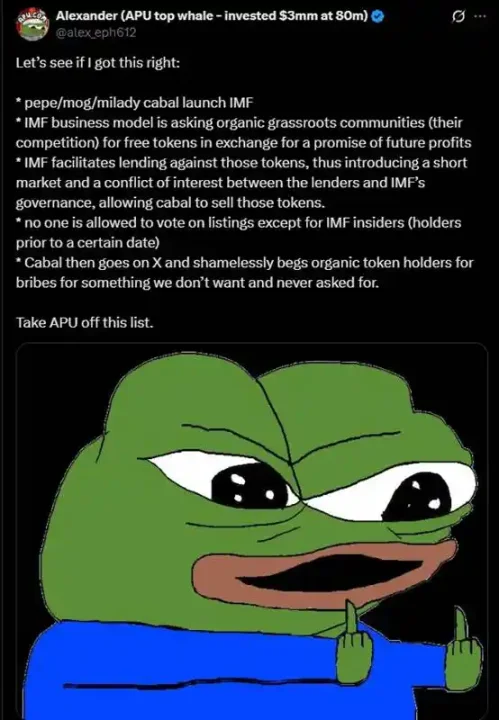
However, controversy surrounding $IMF may not be over. On July 24, @alex_eph612, a major holder of the well-known Ethereum meme coin $APU, attacked IMF, claiming that IMF is a conspiracy group formed by $PEPE, $MOG, and Milady, whose business model essentially extorts free tokens from other organic meme communities in exchange for short-term buying pressure brought by IMF, after which the cartel sells the tokens:
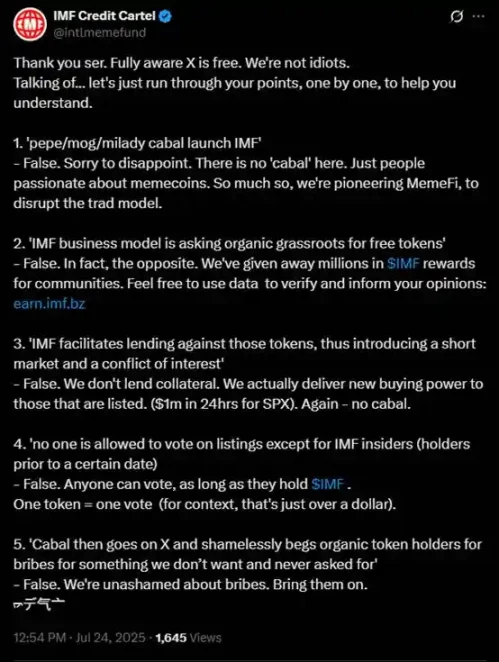
IMF quickly responded, denying any bribery, stating that listing standards are transparent and decided by $IMF holders through voting:
Ethereum's "meme flywheel" will likely continue to face turbulence.
Join TechFlow official community to stay tuned
Telegram:https://t.me/TechFlowDaily
X (Twitter):https://x.com/TechFlowPost
X (Twitter) EN:https://x.com/BlockFlow_News
 BlockBeats