Will Trump's USD1 remain stable without widespread adoption following the initial de-anchoring?
TechFlow Selected TechFlow Selected
Will Trump's USD1 remain stable without widespread adoption following the initial de-anchoring?
When USD1 becomes a key entry point in crypto applications, its own resilience, liquidity design, and user confidence mechanisms are the core factors determining whether it can be sustainably "used" over the long term.
 Navigating Web3 tides with focused insights
By: Dingdang (@XiaMiPP), Planet Daily
At 6 PM on July 29, the stablecoin USD1 briefly lost its peg, dropping as low as 0.9934 USDT, deviating from its 1:1 dollar peg. Subsequently, USD1's price gradually recovered and has since stabilized around 0.9984 USDT. This short-term fluctuation drew market attention.
The Truth Behind USD1's Depegging
Based on current community discussions and speculation, the immediate cause of this depegging event may be closely linked to Gate exchange's IKA Launchpad event launched on July 26. The event offered a total of 200 million IKA tokens for subscription, allowing users to participate using either USD1 or Gate’s native token GT, with the subscription price set at 1 IKA = 0.001424 GT = 0.025 USD1. According to official data disclosed by Gate, by July 28, the total amount subscribed in the USD1 pool alone had already exceeded $200 million. Such a large-scale subscription reflects strong market enthusiasm for the IKA project, but it may also have laid the groundwork for subsequent selling pressure on USD1.
We note that the IKA subscription event officially concluded at 1 PM on July 29. In conjunction with price movements, USD1's initial decline began shortly thereafter and continued until around 6 PM that day. This timeline aligns closely with the depegging incident, further supporting the possibility that "post-event capital outflows led to increased selling pressure." Some participating users may have chosen to quickly cash out their USD1 holdings after subscription, resulting in concentrated sell-offs.
USD1 is issued by World Liberty Financial (WLFI) and is officially positioned as a "low-volatility digital asset option," aiming to provide users with a stable cryptocurrency trading medium through 1:1 dollar pegging. According to its whitepaper and audit reports, USD1's reserve assets primarily consist of U.S. short-term Treasury bonds and dollar deposits, theoretically ensuring strong redemption capacity and price stability mechanisms.
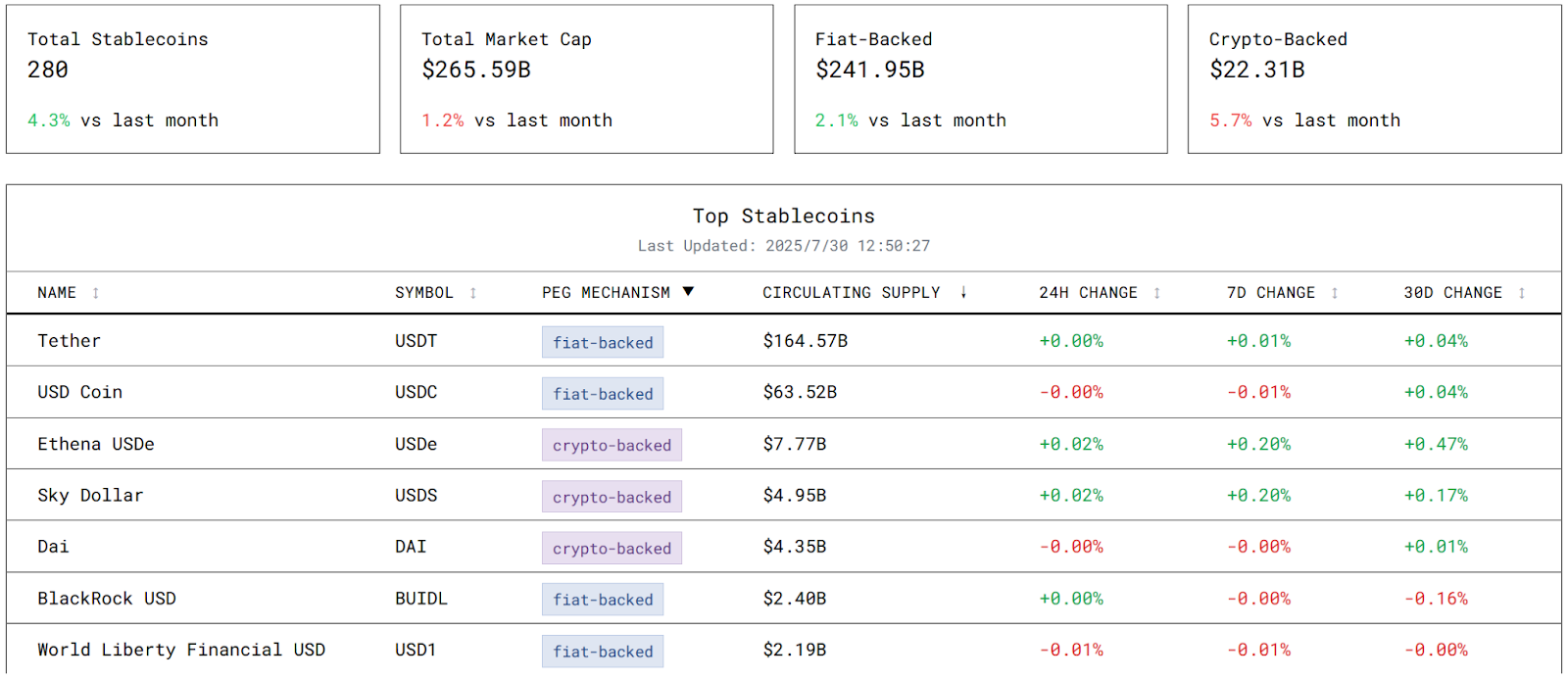
However, from a broader perspective, this depegging incident reveals the inherent fragility of mid- and small-cap stablecoins under intense capital movements. According to data from stablecoins.asxn.xyz, the current total stablecoin market size stands at $265.9 billion, with USDT dominating at $164.57 billion. In contrast, USD1's circulation is only $2.19 billion, accounting for approximately 1.3%. In absolute terms, such a market scale is insufficient to withstand significant application pressure, let alone sudden inflows and rapid withdrawals of $200 million in subscription funds. For USD1, this was not just a real-world test, but more like an involuntary stress test.
Backed by Trump, Resource Advantages Emerge
Looking at the current situation, although USD1 experienced a brief depegging, the event also indirectly confirmed its advantages in terms of market resources. Unlike traditional stablecoins that rely on self-sustaining growth within on-chain ecosystems, USD1 benefits not only from the financial resources of World Liberty Financial but also enjoys political and capital network backing from the Trump family. As a result, USD1 has rapidly entered key areas such as crypto project fundraising, transaction settlements, and Launchpad events, becoming a "strategic stablecoin" option increasingly promoted by platforms to their users.
Yet, having powerful backers does not mean a smooth path ahead. The depegging incident during the IKA Launchpad event clearly demonstrates that market recognition of resource backing cannot substitute for verification of mechanism security. When USD1 becomes a critical entry point in crypto applications, its own resilience, liquidity design, and user confidence mechanisms are what truly determine whether it can be sustainably adopted over the long term.
Especially when facing liquidity shocks involving hundreds of millions of dollars within a short timeframe, the issues exposed by USD1 warrant serious attention from WLFI. The political spotlight surrounding the Trump family may generate repeated attention dividends, but only by converting attention into use cases and transforming those use cases into ecosystem inertia can USD1 evolve from an empowered chip into a significant player within the stablecoin landscape.
Join TechFlow official community to stay tuned
Telegram:https://t.me/TechFlowDaily
X (Twitter):https://x.com/TechFlowPost
X (Twitter) EN:https://x.com/BlockFlow_News
 Odaily