








At New Heights: Exploring the Cross-Industry Newcomer BNB
TechFlow Selected TechFlow Selected
At New Heights: Exploring the Cross-Industry Newcomer BNB
BNB has never been as close to Main Street as it is today, from Wall Street to everywhere.
 Navigating Web3 tides with focused insights
Author: TechFlow
On July 28, BNB hit a new all-time high of $861, up more than 5,700x from its 2017 issuance price of $0.15.
Never before has BNB stood so close to elite Wall Street on one side, and Main Street on the other.
In July 2025, U.S. alternative asset manager 10X Capital and venture firm YZI Labs announced plans to launch a "micro strategy"-style fund dedicated to investing in BNB, aiming to provide institutions and family offices with a compliant pathway for BNB reserves via a U.S. stock market listing.
BNB is integrating into the U.S. equities market, while the U.S. equities market is simultaneously entering the on-chain world through BNB Chain.
In July, the RWA platform xStocks, backed by Kraken and Backed Finance, will launch over 60 tokenized U.S. stocks and ETFs on BNB Chain, covering Tesla, Apple, Nvidia, and even S&P 500 ETFs.
On the other side of Main Street, BNB Chain reaches every cross-border household needing efficient transfers and every developer looking to build startups on blockchain.
From African mobile payment providers to Filipino remittance workers and Latin American crypto freelancers, BNB Chain delivers real financial infrastructure to these users through low fees and fast confirmations.
If Bitcoin is the “digital gold” of the crypto world and Ethereum is the “silver mine” beneath smart contracts, then BNB—once seen as the pioneer of exchange tokens—has evolved into an entirely new crypto species.
No longer just a platform token for fee discounts or a public chain fuel, BNB has become a multidimensional value carrier bridging centralized finance, on-chain ecosystems, and real-world assets:
One side connected to Wall Street’s capital markets, the other embedded in everyday life scenarios for ordinary users. The next chapter begins with this identity transformation.
The Chain's Evolution: Pragmatism
BNB Chain’s development has always carried a strong pragmatic streak.
Compared to public chains focused solely on narratives or capital appeal, BNB’s technical path resembles an ongoing optimization driven by practical needs.
Over the past year, two network upgrades have quietly transformed its core performance.
First, the Lorentz hard fork launched at the end of 2024 reduced block times to 0.75 seconds, cutting transaction confirmation time down to 1.875 seconds, with peak daily transactions briefly surpassing 17.6 million.
In 2025, the Maxwell upgrade followed, further optimizing performance and reducing on-chain transaction fees to around $0.01—a level comparable to centralized exchanges.
The direct result? Improved user experience.
On-chain transfers, interactions, and deployments now offer more predictable response speeds and costs—crucial for high-frequency DeFi or payment applications.
According to the 2025 roadmap, BNB Chain aims even higher.
The official plan targets, within 18 months, phased implementation of:
-
Raising block gas limits to 1 billion to support more complex on-chain operations
-
Reducing confirmation times to 150 milliseconds, approaching standards of traditional payment systems
-
Launching a Rust client to enrich the developer ecosystem
-
Introducing the Super Instructions mechanism to optimize contract execution efficiency
The logic behind these initiatives is clear.
BNB Chain is steadily advancing toward being “high-performance, low-cost, and developer-friendly,” not to dominate narratives but to make on-chain interactions viable for real financial services—especially in performance- and cost-sensitive areas like cross-border payments, micropayments, and on-chain asset issuance.
This means BNB Chain is tackling a more fundamental challenge:
How to make blockchain infrastructure practically applicable within traditional financial use cases.
Toward Wall Street: From xStocks to the “BNB Micro Strategy”
If technical upgrades represent BNB Chain’s internal evolution, connecting with traditional finance marks BNB’s new frontier in ecosystem expansion.
First, integration with real-world assets (RWA).
In July 2025, the RWA platform xStocks officially launched on BNB Chain, supported by Kraken and Backed Finance.
xStocks offers over 60 tokenized versions of U.S. stocks and ETFs, including Apple, Tesla, Nvidia, and S&P 500 ETFs.
Though these are essentially custodial instruments, their launch signals BNB Chain’s emergence as key infrastructure in the tokenized RWA market, participating in experiments that tokenize traditional financial products.
Adam Levi, co-founder of Backed, said: “xStocks represents a neutral, public-interest-driven asset class. Expanding to BNB Chain is a crucial step toward establishing it as a standard for tokenized stocks. BNB Chain’s global reach and deep liquidity make it a natural partner in advancing this vision.”
On July 16, Ondo Finance announced BNB Chain would join its “Global Markets Alliance,” deploying Ondo’s full suite of tokenized assets—including hundreds of U.S. stocks, ETFs, and funds—to BNB Chain in the near term.
This rare public partnership allows BNB Chain users to buy and hold these “tokenized U.S. stocks” without going through traditional brokers or being bound by market trading hours—and even use them in DeFi applications.
This month, Circle also revealed plans to natively issue its interest-bearing stablecoin USYC on BNB Chain.
Second, BNB as an “asset allocation” choice is now gaining institutional attention.
Nano Labs, a publicly traded U.S. company, disclosed raising $500 million in bonds to purchase BNB. On July 28, Nano Labs announced acquiring an additional 8,000 BNB via OTC trades, bringing its total holdings to 128,000 BNB—worth over $108 million—with future reserve targets potentially reaching $1 billion.
On July 28, NASDAQ-listed biopharma Liminatus Pharma (NASDAQ: LIMN) announced plans to establish a subsidiary named “American BNB Strategy” to raise and gradually invest up to $500 million in BNB.
Earlier, Windtree (WINT) announced a $60 million securities purchase agreement with Build and Build Corp, with proceeds primarily allocated to acquiring BNB and launching a BNB treasury strategy.
In early July, U.S.-based alternative investment firm 10X Capital revealed it was collaborating with crypto venture YZi Labs on a BNB reserve initiative, aiming to create a dedicated investment vehicle holding BNB and exploring a U.S. stock market listing.
This is only the beginning.
Binance founder CZ posted on X: "Heard over 30 teams are planning BNB treasury reserve-related listed projects."
This trend echoes Bitcoin’s early “micro strategy” accumulation phase.
The difference? BNB’s rationale ties more closely to its on-chain utility, RWA ecosystem, and burn mechanism—emphasizing practicality and deflationary potential rather than pure store-of-value attributes.
According to BNB’s latest quarterly burn announcement (the 32nd), approximately 15,900 BNB were destroyed, worth about $1.024 billion, reducing the circulating supply to roughly 139 million BNB.
Among the top 10 cryptocurrencies by market cap, BNB is the only one with a clearly defined deflationary model—and its pace is astonishing. This provides solid value support, reduces volatility, and creates sustained upward price pressure.
On July 28, BNB broke $861, setting another record—real-world validation of its deflationary strength.
Overall, whether through RWA adoption or institutional accumulation, BNB’s financialization remains in early stages. Yet these efforts point clearly in one direction—BNB is actively seeking entry points into the traditional financial system, an exploration likely to become a significant part of the future crypto landscape.
Real-World Adoption: Payments and User Growth
While BNB Chain’s tech upgrades and financialization draw attention, its ecosystem rests on a core principle—enabling blockchain to serve far more real users.
In recent years, BNB’s on-chain ecosystem has shown a clear trend: leveraging low cost and high efficiency to penetrate payment systems, community inclusion, and developer ecosystems.
In payments, BNB is becoming a viable option for microtransactions and cross-border settlements.
Since 2025, BNB Chain’s transaction costs have been compressed to around $0.01–$0.05 per transaction, with sub-2-second confirmation speeds—laying the technical foundation for micropayments and international remittances.
BNB Chain also offers merchants easy-to-integrate CMS plugins supporting major e-commerce platforms like Shopify, WooCommerce, and Magento 2.
This “simple to use + fast settlement” combination is driving real-world payment pilots on BNB Chain.
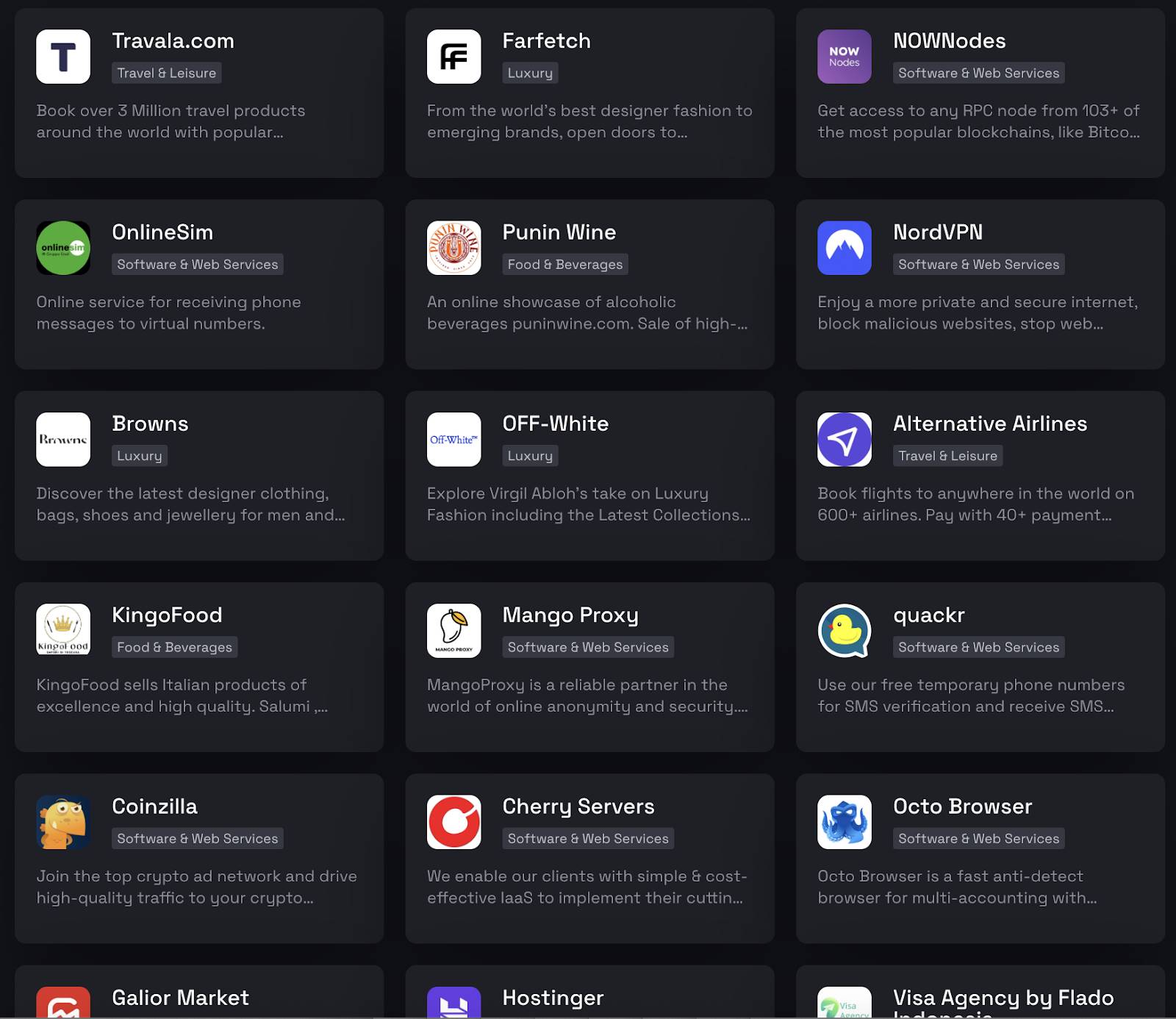
For example, luxury shopping platform Farfetch, fashion brand MAINLESS, virtual number service Onlinesim, and travel platform Travala are among dozens of well-known platforms now accepting BNB and other cryptocurrencies, enabling online purchases with near “Web2-like” ease.
More notably, BNB is deeply penetrating financial use cases.
Beyond RWA, BNB Chain has built a robust stablecoin ecosystem, including established players like FDUSD, TUSD, USDT, and USDC.
In 2025, the Trump family’s crypto project World Liberty deployed its stablecoin USD1 on BNB Chain, with over 90% of its supply now on BNB Chain and liquidity pools established on platforms like PancakeSwap—making BNB Chain the central hub for USD1’s ecosystem.
This stablecoin infrastructure not only fuels DeFi liquidity but also enables diverse combinations for on-chain payments, lending, clearing, and asset issuance.
With stablecoin liquidity as a base, BNB Chain’s Builder Support Program—including hackathons, the MVB (Most Valuable Builder) accelerator, and incubation funding—has attracted numerous DeFi, GameFi, and SocialFi projects to deploy first on BNB Chain, due to:
-
Mature stablecoin liquidity, simplifying the setup of lending pools, AMMs, and payment channels;
-
A low-fee, high-throughput environment ideal for financial-grade micropayments and rapid trading;
-
Early user acquisition support from BNB and partners, helping startups scale faster.
As the BNB team puts it:
“From Wall Street to Main Street, BNB Chain powers real users, real builders, and real results. Performance, fairness, and cost-efficiency — not just in theory, but in every block.”
This ability to be “usable by entrepreneurs and actually used by users” ensures BNB maintains strong ecosystem vitality—even during periods lacking flashy new narratives.
Looking back at BNB’s multiple growth paths, the underlying logic remains unchanged—using low-barrier on-chain interactions and abundant liquidity to serve more everyday users and unlock scalable expansion.
BNB: A Cross-Border New Species
BNB’s story is crossing the fixed boundaries of crypto assets.
From exchange token to public chain gas, from payment network to developer ecosystem, and now into real-world assets (RWA) and U.S. equities markets…
BNB is no longer just labeled a “platform token” or “public chain token.” It is evolving into a “cross-border financial infrastructure”—a new species bridging on-chain and off-chain worlds, serving both users and institutions, combining financial liquidity with public chain performance, and accepted by both traditional markets and decentralized ecosystems.
-
In centralized crypto, BNB is the core asset of the Binance ecosystem, used for trading fee discounts, Launchpool participation, airdrops, and more—anchored to the largest exchange’s liquidity and user base;
-
In decentralized on-chain environments, BNB is the Gas Token for BNB Chain, powering DeFi, payments, gaming, and RWA applications. Its low-cost, high-efficiency network makes it the preferred choice for builders and project deployment;
-
In the real world, with RWA and compliant finance projects like xStocks, Ondo, and USD1 coming online, BNB is becoming an “anchor” for mapping traditional financial assets, with some U.S. companies now adopting BNB as a reserve asset.
This makes BNB one of the few assets capable of capturing value simultaneously from centralized finance, on-chain infrastructure, and real-world asset bridging potential—a true “hybrid asset.”
Thus, BNB not only meets institutional demand for compliant entry but also supports developers building liquidity networks, seamlessly maintaining narrative control across centralized and decentralized domains.
This may be the true significance of BNB as a “new species”—
From Wall Street to Main Street,
beyond Bitcoin’s value storage and Ethereum’s smart contracts,
BNB is carving out a new path defined by “usability + financial attributes + user scale.”
Join TechFlow official community to stay tuned
Telegram:https://t.me/TechFlowDaily
X (Twitter):https://x.com/TechFlowPost
X (Twitter) EN:https://x.com/BlockFlow_News
 深潮TechFlow


