Huobi Growth Academy | In-depth Report on Stock Tokenization: Unlocking the Second Growth Curve of the Bull Market
TechFlow Selected TechFlow Selected
Huobi Growth Academy | In-depth Report on Stock Tokenization: Unlocking the Second Growth Curve of the Bull Market
For the crypto industry, this could be a generational leap that brings trillion-dollar asset pools on-chain.
 Navigating Web3 tides with focused insights
1. Introduction and Background
Over the past year, the concept of tokenizing real-world assets (RWA) has gradually moved from a fringe narrative in fintech into the mainstream spotlight of the crypto market. Whether it's the widespread application of stablecoins in payments and clearing, or the rapid growth of on-chain government bonds and bill products, "bringing traditional assets on-chain" has shifted from an idealistic vision to a real-world experiment. Within this trend, stock tokenization—often referred to as "tokenized U.S. stocks"—has emerged as one of the most controversial yet promising tracks. It carries not only the ambition to transform liquidity and trading efficiency in traditional securities markets but also challenges regulatory boundaries and opens up cross-market arbitrage opportunities. For the crypto industry, this could represent a generational leap that brings trillions of dollars in assets onto blockchain networks; for traditional finance, it resembles an "unauthorized" technological breakthrough—one that promises efficiency gains while simultaneously provoking governance conflicts.
2. Market Status & Key Pathways
Although "tokenization" has become one of the most important mid-to-long-term narratives in the crypto space, progress in applying it specifically to equities remains slow and highly fragmented. Unlike standardized assets such as government bonds, short-term bills, or gold, stock tokenization involves more complex legal ownership issues, settlement timing, voting rights design, and dividend distribution mechanisms. As a result, existing market offerings differ significantly in their compliance frameworks, financial structures, and on-chain implementation approaches.
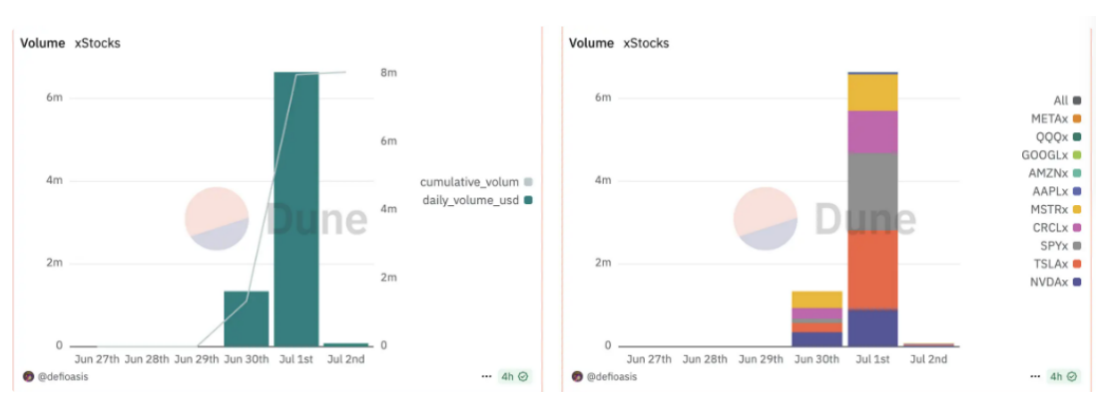
One of the earliest projects to achieve tangible results in this domain is Backed Finance. This Switzerland-based fintech firm partners with regulated securities custodians to issue ERC-20 tokens backed by real stocks and ETFs, aiming to build an "on-chain bridge for securities." A notable example is its wbCOIN product, which claims a 1:1 peg with Coinbase’s actual Nasdaq-listed shares and is redeemable through custodians Alpaca Securities and InCore Bank, theoretically enabling a closed-loop mechanism of "subscription–holding–redemption." Backed has also launched tokens linked to NVIDIA (BNVDA), Tesla (BTESLA), and S&P 500 ETF (BSPY), using chains like Base and Polygon as circulation layers, providing investors with on-chain access. However, there remains a significant gap between theory and reality. As of March 2025, the total TVL across all of Backed’s stock token products had not exceeded $10 million, with wbCOIN averaging less than $4,000 in daily trading volume—often recording near-zero activity. This stems from multiple factors: early users' uncertainty about redemption processes, DeFi ecosystems’ failure to integrate these tokens effectively, and some on-chain market makers’ belief that such assets lack long-term liquidity prospects. Even when asset mapping and custody are technically sound, insufficient trading depth, use cases, and user awareness can leave tokenized U.S. stocks stuck in a "compliant but inactive" state.
In contrast, Robinhood’s approach to tokenization is more conservative but systematically robust. As a platform that has cautiously expanded into crypto, Robinhood chose to launch regulated stock derivative tokens in the EU—products that do not directly represent ownership of underlying stocks but instead track prices under the EU’s MTF (Multilateral Trading Facility) license framework. The model closely resembles traditional CFDs (Contracts for Difference), where traders hold price exposure rather than actual equity. While sacrificing the purity of “1:1 on-chain stock anchoring,” this structure greatly reduces regulatory friction and custody complexity, achieving a compromise: “non-securities, yet tradable.” Robinhood offers full UI support, fractional shares, dividend distributions, and leverage settings, safeguarding user rights via its own custodial account system. More importantly, its planned Layer-2 network (tentatively named Robinhood Chain) indicates an intent to embed tokenized stocks natively within its wallet and crypto exchange through an “app chain” model. This top-down, closed-loop ecosystem may be more accessible to new users, but limits asset interoperability and still restricts trading hours to European market schedules, lacking true on-chain nativeness.
In comparison, Kraken’s xStocks ecosystem—with partner support—offers another alternative. Built on Solana and leveraging Backed for asset tokenization, xStocks structurally bypasses U.S. regulation by targeting non-U.S. global markets. Its defining feature is the “DeFi-ification” of trading: tokens trade 24/7, support T+0 settlement, on-chain swaps, and stablecoin market making, with theoretical integration into existing DeFi primitives such as lending, perpetual contracts, and cross-chain liquidity bridges. xStocks aims to pool liquidity via on-chain pools and has established initial connections with native Solana DEXs like Orca and Jupiter. This on-chain-native, globally distributed, composable architecture represents the “endgame vision” for tokenized stocks—not merely replicating price exposure, but creating a hybrid market fusing traditional finance with crypto infrastructure. Yet xStocks still faces major hurdles: limited user reach, KYC requirements for redemption, and unproven cross-border legal enforceability of custody arrangements. Despite meeting “crypto-native” standards in experience and mechanics, it lacks scale in user base and on-chain liquidity, remaining far from mainstream adoption.
The divergent strategies of these three players highlight the absence of a unified standard in stock tokenization. Each path reflects distinct advantages shaped by regulatory environments and ecosystem resources: Robinhood emphasizes “regulated traditional trading wrapped in crypto,” Backed focuses on “on-chain contracts mirroring real assets,” while Kraken leans toward “building a crypto-native liquidity market.” These differences underscore a typical trait of immature markets: no single player fully balances compliance, asset fidelity, and user demand. Only time and market feedback will determine which models survive and scale.
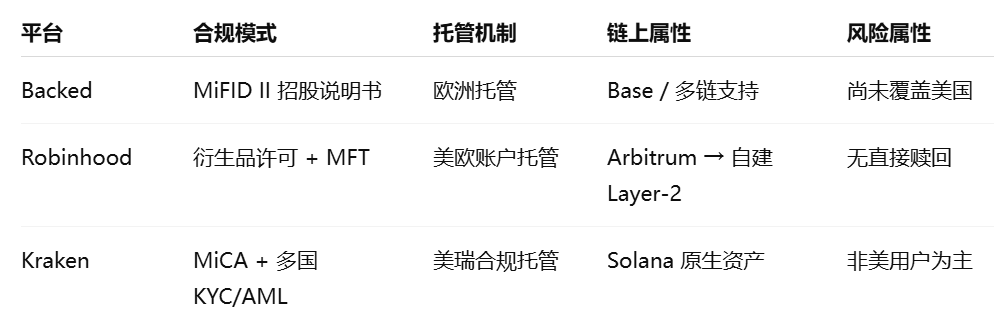
Tokenized stocks remain in a very early experimental phase. While theoretically viable, their on-chain activity and financial efficiency fall well short of expectations. Future success hinges not just on product design, but on convergence around three key elements: first, attracting genuine liquidity providers to establish effective price discovery; second, deeper integration with diverse DeFi applications to expand utility; third, clearer regulatory guardrails that give platforms confidence to broaden services—especially to U.S. users. Until these paths converge, tokenized stocks remain a high-potential financial experiment, not a near-term engine for bullish momentum.
3. Compliance Mechanisms and Implementation Capacity
In every discussion about tokenized stocks, regulation looms as the sword of Damocles. Stocks are among the most heavily regulated financial assets, with issuance, trading, custody, and clearing strictly governed by jurisdictional laws. In traditional finance, securities must either register or qualify for exemptions to be legally sold, and trading venues require exchange or ATS (Alternative Trading System) licenses. Reconstructing these instruments as “on-chain assets” demands not only technical mapping but also clear, enforceable compliance pathways. Without them, even elegant designs risk being confined to limited use, barred from reaching qualified investors—or worse, facing accusations of illegal securities offerings. Project choices here vary sharply, ultimately determining whether they can achieve scalable deployment.
Backed Finance exemplifies a compliance path closest to “traditional securities logic.” Its stock tokens are classified under Swiss regulations as Restricted Securities, meaning buyers must pass KYC/AML checks, agree not to sell to U.S. investors, and face secondary market restrictions limiting trades to qualified investors only. While this approach avoids crossing SEC red lines and ensures relative regulatory safety, it severely limits free trading on public blockchains. A more pressing challenge is that each token transfer requires compliance validation, drastically reducing composability with DeFi protocols. Thus, despite successfully linking tokens to real stocks via InCore Bank and Alpaca Securities, Backed operates within a “regulatory sandbox”—a closed ecosystem unable to support high-frequency trading, collateralization, or leveraged applications in open finance.
Robinhood takes a more sophisticated compliance route. Its tokenized stock products aren't direct equity representations but rather “security derivatives” built under the EU’s MiFID II framework—technically akin to CFDs—supported by regulated subsidiaries for pricing, custody, and clearing. This structure allows Robinhood to avoid direct liability for holding stocks and sidestep delivery obligations, enabling product launches without a full securities license. The advantage lies in high compliance certainty, fast listing of new assets, and leveraging its existing user base. But the cost is reduced programmability and openness: these tokens cannot integrate into native on-chain financial protocols. Fundamentally, this “platform custody + derivative tracking” model remains CeFi (centralized finance), with issuance and settlement entirely internalized. User trust depends on faith in Robinhood’s platform, not decentralized, verifiable on-chain custody.
Kraken and xStocks represent a more radical, purist compliance strategy. While Backed provides the tokenization technology, xStocks adopts a “self-governed on-chain + global non-U.S. access” gray-zone approach. Specifically, it leverages Swiss legal exemptions for “restricted securities” and private placements to offer tokens globally outside the U.S., while using smart contracts to block access from U.S. IP addresses. This avoids direct scrutiny from the SEC and FINRA over securities issuance and exchange operations, while preserving free on-chain circulation and compatibility with DeFi modules like lending, AMM market making, and cross-chain bridges—enabling a relatively complete financial loop. However, the model’s vulnerability lies in its reliance on technical isolation of “non-U.S. identity.” If large-scale circumvention occurs, regulators could deem it “offering illegal securities to U.S. investors,” triggering enforcement actions. Moreover, U.S. authorities often assess “de facto market participation” based on investor behavior and nationality—not just technical barriers—meaning Kraken could still face audits or sanctions despite best efforts.
At a macro level, none of the current approaches—by Backed, Robinhood, or Kraken—achieve truly global compliance. Instead, they rely on “regional arbitrage and operation within legal gray zones.” This fragmentation stems from differing global definitions of what constitutes a security. For instance, the U.S. SEC treats any token pegged to real equity value as a security, requiring Howey Test compliance or Reg A/D exemptions. The EU is more lenient, permitting certain derivative-based tokens under MTF or DLT Pilot Regime frameworks. Countries like Switzerland and Liechtenstein attract innovators with sandbox regimes and dual registration systems. This regulatory patchwork creates vast arbitrage opportunities, resulting in a landscape of “regionally compliant, globally gray” tokenized stocks.
For stock tokenization to scale, breakthroughs in three areas are essential. First, harmonized regulatory recognition and standardized exemption channels—like EU MiCA, UK FCA sandboxes, or Hong Kong VASP rules—are needed to create replicable, legal templates for tokenized securities. Second, on-chain infrastructure must natively support compliance tools—KYC modules, whitelisted transfers, auditable trails—so compliant tokens can integrate into DeFi rather than remain isolated liquidity silos. Third, institutional participation is crucial: collaboration with custodian banks, auditors, and broker-dealers is required to ensure asset authenticity and redemption credibility.
In essence, compliance is not ancillary to stock tokenization—it is the decisive factor. No matter how decentralized a project appears, its foundation rests on whether real-world assets are credibly mapped. And at the core of that lies a fundamental question: can legal systems accept this new paradigm? Therefore, studying tokenized stocks demands more than admiration for technical innovation; it requires understanding the boundaries and compromises of institutional evolution—finding a viable middle ground between regulatory reality and on-chain ideals.
4. Market Analysis and Future Outlook
The global RWA (real-world asset) on-chain market totals approximately $17.8 billion, with stock assets amounting to just $15.43 million—only 0.09% of the total. However, tokenized stocks have grown over threefold in six months, rising from $50 million in July 2024 to ~$150 million by March 2025.
Reassessing the actual performance of tokenized stocks reveals strong conceptual appeal but steep practical barriers. Theoretically, stock tokenization offers clear structural benefits: it maps high-value, widely recognized real-world assets onto blockchains, bringing real-world credit anchors to crypto ecosystems. Simultaneously, it enables automated trading and instant settlement via smart contracts, overturning the traditional reliance on centralized clearinghouses and T+2 cycles, unlocking massive system efficiency. Yet in practice, these advantages have not translated into widespread adoption. Instead, the sector remains stuck in an awkward state of “mechanism works, use cases missing, liquidity dry.” This forces us to ask: what is the true growth engine for tokenized stocks? Can they evolve into core crypto financial assets like stablecoins or on-chain bonds?
Structurally, the primary value of stock tokenization lies in “connecting traditional and on-chain markets.” But real demand must come from three user groups: retail investors seeking low-barrier access to global equities without traditional intermediaries; high-net-worth individuals and gray capital looking to bypass capital controls or time zone limitations; and DeFi protocols and market makers pursuing arbitrage or structured returns. Together, these groups define the “potential market” for tokenized stocks—but none have entered at scale. Retail users often lack on-chain experience and distrust redemption mechanisms; HNWIs remain uncertain about privacy and risk mitigation; and DeFi protocols prefer building around volatile, liquid assets like stablecoins and derivatives, showing little interest in low-volatility stocks. This reflects a classic market misalignment: “financial assets want on-chain presence, but on-chain users aren’t ready to embrace them.”
Still, turning points may emerge from several trends. First, the rise of stablecoins provides a solid monetary foundation for trading and settling tokenized stocks. With USDC, USDT, and PYUSD acting as “digital dollars” in on-chain liquidity, stock tokens gain a universal counterparty asset. This enables U.S. stock-related trading without relying on traditional banking rails, lowering entry barriers and capital-switching costs—particularly vital for users in developing countries. Second, maturing DeFi protocols are increasingly capable of integrating “on-chain traditional assets.” As tokenized treasuries and money funds emerge, market acceptance of “non-crypto-native” assets has risen significantly. Stocks are the next logical candidate for standardization. If future platforms offer portfolios combining “stocks + bonds + stablecoins,” they could attract institutional users and potentially evolve into on-chain ETFs or index funds resembling traditional brokers.
Another critical variable is the explosion of L2 and appchain ecosystems. As Ethereum layer-2 networks like Arbitrum, Base, Scroll, and ZKSync grow their user bases, and high-performance chains like Solana, Sei, and Sui enhance financial nativeness, stock tokens are no longer confined to isolated issuance platforms. They can now deploy directly on chains with deep liquidity and developer activity. For example, if Robinhood’s Robinhood Chain successfully integrates its hundreds of millions of users’ trading data and capital flows—combined with compliant wallet setups and KYC-enabled custody tools—it could theoretically build a hybrid financial model blending “centralized UX with on-chain asset architecture,” boosting usage frequency and financial complexity. Similarly, projects like xStocks on Solana may gain structural advantages in arbitrage, perpetuals, and dollar-cost averaging due to high throughput and low fees.
From a macro-financial perspective, stock tokenization arrives at a pivotal moment when global capital and crypto markets are beginning to converge. With spot Bitcoin ETFs approved and RWA becoming a strategic focus for traditional institutions, crypto is shifting from an “island economy” to a “globally compatible asset system.” In this context, stocks are a symbolic bridge. When investors seek more flexible, efficient, 24/7 cross-border allocation tools, tokenized “U.S. stocks” could become central conduits for global capital flow. This explains why traditional asset managers like Franklin Templeton and BlackRock are actively exploring security tokens and on-chain investment funds—to position themselves ahead of structural market shifts.
That said, short-term constraints remain: scarce liquidity, high user education costs, regulatory uncertainty, and elevated trust requirements in asset mapping. Most critically, no dominant leader has emerged—a “killer app” equivalent to USDC, WBTC, or sDAI that becomes a foundational protocol component. The market remains in exploration mode, with each project tackling compliance and usability differently, but standardization and scale will require time and patience.
Yet precisely because of this, stock tokenization may be at a “severely underestimated early inflection point.” It doesn’t serve a direct monetary function like stablecoins, nor does it enjoy native network effects like ETH or BTC. But its ability to “map the real world on-chain” is becoming a critical puzzle piece connecting two systems. The most impactful future projects may not be new assets, but “compliance-integrated platforms” capable of unifying asset custody, trade matching, KYC verification, on-chain composition, and off-chain settlement. Their goal won’t be to replace traditional brokers, but to act as a “Web3 compatibility layer” for the global financial system. Once such platforms achieve sufficient user scale and infrastructure maturity, tokenized stocks will cease to be mere narratives and become core components of the on-chain capital market.
5. Conclusion and Recommendations
Reviewing the development trajectory of stock tokenization reveals a classic pattern: “technology leads, compliance lags, markets wait.” This isn’t novel or technically inscrutable—the core idea of mapping real stocks onto blockchain to enable global, 24/7 tradability and composability is well-understood and logically sound in both financial and technical terms. The real challenge isn’t feasibility, but finding a viable path for this mechanism to take root and grow amid complex regulatory landscapes, entrenched financial infrastructure, and market inertia. In other words, the reason stock tokenization hasn’t exploded isn’t that it isn’t “good enough,” but that it isn’t yet “mature enough,” “usable enough,” or aligned with a strategic window where policy and demand converge.
But this is quietly changing. On one hand, traditional finance is rapidly embracing blockchain: from BlackRock’s on-chain funds, JPMorgan’s settlement networks, to BlackRock-led RWA infrastructure on Ethereum—all signal a clear message: real-world assets are going on-chain, and future financial infrastructure won’t be a binary choice between “traditional vs. crypto,” but a fused middle ground. In this shift, stocks—as one of the most mature real-world assets—naturally stand out for their on-chain mapping value. On the other hand, the native crypto ecosystem is evolving from pure speculation to structural development. With stablecoins, lending protocols, on-chain treasuries, and ETF experiments, users now demand higher standards in “stability, liquidity, and compliance.” Stocks fit perfectly here—representing real-world credibility while being composable via tokenization into smart contracts and DeFi, serving as vital portfolio components.
Therefore, stock tokenization is not just an “interesting story,” but a mid-to-long-term opportunity grounded in real demand, policy maneuvering, and technical feasibility. For industry practitioners, several strategic directions are clear.
First, projects entering this space must prioritize “compliance pathway design” over technical innovation or UX optimization. The ventures with real scaling potential will be those building legally valid issuance and trading frameworks in favorable jurisdictions—Switzerland, the EU, UAE, Hong Kong. Technology is the prerequisite, but institutions define the boundaries—compliance is the moat.
Second, asset tokenization is fundamentally “infrastructure-level asset issuance.” Its value doesn’t hinge on whether a particular stock is popular, but on whether the entire system can plug into broader DeFi protocols and become a standard component. Tokenized stock projects must proactively integrate with DeFi to enable products like “rTSLA collateral loans,” “aAAPL perpetuals,” or “SPY ETF token restaking.” Without such composability, even compliant, well-custodied tokens will remain low-frequency “conceptual tools.”
Third, user education and product packaging are equally vital. On-chain stock trading must move beyond the current “only experts need apply” model. Projects should learn from Robinhood, eToro, or Interactive Brokers—adopting familiar UIs, simplified workflows, and visualized returns to minimize entry barriers and onboard traditional investors. For average users, the appeal lies in buying a share of AAPL via a wallet—not in understanding whether the custody relies on a CSD.
Fourth, proactive policy engagement and regulatory dialogue are essential—especially in RWA-innovative regions like Hong Kong, Abu Dhabi, and London. Industry self-regulation, technical standards, and pilot sandboxes must be championed. The ultimate success of stock tokenization depends not on building ever more complex wrappers, but on convincing policymakers it’s a “controllable, incremental, beneficial financial innovation,” not another disruptive assault on the existing order.
In sum, stock tokenization is a deeply tensioned proposition. It links the oldest financial assets with the newest technological paradigms, embodying a collective desire for “freer capital flows” and “restructured financial infrastructure.” In the short term, it remains a marathon of regulation, awareness, and trust. But long-term, it may become the “third pillar” of on-chain finance—after stablecoins and on-chain treasuries. This isn’t a hype cycle, but deep water—an area truly worth a 3–5 year commitment. If the next bull market is built on “on-chain real economies,” then tokenized stocks may well be the most concrete, valuable, and contested breakthrough point.
For investors and institutions, we recommend considering the following short-, medium-, and long-term factors:
Short-term: Focus on product launches, TVL, market-making mechanisms, on-chain trading data, and regulatory developments (e.g., MiCA, SEC guidance).
Medium-term: Assess whether platforms add perpetual contracts, leverage features, DeFi integrations, and evaluate on-chain metrics like funding costs and liquidity efficiency.
Long-term: Monitor whether U.S. users gain trading access, how T+0 settlement integrates with compliance, and observe capital reallocation trends between on-chain funds, altcoins, and new asset classes.
In conclusion, tokenized U.S. stocks represent a “critical experiment” in the structural evolution of crypto markets. Though trading volumes remain subdued, foundational layers are being built for the next bull cycle. Should compliance openness, on-chain depth, and mechanism innovation converge, this “old wine in new bottles” could become the true engine driving the next wave of crypto market growth.
Join TechFlow official community to stay tuned
Telegram:https://t.me/TechFlowDaily
X (Twitter):https://x.com/TechFlowPost
X (Twitter) EN:https://x.com/BlockFlow_News
 @HTXAcademy