








GENIUS Bill Passed: How Should We Cautiously Approach the Stablecoin Narrative?
TechFlow Selected TechFlow Selected
GENIUS Bill Passed: How Should We Cautiously Approach the Stablecoin Narrative?
Stablecoins in the context of policy expansion are no longer purely a "Web3" narrative.
 Navigating Web3 tides with focused insights
Author: imToken
In the early hours of today, Beijing time, the U.S. House of Representatives passed three crypto-related legislative bills: the CLARITY Act, the GENIUS Act, and the Anti-CBDC Surveillance State Act. Among them, the GENIUS Act is expected to be signed into law by Trump on Friday local time.
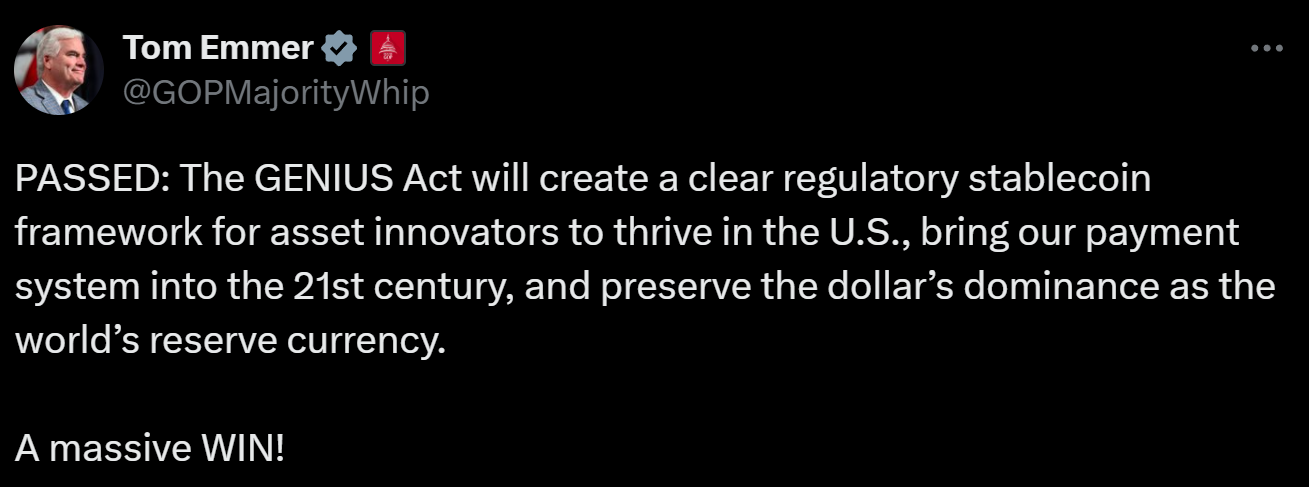
This marks not only the first time the U.S. has established a national regulatory framework for stablecoins, but also sends a clear signal that stablecoins are moving out of the gray zone and approaching the periphery of mainstream financial systems. Meanwhile, major financial centers such as Hong Kong, China, and the European Union are accelerating their pace, ushering in a reshaping of the global stablecoin landscape.
Looking back over recent months, we can see that stablecoins have almost overnight transformed from financial variables under regulatory scrutiny into newly recognized infrastructure. What exactly has happened behind this shift? Who is driving stablecoins to become new leading players on the global financial stage? And how should we rationally understand this wave of enthusiasm?
From Web3 Narrative to National Strategy: Who Is Driving This?
From the beginning of the year to now, stablecoins have undoubtedly risen to become a focal point in global financial policy and discourse.
But this surge is neither accidental nor simply the result of natural technological evolution—it is a structural shift driven primarily by policy forces, with the policy reversal during the Trump era playing a highly disruptive "catfish role."
On one hand, Trump has consistently opposed central bank digital currencies (CBDCs) and clearly supports a market-led path toward digital dollarization; on the other, from endorsing USD1 launched by his family business to pushing for and soon signing the GENIUS Act, Trump is actively fulfilling his campaign promise to loosen regulations on the crypto market.
These signals have directly forced global regulators to re-evaluate stablecoins. Within just a few months, stablecoins have shifted from a niche topic within the crypto community to a key issue at the national strategic level. Besides Hong Kong, China setting a timeline for implementing its Stablecoin Ordinance, major global economies have begun simultaneously considering—and accelerating—the establishment of clear compliance frameworks for stablecoins:
-
The EU’s MiCA Regulation (Markets in Crypto-Assets), effective since 2024, comprehensively covers the compliant regulation of crypto assets and provides detailed classifications for stablecoins;
-
In South Korea, the ruling party led by President Lee Jae-myung proposed the Digital Asset Basic Act, which explicitly states that any Korean company with at least 500 million KRW (approximately $370,000) in capital and sufficient reserves to guarantee redemptions may issue stablecoins;
Objectively speaking, the passage of the GENIUS Act is not merely a deregulation move by the U.S. toward stablecoins, but also a clear choice regarding the digital dollar path—abandoning central bank digital currencies (CBDCs) in favor of supporting compliant, privately issued dollar-backed stablecoins.
It is foreseeable that the U.S. stance will serve as a reference model for regulatory designs in other countries, pushing stablecoins into the universal discussion framework of global financial policy.
The Path of Stablecoins Is Changing
Over the past few years, the stablecoin market has long been dominated by Tether (USDT) and Circle (USDC), representing two distinct paths: “circulation efficiency” versus “compliance and transparency”:
-
USDT focuses on cross-platform circulation and matching efficiency, dominating exchanges and gray settlement networks;
-
USDC emphasizes asset compliance and transparency, targeting regulation-friendly scenarios and institutional client systems;
In terms of overall scale, stablecoins have maintained growth since 2025—according to CoinGecko data, as of July 18, the total market cap of all stablecoins reached approximately $262 billion, an increase of over 20% compared to the start of the year.
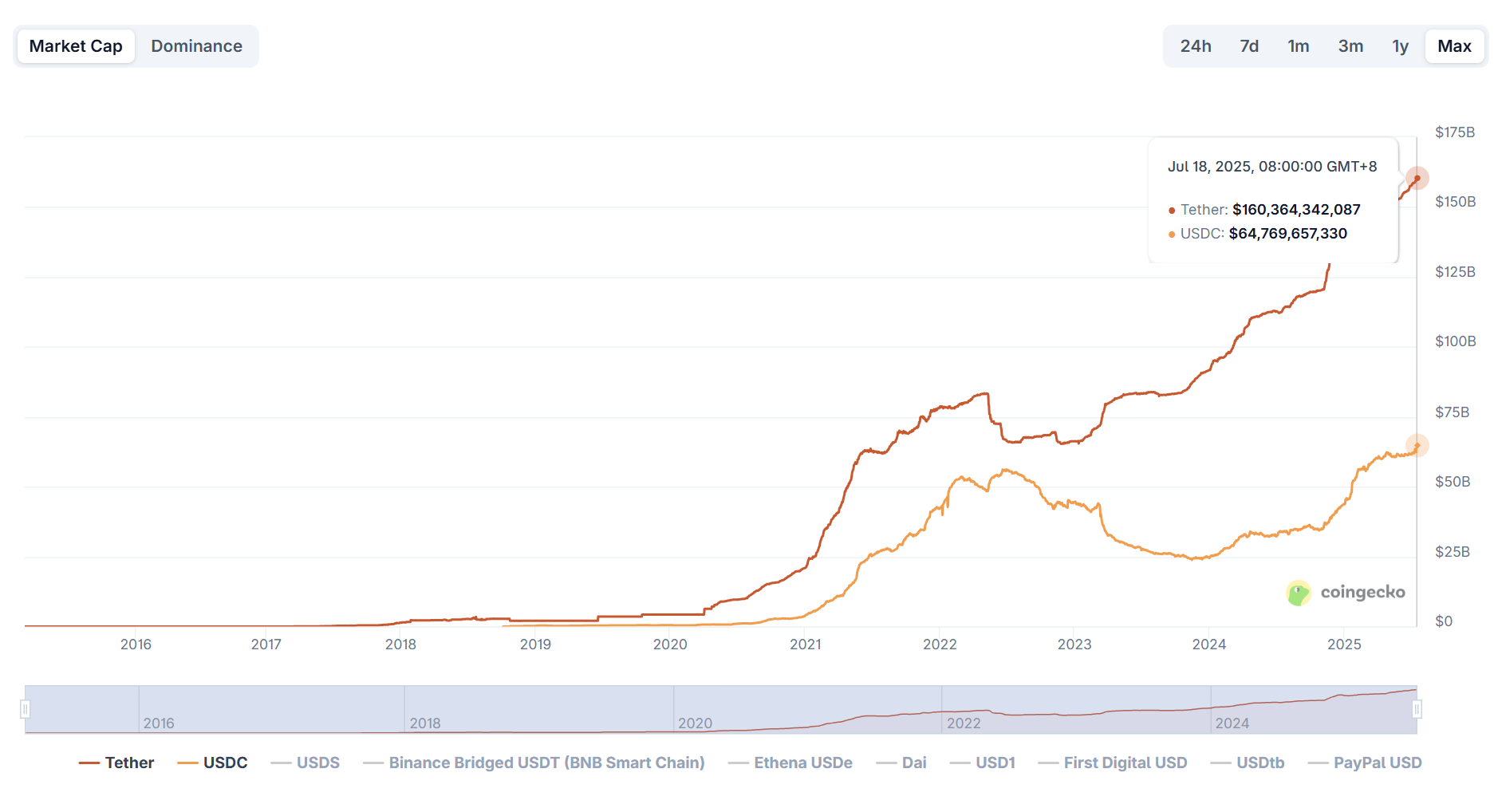
This means that amid the recovery of the crypto market, stablecoins remain the most critical "liquidity gateway," with the duopoly of USDT and USDC still solid—USDT’s market cap exceeds $160 billion, accounting for over 60%; USDC remains around $65 billion, about 25%, together making up nearly 90% of the total share.
Since 2024, more and more Web2 financial companies and traditional capital players have entered the space, using stablecoins to build on-chain settlement tools. For example, PayPal's PYUSD and the newly politically backed USD1 represent two notable signals:
PYUSD (PayPal USD), launched by payment giant PayPal, naturally possesses cross-border settlement capabilities and a global merchant network; USD1 aims at compliant on/off-ramping and cross-border operations, supported by political and business resources endorsed by Trump, entering enterprise settlement use cases.
It can be said that with institutional and national backing, these emerging stablecoin projects are transforming stablecoins from mere "Web3 liquidity tools" into value bridges connecting Web3 and the real-world economy, expanding their applications beyond exchanges and wallets into diverse areas such as supply chain finance, cross-border trade, freelancer payments, and OTC scenarios.
Beneath the Frenzy: Where Lies the Real Challenge for Stablecoins?
However, objectively speaking, while the GENIUS Act grants stablecoins formal recognition, it also brings stricter compliance requirements, setting clearer rule boundaries for their development.
For instance, issuers must comply with KYC/AML regulations, funds must be held in segregated custody and subject to third-party audits, and there could even be caps on issuance volume or usage restrictions under extreme circumstances. This means stablecoins gain legitimacy but formally enter the role of "regulated currency."
From this perspective, whether stablecoins can break free from the application limitations tied to the Web3 label will be key to achieving incremental adoption. Indeed, the greatest growth potential for stablecoins does not lie within the crypto ecosystem itself, but in the broader Web2 and global real economy.
Just like how the main sources of growth for USDT and USDC are no longer on-chain users, but rather small and medium-sized enterprises and individual merchants with strong cross-border settlement needs, emerging markets and financially underserved regions excluded from the SWIFT network, residents in inflation-hit countries seeking to escape local currency volatility, and content creators and freelancers unable to access PayPal or Stripe.
In other words, their biggest future growth lies not in Web3, but in Web2—the true killer application for stablecoins is not the "next DeFi protocol," but the "replacement of traditional dollar accounts."
This also implies that once stablecoins become foundational carriers of digital dollars globally, they will inevitably touch sensitive nerves related to monetary sovereignty, financial sanctions, and geopolitical order.
Therefore, the next phase of stablecoin growth will inevitably be closely tied to the new map of dollar globalization, becoming a new battleground among governments, international institutions, and financial giants.
Final Thoughts
The essence of currency issuance has always been an extension of power, relying not just on asset reserves and clearing efficiency, but also on state credit, regulatory authorization, and international standing.
Stablecoins are no exception. To truly penetrate the real economy from the crypto world, market mechanisms or business logic alone are ultimately insufficient. Thus, while the global policy shift in 2025 providing regulatory support is undoubtedly a major driver pushing stablecoins into the mainstream, it also means they must survive within increasingly complex strategic games.
This is a long-cycle game, and we are right at the beginning of it.
Join TechFlow official community to stay tuned
Telegram:https://t.me/TechFlowDaily
X (Twitter):https://x.com/TechFlowPost
X (Twitter) EN:https://x.com/BlockFlow_News
 @imTokenOfficial


