Finding Promising Crypto-Related U.S. Stocks: How Did Cango Leap from an Auto Company to the World's Second-Largest Bitcoin Miner?
TechFlow Selected TechFlow Selected
Finding Promising Crypto-Related U.S. Stocks: How Did Cango Leap from an Auto Company to the World's Second-Largest Bitcoin Miner?
Cango currently has a computing power of 50 EH/s and plans to become the world's largest mining company by the end of this year.
 Navigating Web3 tides with focused insights
Author: Golem, Odaily Planet Daily
Who would have thought that traditional finance and the crypto industry—once seen as oil and water—have entered a honeymoon phase over the past two months? On one hand, tokenization of traditional stocks is accelerating. Compliant platforms like Robinhood and Coinbase are jumping in, and on-chain U.S. stock platforms are sprouting up like mushrooms after rain. Crypto investors may soon need to shift from "trading altcoins" to "trading U.S. stocks."
On the other hand, the current crypto bull market is playing out on Wall Street. Announcements by listed companies about holding crypto treasuries, crypto firms going public in the U.S., or traditional companies pivoting into crypto consistently drive stock price surges. "The U.S. stock market is willing to pay over $2 for every $1 worth of crypto assets," Bloomberg columnist Matt Levine remarked, describing Wall Street's frenzy for crypto-related stocks.
Yet, whether for crypto investors or U.S. stock investors, one thing is now clear: identifying high-potential crypto-linked U.S.-listed stocks has become paramount. This structural bull market for crypto-themed U.S. stocks is only just beginning. Market attention remains focused on short-term trends such as "well-known U.S. stocks" and "public companies with crypto treasuries," while those truly compliant, rising U.S.-listed firms actively building real crypto businesses remain largely under the radar.
In this article, Odaily Planet Daily will spotlight a U.S.-listed company that transformed from an auto services provider into the world’s second-largest Bitcoin mining firm—Cango Inc. As Robinhood CEO Vlad Tenev said at a launch event in Cannes, the world capital of cinema: "It’s time to move from Bitcoin and meme coins to real-world assets with actual utility."
Cango Inc. is that golden nugget buried beneath the surface. Let’s unearth it together.
1. A Bold Transformation, But Cango Means Business
Cango Inc. (NYSE: CANG) was founded in 2010 and successfully listed on the New York Stock Exchange in 2018. Originally deeply rooted in the automotive sector, Cango ventured into auto financing, vehicle trading, and even new-energy vehicle manufacturing, once making strategic investments in Li Auto. However, in November 2024, this established automotive player announced a full pivot into the crypto industry, focusing on Bitcoin mining, retaining only its online international used car export platform, AutoCango.com.
Today, Web2 companies entering crypto or announcing crypto treasury strategies are nothing new. For most, such moves are merely "market cap management"—a last-ditch effort to boost share prices before collapse, leveraging market hype. But when Cango announced its entry into crypto, the market was still gripped by the meme coin frenzy, and crypto-themed U.S. stocks were far from today’s investor favorites.
"Due to worsening credit conditions caused by the pandemic and economic downturn, Cango began systematically considering business transformation as early as 2022. We conducted thorough research across multiple directions—from auto finance to vehicle trading, new energy vehicles, and eventually computing power mining. While the shift appears massive from the outside, our internal journey has been logical and step-by-step," said Juliet Ye, Cango’s IR lead, discussing the company’s transition.
Becoming the World’s Second-Largest Miner, Aiming for No. 1 by Year-End
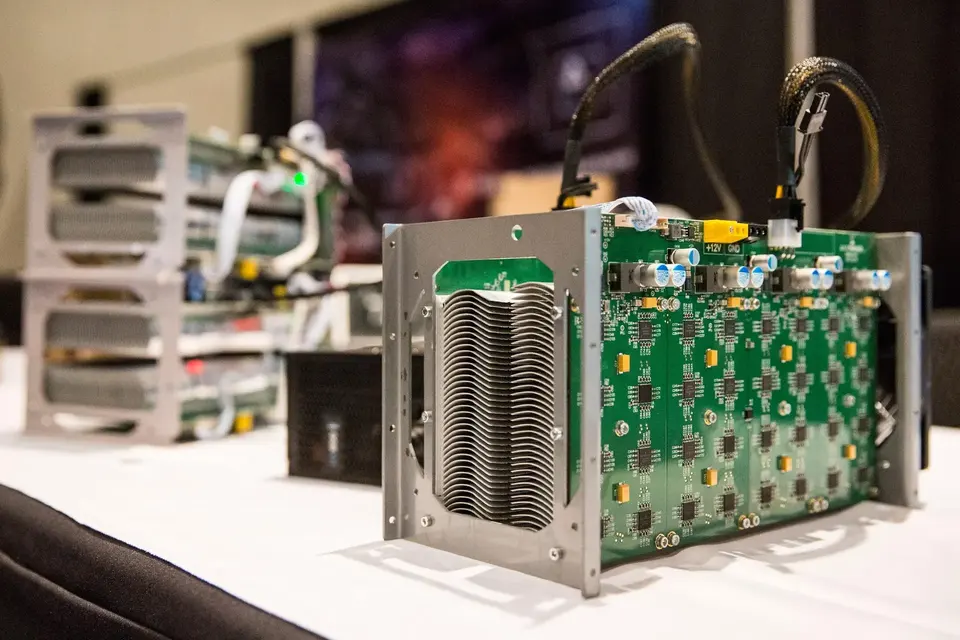
Cango’s move into Bitcoin mining has been nothing short of "cutting off its arm to survive"—a stark contrast to U.S. listed firms that dabble in crypto with minimal investment. On November 15, 2024, Cango acquired rack-mounted Bitcoin mining machines with a total hashrate of 32 EH/s from Bitmain for $256 million. Then, on June 27, 2025, it purchased another 18 EH/s of mining equipment from Golden TechGen in exchange for equity valued at $144 million. These acquisitions brought Cango’s total hashrate to 50 EH/s, instantly propelling it to the rank of the world’s second-largest mining firm, trailing only MARA Holdings (57.4 EH/s).
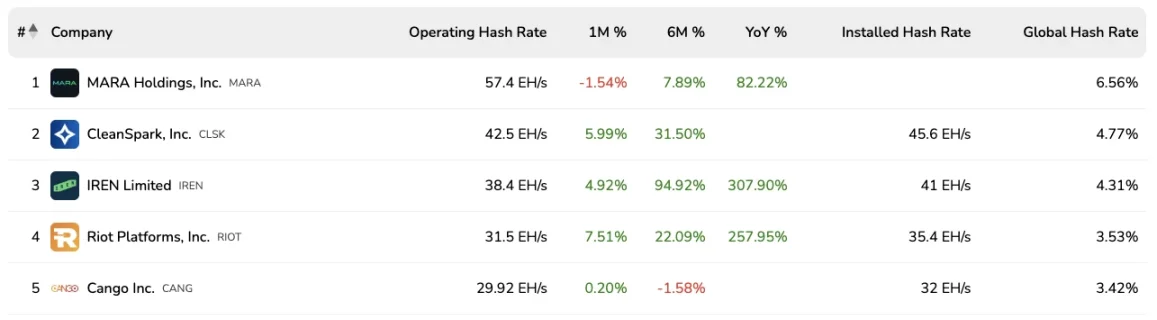
Before acquisition completion, Cango ranked fifth globally in hashrate (Source: BitcoinMiningStock)
"Our plan is to add another 10–15 EH/s by the end of 2025, aiming to become the global leader," Juliet Ye revealed to Odaily regarding Cango’s future mining strategy.
To better integrate into the Web3 ecosystem and steer strategic development, Cango also restructured its leadership. On May 27, the company announced the sale of its China operations to Ursalpha Digital Limited for approximately $351.94 million. Simultaneously, it overhauled its board: four of the original seven members stepped down, and two new directors were appointed—Lin Yanjun, founding partner of blockchain and AI investment advisory firm IN Capital, and Lu Haitian, professor of accounting and finance at Hong Kong Polytechnic University.
In terms of equity, following the 18 EH/s equity transaction, founders Zhang Xiaojun and Lin Jiayuan saw their combined stake drop to 18.54%, with voting rights falling to 12.07%. Golden GenTech now holds 19.85% of shares and 12.92% of voting rights. Meanwhile, another key stakeholder, Enduring Wealth, owns 2.82% of shares but commands a dominant 36.74% of voting power, effectively controlling the company. Enduring Wealth Capital, a Singapore-based financial planning and investment management firm, has partner Andrea Dal Mas, a long-time blockchain veteran.
From rapidly spending heavily to build mining advantages to bringing in seasoned Web3 professionals into decision-making roles, Cango completed its full transformation into a Bitcoin mining enterprise in less than a year—demonstrating not only determination but also a sense of urgency.
"We’re currently in this halving cycle—time is money. We aim to acquire as much Bitcoin as possible with minimal initial capital during this cycle, preparing to expand into the digital economy’s value chain in the next cycle," Juliet Ye explained to Odaily the strategic rationale behind Cango’s decision not to build its own mining farms and instead pivot quickly.
A New Type of Bitcoin Treasury Firm: Implementing a 'Mine-and-Hold' Strategy
For a Bitcoin mining company to publicly state its goal as "acquiring as much Bitcoin as possible" is novel to the market.
Mining firms have long occupied a love-hate relationship with investors. Miners are vital to Bitcoin’s network security, yet they also represent significant potential sell-side pressure. The "mine-sell-dump" model has long been standard operational practice, especially during bear markets or when prices approach miners’ "shutdown thresholds," exacerbating downward price pressure.
But unlike these conventional players, Cango explicitly announced a "mine-and-hold" strategy akin to a Bitcoin treasury approach—refraining from selling mined Bitcoin and instead holding it long-term.
According to Cango’s Q1 2025 earnings report, total revenue reached $145.2 million, with $144.2 million coming from BTC mining. Due to its "mine-and-hold" policy, Cango avoided dumping $144.2 million worth of Bitcoin onto the market in Q1 alone. As disclosed on June 27, Cango holds 3,809.1 BTC, valued at over $416 million. According to BitcoinTreasuries.net, Cango ranks 16th among public companies in Bitcoin holdings.
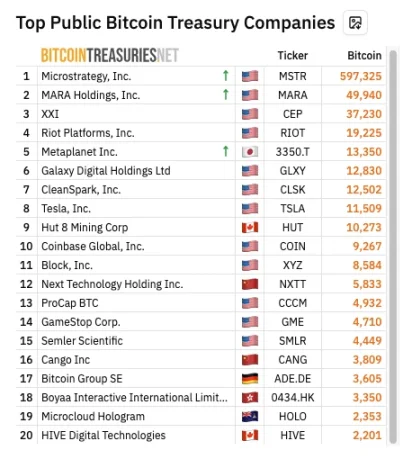
Ranking of public companies by disclosed Bitcoin holdings
The "mine-and-hold" strategy positions Cango as a new breed of Bitcoin treasury company—backed by real crypto operations and continuously accumulating Bitcoin. While it doesn’t create direct buy-side demand in the open market, it reduces supply-side sell pressure. With its current 50 EH/s hashrate, assuming total network hashrate at 900 EH/s, Cango could mine approximately 9,125 BTC annually—worth over $912 million. As Cango grows in hashrate and industry standing, this strategy may inspire imitation by other miners.
Of course, "mine-and-hold" doesn't mean never selling. "We don’t mechanically enforce 'never sell.' Instead, we’ve established a triple-trigger sell mechanism: first, if Bitcoin exceeds $150,000, we may gradually reduce holdings to lock in profits and reward shareholders; second, to meet liquidity needs—such as expanding hashrate or repaying debt—but we’ll prioritize borrowing against held Bitcoin; third, in response to black swan events. All scenarios are integrated into our dynamic risk control model," Juliet Ye clarified when asked about potential Bitcoin sales.
Additionally, because Cango acquires Bitcoin through mining, its cost basis is low. Per its Q1 2025 report, the average Bitcoin mining cost was $70,602.10—lower than Strategy’s average of $70,982 per BTC. Combined with $347 million in cash and equivalents, plus $351.94 million from divesting legacy businesses, Cango enjoys robust cash flow without needing to sell Bitcoin to sustain operations like many other miners.
2. Competitive Mining Operations and a Push Toward Green Energy
As a Web2 company, Cango is no longer young. But as a Bitcoin miner—entering the space in November 2024—it’s practically a newborn compared to other listed mining firms. Currently, Cango deploys its mining operations across North America, the Middle East, South America, and East Africa. Despite being new to Bitcoin mining, Cango already matches top-tier miners in areas beyond hashrate.
In Bitcoin holdings, Cango ranks sixth with 3,809.1 BTC, far behind MARA Holdings’ 49,940 BTC. However, given that Cango only began mining in November 2024, comparing total holdings alone is misleading. Before completing the 18 EH/s acquisition in Q1 2025, Cango operated over 136,000 rack-mounted miners with 32 EH/s of hashrate, placing it behind MARA Holding (54.3 EH/s), CleanSpark (42.4 EH/s), and Riot Platforms (33.7 EH/s), but ahead of Core Scientific (18 EH/s).
Yet, as shown below, in Q1 2025, Cango ranked third in daily average Bitcoin production and second in Bitcoin output per EH/s, showcasing leading efficiency among mining firms. With the completion of the 18 EH/s acquisition and infrastructure upgrades, Cango’s metrics are expected to improve further in Q2 2025.
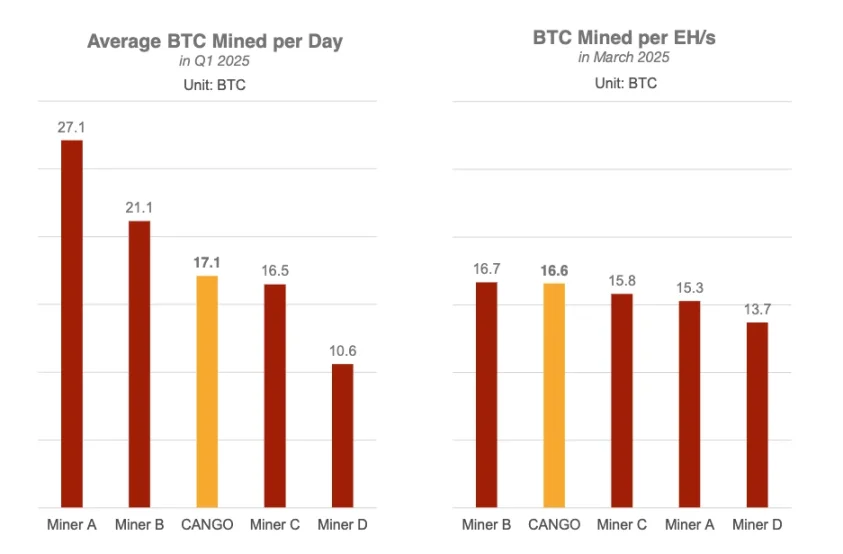
Q1 2025 comparison of daily average Bitcoin production and Bitcoin per EH/s (A, B, C, D represent MARA Holding, CleanSpark, Riot Platforms, and Core Scientific respectively)
Beyond efficiency and hashrate, Cango harbors bigger ambitions. "Actually, 'Energy + Computing Power' is our true transformation direction. Becoming the world’s top mining firm is one goal. On the energy front, Cango aims to deepen its green energy transition, upgrading Bitcoin mining from high-energy consumption to a sustainable model. Through self-built green power and integrated energy storage projects, we plan to achieve 100% renewable-powered mining and ultimately 'zero-cost' mining," Juliet Ye told Odaily, outlining Cango’s core competitive edge in mining and energy.
In 2021, China banned Bitcoin mining nationwide partly due to its massive energy consumption conflicting with carbon reduction goals. If Cango succeeds in achieving fully green-powered mining, it might pave the way for reviving this core industry domestically amid accelerating global regulatory acceptance of crypto.
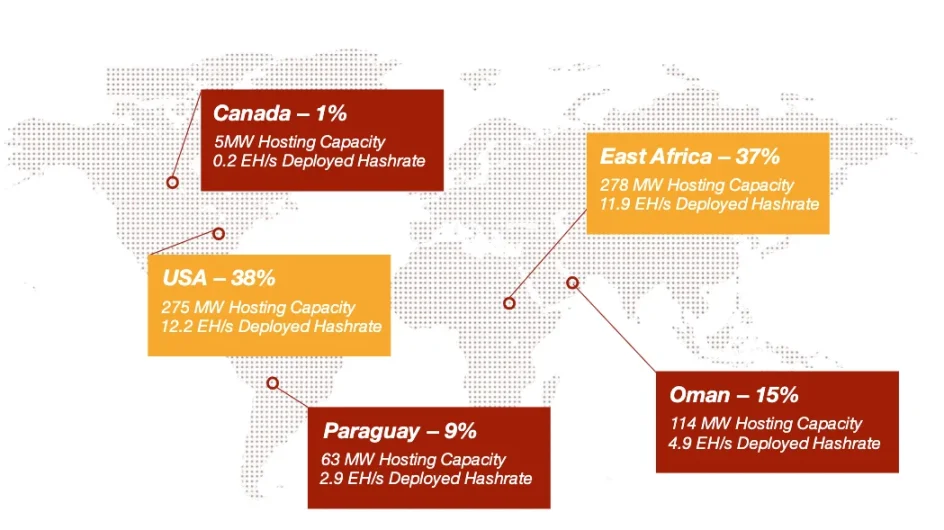
Cango’s global hashrate distribution
The Undervalued CANG
CANG is Cango’s ticker on the NYSE. According to TradingView, CANG’s historical high is $14.20, and its current market cap stands at $540 million, ranking 14th among Bitcoin miners (excluding Galaxy).
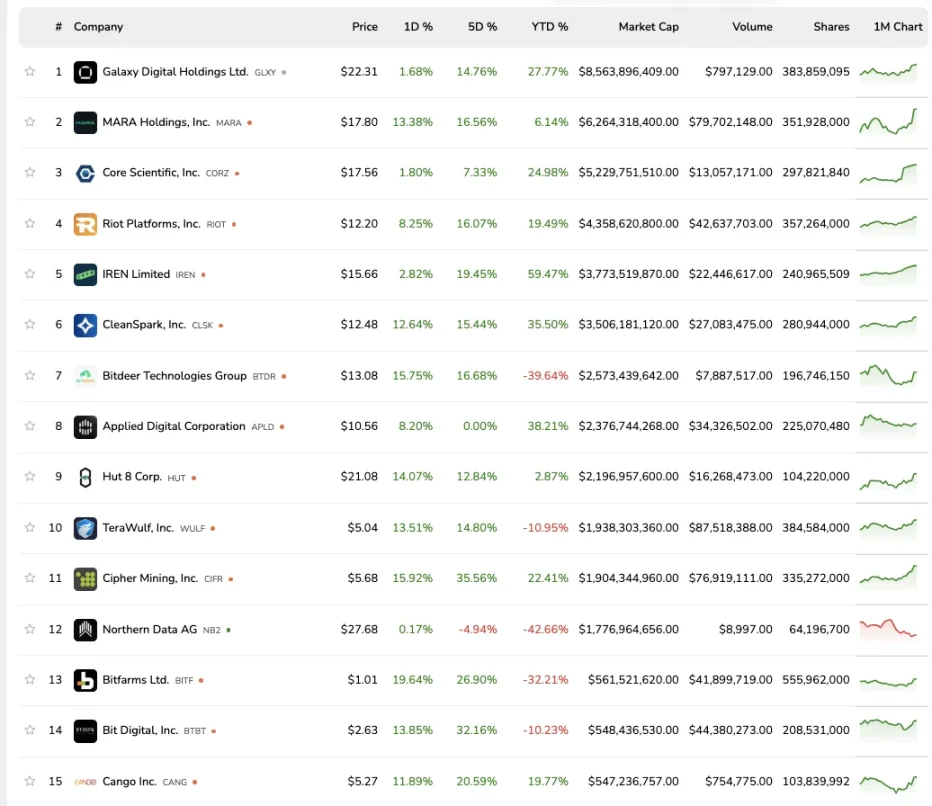
Source: BitcoinMiningStock
Since Cango announced its Bitcoin mining pivot in November 2024, its stock has trended upward with volatility—peaking at $8 in December 2024 before entering a consolidation phase. In June, news of management changes, asset sales, and the 18 EH/s acquisition lifted the stock, with CANG gaining over 14.32% in the past month. Yet, compared to peers, CANG remains undervalued.
As shown above, MARA Holding boasts a $6.2 billion market cap with 57.4 EH/s—the highest globally. Core Scientific, another listed miner, has a $5.22 billion valuation despite only 18.1 EH/s. Riot Platforms, with 31.5 EH/s, has a $4.358 billion market cap. While hashrate doesn’t directly correlate with market cap, for a firm ranked second in hashrate and sixth in Bitcoin holdings, a $540 million valuation is clearly low. Even post-share issuance, Cango’s total market cap would only reach $800 million to $900 million.
Nevertheless, as Cango’s mining capacity and Bitcoin reserves grow, and with this wave of crypto-themed U.S. stock bullishness reigniting "value investing," CANG could emerge as a dark horse.
3. Could Cango Be the Next Strategy?
Thanks to the convergence of crypto and U.S. equities, Bitcoin treasury firms and various altcoin treasury companies have emerged en masse. Amid the noise, investors lacking time for deep research fall into a trap: "Forget what they do—just listen to their story," chasing "the next Strategy." Ultimately, many become exit liquidity for capital.
This noisy environment creates a new challenge for genuinely transforming companies: how to capture investor attention. "If we take November last year as a dividing line, before that, our biggest challenge was: where should we go? Afterward, the main pain point became: how do I tell you my story?" Juliet Ye expressed the anxiety shared by most Web2 companies transitioning into crypto.
Cango’s transformation is bold, but remember: before becoming the first Bitcoin treasury stock, Strategy itself was in commercial data analytics. Since announcing its "Bitcoin treasury" strategy, its stock has surged nearly 2,600%. So, under its "Energy + Computing Power" vision, with growing green mining initiatives and a similar "Bitcoin treasury" strategy, what might Cango’s future hold? Only time will tell.
Join TechFlow official community to stay tuned
Telegram:https://t.me/TechFlowDaily
X (Twitter):https://x.com/TechFlowPost
X (Twitter) EN:https://x.com/BlockFlow_News
 Odaily