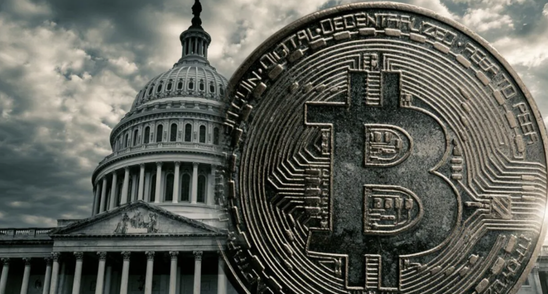
Crypto assets can finally be inherited
TechFlow Selected TechFlow Selected
Crypto assets can finally be inherited
This article analyzes the connection between emergency contacts and cryptocurrency asset inheritance, incorporating Binance's new regulations.
 Navigating Web3 tides with focused insights
By: Liu Zhengyao
Recently, a crypto KOL published an article on a self-media platform stating that Binance has added new "Emergency Contact" and "Heir" features in its updated app version. The blogger also noted that globally, each year people who pass away unexpectedly hold over $1 billion worth of cryptocurrency assets. If these assets are not transferred to family members before death, they will eventually be inherited by exchanges (if the crypto assets are held on exchanges); if stored in cold wallets, they will remain frozen at the wallet addresses forever.
Binance’s new feature indeed addresses the inheritance issue for crypto assets among web3 professionals—an undoubtedly meritorious development.
Before diving into legal analysis of crypto asset inheritance, Attorney Liu must reiterate that this article is purely for educational and analytical purposes and does not constitute any recommendation or endorsement of any virtual currency or exchange.
I. Practical Approaches to Crypto Asset Inheritance
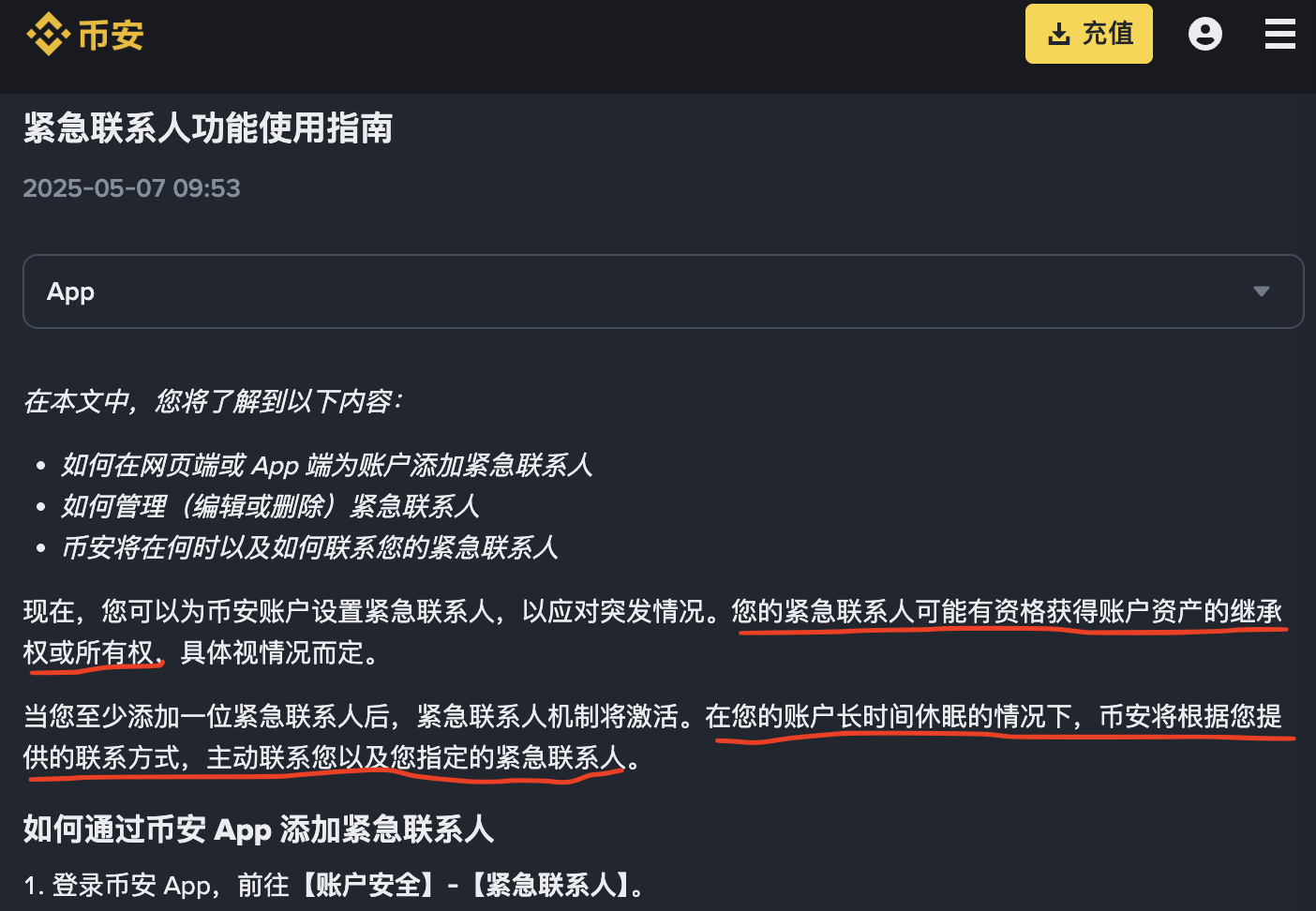
According to Binance's official website, users can set an emergency contact within the app. If a user's account remains dormant for an extended period (default 12 months, customizable to 2 or 3 years), Binance will reach out to the designated emergency contact, who may then gain rights to inherit or own the user’s account assets.
Users can delete or modify their emergency contact at any time.
II. Does Chinese Law Support Crypto Asset Inheritance?
The above mechanism practically resolves the inheritance issue for dormant accounts on decentralized exchanges. As a web3 legal practitioner, Attorney Liu cannot help but wonder whether such practices face any legal obstacles.
(A) Are Virtual Currencies Considered Property?
In Attorney Liu’s previous article (“Judicial Disposal of Virtual Currency: People’s Court Daily Suggests Entrusting Third-Party Institutions”), it was mentioned that Shenzhen Intermediate Court, in its submission to the People’s Court Daily, recognized virtual currencies as having property attributes under both civil and criminal law. The specific reasoning includes:
First, in civil rulings, virtual currencies have been acknowledged to possess exclusivity, controllability, and liquidity—similar characteristics to virtual goods—and thus should be recognized as property.
Second, Article 127 of China’s Civil Code explicitly states: “Where laws provide for the protection of data and virtual network property, such provisions shall apply,” demonstrating the Civil Code’s supportive stance toward protecting virtual property.
Third, Article 83 of the Draft Minutes of the National Court Financial Trial Work Conference also stipulates that “virtual currencies possess certain attributes of virtual network property.”
Fourth, in criminal jurisprudence, cases in the Supreme People’s Court case database have already clarified that virtual currencies qualify as “property” under criminal law and possess recognized property attributes.
Additionally, based on Attorney Liu’s understanding of China’s regulatory policies on virtual currencies, the December 2013 Notice on Preventing Bitcoin Risks defined Bitcoin as “a specific type of virtual commodity.” Then, in the May 2021 Announcement on Preventing Risks Related to Virtual Currency Trading Speculation, the term was expanded to define all virtual currencies—not just Bitcoin—as “a specific type of virtual commodity” (see: Summary of Web3.0 Industry Regulatory Documents in Mainland China). Thus, the scope of “virtual commodity” evolved from referring solely to Bitcoin to encompassing all categories of virtual currencies.
In conclusion, virtual currencies are considered property under Chinese law.

(B) Legal Provisions Regarding Inheritance
China’s Civil Code, under its inheritance chapter, clearly defines inheritable estate as personal lawful property left by a natural person upon death.
Since virtual currencies are legally recognized as property, individuals holding them lawfully can certainly arrange for their inheritance via a will.
Common forms of wills under the Civil Code include handwritten wills, scribed wills, printed wills, audio or video-recorded wills, oral wills, and notarized wills. A will may be revoked or amended at any time.
Setting an emergency contact through an app and granting that person inheritance rights does not violate the principle of individual autonomy emphasized in Chinese civil law. Therefore, such arrangements are legally valid in China.
III. Challenges in Executing Crypto Inheritance
However, here comes a twist.
The joint notice issued on September 15, 2021 (the “9.24 Notice”) by ten government bodies—including the Supreme People’s Court—explicitly prohibits overseas virtual currency exchanges from providing services to mainland residents via the internet.
Suppose Zhang San designates his friend Li Si as his emergency contact in a virtual currency exchange app, giving Li Si the right to inherit his $100 million worth of crypto assets. After Zhang San passes away, Li Si successfully inherits the assets. Upon learning this, Zhang San’s son, Xiao Zhang (not the best name, admittedly), files a lawsuit demanding Li Si return the inherited assets. His main argument: the virtual currency exchange is prohibited from operating in mainland China; therefore, his father’s actions on the exchange app violated mandatory regulations in mainland China, rendering the testamentary inheritance invalid. Consequently, Zhang San’s estate should be distributed according to statutory inheritance rules, with Xiao Zhang as the rightful heir.
So how can this situation be resolved? As a criminal lawyer, Attorney Liu won’t flaunt his limited knowledge of civil law here. Readers interested in discussing further are welcome to connect privately.
IV. Conclusion
Although virtual currencies like Bitcoin emerged as early as 2008, from a legal perspective, they remain relatively novel phenomena—or technologies—not only in China but around the world. Attorney Liu believes that criminal and civil disputes concerning virtual currencies will continue to arise. Nevertheless, we also believe that many web3 entrepreneurs will persist in constructive innovation, and whether proactively or reactively, the law will gradually adapt to new technologies and the transformations they bring to our world.
Join TechFlow official community to stay tuned
Telegram:https://t.me/TechFlowDaily
X (Twitter):https://x.com/TechFlowPost
X (Twitter) EN:https://x.com/BlockFlow_News