From Wyoming to Capitol Hill: How Senator Lummis Is Driving a Hundred-Billion-Dollar Bitcoin Bet
TechFlow Selected TechFlow Selected
From Wyoming to Capitol Hill: How Senator Lummis Is Driving a Hundred-Billion-Dollar Bitcoin Bet
She hopes the U.S. will buy one million bitcoins.
 Navigating Web3 tides with focused insights
Author: Thejaswini M A
Translation: Luffy, Foresight News
The laser eyes said it all. In January 2025, Senator Cynthia Lummis updated her profile picture on X to a meme of glowing red laser eyes. To Bitcoin believers, it was a call to arms.
The 70-year-old senator from Wyoming announced she would make the largest financial bet in American history. Hours later came the news: she had been appointed chair of the Senate’s Digital Assets Banking Subcommittee. After decades managing mineral resources in Wyoming, Lummis is now urging Congress to purchase $100 billion worth of Bitcoin.

Her plan is to buy one million Bitcoins over five years, building a strategic Bitcoin reserve that would make the United States the world’s largest institutional holder—larger than any company, larger than any government. But to understand how a woman who grasped the value of hard assets during the pandemic's market crash became Bitcoin’s most influential political advocate, we must return to the beginning.
In a ranch in Laramie County, a young girl learned that survival meant seeing opportunity where others saw only risk.
The Ranch That Shaped a Vision
September 10, 1954, Cheyenne, Wyoming.
Cynthia Marie Lummis was born into a world where cattle, land, and precise agricultural calculations defined core values. The Lummis Ranch had passed through four generations, teaching its owners over long years that wealth which cannot move will eventually vanish.

In an environment where nature never compromises, Lummis learned her earliest professional principles. Cattle die, markets collapse, natural disasters destroy everything overnight. Her parents, Doran and Enid, may not have taught these lessons through lectures, but ranch life instilled them through reality: watching commodity prices swing wildly due to uncontrollable forces, seeing disease wipe out herds in a single night, understanding how global trade decisions made in Washington could bankrupt a Wyoming rancher by Tuesday. It was here that one learns to think in hedges, prepare for shocks, and diversify against forces beyond individual control.
Most importantly, you learn that conventional wisdom is usually wrong. Survival means making bets others won’t even consider.
The Accidental Politician
1978, University of Wyoming.
At age 24, Cynthia Lummis earned her biology degree while becoming the youngest woman ever elected to Wyoming’s state legislature. It was a practical decision—she knew policies affecting her family’s ranch were being made by people who had never lived with their consequences.
Her education followed the same logic: a degree in animal science in 1976, biology in 1978, and law in 1985—all from the University of Wyoming. She was deeply rooted in a state whose livelihood depended on understanding tangible value.
Her tenure as Wyoming State Treasurer from 1999 to 2007 proved crucial to her later work. While managing the state’s mineral revenues and investment funds, she kept returning to one question: How do you preserve purchasing power when governments control the money supply?
Sixteen years later, her daughter and son-in-law gave her the answer—in the form of a digital asset most politicians still dismissed as a scam or curiosity.
The $330 Experiment
In 2013, Bitcoin traded at $330.
When most Americans were just learning the term “cryptocurrency,” Cynthia Lummis bought her first Bitcoin at $330. Not because she fully understood the technology, but because her experience as state treasurer taught her to seek stores of value outside traditional monetary systems. “I’ve always looked for a store of value,” she once said, “and I believe Bitcoin is an excellent one.”
The purchase was small, experimental. But it showed her motivation wasn’t ideological or speculative. She bought Bitcoin because of its fixed supply, lack of central authority, and resistance to currency devaluation. For someone who had watched inflation erode public funds for years, Bitcoin offered money that couldn’t be printed, manipulated, or seized by governments.
Starting with that $330 investment, she later revealed she purchased up to $100,000 worth of Bitcoin in 2021.
More importantly, the trade gave her credibility—proof she recognized Bitcoin’s potential before Wall Street did. She put her own money behind the idea long before it was politically safe to do so.
Era of the Liberty Caucus
2009, Washington, D.C.
Upon entering the House of Representatives, Lummis brought deep insight into how monetary policy impacts real people. As a founding member of the House Liberty Caucus, she consistently advocated fiscal conservatism and sound money principles. During her time in the House, she built a reputation for challenging financial orthodoxy. She criticized Federal Reserve policies for “punishing savers and rewarding debtors.” She championed a return to sound money and pushed for policies protecting individual financial sovereignty.
It was her work on Western issues, public land management, energy interests, and the complex federal-state relationship that demonstrated her ability to think systematically about how national policy affects local communities. When she chose not to run for re-election in 2016, it seemed like a retreat from national politics—but in fact, she was preparing for her most ambitious project yet.
Senate Gambit
2020, Wyoming Senate Race.
Lummis returned to federal politics with a difference: she now openly advocated for Bitcoin as part of her campaign platform. Promoting Bitcoin became central to attracting voters.
Wyoming voters elected the first woman to represent the state in the U.S. Senate, and Lummis arrived in Washington on a mission to challenge traditional monetary policy.
She partnered with Democrat Kirsten Gillibrand to draft the Responsible Financial Innovation Act, showcasing her ability to build bipartisan consensus around crypto policy. With Democrat Kyrsten Sinema, she co-founded the Congressional Blockchain Caucus, creating an institutional framework for crypto advocacy within Congress.
One of Lummis’s most notable contributions has been using her expertise in Wyoming’s energy sector to counter criticisms of Bitcoin’s environmental impact. Rather than ignoring the issue, she advocated policies encouraging Bitcoin mining using stranded natural gas—capturing energy that would otherwise be wasted. She argues that “40% of Bitcoin mining already uses renewable energy” and that economic incentives from mining can accelerate clean energy development.
By 2025, when Senate Banking Committee Chair Tim Scott appointed Lummis as the first chair of the Digital Assets Subcommittee, she had positioned herself at the intersection of crypto advocacy and mainstream Republican politics.
She was no longer just a Bitcoin believer—she was Bitcoin’s most powerful political defender.
The Bitcoin Bill: America’s $100 Billion Bet
March 2025, Capitol Hill.
The Bitcoin Act—Promoting Innovation, Technology, and Competitiveness through Nationwide Optimization of Investment—represents the boldest monetary policy proposal in American history.
One million Bitcoins, to be acquired over five years—about 5% of Bitcoin’s total supply. At current prices, roughly $100 billion, though the value could rise if the purchases themselves drive price increases.
The proposed funding mechanism is clever: diversifying existing funds within the Federal Reserve and Treasury instead of requesting new appropriations; leveraging returns from existing gold reserves; utilizing Bitcoin obtained through criminal and civil forfeitures.
Just as the Louisiana Purchase secured America’s westward expansion, a strategic Bitcoin reserve would secure U.S. leadership in the emerging digital financial system.
The political hurdles are immense. The proposal requires congressional approval—the largest crypto purchase in history. It must convince fiscal conservatives that Bitcoin is a prudent store of value. It must address Democratic concerns about volatility, environmental impact, and the image of Trump-affiliated crypto ventures profiting from speculation.
Lummis has set an ambitious timeline: comprehensive digital asset legislation passed by the end of 2025.
Pushback From Opponents
Lummis faces resistance from multiple fronts.
Fiscal conservatives worry about betting national resources on a volatile asset; Democrats associate Bitcoin with speculation and environmental harm; traditional banks fear disruptive consequences from widespread crypto adoption.
Some Democrats refuse to support any crypto legislation, especially as Trump profits from memecoins and World Liberty Financial.
Lummis attempts to address concerns through transparency, bipartisan cooperation, and consumer protection provisions—but the political landscape remains brutal.
Lummis frames Bitcoin as a national security issue.
She points to China’s digital yuan as evidence that the U.S. is falling behind in financial innovation; Singapore and Europe offer clearer crypto regulations, drawing businesses away from America.
Her strategic Bitcoin reserve positions early accumulation as economic warfare—digital assets offering geopolitical advantage, much like gold reserves once did.
At the 2025 Bitcoin Conference in Las Vegas, she revealed that several U.S. military leaders support establishing a Bitcoin reserve, framing cryptocurrency as a matter of national financial security, not speculation.
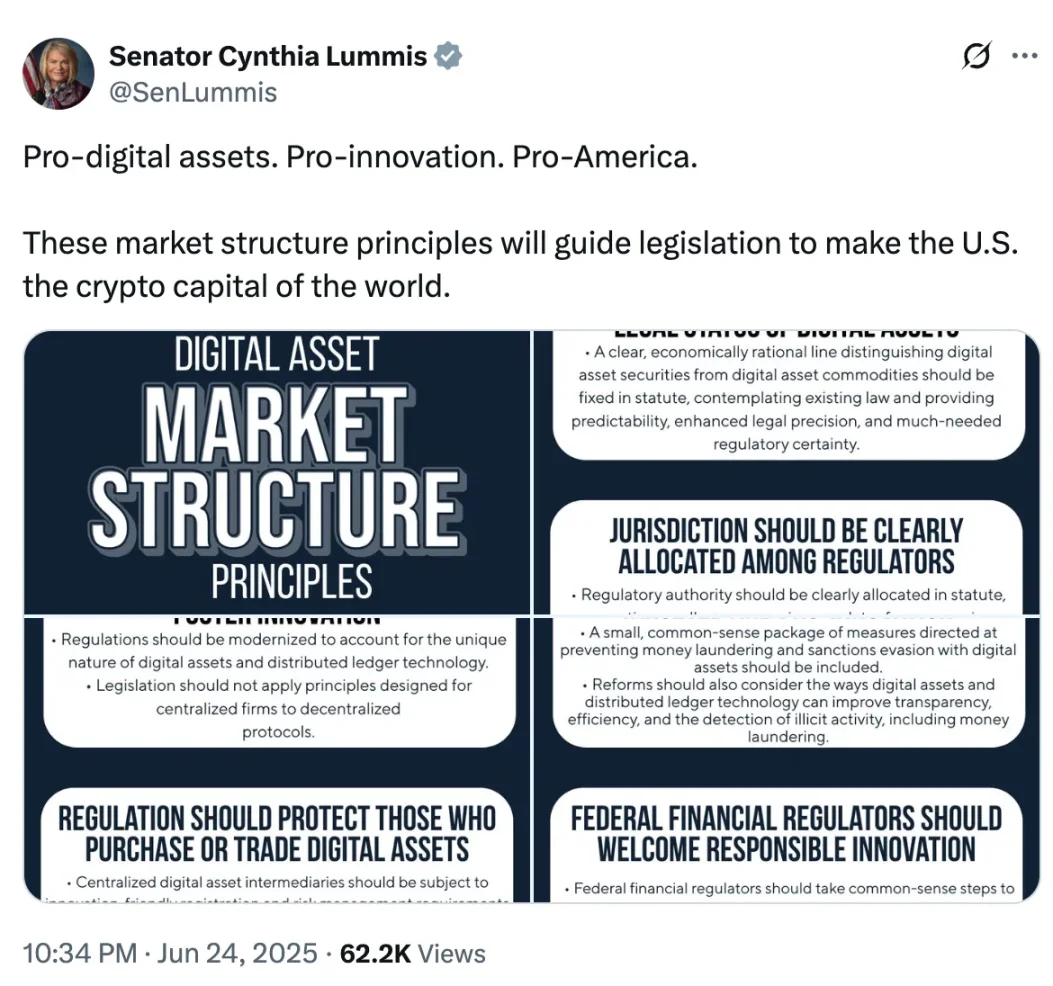
This national security angle appeals to Republicans who might otherwise be skeptical of crypto. Now she is pushing broader market structure principles aimed at making the U.S. the “crypto capital of the world.”
Institutional Legacy
Whether her bill passes or not, Lummis has already transformed how American institutions view cryptocurrency.
The Senate’s Digital Assets Banking Subcommittee ensures crypto receives sustained congressional attention. The Congressional Blockchain Caucus provides training for members needing to understand blockchain technology.
Her collaboration with Democrat Kirsten Gillibrand proves that when focused on practical benefits rather than ideology, crypto policy can earn bipartisan support.
Her transparency—disclosing Bitcoin holdings, using blind trusts, working across party lines—has normalized crypto advocacy within mainstream Republican politics. She elevated cryptocurrency from a technological novelty to a core financial policy issue, creating an institutional framework that will outlast her career.
During her time in public office, Lummis helped position Wyoming as the most crypto-friendly state in the U.S. Wyoming established Special Purpose Depository Institutions (SPDIs), allowing crypto companies to both access banking services and custody digital assets. The state protects private keys as property, supports digital asset custody, and created regulatory sandboxes for blockchain innovation.

Lummis amplified these innovations, making Wyoming a model for other states. Her approach demonstrates how state-level experimentation can inform federal policy.
The Wyoming model—with clear regulations, self-custody protections, and bank access for legitimate crypto businesses—provides the blueprint for the comprehensive framework Lummis seeks at the federal level.
The ultimate test is whether she can convince the U.S. government to make the largest crypto purchase in history. The strategic Bitcoin reserve is a bet on whether American institutions can adapt quickly enough to maintain global financial leadership.
If successful, the U.S. will position itself as the dominant player in digital assets and could capture massive value as crypto adoption accelerates. Government-held Bitcoin could appreciate significantly, providing resources for debt reduction and infrastructure investment.
If it fails, the U.S. risks falling behind jurisdictions more aggressively embracing crypto innovation. Digital asset firms may relocate, taking jobs, tax revenue, and innovation with them.
This is the story of a rancher’s daughter who learned to see value in cattle—and is now asking America to make the biggest financial bet of the digital age.
Join TechFlow official community to stay tuned
Telegram:https://t.me/TechFlowDaily
X (Twitter):https://x.com/TechFlowPost
X (Twitter) EN:https://x.com/BlockFlow_News