Sun Yuchen's strongest rival, Stablecoin arrives tonight
TechFlow Selected TechFlow Selected
Sun Yuchen's strongest rival, Stablecoin arrives tonight
Stablecoins have formed a clear divide.
 Navigating Web3 tides with focused insights
Author: Zuo Ye
Top-tier alphas master both politics and business—like Trump, or Sun Yuchen and Gabriel Abed, the current Chairman of Binance.com. Even more astonishing? This guy used to be Barbados’ ambassador to the UAE.
You might wonder: how does a Barbadian diplomat studying in North America become Chairman of Binance? Well, personal effort matters, but riding the wave of history matters even more.
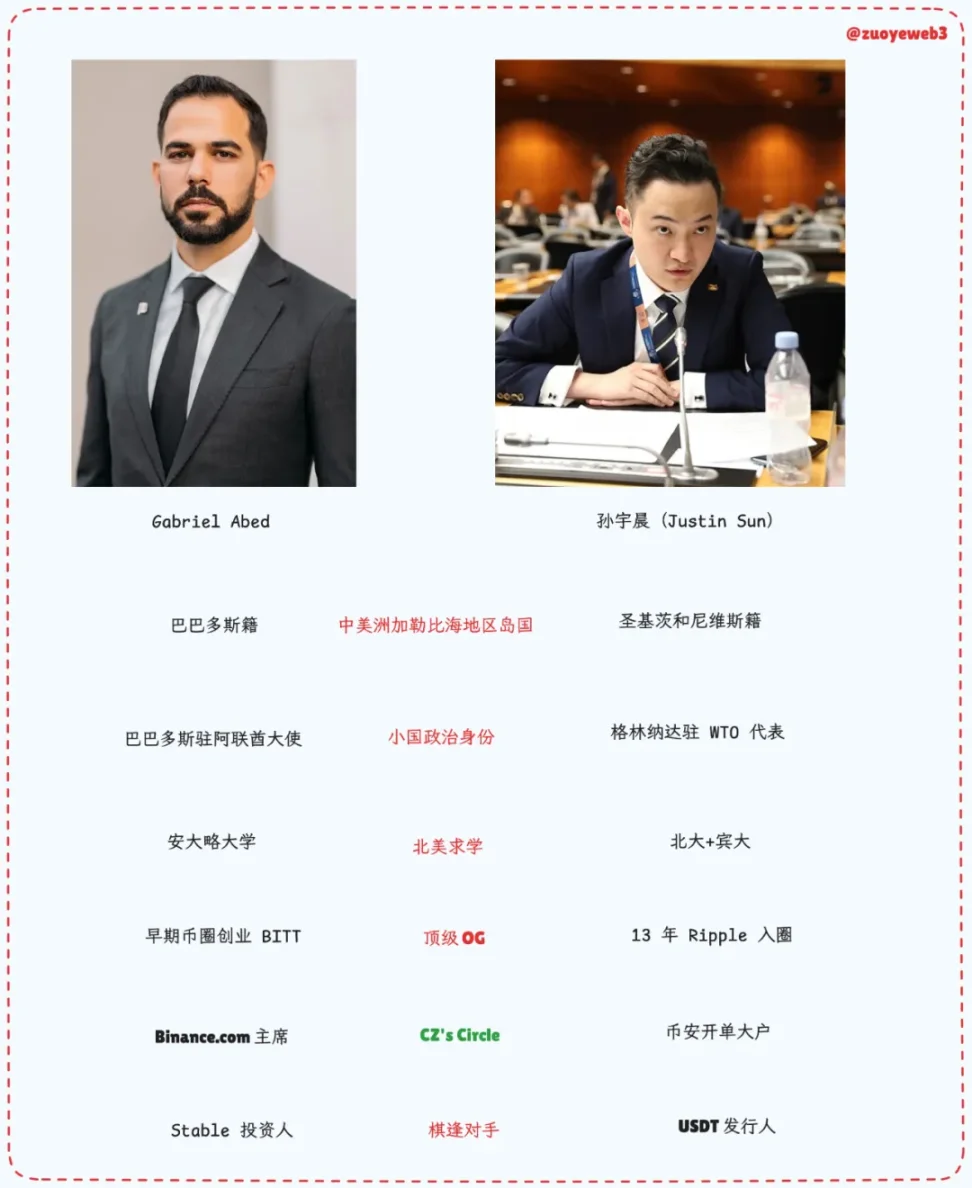
Caption: Gabriel Abed, investor in Stable, Image Source: @zuoyeweb3
Prior to today, USDT was effectively half TRC-20 USDT. Sun Yuchen built his $TRX-centered empire by providing circulation channels for USDT. But the emergence of Stablechain has cracked that empire.
Stablechain is a payment-dedicated L1 launched by Stable, using USDT as its Gas Token. Since Stable is directly backed by USDT, bringing on Gabriel Abed and launching their own chain signals Tether’s outward expansion—specifically targeting institutional markets.
This move aligns with current competitive dynamics. Beyond USD1, a pure Trump-themed meme coin, rivals like USDC and USDe are aggressively pursuing institutional settlement. Not to mention USDG, backed by Paxos and Kraken, also eyeing this lucrative space—and even BUSD planning a resurrection.
Stablecoins Go Corporate
For stablecoins, chasing retail users is practically synonymous with serving gray-market activities.
Sun Yuchen delivered the most successful retail strategy to date—not by making Tron the issuance network for USDT, but by identifying real-world groups with genuine demand for stablecoins. The tight coupling of TRX and USDT made Tron the second most widely used blockchain after Ethereum, with actual user activity.
But amid the institutional adoption wave driven by Stablechain, CPN, and Converge, can Sun come up with another breakthrough? Relying solely on the Trump family won’t cut it—he’s got at most four years, while business is forever.
Today, U-cards and yield-bearing stablecoin (YBS) battles are raging. YBSBarker continues close tracking. Enterprise-facing (B2B) services may seem distant from everyday users, but they harbor the next Circle or Stripe opportunity. (Recently, friends consulting me about stablecoins have grown exponentially. Countless projects, big and small, each claiming to be the next Stripe—the level of competition is evident.)
In the B2B market, pure compliance alone unlocks massive growth potential. It’s also where rugged entrepreneurs can finally go legit. As stablecoins converge evolutionarily, let the race begin!
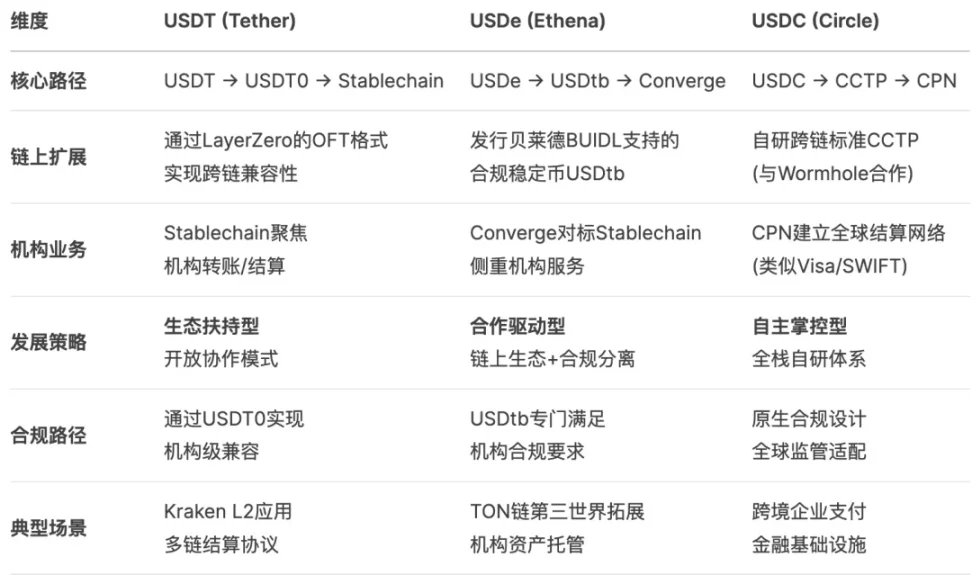
Caption: Comparison of USDC/USDT/USDe, Image Source: @zuoyeweb3
-
USDT → USDT0 (LayerZero) → Stablechain
-
USDe → USDtb → Converge
-
USDC → CCTP (Wormhole) → CPN (Circle Payment Network)
The current market structure follows a basic pattern: stablecoin → on-chain interoperability → off-chain institutional adoption. Business development revolves around three pillars: compliance, cross-chain functionality, and institutional integration.
USDT expands its on-chain presence via USDT0. Beyond direct deployments, it leverages OFT tokens built through LayerZero—backed 1:1 by USDT reserves—to deliver compatibility similar to Circle’s CCTP. However, instead of building in-house, USDT outsources this to USDT0.
Using USDT0 is effectively using USDT, opening doors for broader institutional adoption and compatibility across more public chains and products. For example, Kraken-supported L2 Ink has deployed USDT0, and Stablechain will also use USDT/USDT0 to expand institutional transfers and settlements.
Beyond its native form, USDe issues USDtb—a compliant stablecoin backed by BlackRock’s BUIDL fund—to meet institutional compliance requirements, while USDe itself focuses on growing its on-chain ecosystem, such as partnering with TON to enter developing markets.
Converge, positioned against Stablechain, similarly targets institutional transfer and settlement use cases. Their models are nearly identical, differing slightly in emphasis on compliance, cross-chain standards, and institutional engagement.
USDC prefers in-house development. Though it collaborates with Wormhole, its cross-chain standard CCTP is primarily self-operated. CPN functions as a global USDC settlement network akin to Visa/SWIFT.
In summary: USDT favors ecosystem support, USDe leans on partnerships, and Circle prefers full vertical integration.
Decoding Stablechain: Commercialization Remains Challenging
With innovation plateauing, operational excellence takes center stage.
Technologically, Stablechain offers little novelty as an L1. It uses a CometBFT variant called StableBFT as its consensus mechanism, with plans to later upgrade to DAG mode—an unexpected twist.
Overall, Stablechain adopts a dPoS model. To ensure high efficiency, it will remain relatively centralized, possibly adopting a “single-node mode” similar to Hyperliquid’s early days. While not offering perpetual contracts, handling large-scale USDT transfers demands extreme network stability.
Additionally, StableEVM will evolve into StableVM++, introducing greater parallelization derived from Aptos’ Block-STM framework. Remember: parallel execution isn’t limited to EVMs; high-performance L1s (like Sui) are challenging Ethereum L2s?
Broadly speaking, Stablechain serves three groups: individual users, enterprise clients, and developers. While USDT has already educated retail users, most enterprises and developers remain confused and unaware.
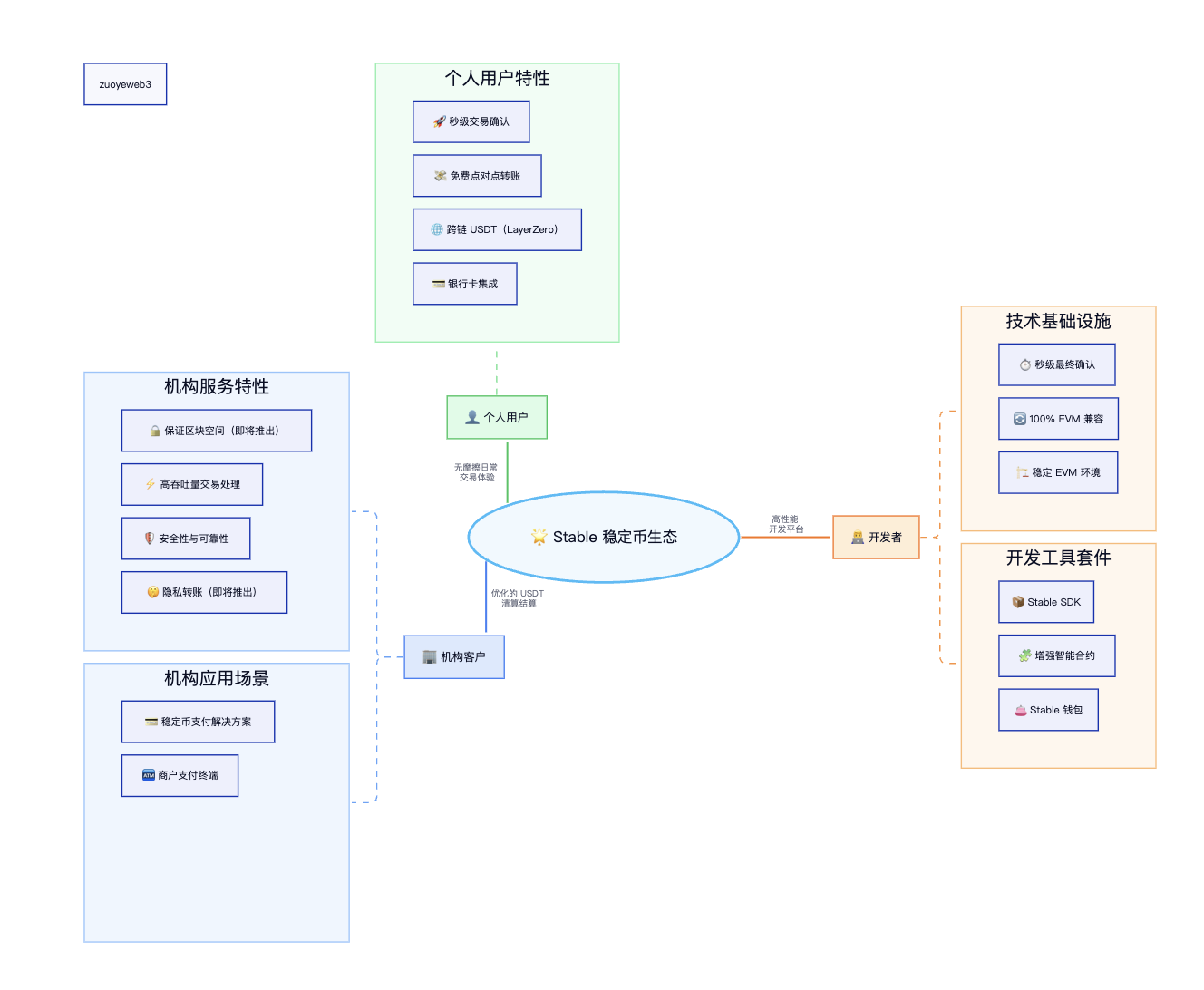
Caption: Stablechain Features, Image Source: @zuoyeweb3
Enterprise adoption is Stablechain’s core focus. From documentation, I’ve distilled three key features. For more details and use cases for individuals and developers, refer to the image above.
-
Guaranteed Blockspace: Enterprises get reserved blockspace, ensuring reliable and accurate transaction execution—like reserving express lanes during peak holidays.
-
USDT-only transactions: Ensures security, speed, and real-time traceability, meeting strict compliance needs like AML.
-
Private transfers: Business-to-business settlements stay confidential. Transactions remain hidden from outsiders, especially competitors, protecting commercial privacy while maintaining compliance.
Other general features include gas-free transfers, sub-second confirmations, and USDT0 cross-chain bridges—largely unremarkable. The true significance of Stablechain lies not here, but in countering Circle’s dominance commercially.
Let’s discuss potential commercialization paths. Right now, no one truly knows the right entry point for B2B adoption—note that this doesn’t contradict earlier claims about commercialization having begun.
If your competitor builds something, you must follow. When Sui launched Walrus for storage, Aptos rushed to build Shelby. Everyone agrees businesses need settlement and internal transfers—but how exactly?
Take the Yiwu payment network, which previously relied on TRC-20 USDT before crackdowns. That was the de facto industry standard, a real business need. Can Stablechain capture this demand?
Currently, no. Stablechain isn’t part of any formal compliance settlement system. At best, it could partner with licensed Payment Service Providers (PSPs), but that would significantly dilute target customers’ brand recognition of Stablechain.
Stablechain’s roadmap includes consumer payment solutions, merchant acquiring tools, Stable Wallet, and built-in compliance utilities. These remain too broad, lacking concrete operational strategies. We’ll have to wait and see.
Conclusion
A clear divide is forming among stablecoins.
One path follows traditional finance or mainstream perception: stablecoins as dollar proxies or digital wallets—exactly what USDT strives to become.
The other follows DeFi logic—stablecoins as shares in financial products. In plain terms: Yield-Bearing Stablecoins (YBS), representing investment certificates and dividend rights. After USDe, others now seek to follow USDT’s growth trajectory.
For now, Stablechain seems largely disconnected from Brother Sun. Let’s hope this time, he survives again.
Join TechFlow official community to stay tuned
Telegram:https://t.me/TechFlowDaily
X (Twitter):https://x.com/TechFlowPost
X (Twitter) EN:https://x.com/BlockFlow_News
 @zuoyeweb3