JD.com's Richard Liu Announces Push into Stablecoins, as Big Tech Discovers a "New Gold Mine"
TechFlow Selected TechFlow Selected
JD.com's Richard Liu Announces Push into Stablecoins, as Big Tech Discovers a "New Gold Mine"
Cryptocurrency re-enters the mainstream spotlight under a legitimate new identity.
 Navigating Web3 tides with focused insights
Source: GeekPark (ID: geekpark)
Author: Su Zihua
Stablecoins are hot.
They may be the hottest tech concept in June 2025 outside of AI. The enthusiasm from major internet companies has brought stablecoins back into the mainstream spotlight.
On June 17, 2025, Richard Liu, Chairman of JD Group, said at a sharing session: "JD will apply for stablecoin licenses in major currency countries globally, aiming to reduce cross-border payment costs by 90% and shorten transfer times to within 10 seconds."
This might be the first time a founder or CEO of a Chinese internet giant has publicly announced plans to enter the cryptocurrency space.
Stablecoins are, in essence, a type of cryptocurrency.
Unlike volatile cryptocurrencies such as Bitcoin and Ethereum, stablecoins maintain price stability by being pegged to fiat currencies (like the US dollar or Hong Kong dollar) or other assets.
Their main advantages lie in cost and efficiency. According to research by the Bank for International Settlements (BIS), stablecoins can be up to 100 times more efficient and over ten times cheaper than traditional payment methods for cross-border transactions.
A fintech sector once surviving in the “gray zone,” niche and marginal, is now exploding. Public data shows that by May 2025, the global stablecoin market cap had surpassed $246.3 billion—nearly 50 times higher than in 2019.
Moreover, on June 5, Circle—the first publicly traded company focused on stablecoins—listed on the NYSE, with its stock surging 168% on the first day, reaching a market cap of over $18.3 billion with fewer than 1,000 employees. Circle’s IPO has significantly boosted confidence across the industry. Recently, tech giants including Ant Group, Walmart, and Amazon have all been actively advancing their own stablecoin projects.
In 2014, when JD went public in the U.S., Richard Liu admitted his biggest regret was not entering the payments space earlier—allowing Alipay and WeChat Pay to surge far ahead.
Now, amid the wave of cross-border e-commerce and overseas expansion, and with tech giants rushing in, stablecoins have clearly become an unavoidable new frontier in payments.
How will the vision of using stablecoins to buy overseas goods or conduct cross-border transfers gradually become reality? Will stablecoins become the next battleground for tech titans?
What Exactly Is JD's Stablecoin?
According to disclosed information, JD’s stablecoin is named JD-HKD—a cryptocurrency pegged 1:1 to the Hong Kong dollar (HKD). This means each issued coin is backed by one Hong Kong dollar worth of high-liquidity assets (such as cash or government bonds), held in custody by licensed banks and subject to regular audits.
The stablecoin is issued by JD Coin & Chain Technology (Hong Kong) Limited, a subsidiary of JD based in Hong Kong.
Established in March 2024, this company holds Types 1, 4, and 9 licenses issued by the Hong Kong Securities and Futures Commission, covering securities trading, asset management, and blockchain technology development.
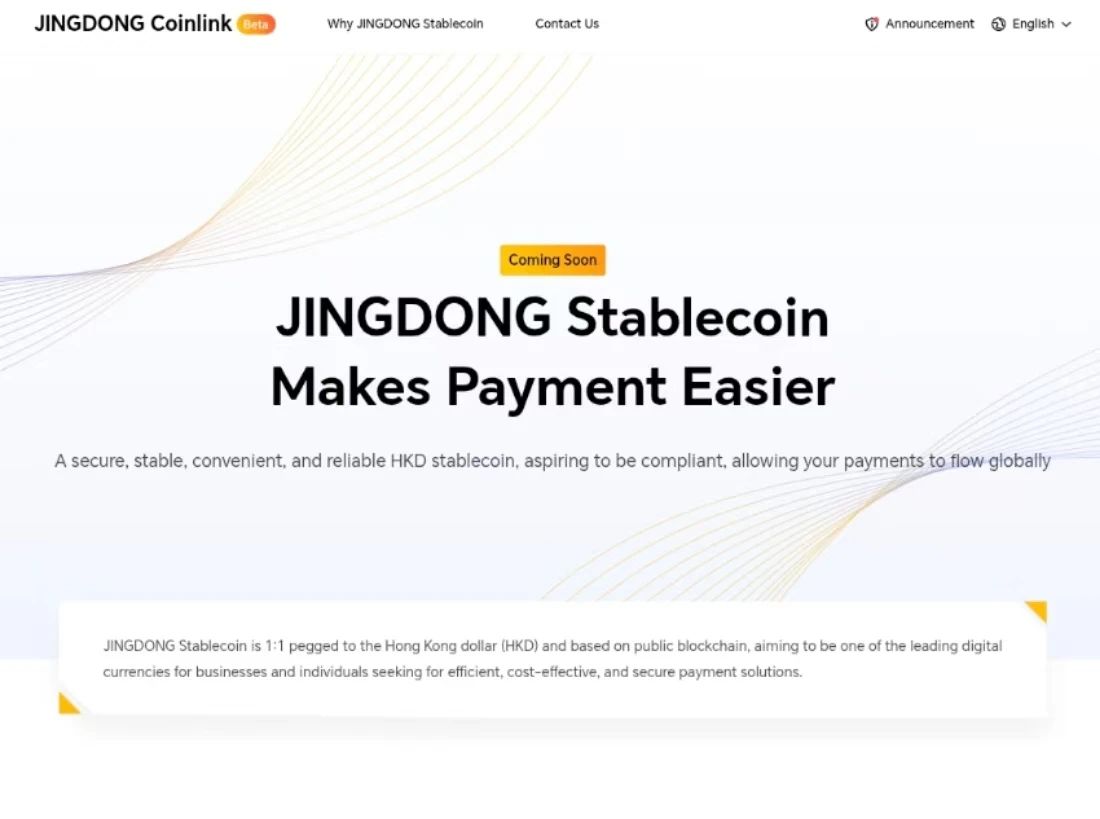
Official website of JD stablecoin|Image source: Network
Currently, JD’s stablecoin has entered the second phase of testing within the Hong Kong Monetary Authority’s (HKMA) “Stablecoin Issuer Sandbox.” (“Sandbox” refers to HKMA’s program allowing institutions intending to issue stablecoins in Hong Kong to test their operational plans, facilitating two-way communication to explore compliant regulatory frameworks.)
So what is the purpose of JD’s stablecoin?
Liu Peng, CEO of JD Coin & Chain Technology, explained in a May interview with TECHHUB NEWS that JD is currently testing use cases including cross-border payments, investment trading, and retail payments.
Based on public information, these applications break down as follows:
-
In cross-border payments: Current systems rely heavily on SWIFT, where international transfers take 2–4 days and incur fees of 1–3% of the transaction amount. Stablecoins, however, can reduce transfer times to seconds and cut costs by 90%.
-
In investment trading: JD is collaborating with regulated crypto exchanges to support institutional and retail investors in digital asset trading, offering a stable pricing and settlement tool.
-
In retail payments: Integrating with JD’s Hong Kong and Macau e-commerce platforms, piloting direct consumer payments using JD-HKD.
Clearly, JD’s ambitions in payments span both B2B and consumer-facing (C-end) markets.
As Richard Liu stated on June 17: "After completing B-end payments, we’ll penetrate into C-end payments. We hope one day people can use JD’s stablecoin to pay anywhere in the world."
The disruption stablecoins pose to traditional payment systems offers e-commerce giants opportunities for lower transaction costs, faster capital turnover, and a chance to leapfrog competitors in cross-border trade.
Beyond that, the stablecoin business itself offers relatively high profit margins.
Take Circle, whose stock just soared after going public. Its net profits were $268 million in 2023 and $156 million in 2024.
Circle earns revenue through two primary channels:
1. Interest income from reserves: The fiat money users deposit to buy stablecoins can be invested by Circle into low-risk assets like U.S. Treasuries, generating interest spreads. According to financial reports, this source accounted for 99% of total revenue in 2024, highlighting the model’s heavy dependence on interest rates.
2. Transaction fees: Charged for services such as cross-border payments and currency exchange.
By analogy, JD’s stablecoin likely follows a similar business model, which we won’t elaborate further here.
Big Tech Rivals Race Into Stablecoins, Flocking to Hong Kong
JD is not the only giant eyeing stablecoins. Major global internet and financial firms have already moved.
For example, also in June, Ant International and Ant Digital Technologies announced they would apply for stablecoin licenses in Hong Kong, Singapore, and beyond. Ant Digital has designated Hong Kong as its global headquarters and is testing stablecoin applications within regulatory sandboxes, focusing on global treasury management and cross-border payments.
Amazon and Walmart, as retail platforms, share similar motivations with JD. Walmart, in particular, aims to attract users underserved by traditional banks and expand into emerging markets by leveraging stablecoins’ low transaction fees.
Xiaomi has taken a lighter approach, with its Tianxing Bank partnering with JD Coin & Chain to develop cross-border payment solutions.
Additionally, traditional payment providers such as Visa and PayPal have launched their own stablecoin initiatives, attempting to preserve market share through partnerships.
For these giants, Hong Kong is an ideal launchpad for stablecoin ventures. Its unique strengths include its status as an international financial center, a mature regulatory system, and strong connectivity with mainland China.
In May 2025, Hong Kong passed the Stablecoin Ordinance, establishing the world’s first legal framework for fiat-backed stablecoins. It requires issuers to have HK$25 million in paid-up capital and to fully back stablecoins 1:1 with high-liquidity assets (e.g., cash or government bonds), ensuring stability and transparency.
The ordinance will take effect in August 2025.
With these requirements, only well-capitalized players remain, forming three competing forces in Hong Kong’s emerging stablecoin ecosystem:
-
Chinese tech giants: JD, Ant Group, Xiaomi, etc., leveraging e-commerce ecosystems and user bases to dominate scenarios like cross-border payments;
-
Traditional financial institutions: Standard Chartered Bank and Hong Kong Telecom, JPMorgan Chase, etc., building stablecoin issuance, trading, and derivative businesses targeting global financial markets;
-
Web3 companies: Such as Ondao Technology, issuer of the HKDR Hong Kong dollar-pegged stablecoin;
The current boom in stablecoins owes much to increasingly robust regulation. As Hong Kong, the U.S., the EU, and others accelerate legislative efforts, stablecoins are transitioning from the “gray zone” into compliance, encouraging big tech and institutional participation.
Standard Chartered forecasts that the global stablecoin market could reach $2 trillion by 2028, growing at a compound annual rate of 58%.
Just as WeChat Pay reshaped mobile payments, stablecoins could become the “new SWIFT” of the digital age. With more heavyweight players entering, the race for dominance in the next-generation global payment network has already begun.
Yet regulatory compliance and user payment experience remain key variables—progress in these areas could profoundly reshape our everyday payment habits and even the future landscape of global finance.
*Header image source: Visual China
Originally published by GeekPark. For reprints, please contact GeekPark via WeChat: geekparkGO.
Join TechFlow official community to stay tuned
Telegram:https://t.me/TechFlowDaily
X (Twitter):https://x.com/TechFlowPost
X (Twitter) EN:https://x.com/BlockFlow_News
 极客公园
极客公园