Casino Lights Out: Is Pump.fun Being "Double Strangled" — Has the End Come for Meme Coins?
TechFlow Selected TechFlow Selected
Casino Lights Out: Is Pump.fun Being "Double Strangled" — Has the End Come for Meme Coins?
This incident highlights the inherent contradictions within the meme coin market and the fragility of decentralized finance's reliance on centralized platforms, serving as a significant warning for the future development of the crypto industry.
 Navigating Web3 tides with focused insights
By Luke, Mars Finance
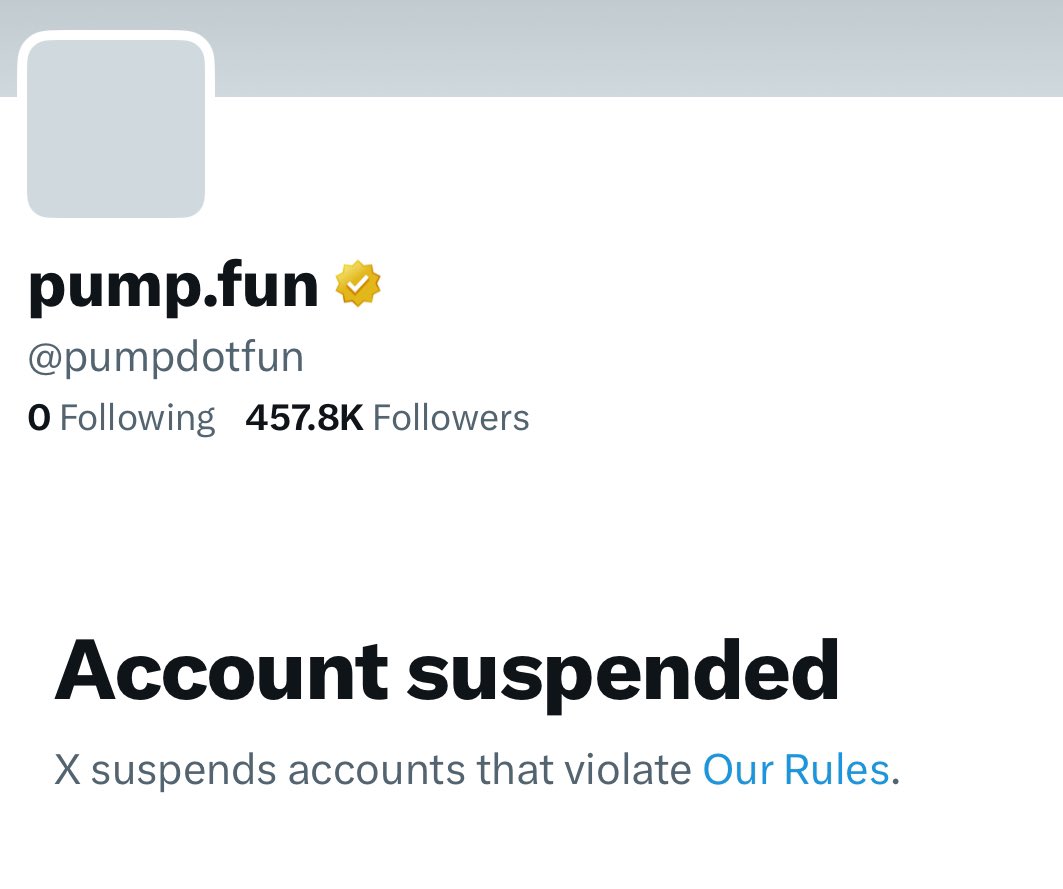
Once upon a time, Pump.fun was an open-all-hours digital amusement park on the Solana blockchain—a money-printing machine fueled by meme coin mania. For less than $2 in costs, anyone could mint a new cryptocurrency within minutes and dive headfirst into frenzied speculative feasts. But the party ended abruptly. Today, the lights are out and silence has fallen. Not only is it facing multiple class-action lawsuits in federal court in New York, but its primary marketing channel—the official account on social platform X—has also been permanently suspended.
The sudden collapse of Pump.fun is not an isolated case. It acts more like a prism, refracting the deep internal contradictions beneath the meme coin craze: a head-on collision between permissionless, gamified financial experiments and the cold realities of securities law, centralized platforms' power to terminate access, and the brutal laws of market economics. Was this digital carnival merely a fleeting bubble, or does it herald the rise of an untamable new form of market speculation? Its trajectory offers us a perfect specimen for dissection.
I. Anatomy of a Meme Factory: Rise and Decay
Pump.fun’s ascent stemmed from its extreme “democratization” of financial speculation, while its downfall lies in the inherent systemic flaws embedded in that very model.
“Innovation”: Opening the Casino Doors to All
The core of Pump.fun was simplifying token creation on the Solana blockchain to an unprecedented degree, creating an all-in-one platform for meme coin creation and trading. At its heart was a mathematical model known as the "bonding curve." Under this mechanism, token prices automatically increase with demand—providing massive incentives for early adopters and continuous fuel for speculative frenzy. This was marketed as “fair distribution,” quickly earning Pump.fun the nickname “the meme coin casino” within crypto circles.
The casino business boomed. The platform charged a 1% fee on every trade and an additional 1.5 SOL fee for tokens that successfully “graduated”—reaching a certain market cap threshold before listing on decentralized exchanges. This built a highly profitable business model. By early 2025, cumulative fees collected had approached $500 million, with daily revenue peaking above $15 million—an efficient money printer indeed.
Inherent Corruption: A System Built on Scams
Beneath the surface of prosperity lay a shocking reality. A devastating report from risk analytics firm Solidus Labs revealed that up to 98.6% of tokens launched on Pump.fun exhibited classic characteristics of “pump-and-dump” scams, rapidly collapsing to zero and becoming worthless. This statistic ripped away the mask of “innovation” and “fairness,” exposing the platform as an industrial-scale breeding ground for fraud.
The relationship between the platform's business model and fraudulent activity wasn’t mere tolerance—it was symbiotic. Pump.fun’s revenue was directly tied to the volume of token issuance and trading. Since the vast majority of trades stemmed from manipulative pump-and-dump schemes, nearly $500 million in revenue was effectively earned by facilitating these scams. This created a perverted incentive structure: to maximize income, the platform prioritized lowering barriers and boosting transaction volume over implementing security checks or protecting investors. Thus, its promise of “fair launch” rang hollow.
The platform’s fragility had long been evident. In May 2024, a former employee exploited privileged access to conduct a flash loan attack, stealing approximately $1.9 million, exposing critical internal control failures. In February 2025, hackers compromised its official X account to promote scam tokens, again highlighting weak defenses against external threats. Legal filings further accused the platform of profiting handsomely amid an environment rife with illegal and antisocial content, adding moral and reputational stains.
II. Legal Reckoning: When Meme Coins Meet the Howey Test
When wild financial experimentation crosses legal red lines, reckoning becomes inevitable. In January 2025, two pivotal class-action lawsuits were filed in the U.S. District Court for the Southern District of New York, placing Pump.fun, its parent entities, and founders in the defendant’s seat.
Legal Siege
The suits were initiated by law firms including Wolf Popper LLP and Burwick Law, naming defendants such as Baton Corporation Ltd.—Pump.fun’s UK-based operating entity—and founders Alon Cohen, Dylan Kerler, and Noah Bernhard Hugo Tweedale. The central allegation: Pump.fun promoted and sold thousands of unregistered securities through its platform, blatantly violating the U.S. Securities Act of 1933. Plaintiffs are seeking full refunds for investor purchases and compensation for economic damages, totaling close to $500 million.
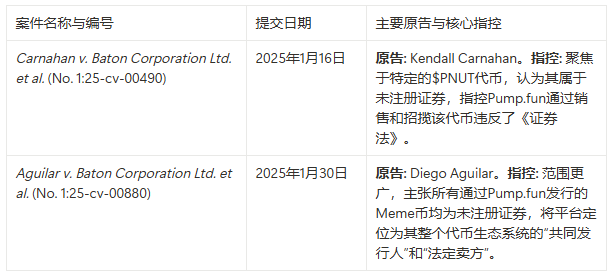
The legal cornerstone of the case is the 1946-originated “Howey Test,” the gold standard for determining whether an investment qualifies as a “security.” The plaintiffs’ argument is profoundly disruptive: they assert that Pump.fun was far more than a neutral technology provider—it actively functioned as a statutory “seller” and “co-issuer” of the tokens.
This claim rests on Pump.fun’s deep control over the entire lifecycle of tokens: providing standardized creation tools, managing liquidity and pricing via bonding curves, and actively promoting tokens through platform features and influencer partnerships. The complaint describes this model as a “new evolution of Ponzi and pump-and-dump schemes.” This litigation strategy marks a significant shift in crypto-related lawsuits. Previously, regulators typically targeted individual token issuers (e.g., SEC vs. Ripple). With tens of thousands of anonymous creators on Pump.fun, such an approach would be impractical. Now, plaintiffs are striking at the root—holding the platform itself accountable. If this logic prevails in court, any “one-click token launch” platform offering standardized tools, controlling pricing, and engaging in promotion could be deemed an unregistered securities seller. This would fundamentally dismantle the “launchpad-as-a-service” business model.
Caught Between Two Regulatory Eras
The lawsuit unfolds during a period of intense regulatory transition in U.S. crypto policy. It emerged at the tail end of the enforcement-driven era led by former SEC Chair Gary Gensler, marked by high-profile actions against giants like Coinbase and Binance, treating most crypto assets as potential securities. Yet, its resolution will occur under a new administration and incoming SEC Chair Paul Atkins, who has signaled a friendlier stance toward crypto and plans to establish clearer regulatory frameworks. Therefore, the outcome won’t just determine Pump.fun’s fate—it will serve as a bellwether for how the U.S. judicial system balances two opposing regulatory philosophies.
III. Signal Lost: Disorientation After Platform Ban
If legal action represents a fundamental challenge to its business model, then the social media ban is a direct severing of its lifeline.
Digital Guillotine
The suspension of Pump.fun’s official X account and founder Alon Cohen’s personal profile was no isolated incident. It was part of a broader purge by X targeting meme coin-related accounts, including GMGN and BullX. Reasons remain speculative. The most plausible explanation is that Pump.fun may have violated X’s terms by using shared or black-market APIs to power trading trackers and “sniper” bots. Alternatively, facing escalating legal risks and fraud allegations, X may have chosen to cut ties preemptively to reduce its own platform liability.
This event starkly reveals the centralization paradox within so-called “decentralized finance.” Though Pump.fun operated atop the decentralized Solana blockchain, its user acquisition, community engagement, and viral marketing depended entirely on X—a centralized social platform. As one CEO recounted on Reddit, losing their X presence meant being “silenced overnight.” This exposes a fatal flaw across the Web3 ecosystem: its social and distribution layers remain firmly under the control of a handful of tech giants.
Community Fracture and Narrative Shift
The platform’s collapse triggered divergent reactions. Some celebrated, viewing Pump.fun as a parasite that drained liquidity and attention from valuable projects—its demise seen as “a good thing.” Others, particularly degens (degenerate gamblers), lamented the loss of their favorite playground: “No more fun.” More forward-thinking voices began calling for a return to rationality, urging focus on value creation—and even explicitly inviting capital rotation back to Ethereum: “Come back, my proud Ethereum meme season!”
IV. Liquidity Black Hole and the Chain Wars
Pump.fun’s rise didn’t just spawn countless scams—it significantly distorted the macro-crypto landscape, intensifying competition between Solana and Ethereum.
Massive Liquidity Drain
At its peak, Pump.fun accounted for over 50% of new token launches across the market. Its model acted like a massive “liquidity black hole,” siphoning vast capital and attention into short-term, high-risk gambling games. This marginalized genuinely useful, long-term projects, diverting funds away from innovation. Such dynamics warped capital allocation, rewarding hype over technological progress and imposing enormous opportunity costs on the industry’s healthy development. When rumors surfaced that Pump.fun itself planned a $1 billion token raise, alarm bells rang—fears mounted that it would further drain already scarce ecosystem liquidity.
Solana vs. Ethereum: The Race for Dominance
Pump.fun’s success was a direct product of Solana’s technical traits. Its capacity for up to 65,000 transactions per second (TPS) and near-zero fees provided the perfect breeding ground for high-frequency, low-cost speculation. In contrast, Ethereum’s high gas fees and slower speeds made replicating such a frenzied “casino” extremely difficult.
Yet, with Pump.fun—the once-heralded “killer app” of the Solana ecosystem—now in ruins, a power vacuum has emerged. Calls for an “Ethereum meme season” are more than emotional outbursts—they may signal a real capital migration. Speculators always chase the next frontier. Ethereum, backed by a $64 billion total value locked (TVL)—a formidable “liquidity moat”—a more mature ecosystem, and a vast user base, stands as the most compelling destination.
Conclusion: After the Party, Only Debris Remains
The story of Pump.fun is a microcosm of the entire meme coin phenomenon. It faces existential legal challenges to its business foundation and suffers from the cutoff of its marketing lifeblood—a double bind from which recovery seems unlikely.
Its rise and fall crystallize the core tension in the crypto world: on one side, the utopian ideal of permissionless creation and absolute freedom; on the other, society’s non-negotiable demands for investor protection and market order. Will Pump.fun’s collapse act as a necessary market cleansing, redirecting capital toward value investing? Or has the spirit of pure, gamified speculation become too deeply rooted to ever be contained?
The casino lights have gone dark—but the gamblers haven’t left. They’re simply scanning the horizon, searching for the next neon sign to flicker to life. Above the wreckage of Pump.fun hangs a giant question mark, challenging the future direction of the entire industry.
Join TechFlow official community to stay tuned
Telegram:https://t.me/TechFlowDaily
X (Twitter):https://x.com/TechFlowPost
X (Twitter) EN:https://x.com/BlockFlow_News