a16z解读:AI正给3000亿的BPO市场创造哪些新机会?
TechFlow Selected TechFlow Selected
a16z解读:AI正给3000亿的BPO市场创造哪些新机会?
Business process outsourcing (BPO) is a $300 billion industry supporting back- and front-office operations for Fortune 100 corporations worldwide.
 Navigating Web3 tides with focused insights
Linkloud Introduction
Business Process Outsourcing (BPO) is a $300 billion industry underpinning back-office and front-office operations for the world’s top 100 large enterprises.
In this episode, a16z podcast host Steph Smith sits down with partner Kimberly Tan to unpack this transformation—from call centers and invoice processing to cross-system automation and R&D outsourcing. They explore how AI is redefining economies of scale, opening new markets, and extending automation beyond Fortune 500 companies to small and medium-sized businesses. For founders and business operators, this conversation offers clear strategic insights into navigating this newly emerging landscape. Enjoy!
Kimberly Tan’s article, “Unbundling the BPO: How AI Will Disrupt Outsourced Work,” provides a deep and comprehensive analysis of how the rise of AI is challenging the status quo. Article link: https://a16z.com/unbundling-the-bpo-how-ai-will-disrupt-outsourced-work/
Key Takeaways:
-
The human-centric BPO model has inherent limitations—no individual can handle 100 tasks simultaneously, and humans are prone to misinterpretation and errors due to various external factors.
-
The best opportunities for startups lie in scenarios with extremely clear ROI, typically involving functions where performance can be measured by well-defined KPIs.
-
AI’s impact on the BPO industry goes beyond replacing existing labor—it is fundamentally expanding the market’s boundaries.
-
The advancement of AI coding does not directly seize existing BPO business; instead, it empowers end users to solve problems independently.
AI Is Quietly Reshaping a $300 Billion Invisible Empire
As waves of AI sweep across the globe and we constantly discuss LLMs, AIGC, and flashy consumer applications, there exists a massive yet “invisible” industry being fundamentally reshaped from its very foundation by AI. This industry is Business Process Outsourcing, commonly known as BPO.
-
BPO: Services Everywhere
BPO services are already deeply embedded in our daily lives. When we call bank customer service, contact airlines about tickets, or receive post-purchase support from e-commerce platforms, the person on the other end of the line is often employed by a BPO company.
Global IT and consulting giants like Accenture, Tata, Wipro, Cognizant, and Infosys all have significant portions of their business dedicated to BPO.
-
The Essence of BPO: Reducing Burden for Enterprises
In simple terms, when a company grows large enough, it accumulates numerous non-core but essential operational processes. Managing all these internally becomes highly complex and costly.
Thus, businesses choose to outsource these tasks to specialized organizations to achieve greater efficiency and scalability.
These tasks include not only familiar customer support roles but also many invisible back-end functions such as:
-
Outsourced HR
-
Finance and accounting
-
Invoice processing
-
Knowledge management and research
-
The Role of BPO: The "Lubricant" of Modern Commerce
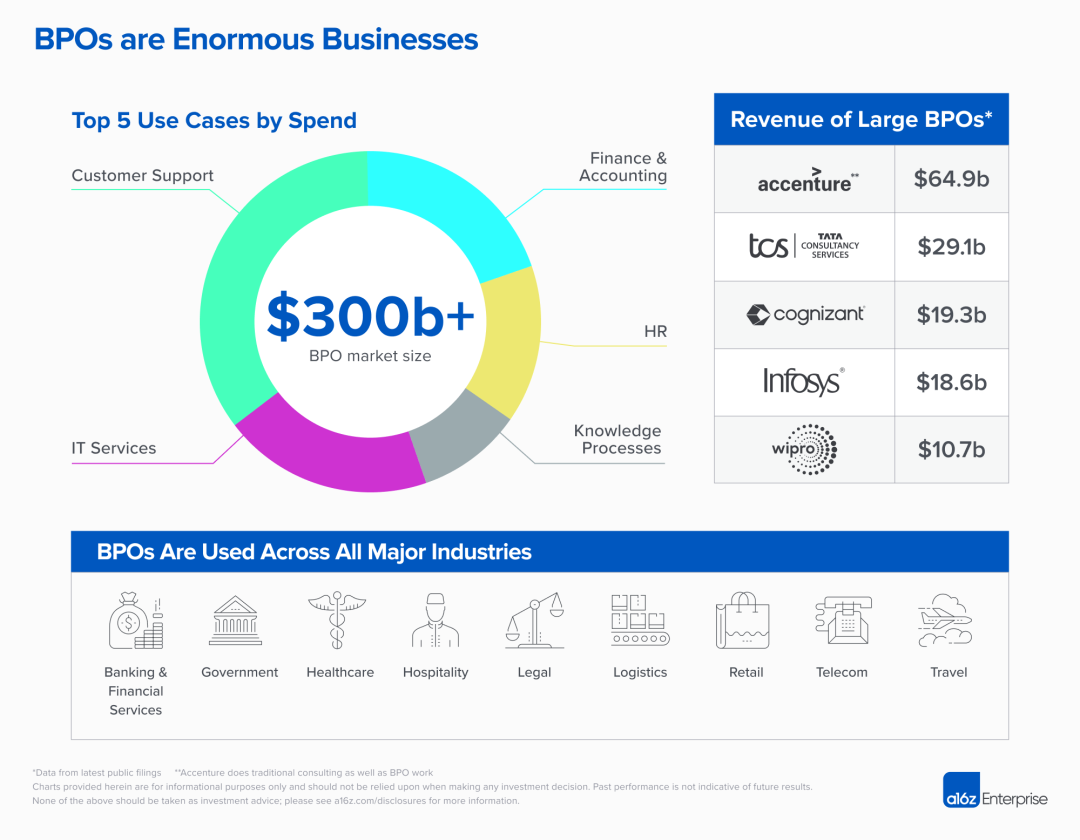
This industry functions like the essential gears and lubricants within the vast machine of modern commerce, ensuring smooth system operation. Its history dates back as far as the 1940s, when some firms began helping manufacturers manage complex operations.
Today, it is deeply integrated into nearly every major sector touched by Fortune 500 companies—retail, travel, telecommunications, logistics, manufacturing, healthcare, insurance, and banking.
It's a massive industrial ecosystem, currently valued at $300 billion and projected to exceed $500 billion by 2030.
This sustained growth underscores the immense volume of work required to maintain daily operations in large enterprises. However, this vast empire built upon "human labor" is now facing an unprecedented disruption—and the force behind it is AI.
The Nature and Limitations of Traditional BPO: Starting from "Humans"
To understand the depth of AI-driven disruption, we must first examine the essence and inherent limitations of traditional BPO models.
While BPO firms may offer strategic consulting or outsourced application development, our focus here is on the core, human-executed operational tasks.
-
Core Problems of the Traditional Model
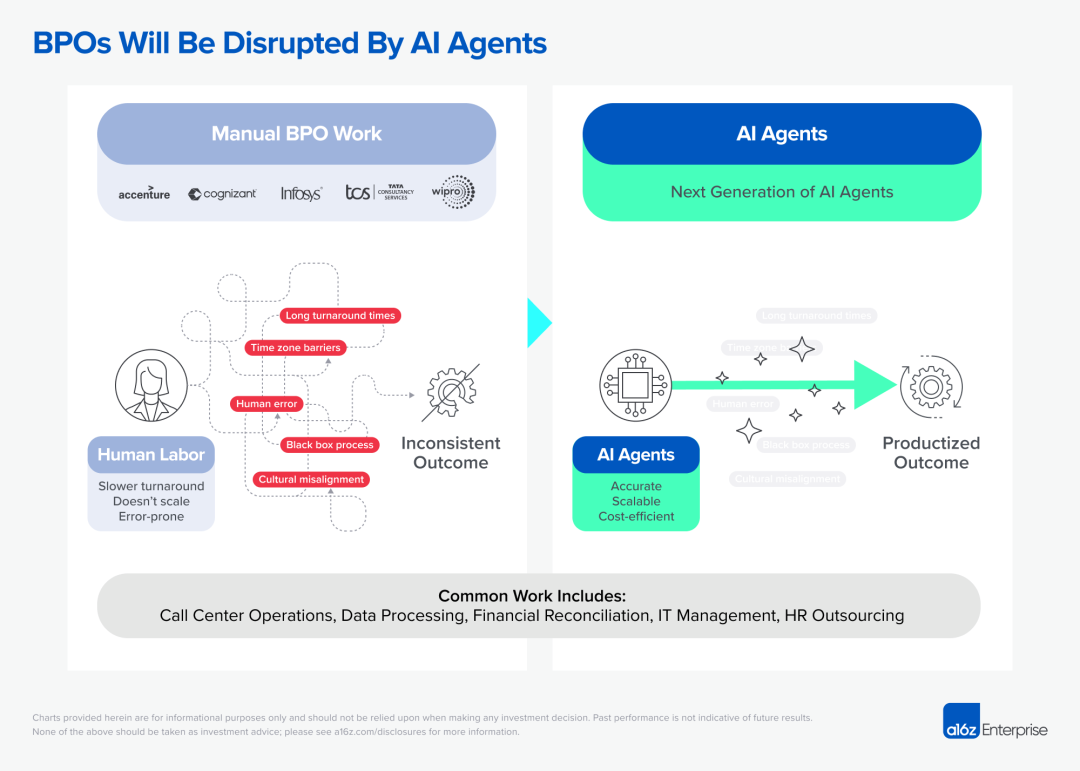
The heart of traditional BPO is ultimately "humans." Whether it's a customer service agent answering calls or an accountant processing invoices, real people perform these tasks.
This means that the efficiency, quality, and scalability of this multi-billion-dollar industry are constrained by human limitations.
One obvious issue is latency—one person cannot process 100 things at once. During peak hours for customer support, users often endure long wait times before reaching a live agent, an experience most of us know all too well.
Another problem is misunderstanding and error. Humans inevitably make mistakes when handling repetitive, procedural work due to fatigue, emotions, or lack of experience.
Although companies outsource these tasks because they are not core competencies or because managing them internally is burdensome, this doesn’t mean the work is being performed optimally.
In fact, many companies are fully aware of this but historically had no better alternative.
-
Limits of Traditional Software: Inability to Replace Human Cognition
Why couldn’t software solve this earlier? Because traditional software is limited by its need for clearly defined, stable processes. It requires structured data inputs, explicit rule sets, and operates poorly in contexts requiring nuanced understanding or judgment.
Yet, most BPO work falls precisely into this software "blind spot."
Consider a customer service scenario—you must truly understand what the caller is asking, detect whether their tone is anxious or confused. Or take invoice processing—you must interpret fields on a document even if formats vary wildly.
Such tasks involve unstructured information and require real-time judgment, which traditional software simply cannot handle. Hence, the only viable solution has been to deploy large numbers of human workers whose cognitive abilities compensate for software shortcomings.
This is the fundamental reason why the traditional BPO industry exists and thrives. It uses a "manpower army" approach to solve the challenge of processing unstructured data and making cognitive judgments—a solution that also represents its biggest ceiling.
A New Paradigm Arrives: How AI Breaks Software’s Shackles
The arrival of AI brings not just optimization of traditional software, but a fundamental paradigm shift. AI, especially LLMs, excels precisely at solving the problems that plagued traditional software.
It is adept at gathering massive amounts of typically unstructured, varied-format data scattered across different systems, synthesizing and understanding this information, and then taking targeted actions based on that understanding.
-
Voice AI: A Breakthrough from Zero to One
Among the technologies driving this AI-led transformation, some already deliver astonishing ROI and act as vanguards in disrupting BPO, while others point toward a broader future.
Voice AI, in particular, has achieved a decisive breakthrough from zero to one. We’ve all suffered through frustrating experiences with legacy phone bots—getting lost in voice menus or repeatedly misunderstood by robotic voices.
However, Voice AI has made astonishing technical progress in recent years. Today, you might engage in a natural conversation with an AI agent over the phone and not realize until much later—or ever—that you’re speaking to AI rather than a human.
These AI agents don’t just sound human in dialogue and tone—they also respond with minimal latency, matching human reaction speeds.
More importantly, they can integrate with enterprise systems, access your background information during calls, and provide faster, more accurate responses.
-
The Next Frontier: The Potential of "Operator" Technology
If Voice AI represents today’s deployed applications, another emerging technology signals AI unlocking a much broader automation frontier—what we might call “Operator” or browser-use technology.
The core idea is enabling AI agents to work across diverse software systems and interfaces—be it desktop applications, web apps, or custom internal enterprise tools—just as humans do.
Soon, AI agents will navigate these complex applications—not just retrieving information, but taking actions. This means jobs like data analysts or invoice processors, previously requiring human intervention, could soon be handled entirely by AI.
New vs. Old in the Arena: Where Should Startups Play?
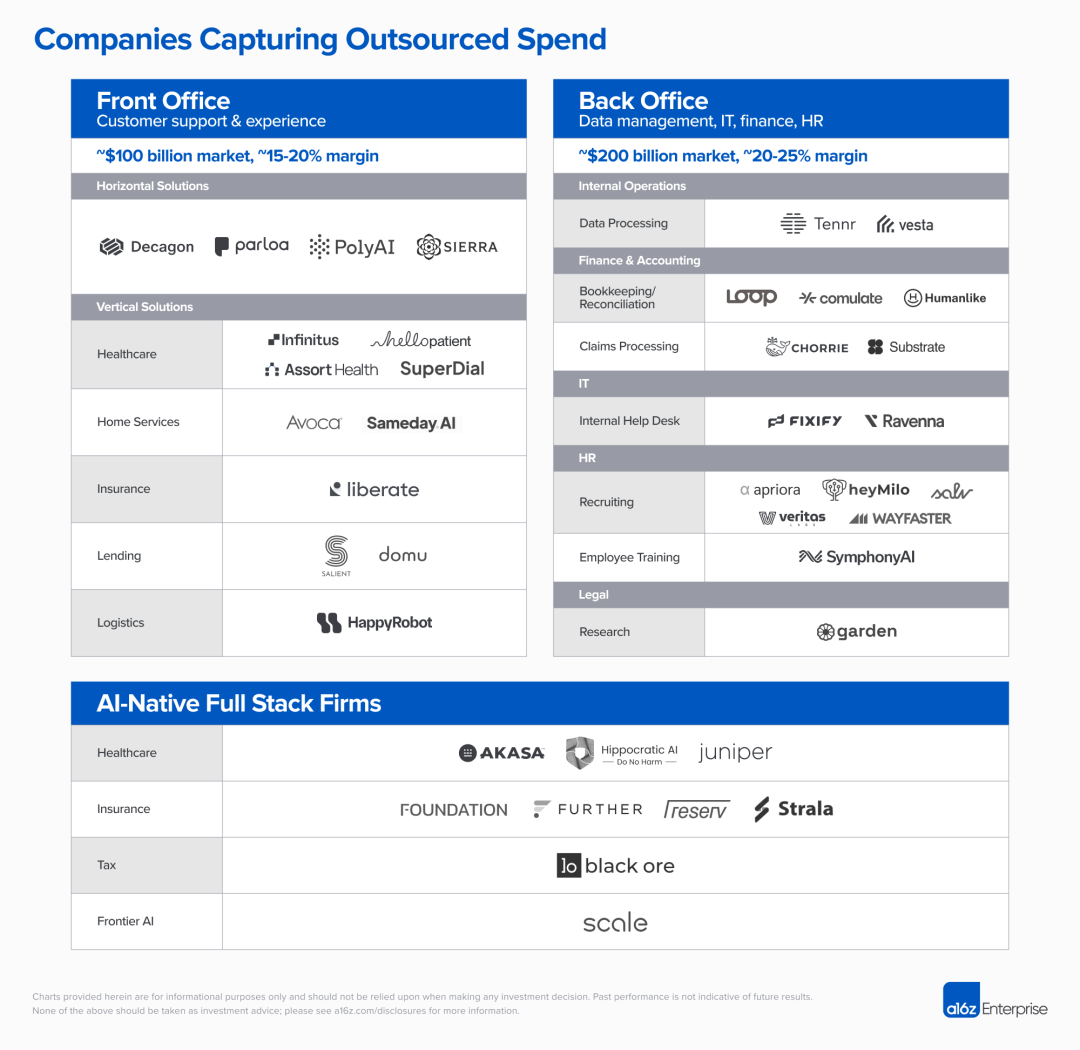
Faced with such massive change, traditional BPO giants like Accenture and Tata won’t sit idle. They recognize the potential of AI. Yet, for startups, there remains a genuinely exciting window of opportunity in the short term.
-
This Opportunity Stems from Two Key Factors:
First, there is a fundamental difference in business models. The foundation of traditional BPO giants is “labor”—organizing large teams of people to execute tasks.
For any publicly traded company generating tens of billions in annual revenue, shifting its core business from “people” to “AI products” is an extremely difficult and painful transition—one that will inevitably be slow.
Second, many underestimate the practical challenges of working with advanced AI systems. You need extensive effort to prevent AI hallucinations, build evaluation frameworks to assess agent response quality, and decide when and how to swap underlying models.
You must be a true AI-native technical founder to deeply understand how to navigate this complexity—an expertise still far from widespread today.
-
High-ROI Scenarios: Customer Support as a Prime Opportunity
Startups’ best opportunities lie in areas with extremely clear ROI—typically functions with well-defined KPIs to measure effectiveness.
Customer support is a perfect example. Its KPIs are crystal clear: number of tickets resolved within a timeframe and post-resolution customer satisfaction score (CSAT).
You can use data to clearly demonstrate the value of AI agents. By contrast, KPIs in areas like HR are much fuzzier, requiring more effort to convince enterprises to quantify the value of an AI HR assistant.
Moreover, AI isn’t omnipotent. There will always be long-tail, highly complex, or unique issues requiring human intelligence. Thus, successful business models must consider who handles these edge cases that AI cannot resolve.
Expansion and Creation: AI Not Only Remakes But Also Opens New Markets
AI’s impact on BPO isn’t merely about replacing human labor—it’s doing something even more important: expanding the entire market’s boundaries.
Historically, BPO services were reserved for large enterprises with sufficient budgets. Now, AI-powered solutions enable small and medium-sized businesses (SMBs), who previously never used BPO, to access similar services.
For instance, a mid-sized e-commerce company may previously have been unable to afford a 24/7 human customer support team. But with an efficient AI support agent, it can now offer round-the-clock service at a fraction of the cost.
In the short term, this model may not directly threaten core BPO firms, as SMBs weren’t their target customers to begin with. Instead, it creates an entirely new incremental market.
But in the long run, if AI-focused startups grow alongside their clients and eventually target larger enterprises, they will profoundly reshape the existing market landscape.
-
Enhancing Value for Existing BPO Clients
For companies already using BPO services, AI helps extend the reach of those services.
Previously, a company might offer human support only for flagship products. Now, with AI, high-quality customer service can be extended across every product line.
A good way to identify such opportunities is to look for operational tasks that "scale linearly" with company growth—meaning costs increase proportionally as the business expands.
The more customers you acquire, the more support requests you get; the larger your operations, the more invoices you process. If you can offer an AI solution that flattens this steep cost curve—or even reverses it—you present an overwhelmingly compelling and irresistible value proposition.
When AI Makes Everyone a Developer
Many large BPO firms don’t just outsource business processes—they also outsource IT or application development, building small internal tools or apps for companies lacking engineering resources.
While building full applications is far more complex than handling customer queries, a powerful trend is emerging: AI Coding Agents are rapidly improving.
This technology will empower individuals with little or no technical background to build complete applications they need.
This represents a fascinating “orthogonal attack vector” against the BPO industry. Rather than directly competing for BPO contracts, it empowers end users to solve their own problems—making the very need for “outsourcing” disappear in certain scenarios.
We can’t yet quantify exactly what this means over the next two to three years. But imagine the transformation when an entirely new group of people gains the ability to build their own applications. This isn’t just reshaping an industry—it’s liberating the way we work and unleashing creativity itself.
Join TechFlow official community to stay tuned
Telegram:https://t.me/TechFlowDaily
X (Twitter):https://x.com/TechFlowPost
X (Twitter) EN:https://x.com/BlockFlow_News