








Huobi Growth Academy | DeFi In-Depth Research Report: SEC's New Regulations, from "Innovation Exemption" to "On-chain Finance," Could Another DeFi Summer Be on the Horizon?
TechFlow Selected TechFlow Selected
Huobi Growth Academy | DeFi In-Depth Research Report: SEC's New Regulations, from "Innovation Exemption" to "On-chain Finance," Could Another DeFi Summer Be on the Horizon?
DeFi's new frontier of wealth has just begun.
 Navigating Web3 tides with focused insights
1. Introduction: SEC's New Policy and a Pivotal Shift in the DeFi Regulatory Landscape
Since 2018, the rapid development of decentralized finance (DeFi) has established it as one of the core pillars within the global crypto ecosystem. Through open, permissionless financial protocols, DeFi delivers a rich array of financial services—such as asset trading, lending, derivatives, stablecoins, and asset management—built on smart contracts, on-chain settlement, decentralized oracles, and governance mechanisms that deeply simulate and reconstruct traditional financial structures. Particularly since the "DeFi Summer" of 2020, the total value locked (TVL) across DeFi protocols briefly surpassed $180 billion, marking an unprecedented level of scalability and market validation.
However, this rapid expansion has been consistently accompanied by regulatory ambiguity, systemic risks, and regulatory vacuums. Under former U.S. Securities and Exchange Commission (SEC) Chair Gary Gensler’s leadership, U.S. regulators adopted a stringent, enforcement-heavy approach toward the broader cryptocurrency industry. DeFi protocols, decentralized exchanges (DEXs), and DAO governance models were increasingly scrutinized for potentially operating as unregistered securities exchanges, brokers, or clearing agencies. Between 2022 and 2024, projects including Uniswap Labs, Coinbase, Kraken, and Balancer Labs received various forms of investigation notices or enforcement letters from the SEC or the Commodity Futures Trading Commission (CFTC). Meanwhile, the persistent lack of clear criteria for determining “sufficient decentralization,” “public fundraising activities,” or “securities exchange operations” has left the entire DeFi sector trapped in a state of policy uncertainty—constraining technological advancement, shrinking capital investment, and prompting developer migration.
This regulatory context underwent a significant shift in the second quarter of 2025. In early June, newly appointed SEC Chair Paul Atkins outlined a proactive regulatory exploration path for DeFi during a congressional fintech hearing, articulating three key policy directions: first, establishing an “Innovation Exemption” mechanism for highly decentralized protocols, temporarily suspending certain registration obligations within defined pilot programs; second, advancing a “Functional Categorization Framework” that regulates protocols based on their operational logic and on-chain behavior rather than categorizing all token-based platforms as securities venues; and third, integrating DAO governance structures and real-world asset (RWA) tokenization projects into an open financial regulatory sandbox, using low-risk, traceable regulatory tools to engage rapidly evolving technical prototypes. This policy shift aligns with the Financial Stability Oversight Council (FSOC) under the U.S. Treasury Department’s May 2025 white paper, “Systemic Risk in Digital Assets,” which for the first time advocated using regulatory sandboxes and functional testing mechanisms to protect investor rights without “stifling innovation.”
2. Evolution of the U.S. Regulatory Approach: From “Presumed Illegality” to “Functionally Adaptive Regulation”
The evolution of U.S. regulation of decentralized finance (DeFi) reflects both the adaptation of financial compliance frameworks to emerging technologies and the regulators’ balancing act between “financial innovation” and “risk prevention.” The current SEC stance on DeFi is not an isolated event but the outcome of five years of inter-agency dynamics and gradual regulatory evolution. Understanding this transformation requires revisiting the foundational regulatory attitudes at DeFi’s inception, feedback loops from major enforcement actions, and the systemic tensions in federal and state legal applicability.
Since the DeFi ecosystem began taking shape in 2019, the SEC’s core regulatory framework has relied heavily on the 1946 Howey Test for securities classification: any arrangement involving capital investment, a common enterprise, profit expectations, and reliance on the efforts of others may be deemed a securities transaction subject to regulation. Under this standard, most tokens issued by DeFi protocols—especially those with governance rights or profit-sharing features—have been presumed to be unregistered securities, posing potential compliance risks. Furthermore, according to the Securities Exchange Act and the Investment Company Act, any activity involving matching, clearing, holding, or recommending digital assets, unless explicitly exempted, could constitute illegal operation as an unregistered broker-dealer or clearing agency.
Between 2021 and 2022, the SEC launched a series of high-profile enforcement actions. Notable cases included investigations into whether Uniswap Labs operated an “unregistered securities platform,” allegations of “illegal marketing” against Balancer and dYdX, and even sanctions by the Treasury’s Office of Foreign Assets Control (OFAC) against privacy-focused protocols like Tornado Cash. These actions revealed a broad, aggressive, and boundary-ambiguous enforcement strategy across the DeFi space—a regulatory posture best described as “presumption of illegality,” where project teams must prove their protocol designs fall outside securities laws or risk non-compliance.
Yet this “enforcement-first, rulemaking-later” strategy soon encountered pushback in legislative and judicial arenas. First, court rulings gradually exposed the limitations of applying traditional regulatory standards in decentralized contexts. For example, in the SEC v. Ripple case, courts ruled that XRP did not constitute a security in certain secondary market transactions, effectively undermining the SEC’s blanket assertion that “all tokens are securities.” Simultaneously, the ongoing legal battle between Coinbase and the SEC elevated “regulatory clarity” as a central issue driving both industry advocacy and congressional crypto legislation. Second, the SEC faced fundamental challenges in applying existing laws to DAOs. As DAOs lack traditional legal personhood or centralized beneficiaries, their on-chain autonomous governance defies conventional securities logic centered on “reliance on others’ efforts.” Consequently, regulators lacked effective legal tools—such as subpoenas, fines, or injunctions—to enforce compliance, leading to enforcement paralysis.
Against this backdrop of accumulating institutional consensus, the SEC shifted its strategy following a leadership change in early 2025. New Chair Paul Atkins, a long-time advocate for “technological neutrality” in regulation, emphasized designing regulatory boundaries based on function rather than implementation technology. Under his leadership, the SEC established a “DeFi Strategy Research Group” and co-launched a “Digital Finance Engagement Forum” with the Treasury Department. Using data modeling, protocol testing, and on-chain tracking, they developed a risk classification and governance assessment system for major DeFi protocols. This technically oriented, risk-tiered approach marks a transition from traditional securities law logic to “functionally adaptive regulation”—using the actual financial functions and behavioral patterns of DeFi protocols as the basis for policy design, thereby harmonizing compliance requirements with technological flexibility.
It should be noted that the SEC has not relinquished its regulatory authority over DeFi but is instead crafting a more flexible and iterative strategy. For instance, DeFi projects with clear centralized components—such as front-end operators, multi-sig governance controllers, or protocol upgrade authorities—will be prioritized for registration and disclosure obligations. In contrast, highly decentralized, purely on-chain-executed protocols may qualify for exemptions through “technical testing + governance auditing.” Additionally, by encouraging voluntary participation in regulatory sandboxes, the SEC aims to cultivate a compliant DeFi “middle ground” that maintains market stability and user protection while avoiding the innovation drain caused by overly rigid policies.
Overall, the U.S. DeFi regulatory trajectory is shifting from early legal overreach and enforcement suppression toward institutional dialogue, functional identification, and risk-guided oversight. This evolution reflects a deeper understanding of technological heterogeneity and signals regulators’ attempt to adopt new governance paradigms in response to open financial systems. Going forward, achieving a dynamic balance among investor protection, systemic stability, and technological advancement will remain the central challenge for the sustainability of U.S. and global DeFi regulatory frameworks.
3. Three Wealth Catalysts: Value Reassessment Under Institutional Logic
With the formal implementation of the SEC’s new regulatory policy, the overall U.S. regulatory environment toward decentralized finance has undergone a substantive shift—from “reactive enforcement” to “proactive compliance” and now to “functional alignment.” This transition provides long-awaited positive institutional incentives for the DeFi sector. As the new regulatory framework becomes clearer, market participants are reassessing the fundamental value of DeFi protocols. Several sectors and projects previously suppressed by “regulatory uncertainty” are now showing strong potential for revaluation and portfolio relevance. From an institutional logic perspective, the current value re-rating in DeFi centers on three core themes: institutional premium for compliant intermediaries, strategic positioning of on-chain liquidity infrastructure, and credit restoration opportunities for protocols with high intrinsic yield models—these three vectors form the foundation of the next wave of DeFi “wealth catalysts.”
First, as the SEC emphasizes function-oriented regulation and proposes regulatory sandbox testing or exemption for certain front-end operators and service-layer protocols, compliant on-chain intermediaries are emerging as new value pools. Unlike the early DeFi ethos of extreme “disintermediation,” there is now structural demand from regulators and markets for “compliant intermediary services,” especially in identity verification (KYC), on-chain anti-money laundering (AML), risk disclosure, and governance custody. Projects with clear legal entity structures and service licenses are becoming essential gateways in the compliance pathway. This trend elevates the valuation of DID protocols offering on-chain KYC, compliant custodians, and front-end platforms with transparent governance—from mere “technical tools” to “institutional infrastructure.” Notably, emerging “compliance chains” within Layer 2 solutions—such as rollups with whitelisting capabilities—are poised to play a critical role in this shift, providing a trusted execution layer for traditional financial capital entering DeFi.
Second, on-chain liquidity infrastructure—the backbone of resource allocation in the DeFi ecosystem—is regaining strategic valuation support due to regulatory clarity. Platforms like Uniswap, Curve, and Balancer, despite facing challenges over the past year—including liquidity depletion, ineffective token incentives, and regulatory overhangs—are once again becoming primary destinations for structural capital inflows. Especially under the SEC’s principle of “separating protocol from front-end” regulation, underlying AMM protocols, viewed as on-chain code executors, face significantly reduced legal risk. Combined with the growing integration of real-world assets (RWA) and on-chain asset bridges, expectations for on-chain depth and capital efficiency are set for systemic recovery. Moreover, on-chain oracle and price feed infrastructures such as Chainlink, which do not function as direct financial intermediaries under regulatory classification, are becoming key “risk-controlled neutral nodes” in institutional-grade DeFi deployments, playing vital roles in liquidity provision and price discovery within compliant frameworks.
Third, DeFi protocols with high intrinsic yields and stable cash flows are entering a credit recovery phase post-regulatory relief, drawing renewed attention from risk capital. In earlier cycles, lending protocols such as Compound, Aave, and MakerDAO served as the credit backbone of the ecosystem, supported by robust collateral models and liquidation mechanisms. However, amid the 2022–2023 crypto credit crisis, these protocols faced balance sheet stress, frequent stablecoin de-pegging, and liquidity crunches—exacerbated by regulatory gray areas that eroded asset safety perceptions—leading to weakened market trust and depressed token prices. Now, with clearer regulations recognizing protocol revenues, governance models, and audit mechanisms, these protocols are positioned to become credible “on-chain stable cash flow vehicles.” Their quantifiable, blockchain-verified revenue streams and low operational leverage enhance their appeal. Particularly as DeFi stablecoin models evolve toward “multi-collateral + real-world asset backing,” native stablecoins like DAI, GHO, and sUSD can build institutional-grade moats against centralized counterparts (e.g., USDC, USDT), increasing their systemic attractiveness in institutional portfolios.
Notably, the shared logic behind these three trends is the transformation of “policy perception dividends” under the SEC’s new policy into a rebalancing of “market capital valuation weights.” Historically, DeFi valuations relied heavily on speculative momentum and amplified expectations, lacking stable institutional moats or fundamental support—making them vulnerable during downturns. Now, with regulatory risks easing and legal pathways confirmed, DeFi protocols can establish valuation anchors for institutional capital based on verifiable on-chain revenues, compliance capabilities, and systemic access thresholds. This shift enables DeFi to rebuild “risk-premium-to-return” models and, for the first time, adopt credit pricing logics akin to traditional financial enterprises—laying the institutional groundwork for integration with legacy finance, RWA pipelines, and on-chain bond issuance.
4. Market Response: From TVL Surge to Asset Repricing
The SEC’s regulatory announcement not only signaled cautious acceptance and functional regulation of DeFi at the policy level but also triggered immediate market reactions, creating an efficient positive feedback loop of “regulatory expectation → capital return → asset revaluation.” The most direct manifestation has been a notable rebound in DeFi total value locked (TVL). Within one week of the policy release, according to data from DefiLlama and other major analytics platforms, Ethereum-based DeFi TVL surged from approximately $46 billion to nearly $54 billion—an increase of over 17%, the largest weekly gain since the FTX crisis in 2022. Concurrently, TVL rose across major protocols such as Uniswap, Aave, Lido, and Synthetix, while on-chain metrics including transaction activity, gas usage, and DEX trading volume showed broad-based recovery. This widespread market response indicates that the regulatory signal has effectively alleviated institutional and retail concerns about legal exposure, prompting off-chain capital to re-enter the sector and inject structural liquidity.
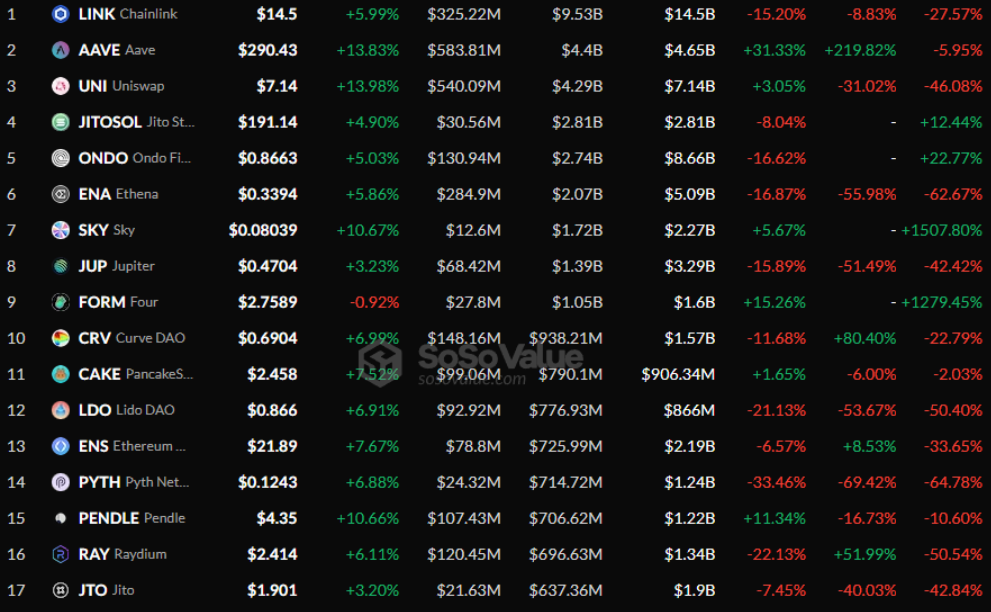
Fueled by rapid capital inflows, leading DeFi assets experienced price revaluations. Governance tokens such as UNI, AAVE, and MKR saw average price increases of 25% to 60% within a week of the policy rollout—significantly outperforming BTC and ETH during the same period. This rally was not merely sentiment-driven but reflected a market recalibration of future cash flow potential and institutional legitimacy. Previously, regulatory uncertainty led to substantial valuation discounts on DeFi governance tokens, with real protocol revenues, governance rights, and growth prospects poorly reflected in market caps. Now, with clearer regulatory pathways and growing policy tolerance for operational legality, markets are adopting traditional financial metrics—such as price-to-earnings (P/E) ratios, TVL multiples, and active user growth models—to conduct valuation repairs on DeFi protocols. This methodological shift not only strengthens the investment appeal of DeFi assets as “cash-flow-generating instruments” but also marks the sector’s progression toward a more mature, quantifiable capital pricing regime.
On-chain data further reveals shifts in capital structure. After the policy announcement, deposit transaction counts, user numbers, and average transaction sizes increased significantly across multiple protocols—particularly those integrated with RWAs, such as Maple Finance, Ondo Finance, and Centrifuge, where institutional wallet shares rose sharply. For example, Ondo’s short-term U.S. Treasury token OUSG expanded its issuance by over 40% since the policy launch, indicating that some institutionally aligned capital is beginning to deploy fixed-income-like assets via DeFi platforms. At the same time, stablecoin inflows into centralized exchanges declined, while net inflows into DeFi protocols resumed upward momentum—suggesting restored confidence in on-chain asset security. Early signs indicate that decentralized financial systems are regaining pricing power over capital allocation, with TVL evolving from a short-term speculative metric into a barometer of asset allocation and trust.
Importantly, while current market responses are strong, asset repricing remains in its early stages, and the full realization of institutional premiums is far from complete. Compared to traditional financial assets, DeFi protocols still face high regulatory trial costs, governance inefficiencies, and on-chain data audit challenges, prompting continued caution even as risk appetite improves. Yet precisely this convergence of “shrinking institutional risk” and “restored value expectations” opens room for mid-term valuation expansion. Currently, the P/S (price-to-sales) ratios of many leading protocols remain well below their mid-2021 bull market peaks. With sustained revenue growth and enhanced regulatory certainty, their valuation floors are likely to rise. Furthermore, asset repricing is influencing token design and distribution—for example, some protocols are restarting governance token buybacks, increasing surplus dividend payouts, or reforming staking models tied to protocol revenues—further embedding “value capture” into market pricing logic.
5. Outlook: Institutional Reconstruction of DeFi and a New Cycle
Looking ahead, the SEC’s new policy is not just a regulatory adjustment but a pivotal turning point for DeFi’s institutional reconstruction and sustainable development. By clarifying regulatory boundaries and market rules, the policy lays the foundation for DeFi to transition from a “wild west” phase to a mature, orderly, and compliant market. In this context, DeFi faces not only reduced compliance risks but also a new era of value discovery, business innovation, and ecosystem expansion.
First, from an institutional logic perspective, DeFi’s institutional reconstruction will profoundly reshape its design paradigms and business models. Traditional DeFi protocols often emphasized “code is law” automation while neglecting compatibility with real-world legal systems—creating legal gray zones and operational risks. The SEC’s policy, by specifying compliance requirements, compels DeFi projects to develop dual-identity systems that combine technical strengths with regulatory compliance. Issues such as balancing KYC/AML checks with on-chain anonymity, assigning legal responsibility for protocol governance, and establishing compliant data reporting mechanisms have become central to future protocol design. By embedding compliance into smart contracts and governance frameworks, DeFi will gradually adopt a new paradigm of “compliance-by-design,” achieving deeper integration between technology and law—and reducing uncertainties and penalties arising from regulatory conflicts.
Second, institutional reconstruction will inevitably drive diversification and deepening of DeFi business models. Historically, the DeFi ecosystem relied excessively on short-term incentives like liquidity mining and trading fees, failing to generate stable cash flows or profitability. Under the new policy, project teams are incentivized to build sustainable revenue streams—through protocol-level profit sharing, asset management services, compliant bond and collateral issuance, and RWA tokenization—gradually forming revenue loops comparable to traditional financial assets. In particular, the regulatory green light significantly boosts institutional confidence in DeFi products, enabling diverse asset classes—such as supply chain finance, real estate securitization, and invoice financing—to enter the on-chain ecosystem. In the future, DeFi will no longer be merely a decentralized trading venue but a fully institutionalized financial infrastructure for issuing and managing on-chain assets.
Third, the institutional redesign of governance mechanisms will become a core driver of DeFi’s new cycle. Past DeFi governance largely depended on token voting, suffering from fragmented control, low turnout, and inefficiency, with little connection to legal frameworks. The SEC’s proposed governance standards are pushing protocol designers to explore legally recognized governance models—such as registering DAOs as legal entities, validating governance actions under law, and introducing multi-party compliance oversight—to enhance legitimacy and enforceability. Future DeFi governance may adopt hybrid models combining on-chain voting, off-chain agreements, and legal frameworks to create transparent, compliant, and efficient decision-making systems. This not only mitigates risks of power concentration and manipulation but also strengthens trust from regulators and investors, serving as a cornerstone for long-term sustainability.
Fourth, with improved compliance and governance, the DeFi ecosystem will attract a broader range of participants and undergo capital structure transformation. The new policy drastically lowers the entry barrier for institutional investors and traditional financial institutions. Major asset managers, pension funds, and family offices are actively seeking compliant on-chain asset allocation strategies, spurring demand for institutional-grade, customized DeFi products and services. Meanwhile, insurance, credit, and derivatives markets under compliant conditions are poised for explosive growth, enabling comprehensive coverage of on-chain financial services. Project teams will also refine token economic models, reinforcing the rationale for tokens as governance instruments and value carriers—encouraging long-term holding and value investing while reducing short-term speculation, thus fueling stable ecosystem growth.
Fifth, technological innovation and cross-chain integration serve as the technical backbone and engine for DeFi’s institutional reconstruction. Compliance demands are accelerating innovation in privacy protection, identity verification, and contract security—driving wider adoption of zero-knowledge proofs, homomorphic encryption, and secure multi-party computation. At the same time, cross-chain protocols and Layer 2 scaling solutions will enable seamless transfer of assets and information across multi-chain ecosystems, breaking down silos and enhancing liquidity and user experience. In the future, a multi-chain, compliance-enabled ecosystem will provide a solid foundation for DeFi innovation, facilitating deeper integration with traditional finance and enabling a new hybrid “on-chain + off-chain” financial architecture.
Finally, while the institutionalization of DeFi opens a new chapter, significant challenges remain. These include policy consistency and international regulatory coordination, managing compliance costs, improving project teams’ compliance awareness and technical capacity, and balancing user privacy with transparency. Industry stakeholders must collaborate to develop standards and self-regulatory mechanisms, leveraging industry consortia and third-party auditors to build a multi-layered compliance ecosystem—continuously raising the sector’s institutional maturity and market credibility.
6. Conclusion: The New Frontier of DeFi Wealth Has Just Begun
As the frontier of blockchain financial innovation, DeFi stands at a critical juncture of institutional restructuring and technological upgrading. The SEC’s new policy creates an environment of both regulation and opportunity, guiding the industry from unregulated growth toward compliant development. As technology advances and the ecosystem matures, DeFi holds the potential to deliver broader financial inclusion and value transformation, becoming a cornerstone of the digital economy. Yet sustained efforts in regulatory compliance, technical security, and user education remain essential for unlocking the long-term prosperity of this new wealth frontier. With the SEC’s new policy—from “innovation exemptions” to “on-chain finance”—a comprehensive breakout may be imminent. Another “DeFi Summer” could be on the horizon, and blue-chip DeFi tokens may be poised for significant value revaluation.
Join TechFlow official community to stay tuned
Telegram:https://t.me/TechFlowDaily
X (Twitter):https://x.com/TechFlowPost
X (Twitter) EN:https://x.com/BlockFlow_News
 @HTXAcademy


