CZ Announces 'DeFi Day': Decoding SEC's New Regulations and the Three Wealth Codes Set to Ignite the Summer
TechFlow Selected TechFlow Selected
CZ Announces 'DeFi Day': Decoding SEC's New Regulations and the Three Wealth Codes Set to Ignite the Summer
SEC's new chair, Atkins, outlined three "wealth codes" in a speech, signaling a new regulatory direction for the crypto industry.
 Navigating Web3 tides with focused insights
By Oliver, Mars Finance
In the ever-changing world of investing, true opportunities are rarely found in the noise of market charts, but rather hidden within seemingly dull policy documents from Washington. When the regulatory tide turns, its ripple effects can define the flow of wealth for years to come. Recently, a speech delivered by Gary Gensler’s successor, SEC Chair Evelyn Atkins, at a conference on “DeFi and the American Spirit,” has emerged as precisely such a document—a veritable treasure map worthy of deep analysis.
The impact of this event spread rapidly, prompting Binance founder CZ (Changpeng Zhao) to publicly declare on social media: “June 9 will be remembered as DeFi Day.” This statement has already etched the moment into history. Industry observers have also sensed an unusual shift in the air, suggesting that a new “DeFi Summer” may be on the verge of unfolding. And this is no mere speculation. Looking back at the fiery summer of 2020, DeFi flourished wildly in a regulatory gray zone, creating countless legends. Today, Atkins’ remarks appear to be laying the runway for a more compliant, powerful, and potentially inclusive “DeFi Summer 2.0”—one where both institutions and retail investors can participate.
This was not just another routine government statement, but a profound reflection and systematic correction of Gensler-era “enforcement-first” regulatory philosophy. Within this emerging regulatory blueprint, we can identify three transformative “wealth codes” capable of reshaping the industry landscape and igniting a new era of growth. Let us now dissect their deeper meanings with careful precision.
Market Reacts Instantly: Strong Response from the DeFi Sector
Following the release of Chair Atkins’ remarks, financial markets responded swiftly and decisively. Major DeFi protocol tokens surged, forming a striking market rally—as if collectively applauding the arrival of a new regulatory wind.
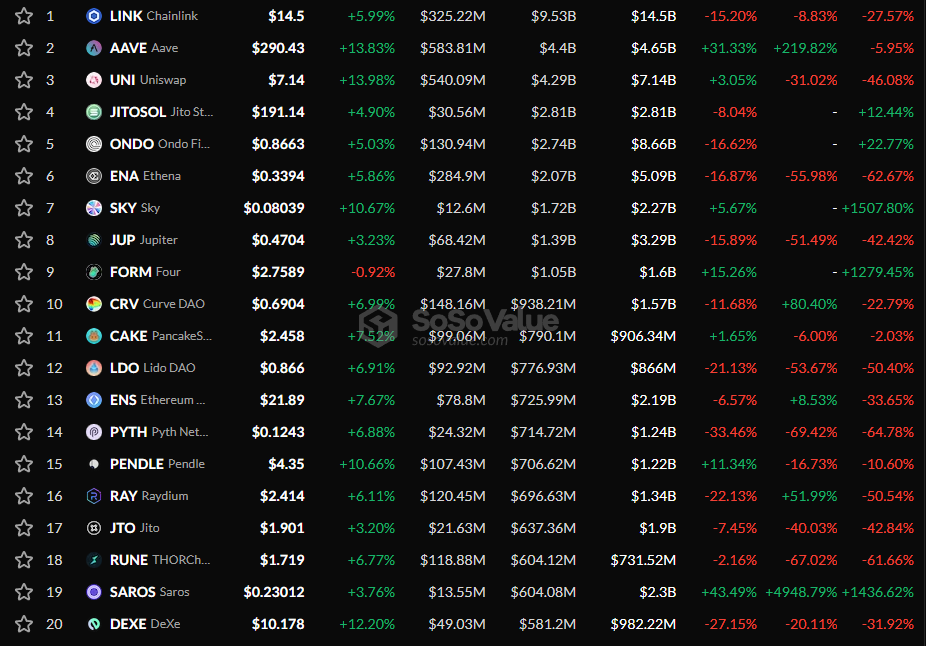
According to market data, blue-chip DeFi projects posted significant gains. Leading decentralized lending platform Aave (AAVE) and top decentralized exchange Uniswap (UNI) both soared over 13%, while Chainlink (LINK), a cornerstone infrastructure provider and oracle leader, rose nearly 6%. Additionally, liquid staking protocol Jito (JITOSOL) and real-world asset (RWA)-focused Ondo Finance (ONDO) each gained more than 5%.
This data is no random coincidence—it directly validates the value of the three “wealth codes” we are about to explore. The market logic is clear: the strong rebound in AAVE and UNI reflects investor confidence in core DeFi applications under clearer regulation; LINK’s rise signals renewed optimism for infrastructure-layer valuation; while gains in Jito and Ondo highlight growing recognition of the potential in staking ecosystems built on self-custody and the RWA赛道 within an innovation sandbox. In short, the market has already cast a vote of confidence—using real capital—to affirm the positive implications of Atkins’ new policies.
The First Wealth Code: Immunity for Code — Rebuilding the Soil for Innovation
The first and most fundamental code lies in Atkins’ redefinition of developer responsibility. She offered a compelling analogy: “It would be irrational to hold the developers of self-driving cars responsible when third parties use them to break traffic laws or rob banks.” Behind this statement is the formal coronation of the principle of “code neutrality.”
This very principle was the foundational condition for the explosive DeFi Summer of 2020—“permissionless innovation.” Back then, developers could freely launch experimental protocols without fear of liability for how others might misuse the code. However, the Gensler era, epitomized by the Tornado Cash case, abruptly ended this spirit of free innovation, leaving developer communities in constant legal anxiety.
Atkins’ framing effectively lifts this chilling effect. By clearly shifting accountability from the tool’s creator to its user, she strongly defends the open-source world’s foundational belief: “code is speech.” When regulation focuses not on the code itself but on malicious usage, the entire industry’s foundational logic becomes clear once again. An environment where developers can boldly experiment and iterate rapidly is returning.
The first beneficiaries of this shift are the foundational infrastructure projects building the crypto ecosystem. Whether Layer 1 and Layer 2 blockchains or teams providing development toolkits (SDKs), they have had a major negative variable removed from their valuation models. Moreover, this opens up room for value recovery in decentralized privacy projects. Once technological neutrality is acknowledged, “privacy” is no longer conflated with “guilt.” Markets will begin to reassess privacy-focused projects with solid technology that protect users’ legitimate rights. This signals that investment certainty in infrastructure and developer ecosystems has reached unprecedented levels.
The Second Wealth Code: Return of Property Rights — Igniting the Engine of Liquidity
If the first code liberates innovation, the second provides the essential fuel to ignite liquidity. Atkins emphasized: “The right to autonomously manage private property is one of America’s core values—and this right should not vanish simply because someone logs onto the internet.” This is nothing less than a royal endorsement of “self-custody” in the crypto world.
The DeFi Summer of 2020 revolved around yield farming, where users staked or lent their assets across various protocols to earn returns. All of this relied fundamentally on users having absolute control over their own assets. Yet during the Gensler era, crackdowns on centralized staking services cast a shadow over the legality of such practices.
Atkins’ remarks, however, amount to a full declaration of “property rights restoration.” She shifts the narrative focus from platforms’ “services” back to users’ “rights,” explicitly supporting direct participation in on-chain finance via personal wallets. This is not merely technical recognition—it’s an affirmation, grounded in American core values, of the sacred principle: “Not your keys, not your coins.”
This code unlocks the vast ecosystem of staking and its derivatives. Liquid staking protocols like Lido and restaking platforms like EigenLayer now enjoy fundamental legitimacy for their business models. The biggest market concern—whether these would be classified as unregistered securities—has largely evaporated, opening the door to trillions in institutional asset allocation. At the same time, the strategic value of all wallet providers has been dramatically elevated, positioning them as gateways to the next generation of internet “super apps.”
The Third Wealth Code: The Innovation Sandbox — An Official Incubator for New Species
After clarifying the two foundational principles of “innocent code” and “sacred property rights,” Atkins introduced the third and most constructive code: an “Innovation Exemption” framework. This marks a pivotal shift in the SEC’s approach—from “passive defense” and “after-the-fact punishment” toward “proactive guidance” and “preemptive planning.”
The original DeFi Summer witnessed a “Cambrian explosion” of new species—AMM DEXs, decentralized lending, algorithmic stablecoins—all emerging in a regulatory wilderness. Atkins’ “innovation sandbox” aims to provide an officially sanctioned, safer incubator for the next wave of breakthrough innovations.
This is a masterstroke of regulatory wisdom. It acknowledges that forcing 20th-century laws onto fast-evolving digital finance is inherently misguided. Therefore, as long as core safeguards like anti-fraud are maintained, granting emerging technologies space to test, fail, learn, and grow in real market conditions becomes not only reasonable—but necessary.
This code opens a new testing ground for visionary entrepreneurs and discerning investors alike. Pioneers working to tokenize real-world assets like real estate and bonds, or dreamers envisioning decentralized social networks, now have a predictable “fast lane” to validate their ideas. For venture capital firms and early-stage investors, this means the largest systemic risk in their portfolios—regulatory uncertainty—is significantly reduced.
Outlook: The Prelude to “DeFi Summer 2.0”
Chair Atkins’ speech serves as a key unlocking the new SEC regulatory paradigm. These three “wealth codes”—immunity for code, return of property rights, and the innovation sandbox—are interconnected, collectively forming a clearer, friendlier, and more dynamic regulatory framework.
If the 2020 DeFi Summer was a grassroots celebration driven by hackers and adventurers—an organic, bottom-up movement—then what Atkins’ policies herald may be a “DeFi Summer 2.0”: a coordinated boom involving developers, retail investors, and Wall Street giants alike. This time, it won’t be wild west growth, but orderly prosperity under well-defined rules.
This is not just about short-term gains in a few sectors, but a profound long-term revaluation. It signals that the U.S. is adopting a more confident and open posture to reclaim leadership in the global crypto economy. For everyone in this space, understanding these signals and transforming them into deep insight may well be the key to navigating market cycles and seizing the pulse of the next era. The gears of history have begun to turn. A new chapter of maturity and prosperity in crypto is unfolding before our eyes.
Join TechFlow official community to stay tuned
Telegram:https://t.me/TechFlowDaily
X (Twitter):https://x.com/TechFlowPost
X (Twitter) EN:https://x.com/BlockFlow_News