Why is Circle's上市 considered another landmark event for the crypto industry?
TechFlow Selected TechFlow Selected
Why is Circle's上市 considered another landmark event for the crypto industry?
Its significance lies in elevating a stablecoin—previously recognized only by a specific group—to the mainstream stage, gaining favor from some Old Money as well.
 Navigating Web3 tides with focused insights
On Thursday evening last week, Circle, the issuer of the world's second-largest stablecoin USDC (holding around 25% market share), officially listed on the New York Stock Exchange at an IPO price of $31 per share. Circle triggered multiple trading halts during the session and closed its first trading day with a surge of 168.48%, reaching $83.23 per share. Its market capitalization exceeded $18.5 billion on the day and rose nearly 30% further the following day.
The global stablecoin market has now surpassed $250 billion in total market cap, with USDT and USDC together accounting for 86% of the market share. This is precisely why Circle repeatedly adjusted its pricing ahead of the IPO—the demand far exceeded expectations.
Circle’s NYSE listing also placed "stablecoins" at the center of financial headlines for several days, helping more traditional finance professionals recognize the value of stablecoins in a new light.
Adding to this momentum, on almost the same day, Hong Kong SAR officially announced August 1, 2025 as the implementation date for its Stablecoin Regulation, further fueling market interest. Meanwhile, the U.S. GENIUS stablecoin bill is also making progress—everything seems to be aligning perfectly.
We won’t dwell here on the intrinsic value of stablecoins. After years of explosive growth, denying their significance today might be as shortsighted as claiming “BTC is useless”—a perspective that demands reevaluation.
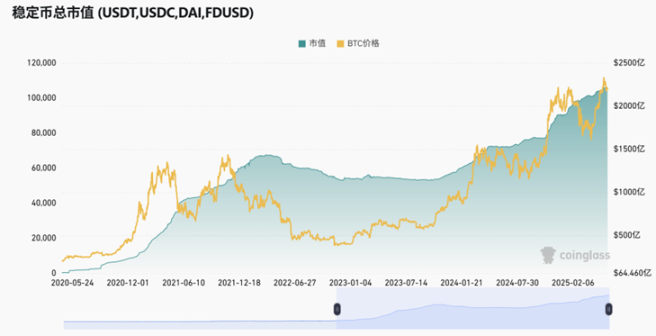
Flash back four years to roughly the same period—the previous bull cycle—when Coinbase, the largest U.S. crypto exchange, successfully went public on Nasdaq. On its debut day, its stock surged to $429, briefly exceeding $112 billion in market cap, delivering hundredfold returns to early investors.
However, it was followed by over two years of correction. The performance in the months after listing drew criticism, with some even labeling it a “junk company.” Yet, Coinbase’s successful IPO opened the eyes of traditional finance to this emerging asset class, paving the way for today’s BTC ETFs and institutional-grade digital asset reserves.
Likewise, Circle’s listing marks a pivotal moment: it brings stablecoins—once recognized only by a niche community—into the mainstream spotlight and earns favor from established financial players. Without broader visibility, especially through a regulated public listing that demonstrates financial health and corporate transparency, stablecoins would struggle to gain legitimacy in the mainstream world—an essential step for their long-term development.
As Circle co-founder Jeremy Allaire said in a Bloomberg interview: “The IPO will bring greater trust, compliance, and transparency to Circle’s regulated stablecoin network, and help us build partnerships with other financial institutions.”
In 2008, Satoshi Nakamoto introduced the concept of “trustless money” and created BTC, aiming to challenge traditional financial institutions prone to monetary over-issuance. However, due to various limitations, BTC has largely failed to function effectively as a payment method—precisely why stablecoins have risen so rapidly.
In a sense, stablecoins have inherited part of Satoshi’s original vision—but only in form. They’ve reverted to institutional logic, merely adopting blockchain technology. Still, we cannot dismiss their value because of this.
a16z Crypto’s latest report highlights that stablecoin transaction volume reached $33 trillion over the past 12 months—continuously setting new records and approaching 20 times PayPal’s volume and nearly three times that of Visa.
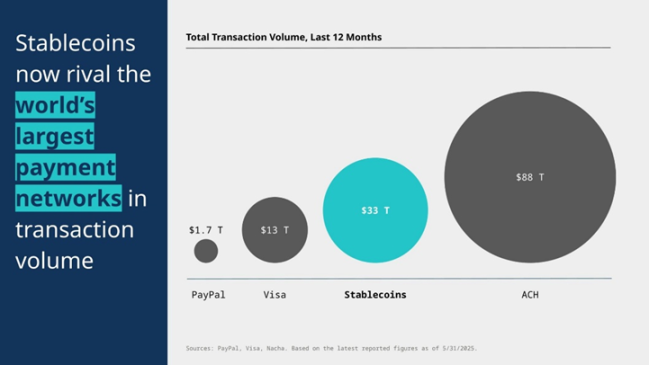
Some may argue that the current stablecoin market is already substantial, but compared to the traditional payment industry, which operates at tens of trillions of dollars annually, it still appears somewhat “nascent.” But if stablecoins are poised to become a multi-trillion-dollar standalone market within the next 3–5 years, then we may have only just passed the starting line.
Hence, Circle’s IPO feels like a small celebration—a moment of legitimization for stablecoins. But the real show begins after the celebration ends. As the most mature application in the crypto space beyond trading, stablecoins may well be the true gateway that brings Web3/crypto into everyday life—not the NFT craze of earlier years.
For investors and entrepreneurs, this transition presents abundant opportunities. Making money from money will always be a solid business. And even if you’re not creating the money itself, being a service provider in this ecosystem offers immense potential. The journey has only just begun—risks and rewards lie ahead in equal measure.
So, what will Circle’s market cap be in four years?
Join TechFlow official community to stay tuned
Telegram:https://t.me/TechFlowDaily
X (Twitter):https://x.com/TechFlowPost
X (Twitter) EN:https://x.com/BlockFlow_News