
From crypto whale James Wynn to market manipulation: analyzing the opportunities and risks of the on-chain contract Hyperliquid
TechFlow Selected TechFlow Selected
From crypto whale James Wynn to market manipulation: analyzing the opportunities and risks of the on-chain contract Hyperliquid
For investors, Hyperliquid is both a land of opportunity and a minefield of risks.
 Navigating Web3 tides with focused insights
Author: Lawrence, Mars Finance
Hyperliquid: The New Dominator of On-Chain Liquidity
In May 2025, the crypto market witnessed a new surge, with Bitcoin breaking past the $110,000 mark and Ethereum stabilizing above $2,600. Amid this rally, an on-chain derivatives platform named Hyperliquid is redefining industry standards with staggering data.
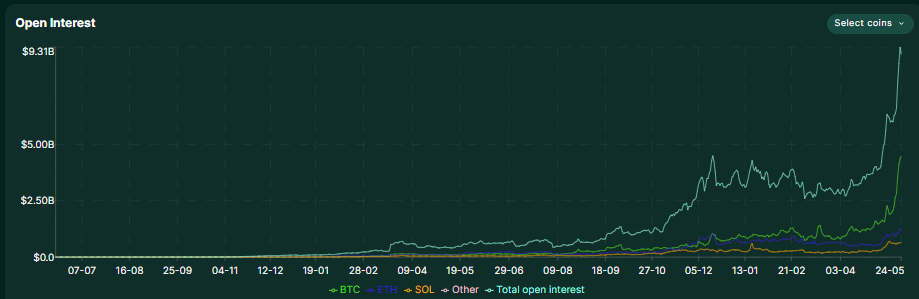
On May 26, Hyperliquid announced its open interest had reached $10.1 billion, 24-hour fee revenue hit $5.6 million, and USDC locked value surpassed $3.5 billion—three metrics all setting new historical highs.
This achievement not only signifies Hyperliquid overtaking traditional CEXs (such as Binance and Bybit) to become the central hub for on-chain derivatives traffic, but also reveals a new trend: crypto whales are shifting their battleground from centralized exchanges to on-chain platforms, with Hyperliquid emerging as their primary "hunting ground."
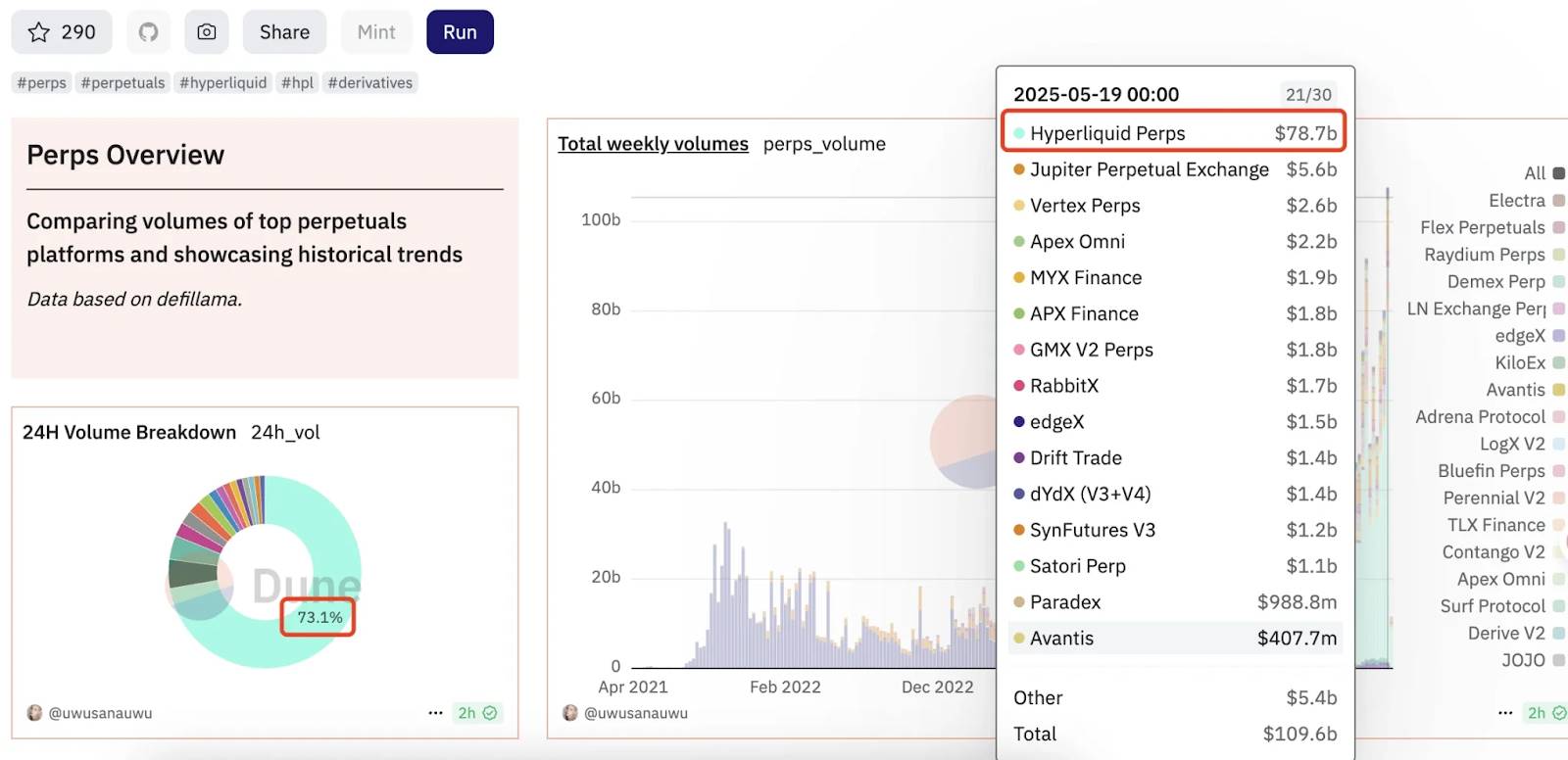
Data shows Hyperliquid’s rise is no accident. Its daily trading volume share exceeds 70%, and its 7-day trading volume growth reached 46%, far outpacing comparable platforms.
Behind this phenomenon lies whales’ relentless pursuit of high leverage, low fees, and transparency. Take renowned trader James Wynn, who recently opened a $568 million long position on Bitcoin at 40x leverage on Hyperliquid, directly pushing BTC past the psychological $100,000 threshold—a maneuver nearly impossible on traditional CEXs. Hyperliquid's "on-chain CEX" characteristic—combining DeFi-like transparency with centralized-exchange-level leverage—has made it the ideal arena for whale battles.
The Whale Hunting Logic: From Position Warfare to Market Sentiment Manipulation
Within Hyperliquid’s ecosystem, whales' profit models have evolved beyond simple long/short trading into a blend of "attention economics" and psychological warfare.

James Wynn exemplifies this strategy through three key traits: high leverage (40x), massive positions (hundreds of millions of dollars), and public signaling. By disclosing his holdings, he attracts follower capital to push asset prices upward while amplifying market sentiment via social media, creating a positive feedback loop of "position-sentiment-price." For instance, his persistent claim that "Bitcoin at $100,000 remains undervalued" has drawn in large numbers of retail investors, further reinforcing the bullish trend.
This strategy is not isolated. Earlier, another Hyperliquid whale @qwatio precisely predicted the Fed interest rate decision using 50x leverage, earning over $9 million in a single day—an event so well-timed with policy announcements that it raised suspicions of insider trading.
Although on-chain investigator ZachXBT exposed his real identity as British fraudster William Parker, this did not diminish his market influence. These cases reveal a harsh reality: in the on-chain derivatives market, whales’ "legitimacy" and "profitability" are often decoupled, with the market prioritizing outcomes over methods.
More alarmingly, whales’ on-chain activities have given rise to new forms of market manipulation. For example, by withdrawing unrealized profits to reduce margin requirements, they can trigger the platform’s liquidation mechanism to take over their positions, thereby transferring risk to liquidity pools (e.g., HLP Vault). In Hyperliquid’s March 2025 liquidation incident, one whale profited $1.86 million this way, while the platform’s liquidity pool suffered a $4 million loss. This form of "rule-compliant arbitrage" exposes risk management flaws in on-chain derivatives and forced Hyperliquid to urgently reduce leverage caps (BTC to 40x, ETH to 25x) and upgrade its margin system.
Meme Coins and Leverage: The Whale’s Double-Edged Sword
Within Hyperliquid’s ecosystem, the combination of meme coins and high-leverage contracts has become another powerful tool for whales to extract liquidity. James Wynn’s rise is closely tied to meme coins: in 2023, he turned a $7,000 investment in PEPE into over $25 million in profits;
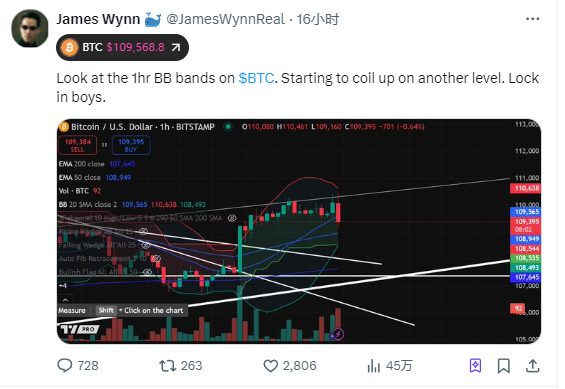
In 2025, associated addresses transferred 389.18 billion PEPE tokens to Binance, again triggering price volatility. The core of this "meme + leverage" model lies in leveraging on-chain transparency to generate FOMO, then amplifying returns through high leverage.
Recently, the meme coin moonpig became a textbook case of this model. On May 22, moonpig’s market cap surged from $30 million to $100 million—a gain of over 300%—driven primarily by James Wynn’s public endorsement. However, when the price briefly dropped 30%, critics accused him of "pump and dump." Though he denied it and hinted at exiting the derivatives market, his subsequent deposit of 4 million USDC to increase his Bitcoin position reaffirmed whales’ power over market sentiment.
The essence of such operations is combining meme coins’ volatility with leverage’s explosive potential to create short-term windfalls—at the cost of increased market fragility.
Notably, Hyperliquid’s low fees and high liquidity further amplify these risks. For example, in March, its absolute funding rates for BTC and ETH were significantly lower than those of Binance and Bybit, while its average daily liquidation amount reached $400 million, far exceeding traditional platforms.
This environment attracts numerous "gambler-type" whales—for instance, one user leveraged ETH 50x long and earned $6.8 million in a single day following favorable Trump policy news, despite being just $22 away from liquidation at entry. Such "playing on the edge" pushes on-chain derivatives to extremes of speculation and risk.
Controversy and Reflection: The Regulatory Dilemma of On-Chain Derivatives
Beneath Hyperliquid’s success lie inherent contradictions within decentralized finance (DeFi): the coexistence of transparency and manipulability. On one hand, on-chain data transparency makes whale positions visible, allowing retail traders to track "smart money"; on the other, whales exploit this very transparency to manipulate markets in reverse, creating a distorted "open-card博弈" ecosystem. Trader Eugene sharply criticized: "The disadvantages of publicly revealing massive positions outweigh the benefits, with negative externalities far exceeding positive ones."
This contradiction is even more pronounced in regulation. Traditional CEXs can curb manipulation through dynamic risk controls and position size limits—such as capping large positions at 1.5x leverage.
But as a DEX (decentralized exchange), Hyperliquid must balance "permissionless access" with "risk control." Although it has introduced margin improvements (e.g., requiring liquidation losses to exceed 18.3%), whales can still circumvent limits by distributing positions across multiple accounts. This "cat-and-mouse game" reflects DeFi’s governance challenge: how to prevent systemic risk while preserving decentralization?
The community is deeply divided. Some advocate introducing CEX-style risk controls, such as tiered margin adjustments based on position size; others argue this violates DeFi principles, believing the true solution lies in attracting more market makers to boost liquidity and naturally raise manipulation costs. Hyperliquid leans toward the latter, and its recent moves to onboard professional market makers and expand on-chain asset offerings may prove crucial for future ecosystem stability.
Future Outlook: Opportunities and Challenges of Onchain Summer
Hyperliquid’s rise marks the crypto market’s entry into a new phase—"Onchain Summer." As CEXs like Binance and OKX embrace on-chain ecosystems via Wallet features, and traditional institutions enter through ETFs, the liquidity barriers of on-chain derivatives are gradually dissolving. With its positioning as a "high-performance L1 chain + on-chain CEX experience," Hyperliquid has become the biggest beneficiary of this trend.
Yet, can a whale-dominated ecosystem be sustainable? The answer hinges on three variables:
-
Regulatory pressure: If countries bring on-chain derivatives under derivative regulatory frameworks, Hyperliquid could face KYC requirements and leverage caps, potentially weakening its competitive edge.
-
Technological iteration: Currently, Hyperliquid’s TPS (transactions per second) still lags behind chains like Solana. Without performance improvements, large whale trades may cause network congestion and increased slippage.
-
Retail participation: Hyperliquid currently has only 390,000 users and limited spot trading options. Without attracting more retail traders to hedge whale-driven volatility, the platform risks becoming merely a "whale playground."
For investors, Hyperliquid is both an opportunity zone and a minefield. Following whales requires caution against "survivorship bias"—James Wynn’s success obscures the tragedies of countless liquidated traders. Blindly copying high-leverage strategies may simply turn one into fuel for whale harvests. Only by building independent analytical frameworks can one navigate the turbulent waters of on-chain derivatives with resilience.
Join TechFlow official community to stay tuned
Telegram:https://t.me/TechFlowDaily
X (Twitter):https://x.com/TechFlowPost
X (Twitter) EN:https://x.com/BlockFlow_News