








“True Buybacks” in the DeFi Sector in 2026: JST Has Burned Over 1.35 Billion Tokens; JUST Demonstrates Long-Termism Through Its Ecosystem’s Hard Capabilities
TechFlow Selected TechFlow Selected
“True Buybacks” in the DeFi Sector in 2026: JST Has Burned Over 1.35 Billion Tokens; JUST Demonstrates Long-Termism Through Its Ecosystem’s Hard Capabilities
The JUST ecosystem leverages the dual engines of JustLend DAO and USDD to drive continuous deflation of JST. Meanwhile, JST’s value is deeply tied to the revenues generated by these two core businesses, achieving high alignment between overall ecosystem growth and token holders’ interests.
 Navigating Web3 tides with focused insights
Against the backdrop of Bitcoin’s market volatility and downward trend, tightening liquidity across the broader crypto market, and a generally subdued trading atmosphere, JST has completed its third large-scale token buyback and burn. This “real buyback” strategy—valued in the tens of millions of dollars—has enabled JST to break out against the tide, acting like a ray of sunlight injecting much-needed long-term confidence into an otherwise chilly industry. This move not only fully demonstrates JST’s robust ecosystem strength capable of weathering market cycles but also reaffirms its steadfast commitment to long-term value creation.
Unlike the many short-lived, marketing-driven burns seen across the industry, JST’s buyback-and-burn mechanism is deeply rooted in genuine ecosystem revenues—a self-sustaining, repeatable, long-term value-enabling program. As such, JST has established a complete value loop and a logically rigorous deflationary governance framework, building a truly sustainable and implementable governance system.
Specifically, JST’s buyback-and-burn mechanism is tightly linked to real ecosystem revenues generated by JUST’s two core business lines: the lending platform JustLend DAO and the stablecoin USDD. Currently, all buyback funds originate exclusively from JustLend DAO. The entire process is fully transparent and publicly auditable: fund sources are clearly traceable, and every burn transaction is permanently recorded on-chain for anyone to verify—ensuring, at the foundational design level, both the sustainability and credibility of its deflationary governance.
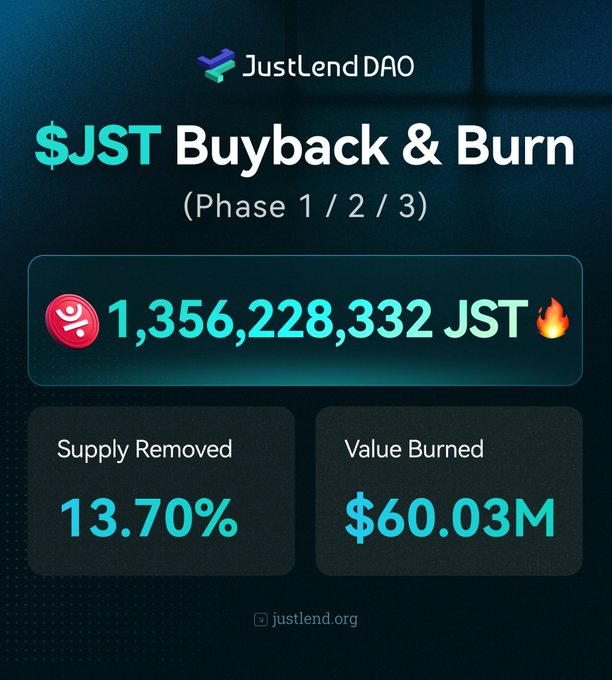
In just six months, JST has efficiently executed three consecutive large-scale buyback-and-burn operations, investing over $60 million in total and burning 1.356 billion JST tokens—approximately 13.7% of the total token supply. Based on JST’s recent market price of roughly $0.08 per token, the total value of tokens burned across the three rounds exceeds $100 million.
Three Rounds of “Real Money” Burns Escalate Steadily—The Deflationary “Flywheel” Drives Dual Growth in JST Price and Market Cap
After three textbook-level, large-scale buyback-and-burn operations, JST’s deflationary strategy has delivered an impressive market performance: the total token supply has been directly reduced by over 1.356 billion tokens. As JST’s buyback-and-burn mechanism becomes increasingly institutionalized, its deflationary “flywheel” effect is accelerating—enhancing token scarcity and thereby building a formidable value moat, providing strong support for steady, concurrent growth in both JST’s price and market capitalization.
Looking at the specific burn trajectory, each round shows a clear and robust upward trend in funding:
- Round One (October 2025): Breaking New Ground— Burned approximately 559 million JST tokens (5.66% of total supply), with ~$17.72 million invested;
- Round Two (January 2026): Exceeding Expectations— Burned approximately 525 million JST tokens (5.30% of total supply), with investment increased to ~$21 million—including $10.34 million in accumulated earnings and $10.19 million in net earnings added in Q4 2025;
- Round Three (April 15, 2026): Executed as Scheduled— Burned approximately 271 million JST tokens (2.74% of total supply), with investment further rising to ~$21.3 million—including $10.34 million in accumulated earnings and $10.97 million in net earnings added in Q1 2026.
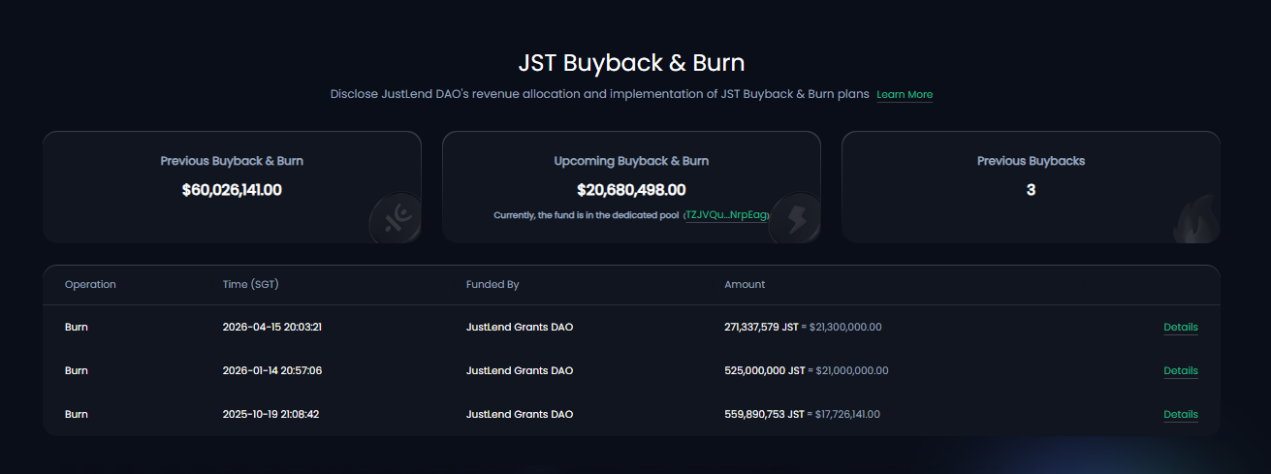
The cumulative investment across these three rounds exceeds $60 million—and follows a clear, stepwise escalation in “real money”: from $17.72 million in Round One, to $21 million in Round Two, and then to $21.3 million in Round Three. All funds come exclusively from JustLend DAO’s genuine operational revenue—including both accumulated earnings and newly generated quarterly net earnings. No token minting or reserve funds have been tapped; every dollar invested represents tangible ecosystem profits being reinvested back into the protocol—fully demonstrating JST’s solid, self-sustaining ecosystem revenue-generating capacity.
Beyond authentic funding sources, JST strictly adheres to principles of “openness, transparency, and decentralization” throughout its buyback-and-burn execution. Each round is carried out rigorously by Grants DAO under decentralized governance rules, with all actions conducted openly on-chain.
The 1.356 billion JST tokens burned across the three rounds represent far more than a mere numerical sum—they constitute a profound reshaping of token supply: over 13.7% of the total JST supply has been permanently removed, effectively shrinking the circulating supply by 13.7%. With each successive burn, JST’s circulating supply continues to contract sharply, reinforcing its scarcity value. This positive shift directly translates to the market, driving steady upward momentum in both JST’s token price and overall market cap—establishing a clear, powerful, and sustainable upward value trajectory.
JST’s tangible market gains further validate the effectiveness of its deflationary model. Since the official launch of its buyback-and-burn program in October 2025, JST has completely decoupled from broader market fluctuations, charting an independent, strongly bullish course. According to recent CoinGecko data, JST’s token price surged from a low of ~$0.03 in October 2025 to highs exceeding $0.08—a cumulative gain of over 160%, marking transformative growth. Concurrently, its market capitalization rose steadily from an initial $300 million to nearly $700 million—more than doubling. This “dual growth in price and market cap” is not the result of short-term speculative capital, but rather the highest possible endorsement from investors recognizing JST’s core principle: “real money drives real deflation”—a powerful testament to the market’s deep appreciation of JST’s long-term value.
Now that the third round of buybacks and burns has been successfully and timely executed, it marks not only a key milestone in the maturity of JST’s deflationary mechanism—but also signals the official onset of the “golden era” for accelerated realization of JST’s “deflationary dividends.”
Two Core Engines of the JUST Ecosystem Power JST’s Deflation: JustLend DAO’s Steady Profit Growth and USDD’s Accelerating Supply Expansion
JST’s deflationary model is no theoretical construct—it is firmly grounded in real revenues generated by JUST’s two foundational pillars: the lending platform JustLend DAO and the stablecoin USDD. Its core advantage lies in hardwiring burn scale to the actual profitability of ecosystem protocols: the higher the protocol profit, the larger the buyback budget, and the stronger the deflationary impact.
It must be emphasized that this “genuine ecosystem revenue” does not involve project teams tapping pre-allocated reserve pools, nor does it rely on token emissions to create artificial, circular accounting prosperity. Rather, it stems from real operational income—both JustLend DAO’s net revenue derived from core, real-world use cases such as lending and staking, and the excess yield generated by USDD through issuance, redemption, and yield-bearing activities. Every cent originates from organic ecosystem revenue—not short-term speculation or external inflows.
As prominent crypto KOL DADA previously analyzed: “JST’s buybacks essentially reflect that TRON’s DeFi ecosystem has entered a ‘profit realization phase.’ Protocol revenues flow directly back to the token layer via DAO treasury rules, forming a closed loop. Cumulative buyback volume is directly tied to protocol revenue, causing JST’s supply-demand structure to trend continuously toward contraction. This use-case-driven buyback model offers far greater certainty than designs overly reliant on ‘deflationary expectations.’”
Per publicly disclosed mechanism rules, JST buyback funding primarily draws from two core segments of the JUST ecosystem—creating a dual-support structure of “baseline + incremental pool”:
- Baseline (JustLend DAO): The primary source of funds—drawing on both accumulated earnings and newly generated quarterly net earnings—to provide stable, continuous financial backing for buybacks and burns;
- Incremental Pool (USDD): A high-potential growth source—once USDD’s multi-chain ecosystem exceeds $10 million in total value, any amount above that threshold will be fully allocated to the buyback fund, serving as a vital incremental boost to the deflationary mechanism.
At the time of the third burn, USDD’s ecosystem had not yet reached the $10 million activation threshold; thus, 100% of the funding for the first three JST buyback-and-burn rounds came exclusively from JustLend DAO’s authentic operational profits.
As the undisputed engine behind JST’s buyback-and-burn program, JustLend DAO has demonstrated exceptional profitability—and its three consecutive rounds of escalating “real money” investments underscore its unwavering commitment to the deflationary strategy and formidable ecosystem strength. Notably, all three progressively scaled buyback actions occurred during a broader crypto market downturn. This “counter-cyclical growth,” indifferent to general market weakness, stems entirely from JustLend DAO’s substantive quarterly net revenue increases—enabling stronger buyback intensity even amid bearish conditions, delivering outsized surprises to the community and investors alike.
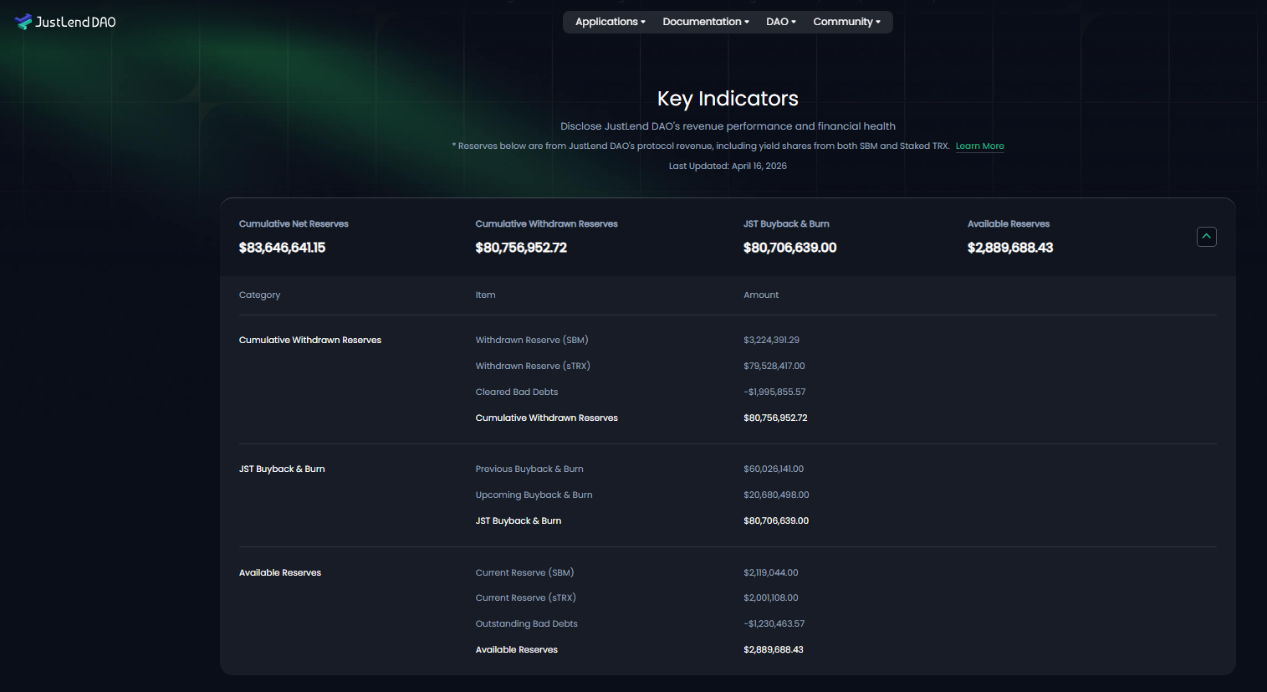
To date, JustLend DAO has committed over $80 million to JST’s buyback-and-burn program (including both executed and pending allocations). Of this, approximately $60 million in USDT has already been deployed for burns, while over $20 million in USDT in accumulated earnings remains on the books, scheduled for future quarterly buyback deployments. This ample reserve reflects its strong, self-sustaining revenue generation capacity.
This confidence in steady profitability stems from JustLend DAO’s comprehensive, full-stack DeFi “aircraft carrier” ecosystem moat. As TRON’s core financial infrastructure, JustLend DAO delivers end-to-end DeFi solutions covering SBM lending, sTRX liquid staking, Energy Rental, GasFree smart wallets, and more—spanning asset custody, collateralized lending, on-chain staking, and gas cost optimization. Its diversified, high-growth core business matrix provides a solid foundation for sustained profitability and supplies JST’s buyback-and-burn program with a continuous stream of financial “ammunition.”
Currently, JustLend DAO’s overall business remains on a steady growth path, with both user base and profitability expanding in tandem. As of April 16, the platform’s total value locked (TVL) has surged to approximately $6.89 billion, serving over 480,000 highly engaged users—the ecosystem’s influence continues to grow.
According to the latest financial dashboard data published on JustLend DAO’s site on April 16, the platform’s cumulative net earnings have exceeded $83.64 million. Of this, $80.75 million has been withdrawn, with ~$80.7 million allocated to JST buyback-and-burn activities (including $60.02 million already burned across the three rounds and $20.68 million reserved for future burns); approximately $2.89 million remains in reserve earnings.
Specifically, JST’s buyback-and-burn funding is drawn mainly from JustLend DAO’s two flagship businesses: the SBM lending market and Staked TRX liquid staking. Per DeFiLlama data, the SBM lending market currently holds a TVL exceeding $3.58 billion—consistently ranking among the top three globally in the lending category, with assets over $1.5 billion larger than SparkLend (formerly MakerDAO), the fourth-ranked traditional platform. In the Staked TRX business, over 9.53 billion TRX tokens are staked—worth over $3 billion.
Beyond those, JustLend DAO also operates widely used services including Energy Rental (helping users significantly reduce on-chain gas costs) and the GasFree smart wallet (enabling users to pay on-chain fees using various transfer tokens).
If JustLend DAO serves as JST’s current profit cornerstone—providing stable, reliable support for the deflationary mechanism—then the stablecoin USDD is the imminent “second growth curve,” set to inject fresh, powerful momentum into JST’s deflationary engine.
Since the start of 2026, USDD has officially entered a period of rapid expansion, with ecosystem development accelerating. On April 8, USDD launched its WBTC vault, enabling users to mint USDD using WBTC as high-quality collateral—a major expansion of USDD’s collateral asset landscape, boosting capital capacity and laying a solid foundation for further scaling. As of April 16, USDD’s total supply has surged past $1.55 billion, and its market cap has steadily secured a top-ten position among global stablecoins; related platform TVL has surpassed $2.2 billion, with ecosystem scale and influence continuing to rise.
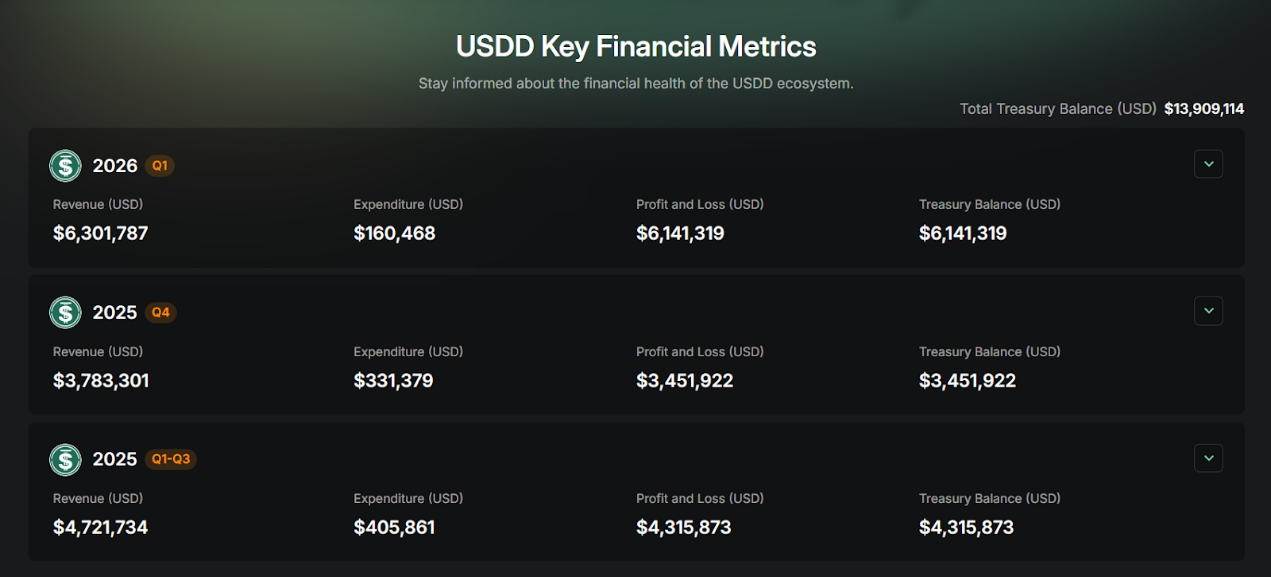
More notably, per Q1 2026 financial updates, USDD’s treasury reserves have accumulated to $13.9 million. Going forward, as USDD scales rapidly, its substantial excess yields will formally convert into massive incremental funding for JST’s buyback-and-burn program—injecting unprecedented momentum into JST’s deflationary mechanism and driving continuous enhancement of JST’s scarcity and long-term value.
JUST Demonstrates Long-Term Commitment Through Ecosystem Strength—JST’s Value Capture Enters a New Era
By deeply linking JST’s token value to the real-world development progress and revenue-generating capacity of core protocols such as JustLend DAO and USDD, JUST achieves tight alignment between overall ecosystem growth and JST token holders’ interests. As TRON’s one-stop DeFi solution provider, JUST’s offerings extend beyond JustLend DAO–centered services—including lending, liquid staking, energy rental, and GasFree—to encompass the stablecoin USDD and cross-chain solution JustCrypto, among others.
This robust business architecture directly translates into leadership in ecosystem scale and influence: JUST consistently manages the largest asset pool within the TRON ecosystem and routinely accounts for roughly half of TRON’s entire network TVL. Per the official data released on April 17, JUST’s ecosystem TVL stands at approximately $11.6 billion, while TRON’s total network TVL is $27.3 billion—underscoring its pivotal role.
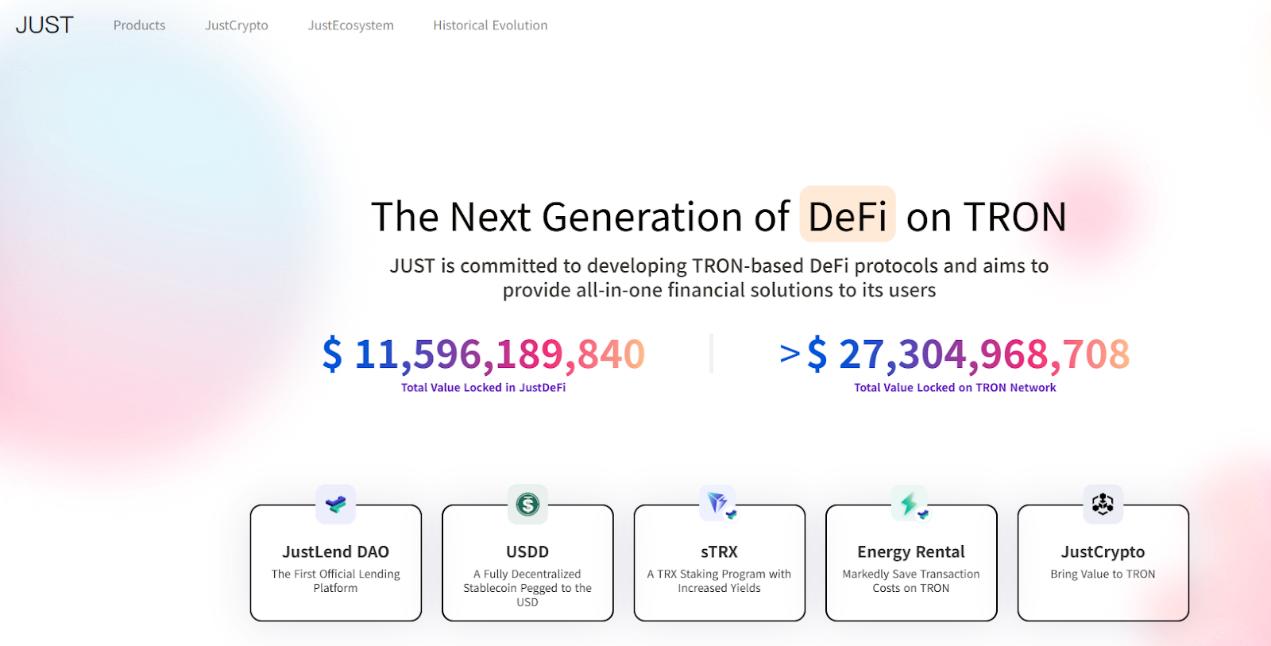
This resilience shines especially bright during industry-wide winter conditions. In early April, the DeFi lending sector suffered repeated shocks: UX Chain announced shutdown on April 1; Drift was hacked on April 3, losing over $280 million; Seamless Protocol officially ceased operations on April 8. In stark contrast, the JUST ecosystem charted a wholly counter-cyclical, stable course. Its flagship protocol, JustLend DAO, has operated safely and reliably since launch—navigating multiple bull and bear cycles without interruption—and has proven its profit resilience through concrete buyback actions. Notably, JustLend DAO still holds over $20 million in accumulated earnings earmarked for future burns.
Looking ahead, as JUST’s two core ecosystems—JustLend DAO and USDD—continue to expand, ever-larger, uninterrupted streams of real operational revenue will flow into JST’s buyback-and-burn pool. Fueled by this robust, self-sustaining revenue engine, the deflationary flywheel—“ecosystem revenue → token burn → value reinforcement”—will spin faster and faster, continually strengthening JST’s long-term value foundation and paving a resilient, upward value path for JST through crypto’s cyclical turbulence.
Join TechFlow official community to stay tuned
Telegram:https://t.me/TechFlowDaily
X (Twitter):https://x.com/TechFlowPost
X (Twitter) EN:https://x.com/BlockFlow_News


