








Huobi Growth Academy | Cryptocurrency Market Macro Research Report: The GENIUS Act Makes Significant Progress, BTC Breaks New All-Time High, Fresh Outlook for Future Markets
TechFlow Selected TechFlow Selected
Huobi Growth Academy | Cryptocurrency Market Macro Research Report: The GENIUS Act Makes Significant Progress, BTC Breaks New All-Time High, Fresh Outlook for Future Markets
BTC's new high is just the prologue—the on-chain dollar and structural bull market are only beginning.
 Navigating Web3 tides with focused insights
On May 22, 2025, Bitcoin's price officially broke through the $110,000 threshold, setting a new all-time high. Driven by policy developments, macroeconomic trends, capital flows, and shifts in investor structure, a structural bull market is unfolding. The core driver behind this rally is the substantial progress of the U.S. GENIUS Stablecoin Act, along with multiple favorable catalysts. This article will comprehensively analyze the deep logic behind BTC’s latest record highs from five dimensions—policy breakthroughs, macro environment shifts, on-chain and ETF capital structures, trading behavior evolution, and key beneficiary sectors—and offer forward-looking insights into potential market trends for the second half of the year.
1. Policy Front: Stablecoin Legislation Breakthrough – The GENIUS Act Unlocks Trillion-Dollar "Dollar-Style Liquidity"
On May 14, 2025, the U.S. Senate passed the motion to advance the GENIUS Act stablecoin regulatory bill by a vote of 69 to 31, marking its formal entry into the final amendment and full chamber voting process. This represents a major breakthrough in U.S. history—the first time stablecoins have been brought into the federal legislative system—signaling that the crypto industry is poised to gain unprecedented incremental liquidity within a compliant framework. At its core, the bill establishes a clear and legal operating mechanism for the current ~$200 billion dollar-pegged stablecoin market, which has long operated in a gray zone, thereby channeling vast amounts of off-chain dollar capital into on-chain systems and opening the main conduit for "dollar-style liquidity" across the entire crypto ecosystem.
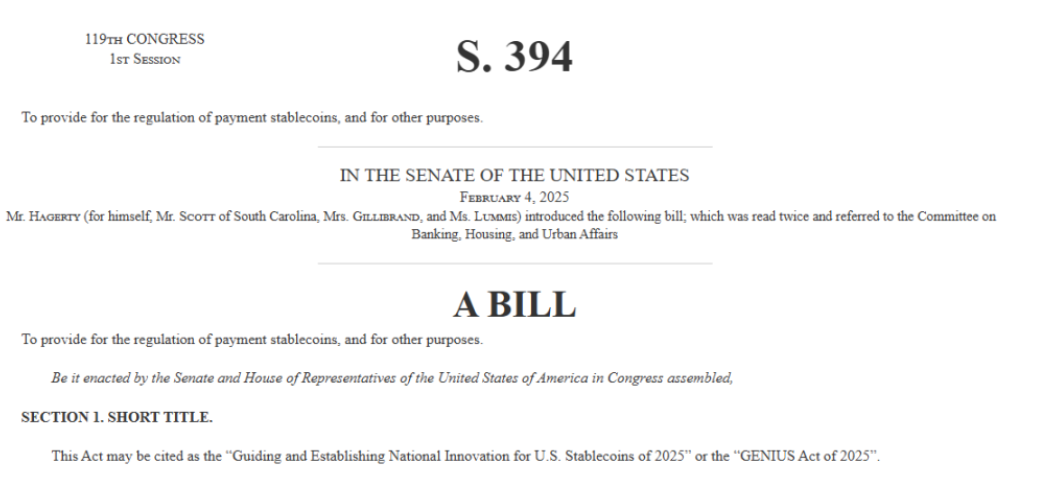
The legislative urgency behind the GENIUS Act is deeply rooted in reality. On one hand, stablecoins as “on-chain dollars” have become foundational assets for crypto trading and DeFi finance, yet they have long existed in a U.S. regulatory vacuum, often caught in jurisdictional disputes among agencies like the Treasury and SEC. On the other hand, global initiatives such as China’s digital yuan and the EU’s MiCA regulations are accelerating sovereign digitization and stablecoin oversight, putting pressure on the U.S. to respond in the arena of “financial geopolitical competition.” Compliance for stablecoins has thus become a frontline battleground for maintaining the dollar’s global dominance. As such, the GENIUS Act carries strategic significance—it is not merely a regulatory response to financial innovation but also a digital extension of the U.S. dollar’s financial infrastructure.
In terms of design, the bill mandates that all stablecoins must be issued by U.S. federally or state-chartered banks or registered trust institutions, fully backed by cash or short-term U.S. Treasuries at a 1:1 ratio, with daily public disclosure of reserves and oversight by the Treasury, SEC, and CFTC. In other words, future stablecoins must not only be “compliant” but also “auditable on-chain,” a high standard directly targeting credit risks and audit opacity issues present in traditional models like USDT. The bill also includes a specific CBDC exclusion clause, clarifying that its goal is not to promote a central bank digital currency but rather to build a market-driven “competitive stablecoin ecosystem.” This distinction holds significant practical importance amid the current political climate and clears the path for long-term development of market-led dollar-pegged stablecoins.

Notably, the GENIUS Act enjoys strong Republican support and tacit approval from moderate Democrats, with even the Trump camp viewing it as a cornerstone of future digital finance strategy. Trump’s crypto advisor David Sacks publicly stated that once enacted, the bill would generate “trillions of dollars” in on-chain demand for short-term U.S. Treasuries, indirectly enabling digital absorption of U.S. debt and alleviating fiscal refinancing pressures. Meanwhile, the Federal Reserve and Treasury have begun preparing data interfaces and audit mechanisms for compliant stablecoins, while the SEC has started drafting配套 (supporting) crypto regulations—clear signals that government agencies are actively laying the groundwork for the bill’s implementation.
This series of institutional and financial preparations implies that upon passage, a legal, transparent, and deeply interconnected on-chain dollar ecosystem will rapidly emerge. Major fintech firms like Circle, PayPal, Visa, and JPMorgan are likely to immediately join the issuance and clearing systems of next-generation stablecoins, becoming vanguards of the dollar’s global digital expansion. The crypto market will reach an inflection point where it becomes fully integrated with traditional capital markets, particularly as short-term Treasuries are injected en masse onto the blockchain as standard collateral for stablecoins. Their low volatility and high credit quality will provide a new “risk-free rate anchor” for the entire on-chain financial system.
It is foreseeable that once formally legislated, the U.S. stablecoin market will transition from an unregulated state to a new paradigm of “strong regulation + high transparency.” Non-compliant stablecoins such as USDT and DAI may face business model overhauls, while U.S.-aligned stablecoins like USDC and PYUSD are poised to dominate under compliance frameworks. In terms of capital, multiple institutions estimate that the first phase alone could bring $200–400 billion in newly issued stablecoins onto the blockchain. This would not only reshape on-chain payment and settlement mechanisms but could also directly elevate valuation anchors for Bitcoin and other major assets. Historically, Bitcoin’s price movements were driven primarily by spot and futures capital; going forward, the “on-chain dollar deposit” mechanism carried by stablecoins will become a new foundation for Bitcoin’s pricing system.
The advancement of the GENIUS Act marks a historic turning point in stablecoins’ evolution—from peripheral tools to core financial infrastructure. What it unleashes is not just liquidity, but a rebalancing of U.S. control over on-chain financial order. Within this new architecture, stablecoins will become strategic instruments of “dollar on-chain deployment,” and crypto finance will truly shift from gray-zone experimentation to institutionalized tracks. As compliant capital floods in, the market may enter a new phase of “macro-driven bull market” in the second half of 2025, with the stablecoin sector emerging as the leading “policy-driven theme” of this cycle.
2. Macro Environment: Falling Treasury Yields, Easing Financial Conditions, and the Dawn of "Stealth QE"
The crypto market is currently undergoing a repricing of capital driven by shifts in the global macro environment—a trend centered on rebalancing structural U.S. debt dynamics with interest rate policy, and a tangible shift from tight to looser financial conditions amid coordinated fiscal and monetary policies. Recent market changes clearly reflect this turning point. The yield on the U.S. 10-year Treasury has dropped significantly from its peak, now falling to 4.46%. Market expectations for long-term rates have softened, indicating investors are re-evaluating the trade-off between U.S. economic growth and inflation—a favorable precondition for the revaluation of risk assets including Bitcoin. This decline in Treasury yields is not purely a result of market forces but stems from active intervention by the U.S. Treasury. This month, the Treasury announced a $40 billion Treasury buyback program. While not explicitly labeled as “QE,” its core mechanism closely resembles quantitative easing: actively buying back outstanding Treasuries to relieve liquidity pressure and refinance new debt at lower rates. Wall Street widely views this as a form of “stealth QE” or “quasi-QE operation.” Crucially, this maneuver does not require Fed involvement—achieving downward pressure on real interest rates without expanding the Fed’s balance sheet. Since the start of the buyback, the MOVE index—a measure of bond market volatility—has rapidly declined, reflecting stabilized market expectations for future rate paths. This stability provides exactly the kind of “mild monetary environment” signal that crypto assets need most at the macro level.
At the same time, inflationary pressures are easing marginally, with both CPI and PPI showing sequential declines. Consensus within the Fed on maintaining high interest rates is beginning to unravel. Markets previously feared that “higher-for-longer” rates would suppress valuations of risk assets, but as inflation cools and fiscal burdens mount, the Fed has gradually signaled a possible policy shift in the second half of the year. Recently, some voting members have stopped emphasizing “further hikes” and instead focus on “flexible responses based on incoming data.” This suggests the Fed’s next phase will pivot from “inflation control” toward “growth stabilization” and “debt sustainability”—a subtle policy adjustment that effectively drives marginal easing in financial conditions.
Just as the macro economy begins to slow and the window for policy tweaks opens, the crypto market—on the opposite end of the global financial system—is experiencing a rare structural inflection: on-chain capital structure is improving steadily, and the proportion of long-term holders is hitting record highs. Glassnode data shows that 97% of Bitcoin addresses are currently in profit, and non-liquid supply on-chain has reached an all-time high. This means Bitcoin’s price is no longer driven solely by short-term speculation, but is being repriced within an environment of tightening liquidity and strengthening market conviction. Against this backdrop of structural holding patterns, any macro-level signal of loosening conditions will quickly restore risk appetite and reopen valuation space for major cryptocurrencies.
More importantly, the sustained decline in Treasury yields is reshaping the role of the “risk-free yield anchor” in global capital markets. Over the past two years, rising Treasury yields suppressed digital assets. But as the yield curve shifts downward, the opportunity cost of holding crypto versus cash is rapidly shrinking. At times, yield from stablecoin-based DeFi strategies has already surpassed that of equivalent-term Treasuries. This micro-level rebalancing of interest differentials is driving some capital back into on-chain assets. With real interest rates falling, stablecoin holders are increasingly willing to engage in DeFi to earn excess returns, pushing prices of major assets like Bitcoin and Ethereum higher.
Ongoing inflows into spot Bitcoin ETFs further confirm the changing pricing logic for crypto assets under shifting macro conditions. Even as U.S. equities fluctuate due to concerns over fiscal health and credit ratings, Bitcoin broke its all-time high over the weekend, surpassing $110,000—demonstrating remarkable resilience. These ETF inflows represent a “vote of confidence” in macro stability: institutional investors believe Bitcoin now serves as a long-term value anchor capable of hedging uncertainties in traditional financial markets. As the rate-cutting cycle approaches and expectations grow for a “re-inflation of financial assets,” Bitcoin’s dual narrative as “digital gold” offering both safe-haven and appreciation potential will become increasingly compelling.
In summary, the macro environment is entering a new phase of “structural easing + policy recalibration + capital repricing.” From Treasury buybacks to growing expectations of a Fed pivot, from declining bond yields to steady ETF inflows, all variables are converging to push crypto assets onto a bullish trajectory with inherent resilience. Under these conditions, Bitcoin is not just a market engine but also the foundational asset for repricing the entire digital asset ecosystem. Key sectors such as stablecoins, DeFi, and RWA (real-world asset tokenization) will benefit from amplified capital and user inflows in this macro-fueled cycle.
3. On-Chain Structure: BTC Non-Circulating Supply Hits Record High, ETFs Keep Absorbing Capital, Chip Structure Stabilizes
Bitcoin’s ability to sustain strength and break through $110,000 despite a complex mix of macro and policy variables lies in a profound transformation of its on-chain structure. Glassnode and other on-chain analytics platforms show that BTC’s non-circulating supply has reached an all-time high, meaning more Bitcoin is being held long-term and locked away in wallets rather than flowing into trading markets. This is not just a technical indicator shift—it reflects a deepening structural conviction: more investors view Bitcoin as a long-term store of value rather than a short-term speculative instrument, willing to trade time for long-term value realization.
This trend is fueled by continuous inflows into spot Bitcoin ETFs over recent months. To date, cumulative net inflows into U.S. spot Bitcoin ETFs have exceeded $10 billion. Particularly with participation from asset management giants like BlackRock and Fidelity, these funds represent not short-term arbitrage but likely the “formal allocation” of BTC by long-term institutional capital such as pension funds, sovereign wealth funds, and family offices. Their entry not only provides strong buying support but profoundly reshapes Bitcoin’s liquidity structure. Compared to previous retail-dominated cycles marked by volatile swings, today’s Bitcoin price exhibits more “institutional characteristics”: tighter volatility, clearer trends, limited drawdowns, and steady inflows.
More importantly, in terms of chip distribution, Bitcoin is gradually breaking free from its historical fate of “every bull market ends in top-heavy losses.” This rally is not driven by retail hot money but by institutional investors with long-term capital and “new-type long-term holders” who deeply understand macro and monetary systems. On-chain data shows that while active addresses remain stable, the proportion of short-term chip movement has decreased, indicating no rush to take profits—market sentiment remains rationally optimistic. Meanwhile, the average holding period for coins held by long-term holders (LTH) continues to extend, signaling a strengthening consensus around Bitcoin.
ETF inflows, record-high non-circulating supply, and rising proportions of long-term holder holdings together form the “anchor” of Bitcoin’s current price—the fundamental reason it can rise independently and resist downturns amid ongoing uncertainty in traditional markets. Unlike in the last cycle, Bitcoin is gradually gaining recognition as a “reserve asset,” no longer just a price barometer for the crypto industry but achieving strategic asset status comparable to gold and bonds in global portfolio allocations.
At the same time, on-chain infrastructure around the Bitcoin ecosystem is maturing. Products pegging stablecoins to BTC are increasing, DeFi tools combining Bitcoin assets are becoming active, and some high-net-worth users are even using Bitcoin as collateral for on-chain lending and yield generation—enhancing Bitcoin’s capital efficiency. Projects like BTC staking on HTX’s public chain or Tron network’s TUSD and USDD stablecoins anchoring to Bitcoin further strengthen Bitcoin’s role in the on-chain financial system. Bitcoin is evolving from merely a “price-watched asset” into a “used asset.” This structural shift provides stronger long-term support for future price performance.
In essence, Bitcoin has completed its transformation from a “trading tool” to an “institutional asset,” a shift whose significance far exceeds short-term price moves. From an on-chain data perspective, today’s Bitcoin market is more mature, stable, and promising than in any previous cycle. This not only lays a solid foundation for continued gains but also establishes a “valuation anchor” for the entire crypto market, making Bitcoin the true engine of this structural bull run.
4. Trading Behavior: Healthy Long-Short Structure, No Signs of Overheating, Limited Downside Risk
As Bitcoin breaks new highs amid expectations of macro easing and policy tailwinds, investors’ biggest concern is whether the market has overheated and whether a sharp correction is imminent. From a trading perspective, the answer is “not yet.” Despite the rapid rally, trading structures and sentiment indicators show a remarkably healthy pace—no panic buying, no signs of excessive leverage buildup. Funding rates in the futures market remain in a reasonable, neutral range, with no significant positive premium, indicating bullish sentiment is strong but not out of control. The basis between spot and futures prices remains stable, further confirming that the current price move is primarily driven by spot demand rather than derivatives leverage.
From the options market, the put/call ratio at major exchanges remains moderately bullish. Especially in mid-term contracts expiring between late June and September, call option positions are actively built, suggesting investors still expect gains over the coming quarters. Additionally, the options volatility curve shows a mild upward slope—not sharply steepened by the price surge—indicating the market hasn’t overpriced future volatility. Under these conditions, any technical pullback is likely just short-term profit-taking by longs, not a trend reversal. A pattern of “moderate corrections, slow bull market” is precisely the hallmark of a structural bull run.
On-chain metrics also support this view. While Bitcoin’s average holding profitability has risen to high levels, “profit-taking” activity is not concentrated. Activity and inflow data rise in tandem, with no divergence between price increases and user engagement—a typical sign of market tops. Although the Fear & Greed Index has climbed to “extreme greed,” it still lags behind the peaks seen during the 2021 bull market. Crucially, no large-scale outflows or institutional de-risking have been observed on major platforms like Binance, HTX, or Coinbase—meaning core market participants are still holding or even adding positions, not exiting.
Notably, the current market’s structural health is also得益于 (benefited from) the “deep deleveraging” of the previous liquidation cycle. Events like the 2022 FTX collapse, LUNA crash, Three Arrows Capital liquidation, and Genesis bankruptcy triggered short-term panic but cleared out massive over-leverage and fragile chains, placing the market on a more robust upward trajectory. This laid a clean foundation for Bitcoin’s steady breakout this time.
From a retail perspective, on-chain data shows wallet creation has picked up but is far from the “FOMO explosion” levels seen in bubble cycles. Search volume, social media discussions, and crypto content on YouTube and TikTok are rising but haven’t reached mass mania. In other words, the current rally is primarily driven by structural capital and professional investors, not widespread public participation or topping signals. Put differently, the “popular base” of this bull market has not yet fully activated—there remains substantial upside potential, and any pullback will be strongly supported by chip structure and professional capital, making extreme corrections of 40–50% like those in 2021 unlikely.
Therefore, from futures funding rates and options positioning to on-chain activity and exchange flows, the market is not in a state of “irrational exuberance” but instead displays a calm, healthy, and rhythmic upward path. In such a market, downside space is limited—any correction is more likely “strong consolidation” than “trend reversal.” Investors should align their strategies with this structural slow-bull rhythm, avoiding excessive chasing or panic selling, and favor “buying the dip” over “gambling at peaks.”
5. Key Sectors & Investment Logic: TRX Ecosystem and Stablecoin Payments Emerge as Top Beneficiaries
With the GENIUS Act making major progress, macro liquidity conditions easing slightly, and Bitcoin breaking new highs, investors are now less focused on whether BTC can go higher and more on which “sectors” and “assets” will absorb new capital and become structural winners in the next phase. From policy trajectories and on-chain data to capital flows and technological progress, one conclusion stands out: the stablecoin payments sector—especially the on-chain dollar payment system represented by TRX (Tron)—is set to be the biggest beneficiary of this policy windfall and capital rotation.
First, the policy logic is crystal clear. The GENIUS Act aims to establish a federal regulatory framework for stablecoins, opening a virtuous channel between U.S. Treasuries and crypto dollars—essentially “legally pushing the dollar on-chain.” It does not directly benefit high-volatility assets like BTC or ETH, but rather infrastructure-layer blockchains and protocols that build payment networks and dollar-denominated settlement systems around stablecoins. And the undisputed leader in this space today is the TRON network. According to DefiLlama, over $42 billion of USDT circulates on TRON—far exceeding Ethereum. On-chain tracking shows TRON handles over 75% of global stablecoin cross-border transactions, making it the most widely used “on-chain dollar highway” in the real world. Once regulatory tailwinds and legalization channels open, TRON will be the most direct beneficiary, naturally claiming the status of “first-mover compliant stablecoin application chain.”
From a capital behavior standpoint, market attention has already quietly shifted toward key assets in the TRX ecosystem. TRX, the gas token of the TRON mainnet and foundational value support for its entire financial system, has seen steady gains for several consecutive weeks. While its price increase hasn’t been extremely explosive compared to other Layer 1 tokens, its volatility is minimal and core capital holdings remain stable—indicative of “continuous structural accumulation.” Ecosystem tokens linked to TRX, such as JUST (Tron’s DeFi lending protocol) and USDD (Tron’s native stablecoin), are becoming focal points for high-net-worth investors and VCs. The pace of TRON’s technical upgrades and external partnerships has also visibly accelerated—recently, Justin Sun, during his U.S. visit and meetings with the Trump family, repeatedly emphasized his goal of promoting global adoption of “on-chain dollars,” aligning closely with U.S. policy direction. This convergence of “policy alignment + technical execution + reasonable asset pricing” is a rare “triple resonance” few crypto projects achieve early in a bull market, and its scarcity forms the core support for TRX’s current valuation.
More importantly, unlike other Layer 1 ecosystems that chase hype or build narratives on air, TRON has consistently advanced along the clear主线 (mainline) of “stablecoin payments” and “on-chain financial efficiency.” This narrative consistency is key to its ability to survive multiple bear markets. As global demand for on-chain payments, cross-border settlements, and tokenized dollars grows, and as U.S. policy shifts toward “using dollar-pegged stablecoins to maintain global financial dominance,” the stablecoin payment narrative championed by TRON may undergo a “strategic repricing” over the next 1–2 years—from the periphery to center stage.
In short, with the GENIUS Act advancing and global policy shifting, the crypto market is on the verge of a “on-chain dollar era” explosion. Ecosystems that genuinely deliver dollar payment functionality and already have real-world usage will be the biggest winners. TRON not only possesses actual payment data and a user base but also aligns with clear technical pathways and policy strategy. Its ecosystem tokens—TRX, USDD, USDJ, TUSD, SUN, BTT—will become the most critical portfolio targets in this wave of macro liquidity and policy dividends.
6. Conclusion: BTC’s New High Is Just the Prelude—The On-Chain Dollar Era and Structural Bull Market Are Only Beginning
The advancement of the GENIUS Act marks a paradigm shift in U.S. crypto regulation—from “cracking down on speculation” to “embracing digital dollar infrastructure.” This is a profound restructuring of global capital markets. Bitcoin, as the purest “non-sovereign, anti-inflation asset,” is not only achieving a technical breakthrough but also undergoing a “cognitive upgrade” and “status elevation.” Its $110,000 milestone is merely the starting point—the real floodgates for capital are just opening.
For investors, the real opportunity lies in positioning early within structural trends and investing in ecosystem infrastructure, not just price speculation. In the second half of 2025, we have good reason to believe: Bitcoin’s next target is $150,000–180,000, and what will truly explode is the trillion-dollar springtime of the “on-chain dollar ecosystem.”
Join TechFlow official community to stay tuned
Telegram:https://t.me/TechFlowDaily
X (Twitter):https://x.com/TechFlowPost
X (Twitter) EN:https://x.com/BlockFlow_News
 @HTXAcademy






