Has the breakthrough moment for tokenization arrived?
TechFlow Selected TechFlow Selected
Has the breakthrough moment for tokenization arrived?
As Wall Street giants rapidly scale up deployments, tokenization is flourishing.
 Navigating Web3 tides with focused insights
Writing: Token Dispatch, Prathik Desai
Translation: Block unicorn
Introduction
Tokenization is booming as Wall Street giants rapidly scale up—just a few years after the concept was still in testing phases.
Multiple financial powerhouses are simultaneously launching platforms, building infrastructure, and creating products that connect traditional markets with blockchain technology.
Last week alone, BlackRock, VanEck, and JP Morgan made significant moves signaling that real-world asset (RWA) tokenization has moved beyond proof-of-concept into the core of institutional strategy.
In today’s article, we’ll show you why the long-awaited inflection point for tokenization may have already arrived—and why it matters even if you’ve never bought cryptocurrency.
Ten-Trillion-Dollar Potential
"Every stock, every bond, every fund—every asset—can be tokenized. If realized, this would revolutionize investing," said Larry Fink, CEO and Chairman of BlackRock, in his 2025 annual letter to investors.
Fink is referring to an opportunity to allow fund managers to tokenize assets worth over $10 trillion within the global asset industry.
Traditional financial giants have already seized this opportunity, with adoption surging over the past 12 months.
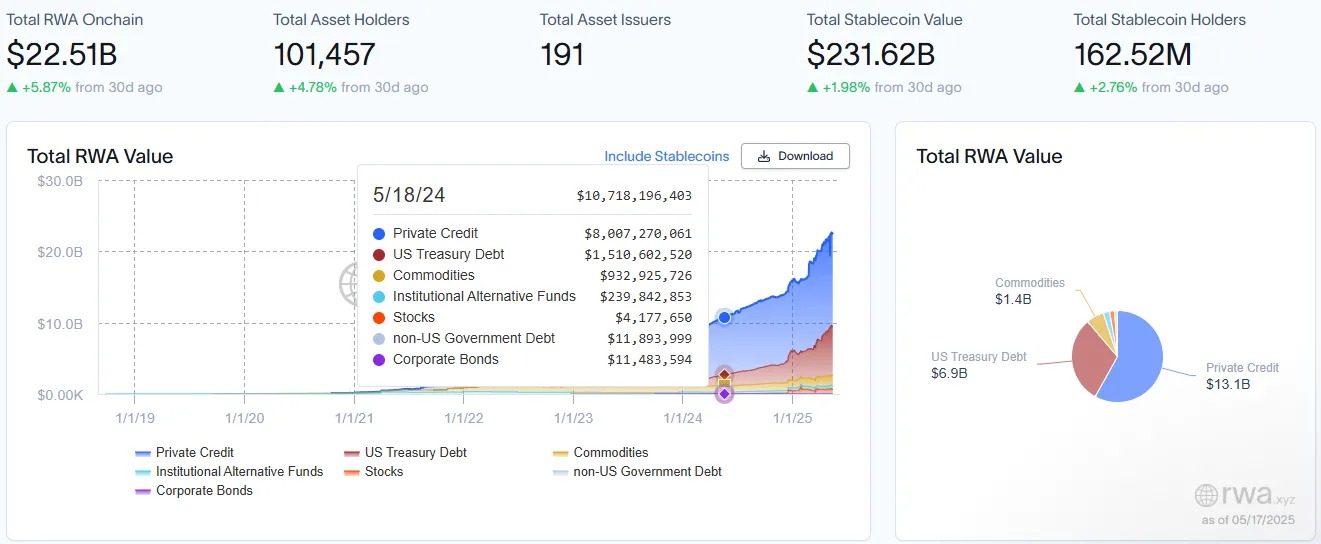
Tokenized real-world assets (RWA, excluding stablecoins) have surpassed $22 billion, growing 40% just this year. Yet this is only the tip of the iceberg.
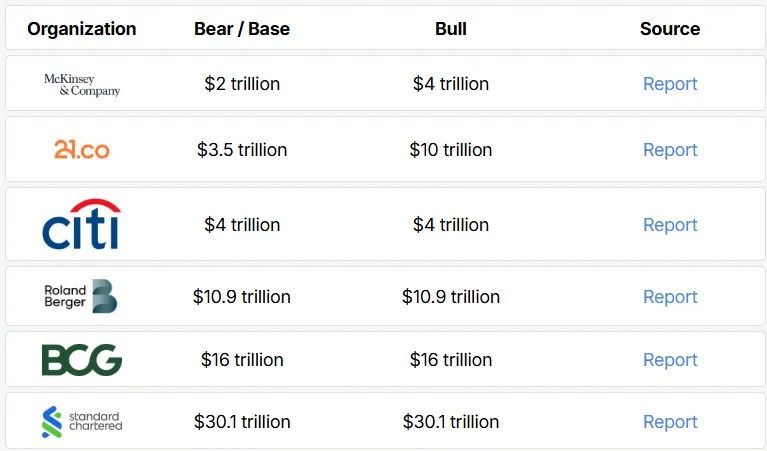
Consulting firm Roland Berger forecasts the tokenized RWA market will reach $10 trillion by 2030, while Boston Consulting Group estimates $16.1 trillion.
To put that in perspective, even at the lower estimate, this means growth by a factor of 500 from today. If just 5% of global financial assets move on-chain, we’re talking about a multi-trillion-dollar shift.
Before diving into fund managers’ tokenization initiatives, let’s first understand what tokenization is and what it means for investors.
Bringing Physical Assets onto the Blockchain
Three simple steps: select a real-world asset, create digital tokens representing ownership (partial or full) of that asset, and make them tradable on a blockchain. That’s tokenization.
The underlying asset itself—Treasury bonds, real estate, stocks—doesn’t change. What changes is how ownership is recorded and traded.
Why tokenize? Four key advantages:
-
Partial ownership: Own a fraction of a commercial building for $100 instead of needing millions.
-
24/7 trading: No need to wait for market open hours or settlement cycles.
-
Lower costs: Fewer intermediaries mean lower fees.
-
Global access: Investment opportunities previously limited by geography are now globally accessible.
"If SWIFT is like postal mail, then tokenization is like email itself—assets can bypass intermediaries and transfer instantly," Fink wrote in the letter.
A Silent Revolution
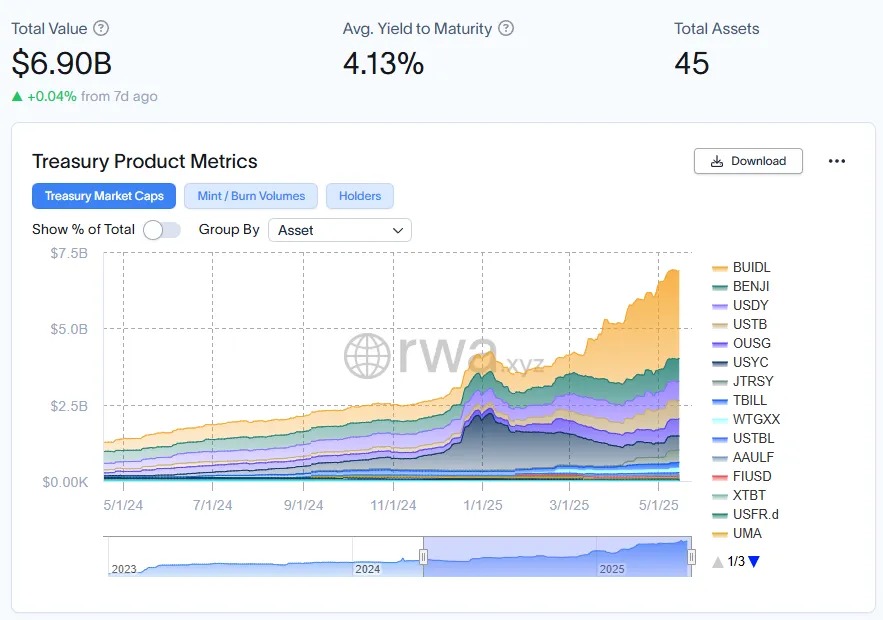
BlackRock’s tokenized Treasury fund BUIDL has surged to $2.87 billion, more than quadrupling in 2025 alone. Franklin Templeton’s BENJI holds over $750 million. JP Morgan’s latest move connects its private blockchain Kinexys with public blockchains.
The value of tokenized U.S. Treasuries now approaches $7 billion—up sharply from less than $2 billion a year ago—further reinforcing the growth story.
More heavyweights are joining the trend with unique offerings.
This week, VanEck launched a tokenized U.S. Treasury fund accessible across four blockchains, intensifying competition in the fast-expanding on-chain RWA market.
Earlier this month, MultiBank Group—the world’s largest financial derivatives institution based in Dubai—signed a $3 billion RWA tokenization agreement with UAE-based real estate giant MAG and blockchain infrastructure provider Mavryk.
Even smaller nations are getting involved. According to The Bangkok Post, the Thai government is offering tokenized bonds to retail investors, lowering entry barriers from the traditional $1,000+ down to just $3.
Even government agencies aren’t missing out on this revolution.
The U.S. Securities and Exchange Commission (SEC) recently hosted a roundtable with nine financial giants to discuss the future of tokenization—a stark contrast to previous administrations.
For investors, this means 24/7 access, near-instant settlement, and fractional ownership.
Think of it as the difference between buying a full CD album versus streaming only the songs you want. Tokenization breaks assets into affordable pieces, making them accessible to everyone.
Why now?
-
Regulatory clarity: Under President Donald Trump’s leadership, the U.S. government has shifted from enforcement to promoting innovation, with multiple crypto-friendly figures leading regulatory agencies.
-
Institutional adoption: Traditional financial giants lend legitimacy and infrastructure support to tokenization.
-
Technology maturity: Blockchain platforms have evolved to meet institutional demands.
-
Market demand: Investors are seeking more efficient and accessible financial products.
SEC Chair Paul Atkins views tokenization as a natural evolution of financial markets, likening it to "the decades-long transition of audio from analog vinyl records to tapes, then to digital software."
The Road Ahead
Despite strong momentum, challenges remain.
Fragmented regulation: The global regulatory landscape remains inconsistent. While the SEC roundtable signals openness in the U.S., international coordination is lacking. Japan, Singapore, and the EU are progressing at different speeds, with incompatible frameworks posing compliance hurdles for global tokenization platforms.
Lack of standardization: The industry lacks unified technical standards for tokenizing different asset classes. Should tokenized Treasuries on Ethereum be compatible with those on Solana? Who verifies the link between a token and its underlying asset? Without standardization, isolated liquidity pools may form instead of a unified market.
Custody and security concerns: Traditional institutions remain cautious about blockchain security. Earlier this year, the $1.4 billion Bybit hack raised difficult questions about immutability versus recoverability.
Knowledge gap: Wall Street may be moving fast, but Main Street still widely lacks understanding of tokenization.
Our Take
Tokenization may be the bridge connecting blockchain technology with mainstream finance. For those tracking blockchain’s evolution, this could be the space’s biggest impact yet—not through creating new money, but by changing how we access and trade existing assets.
Most people don’t care about blockchain. They care about getting paid faster, accessing investment opportunities once reserved for the wealthy, and not being gouged by high fees when transferring money. Tokenization delivers these benefits without requiring users to understand the underlying technology.
As this space evolves, tokenization may become “invisible infrastructure”—like how you don’t think about SMTP protocols when sending an email. You’ll simply access investments more easily, at lower cost, with fewer restrictions.
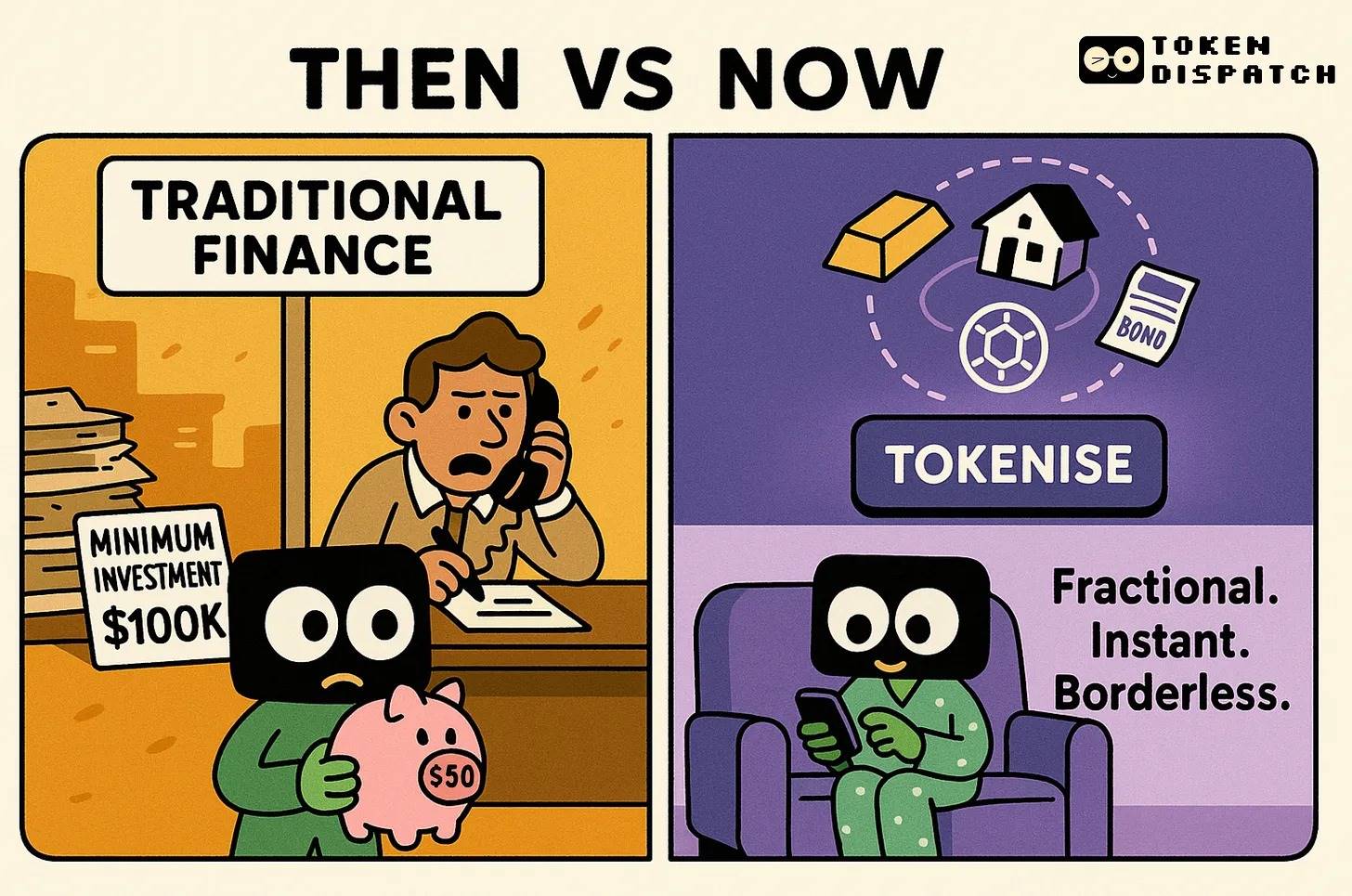
Traditional finance spent centuries building systems that favor institutions and exclude ordinary people. For decades, we accepted a financial system designed around institutional convenience rather than human experience. Want to trade after work? Sorry, markets are closed. Only $50 to invest? Not worth our attention. Want to send money internationally without losing 7% in fees? Then wait weeks.
Tokenization could break this inequality within just a few years.
As tokenized experiences become widespread, the conceptual barrier between “traditional finance” and “decentralized finance” will naturally dissolve. Someone buying a tokenized bond from the Thai government for $3 might later explore yield-generating DeFi protocols. Institutional investors entering blockchain via BlackRock’s BUIDL may eventually invest in native crypto assets.
This pattern drives real adoption—not through ideological shifts, but through practical advantages that make the old way seem painfully inefficient by comparison.
Join TechFlow official community to stay tuned
Telegram:https://t.me/TechFlowDaily
X (Twitter):https://x.com/TechFlowPost
X (Twitter) EN:https://x.com/BlockFlow_News