Alpenglow: A New Consensus Paradigm for Solana
TechFlow Selected TechFlow Selected
Alpenglow: A New Consensus Paradigm for Solana
Under the new architecture, transaction finality efficiency will improve by 100x.
 Navigating Web3 tides with focused insights
Author: Pzai, Foresight News
On the evening of May 19, Anza, a developer studio previously spun out from Solana Labs, released Alpenglow, a new consensus layer protocol for Solana. The protocol changes the TowerBFT and PoH consensus mechanisms, introducing a new component called Votor to handle voting and block finality, while using the Rotor component to improve Solana's existing block propagation protocol. Built atop Turbine (Solana’s sharding system), it employs a single-layer relay node architecture and optimizes bandwidth usage based on stake weight.
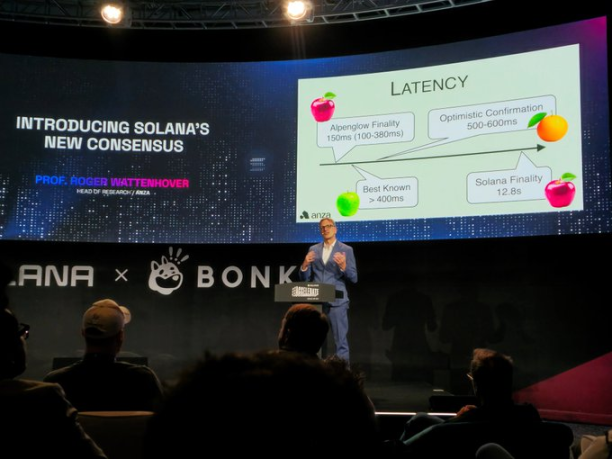
Roger Wattenhover, Research Lead at Anza, stated at Solana Accelerate that the new consensus mechanism will drastically reduce transaction finality time from the current 12.8 seconds to just 150 milliseconds. In terms of development progress, Alpenglow has completed prototype testing and is expected to deploy on testnet by mid-2025. Following approval via a Solana Improvement Document (SIMD) proposal, mainnet deployment is anticipated later in 2025. Compared to Solana’s current mainnet, Alpenglow simplifies the architecture and optimizes data dissemination efficiency, bringing performance closer to traditional internet infrastructure—making it suitable for high-frequency trading and real-time payments. This article provides an overview of Alpenglow, dubbed "Solana’s consensus re-architecture."
Votor will handle consensus logic and replace TowerBFT. Instead of relying on the current nodes’ “gossip” model, it uses “direct communication” to vote on block finality. As the core component of the Alpenglow protocol, Votor’s key innovations lie in its communication model, voting mechanism, and performance optimization.
First, Votor does not rely on the current nodes’ “gossip” model; instead, it adopts peer-to-peer direct communication combined with dynamic grouping strategies (divided by stake weight or geographic location), significantly reducing redundant message transmission and lowering network latency.
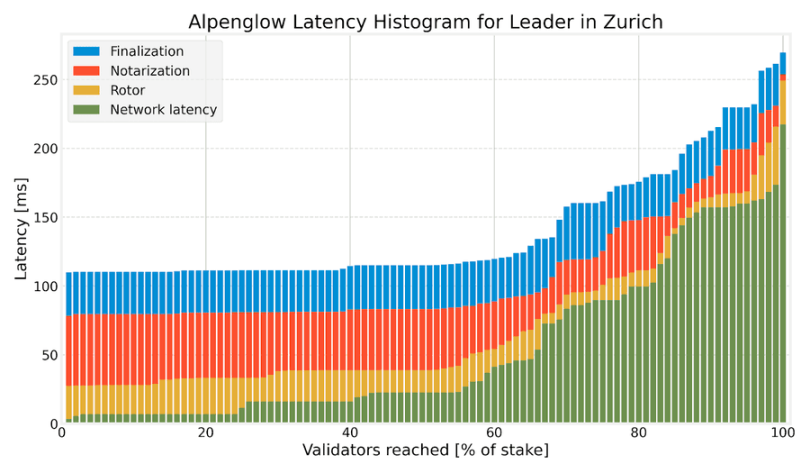
Second, Votor introduces a tiered staking-based voting mechanism: if a block receives over 80% stake support in the first round, it achieves immediate notarization; if support falls between 60% and 80%, a second fast confirmation round is triggered through parallel voting tracks, while allowing validators to actively skip voting upon detecting block delays or risks, thus avoiding resource waste. Data shows that when the overall validator threshold is below 60%, latency can be kept around 100 milliseconds.
Rotor focuses on improving block propagation efficiency and network resource allocation. By integrating Turbine sharding technology, it enhances Solana’s existing block propagation protocol. In practice, Rotor replaces the traditional multi-layer relay model with a single-layer relay node architecture, splitting block data into lightweight shards and dynamically optimizing transmission paths—significantly reducing network complexity and transmission latency.
In addition, Rotor introduces an adaptive propagation algorithm that monitors network conditions in real time, switches away from congested routes, and combines lightweight data verification to reduce computational overhead, greatly enhancing propagation speed and fault tolerance. In performance terms, Rotor reduces block propagation latency to the millisecond level, supporting Solana’s goal of achieving 50,000 TPS and meeting the demands of high-frequency scenarios such as DeFi liquidations and real-time payments.
Overall, the Alpenglow protocol removes the PoH mechanism, reducing operational risks across the chain and simplifying the architecture. By replacing TowerBFT with Votor and adopting a stake-driven 1–2 round voting process, it achieves block finality within 100–150 milliseconds without relying on optimistic confirmations. Rotor optimizes Turbine sharding through a single-layer relay system, pushing propagation efficiency to the physical limits of network latency via global bandwidth optimization and adaptive path selection—leaving only underlying network transmission speed as the primary bottleneck. At the same time, system resilience is significantly enhanced, capable of withstanding extreme scenarios involving up to 20% malicious nodes or 20% offline staking, thereby improving attack resistance and fault tolerance. Ultimately, Alpenglow compresses transaction finality to the millisecond level, providing foundational support for high-frequency trading, real-time payments, and large-scale on-chain applications.
Join TechFlow official community to stay tuned
Telegram:https://t.me/TechFlowDaily
X (Twitter):https://x.com/TechFlowPost
X (Twitter) EN:https://x.com/BlockFlow_News
 Foresight News