








Ethos Explained: Rebuilding Crypto Trust with Tokenized Reputation
TechFlow Selected TechFlow Selected
Ethos Explained: Rebuilding Crypto Trust with Tokenized Reputation
Ethos is an emerging tokenized reputation protocol designed to address trust issues in cryptocurrency.
 Navigating Web3 tides with focused insights
Author: Eli5DeFi
Translation: TechFlow
The cryptocurrency space is filled with scammers and questionable behavior. The launch of @ethos_network aims to separate the good from the bad by tokenizing reputation.
Here’s why Ethos stands out 🧵
Ethos 101
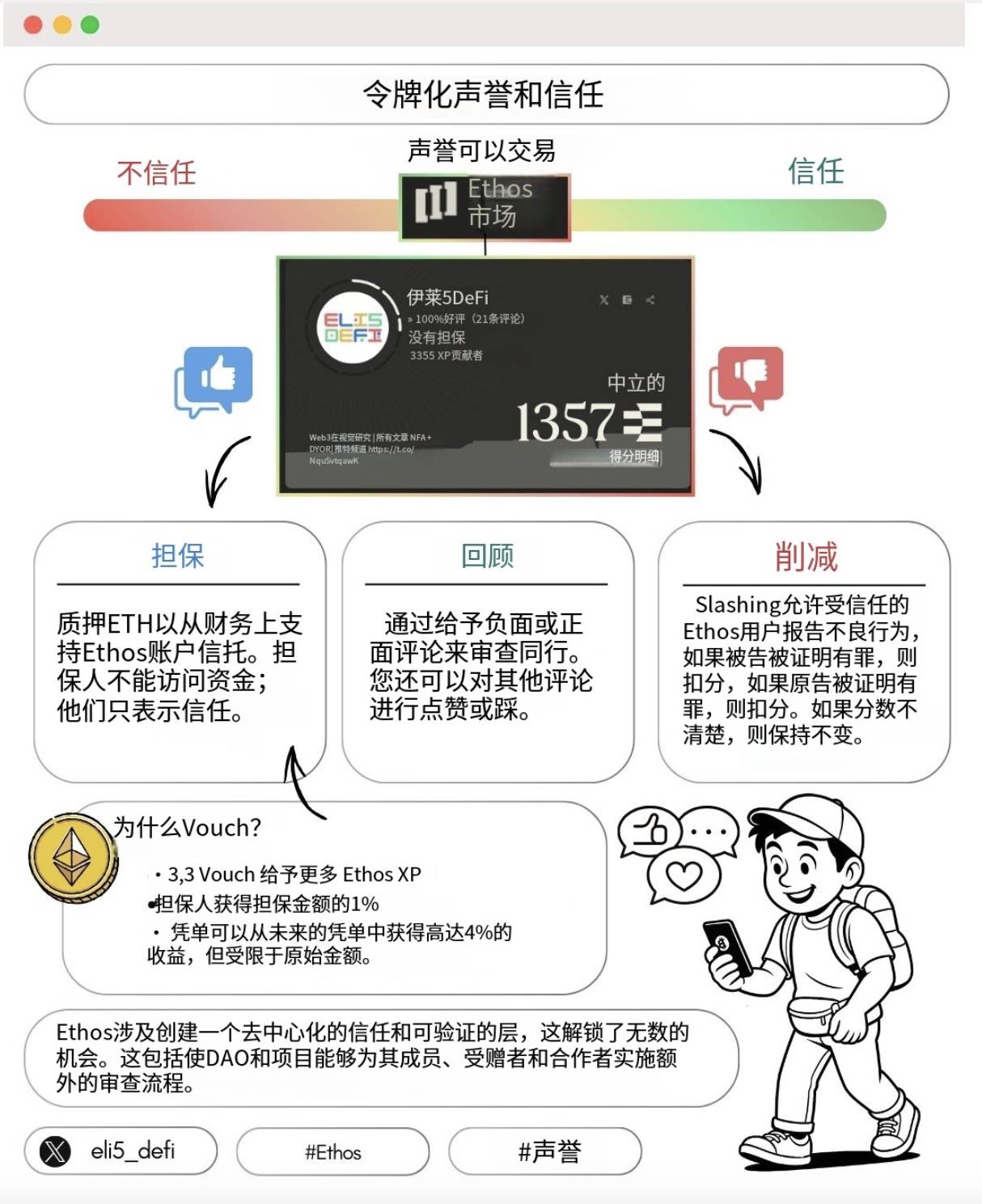
Ethos is, in a sense, a tokenized reputation platform that builds a trustless and verifiable system to represent an account's credibility within crypto.
Ethos reputation scores are measured based on community sentiment and public interactions from accounts such as Twitter and ENS. A detailed breakdown can be seen in each Ethos profile, including:
-
Peer reviews
-
Community votes on your profile
-
Number of support endorsements
-
Mutual endorsements
-
Ethereum staked on your reputation
-
Age of your Twitter account
-
Age of your Ethereum address
It should be noted that these scores aggregate user feedback and metrics, but are not absolute measures of reputation or character. These standards are dynamic and may change over time.
To participate in Ethos, you must be invited by a registered member who has achieved a certain score, adding another layer of verifiable trust.
How to Use Ethos
In Ethos, you earn points and reputation scores through the following actions:
Reviews
Through reviews, you can rate your peers with positive or negative feedback. You can also vote for or against other reviews.
Endorsements
An endorsement involves staking your $ETH to an Ethos account as a form of financial backing, signaling strong support and credibility.
Staking more ETH signifies greater trust. The endorsed party cannot access these funds; they purely represent trust.
You can also collaborate with peers through mutual endorsements—achieving a 3,3 (originating from game theory, where participants achieve win-win outcomes through cooperation)—amplifying both parties’ reputation scores and rewards.
Through endorsements, you can also receive the following incentives:
-
Users receive 1% when endorsed by others.
-
If users endorse others, they can earn up to 4% from future endorsements, capped by the initial amount.
-
A 1% protocol fee applies when endorsing or unendorsing.
Punishments
Punishments allow trusted Ethos users to flag unethical behavior. If successful, the accused’s score decreases by the bond amount. If unsuccessful, the accuser’s score decreases. If inconclusive, scores remain unchanged.
Several requirements must be met before someone can punish another Ethos account, and the impact of punishment is capped based on the punisher’s score.
Ethos Market
If you think that’s all, consider this core feature that shows why tokenized reputation is truly novel: the reputation market.
The Ethos reputation market is based on Hanson's LMSR, similar to @polymarket, but with key differences. Here, you can trade and speculate on the reputation of Ethos accounts by choosing to trust or distrust them. Prices fluctuate with sentiment, and the market never resolves.
However, because reputations can shift dramatically if an account becomes controversial, it is also susceptible to manipulation—similar to how whales on Polymarket might influence markets through large bets.
Summary
Ethos is an emerging tokenized reputation protocol designed to solve trust issues in cryptocurrency. It combines community reviews, incentives, Ethereum-based endorsements, and a reputation market to create a dynamic, real-time credibility metric.
Ethos decentralizes trust by enabling users to verify each other, reward good behavior, and flag bad actors—all executed on-chain without central authority. This transparent system provides clear, native signals of trust, opening new opportunities for decentralized autonomous organizations (DAOs) and decentralized applications (dApps).
I believe Ethos is a critical step for Web3, helping communities rebuild trust and accountability in a decentralized world.
Source: Eli5DeFi; Translation: TechFlow
Join TechFlow official community to stay tuned
Telegram:https://t.me/TechFlowDaily
X (Twitter):https://x.com/TechFlowPost
X (Twitter) EN:https://x.com/BlockFlow_News
 @eli5_defi








