Why is CZ so interested in Kyrgyzstan?
TechFlow Selected TechFlow Selected
Why is CZ so interested in Kyrgyzstan?
A quick overview of the country's cryptocurrency tax and regulatory system.
 Navigating Web3 tides with focused insights
Author: TaxDAO
1 Introduction
Since the early April signing of a memorandum of understanding between the Kyrgyz Republic's State Agency for Investment and the co-founder of Binance, Changpeng Zhao (CZ), on cooperation regarding crypto assets and blockchain technology, the government of Kyrgyzstan has engaged in frequent interactions with CZ. On May 5, CZ posted on social media about his local license plate "888BNB" and praised the country. Concurrently, the President of Kyrgyzstan tweeted about meeting with CZ and invited him to join the national crypto committee, to which CZ suggested that Kyrgyzstan include BNB and BTC into its national cryptocurrency reserves. Why is CZ so interested in Kyrgyzstan? What are the characteristics of the country’s tax and regulatory system concerning crypto assets? This article will provide the answers.
1.1 Country Overview
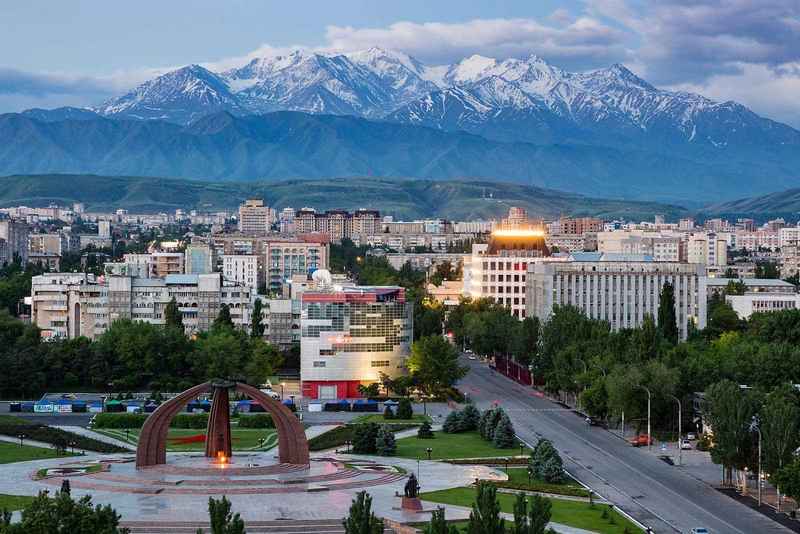
The Kyrgyz Republic (English: Kyrgyz Republic), commonly referred to as "Kyrgyzstan," is located in northeastern Central Asia at the crossroads of Central Asia, Western Europe, and East Asia, with its capital city being Bishkek. The state language is Kyrgyz, while Russian serves as the official language. The national currency is the Kyrgyzstani som (abbreviated as “som”). In recent years, Kyrgyzstan has made significant progress in the field of crypto assets, actively developing regulations for virtual assets and supporting the growth of digital technologies and blockchain ecosystems. It stands as a leader in digital asset regulation and market development within Central Asia and a core region for the crypto industry.
1.2 Classification of Crypto Assets
According to the definition provided by Kyrgyzstan's Virtual Assets Law, a virtual asset is a set of electronic digital data having value, serving as a digital representation of value and a means of proving property or non-property rights, created, stored, and circulated using distributed ledger technology or similar technologies, but not constituting monetary units (currency), payment instruments, or securities. Cryptocurrencies are one form of virtual assets.
2 Taxation Policies
2.1 Tax System Overview
Kyrgyzstan's legal system evolved from the framework of former Soviet republics and shares similarities in many aspects with the legal systems of the Russian Federation and other post-Soviet states. Overall, its legal system consists of four levels: constitutional laws, codes, laws, and regulations. Since independence, Kyrgyzstan has further revised and improved its legal system, enacting new legislation such as the Constitution, Civil Code, Foreign Trade Law, Tax Code, and Investment Law covering various domains.
In terms of taxation, Kyrgyz tax authorities manage taxpayers according to the procedures for tax collection and administration established in the Tax Code of the Kyrgyz Republic (hereinafter referred to as the "Tax Code"), and taxpayers must comply with all requirements under the Tax Code and fulfill their tax obligations accordingly. Taxes in Kyrgyzstan primarily consist of income taxes, turnover taxes, and minor local taxes, including central-level taxes such as corporate income tax, personal income tax, value-added tax (VAT), sales tax, excise tax, and subsoil resource usage tax, as well as local taxes like property tax and land tax. Additionally, the Tax Code introduces several special tax regimes, including simplified taxation based on a single tax, cryptocurrency mining tax, e-commerce tax, entertainment tax, special business license tax, special tax regime for special trade zones, special tax regime for free economic zones, and special tax regime for high-tech parks.
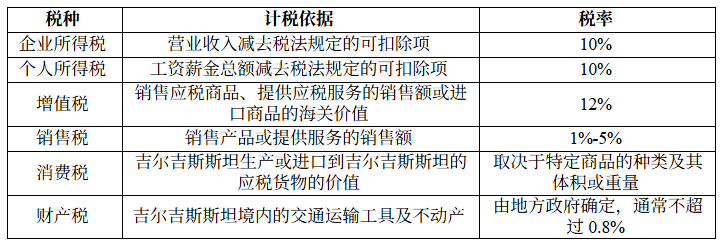
Corporate Income Tax: 1) Resident Enterprises. Legal entities and individual entrepreneurs registered and established under the laws of Kyrgyzstan are considered resident entities of Kyrgyzstan (including resident enterprises and non-enterprise units, institutions, and organizations). Partnerships in Kyrgyz law are treated as transparent entities; profits received from partnerships are regarded as income of the partners themselves, and the partnership itself does not pay corporate income tax. The tax applies to worldwide annual income earned by resident enterprises. Special economic zones often offer preferential policies reducing corporate tax burdens and implement free currency management systems. However, depending on the enterprise’s location, an additional incentive fee ranging from 0.1% to 2% of revenue may apply. Resident enterprises qualifying as innovative technology park participants are exempt from corporate income tax. 2) Non-resident Enterprises. Entities established under foreign laws, along with non-resident individuals required to register as individual entrepreneurs in Kyrgyzstan, are classified as non-resident taxpayers. This includes non-resident enterprises with permanent establishments in Kyrgyzstan, as well as those without permanent establishments but earning income sourced from Kyrgyzstan. The tax applies only to income derived from sources within Kyrgyzstan.
Personal Income Tax: 1) Resident Taxpayers. Any individual who resides in Kyrgyzstan for 183 days or more within any consecutive 12-month period is considered a resident taxpayer. Individuals performing official duties abroad for Kyrgyzstan are also deemed resident taxpayers. Citizens of Kyrgyzstan and foreign nationals holding permanent residency or repatriate certificates in Kyrgyzstan must pay personal income tax in Kyrgyzstan on their global income. Individuals meeting the residency criteria but lacking Kyrgyz citizenship or permanent residency/repatriate status are taxed only on income sourced from within Kyrgyzstan. Individual entrepreneurs do not pay personal income tax but instead pay corporate income tax. 2) Non-resident Taxpayers. Individuals residing in Kyrgyzstan for fewer than 183 days within any consecutive 12-month period are considered non-resident taxpayers. They are subject to personal income tax only on income sourced from within Kyrgyzstan.
Value-Added Tax (VAT): VAT liability applies to businesses and individuals selling taxable goods or providing taxable services within Kyrgyzstan, importers of taxable goods, and foreign enterprises providing labor, services, or electronically supplied services (including e-commerce services to residents of Kyrgyzstan). Under tax law, except where VAT exemptions apply, all domestic sales of taxable goods and provision of taxable services and labor are subject to VAT. Importation of taxable goods is also subject to VAT, calculated based on the customs value of imported goods. Sale of crypto property does not require VAT payment.
Simplified Tax Based on Single Tax: Starting January 2024, the previous 30 million som income cap was removed. Except for a few restricted industries, all individual entrepreneurs and enterprises (excluding foreign enterprises without a permanent establishment in Kyrgyzstan) can now apply for this simplified tax regime. The tax base is generally gross sales revenue, though specific business types have special rules for determining the tax base.
Tax Incentives under Special Tax Regimes: 1) Special Tax Regime for Free Economic Zones. Taxpayers registered in free economic zones benefit from a special tax regime. Unless otherwise specified, these taxpayers are exempt from all tax liabilities and need only fulfill social security contribution obligations. This regime does not impose additional tax filing or payment requirements. 2) Special Tax Regime for High-Tech Parks. Taxpayers registered in high-tech parks benefit from a special tax regime exempting them from corporate income tax, sales tax, and VAT. Other tax obligations remain unchanged and must be fulfilled per standard rules. Like the free economic zone regime, it does not introduce new tax reporting or payment duties.
Overall, to better promote economic development, Kyrgyzstan continues to simplify its tax system, optimize tax structures, and adopt digital tools to build a more efficient, fair, transparent, and compliant tax administration system.
2.2 Crypto Tax Policies and Recent Developments
Under a government decree issued on August 1, 2020, Kyrgyzstan implemented a special tax regime for entities engaged in cryptocurrency mining operations, introducing a dedicated crypto mining tax. According to the Tax Code, companies and individuals conducting mining activities through software and hardware computation operations shall pay the mining tax instead of income tax. Taxpayers must submit an application to the tax authority at their registration location to become recognized mining tax payers. The tax base is the accrued amount of electricity consumed during mining, inclusive of VAT and turnover tax, with a fixed tax rate of 15%.
Gains exceeding the acquisition cost from selling crypto assets, as well as the value of crypto assets obtained free of charge, constitute part of the taxpayer’s annual total income and are subject to income tax at a rate of 10%. Notably, the term “sale” refers specifically to converting crypto assets into domestic or foreign fiat currency. Exchanging one crypto asset for another is not considered a sale.
No VAT is levied on the sale of crypto assets in Kyrgyzstan. However, when selling goods, works, or services exempt from VAT, the trade and production sectors pay a 2% sales tax, while others pay 3%. Under Islamic finance principles, the tax base for transactions involving stocks, organizational equity, currencies, crypto assets, fixed assets, and goods is defined as proceeds minus acquisition costs.
Notably, on October 15, 2024, the Financial Market Supervision Agency under the Ministry of Economy and Commerce of Kyrgyzstan announced the initiation of discussions and consultations with stakeholders on proposed legislative amendments to Cabinet Resolution No. 159 dated April 15, 2019, “On Approval of State Tariffs.” The goal is to increase non-tax revenues by raising state tariff rates for operators in the non-banking financial sector—such as crypto asset exchange operators, insurance institutions, securities market professionals, pawnshops, and crypto mining organizations—with particular emphasis on enhancing financial stability through higher taxation of high-risk sectors like crypto assets, insurance, and securities.
3 Crypto Asset Regulatory Developments
3.1 Crypto Asset Regulation Policy
In 2022, Kyrgyzstan adopted the Virtual Assets Law, establishing a regulatory foundation for the creation, issuance, storage, and circulation of crypto assets. This has fueled rapid growth in the country’s crypto industry and distinguished Kyrgyzstan among Central Asian nations due to its positive stance toward crypto assets and blockchain technology. The Virtual Assets Law clearly defines a licensing regime for Virtual Asset Service Providers (VASPs), uniformly supervised by the State Service for Financial Markets Regulation. This enables service providers easier market access while allowing regulators enhanced oversight. As of January 31, 2025, the financial regulator had issued 144 operating licenses for crypto asset service providers, including 8 licenses for crypto asset trading operators and 138 for crypto asset exchange operators.
On January 10, 2025, the Cabinet of Ministers of the Kyrgyz Republic adopted Resolution No. 823 dated December 31, 2024, titled “On Amending Certain Resolutions of the Cabinet of Ministers of the Kyrgyz Republic in the Field of Virtual Asset Circulation,” aimed at improving the efficiency of crypto asset service providers. Key changes include: 1) Stricter requirements for crypto asset trading operators, including customer identification and verification, publication of exchange rules, and verification of beneficial owners’ reputations; prohibition of transactions via unlicensed operators and use of more privacy-focused crypto wallets; minimum authorized capital requirement set at 2,000,000 calculation units. 2) Requirements for crypto asset exchange operators, including verification of beneficial owners’ reputations, mandatory annual audits, and notification of changes to authorized bodies; prohibition of prepaid cards issued by foreign financial institutions and transfers of crypto assets to online casinos or decentralized systems; minimum authorized capital set at 1,000,000 calculation units. 3) Changes in crypto asset issuance regulations, eliminating the possibility of private placements for issuers; allowing nomination of foreign currency-denominated crypto asset issuers.
Since the 2022 Virtual Assets Law established a clear legal framework for crypto activities, Kyrgyzstan has continued advancing initiatives such as integrating crypto banking technology into its banking system and updating digital payment and financial regulations, demonstrating its proactive and open approach toward the crypto industry. In October 2024, the Ministry of Economy initiated and submitted to parliament a bill proposing the establishment of crypto banks in Kyrgyzstan. The bill suggests amending existing crypto asset legislation to require crypto banks to be legal entities registered in Kyrgyzstan and licensed under the Law on Banks and Banking Activities, offering one or more bank services related to crypto assets. Once licensed, crypto banks may engage in any type of digital asset-related activity specified by law without needing additional licenses. No separate banking license is required. Establishing crypto banks will help protect user rights and reduce risks of fraud and unauthorized fund access. Crypto banks will also serve as platforms for implementing emerging financial technologies such as smart contracts and DeFi, contributing to the modernization of the financial system.
Notably, in February 2025, the Financial Market Supervision Agency under the Ministry of Economy and Commerce announced the launch of discussions and stakeholder consultations on legal regulation of Virtual Asset Service Providers. The overarching regulatory direction aims to ensure transparency, security, and protection of market participants. Proposed regulations involve modifying and updating supervisory norms to align the legal framework with evolving dynamics in the crypto asset market, creating a clearer and more stable legal environment for market participants and promoting stronger internal controls among VASPs. These developments indicate that Kyrgyzstan is moving toward stricter regulatory policies to further enhance transparency in crypto asset trading. The introduction of new regulations will also help combat terrorist financing and money laundering while improving operational efficiency.
3.2 Local Crypto Industry Updates
The Ministry of Finance of Kyrgyzstan established Coin National Exchange, the country’s first state-owned crypto asset exchange, making Kyrgyzstan the first nation in Central Asia to launch a national crypto exchange. The exchange officially entered the Ministry of Justice registry on December 30, 2024, focusing primarily on financial market management. Currently, this category includes the Kyrgyz Stock Exchange, BTS Exchange, EVDE Universal Exchange, and numerous other crypto asset exchanges. According to ministry documents, an initial authorized capital of 100 million KGS was allocated from the national budget for Coin National Exchange.
To further solidify its position as a regional crypto hub, Kyrgyzstan actively supports the development of stablecoins. In April 2025, Kyrgyz company Old Vector launched A7A5, a stablecoin pegged 1:1 to the Russian ruble. Issued under newly enacted crypto regulations and backed by government support, A7A5 publishes reserve reports weekly and undergoes quarterly external audits by independent firms to ensure full accountability and trust. A7A5 generates revenue from interest income and automatically distributes 50% of daily earnings to all token holders whenever bank deposits are received, requiring no action from holders to receive distributions.
Regarding stablecoins and CBDCs, Kyrgyzstan previously launched Gold Dollar (USDKG), a stablecoin pegged to both gold and the U.S. dollar. Unlike other stablecoins, USDKG is a 1:1 USD-pegged, gold-backed stablecoin, with the role of the Ministry of Finance limited solely to providing gold reserves. All other development, auditing, and maintenance tasks are carried out by private companies and individuals. This initiative could better promote transparency and standardization within the crypto ecosystem, modernize infrastructure, facilitate cross-border trade, and attract international investment. Furthermore, in mid-April this year, the President of Kyrgyzstan signed a bill granting legal status to the “Digital Som.” If Kyrgyzstan ultimately decides to issue a CBDC, the Digital Som would become the country’s legal tender.
4 Conclusion and Outlook
Kyrgyzstan is proactively advancing its crypto industry, placing strong emphasis on optimizing crypto asset taxation policies. Its clear tax framework and competitive tax rates have not only enhanced Kyrgyzstan’s appeal in the global crypto market but also created stable and favorable operating conditions for investors and market participants. Moreover, both prior regulatory reforms and frequent interactions with CZ reflect Kyrgyzstan’s friendly posture toward crypto assets. We believe that against the backdrop of rapid global growth in the crypto industry, Kyrgyzstan’s tax and regulatory frameworks will help the country build competitive advantages in the crypto space. Especially with the development of crypto banks, national exchanges, and stablecoins, crypto assets in Kyrgyzstan are poised to integrate further with traditional financial systems, driving innovation in infrastructure and fostering broader industry growth across the country and the wider Central Asian region.
Join TechFlow official community to stay tuned
Telegram:https://t.me/TechFlowDaily
X (Twitter):https://x.com/TechFlowPost
X (Twitter) EN:https://x.com/BlockFlow_News
 TaxDAO