OP_RETURN: One of the most serious BTC controversies
TechFlow Selected TechFlow Selected
OP_RETURN: One of the most serious BTC controversies
Bitcoin, as a consensus, does not necessarily have to rely on a single dominant client software.
 Navigating Web3 tides with focused insights
Author: Liu Jiaolian
Recently, a proposal to remove the size limit on auxiliary data carried by OP_RETURN in the Bitcoin Core client has stirred significant controversy within the industry. Prominent advocates such as developer Peter Todd have repeatedly submitted PRs (Pull Requests), showing clear determination to push this change through.
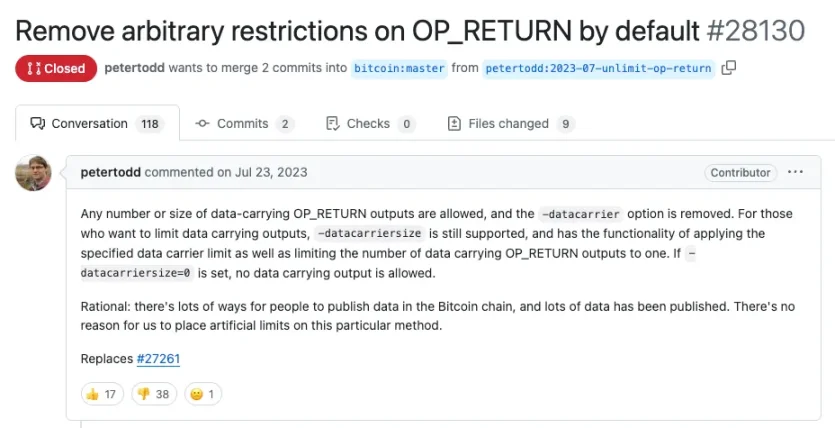
On July 23, 2023, Peter Todd submitted PR#28130, proposing to remove the data size restriction for OP_RETURN. The PR was closed and not adopted.
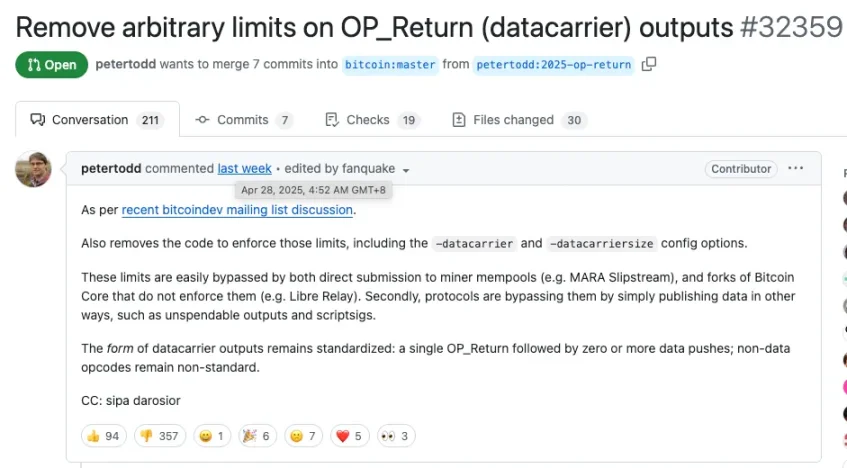
On April 28, 2025, undeterred, he resubmitted the same proposal as PR#32359. This version aggressively demanded not only removal of the data limit but also deletion of the configuration option, preventing users from manually enabling it in client software.
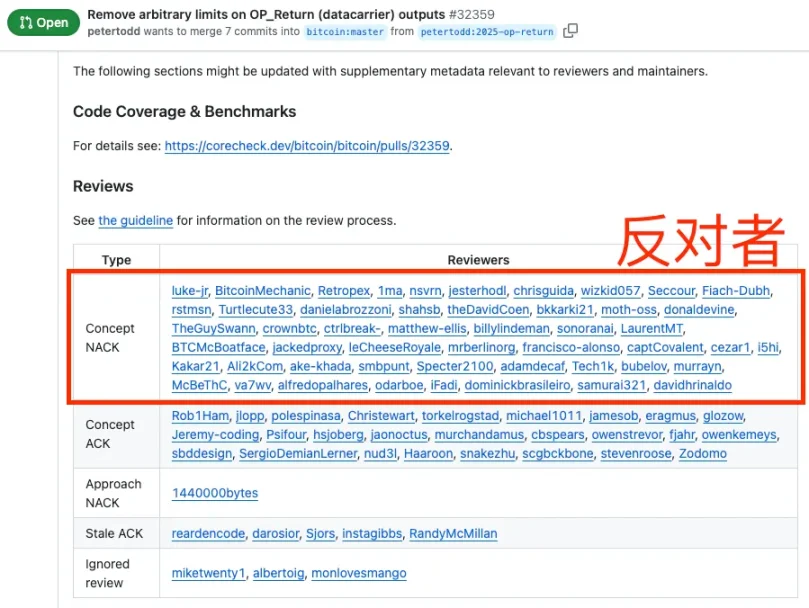
The proposal received majority opposition.
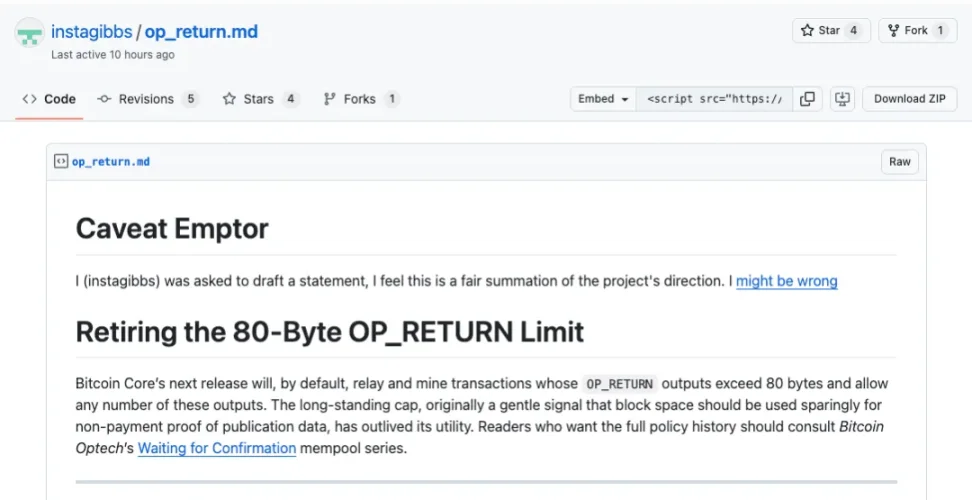
Another developer, instagibbs, proposed a slightly more moderate alternative, PR#32406. He suggested temporarily retaining the configuration option but setting no restriction by default.
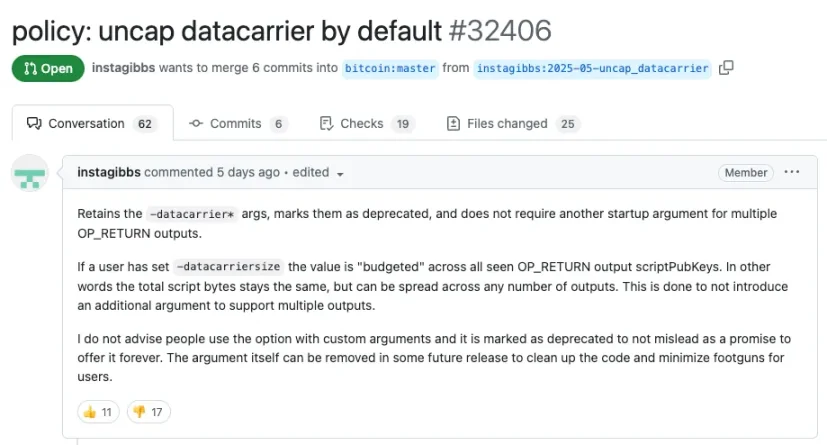
This proposal also received more downvotes than upvotes. instagibbs wrote an accompanying explanation detailing the history of OP_RETURN and his rationale for the proposed change.
A typical opponent is developer Luke Dashjr, maintainer of the Bitcoin Knots client software and a vocal critic of inscriptions two years ago. See earlier articles by TechFlow for details.
For general readers, TechFlow offers a simple analogy to understand this issue:
Removing data limits + executing auxiliary data in VM = Ethereum
Of course, reality is more complex. Bitcoin's ledger uses a stateless UTXO model. Only by modifying the ledger to store state data—leading to new problems like state bloat—could it approach Ethereum's design.
In fact, it was precisely because Bitcoin Core rejected Vitalik Buterin’s idea of using Bitcoin's auxiliary data capability to implement his vision of smart contracts that he went on to create Ethereum.
Throughout this market cycle, those betting on Ethereum outperforming BTC must be feeling quite uneasy now.
Since this feature is merely a function of client software and not part of Bitcoin's protocol consensus, there is no need to worry about this dispute leading to a hard fork like in 2017.
Main arguments in favor include: many modified clients have already removed this limit and gained support from certain mining pools; it might offer greater incentives to miners; restricting OP_RETURN won't stop people from creatively using other features like multisig or taproot scripts to embed data, and may instead lead to UTXO fragmentation due to data splitting; prohibition is less effective than regulation, and there's no precise way to universally identify "junk" data, making this an inevitably futile cat-and-mouse game; etc.
Main opposing arguments include: lifting data limits could cause rapid bloating of the Bitcoin ledger, weakening decentralization; encourage numerous non-financial applications, diluting BTC's positioning and reducing it to a mere checkbook; etc.
According to Clark Moody Bitcoin statistics, the current size of the Bitcoin blockchain is approximately 748.1GB, with OP_RETURN auxiliary data accounting for about 3.83GB, or roughly 0.5%.
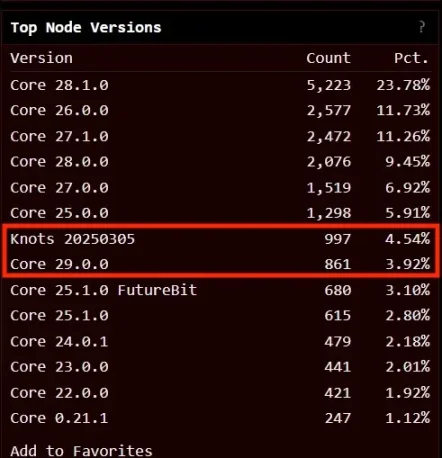
There is currently no definitive conclusion on whether these PRs will be merged and released. However, judging by community voting-with-their-feet, the number of nodes running the lightweight Bitcoin Knots client has already surpassed the number of nodes running the latest Bitcoin Core 29.0 version.
We may witness a historic moment: Bitcoin as a consensus does not necessarily depend on a single dominant client software. (Although this has always been true, it remains largely unrecognized by many.)
Would a diversified Bitcoin ecosystem—with two or three equally influential Bitcoin client software implementations, codebases, and development teams balancing each other—adhering to one Bitcoin consensus, harmonious yet distinct, competing without breaking apart—better showcase the charm of Bitcoin's decentralization?
Join TechFlow official community to stay tuned
Telegram:https://t.me/TechFlowDaily
X (Twitter):https://x.com/TechFlowPost
X (Twitter) EN:https://x.com/BlockFlow_News