RWAiFi Summit 2025 Concludes Successfully in Dubai, Recap of Highlights at the Intersection of AI, RWA, and DeFi
TechFlow Selected TechFlow Selected
RWAiFi Summit 2025 Concludes Successfully in Dubai, Recap of Highlights at the Intersection of AI, RWA, and DeFi
RWAiFi Summit 2025 has become a key platform for driving AI innovation.
 Navigating Web3 tides with focused insights
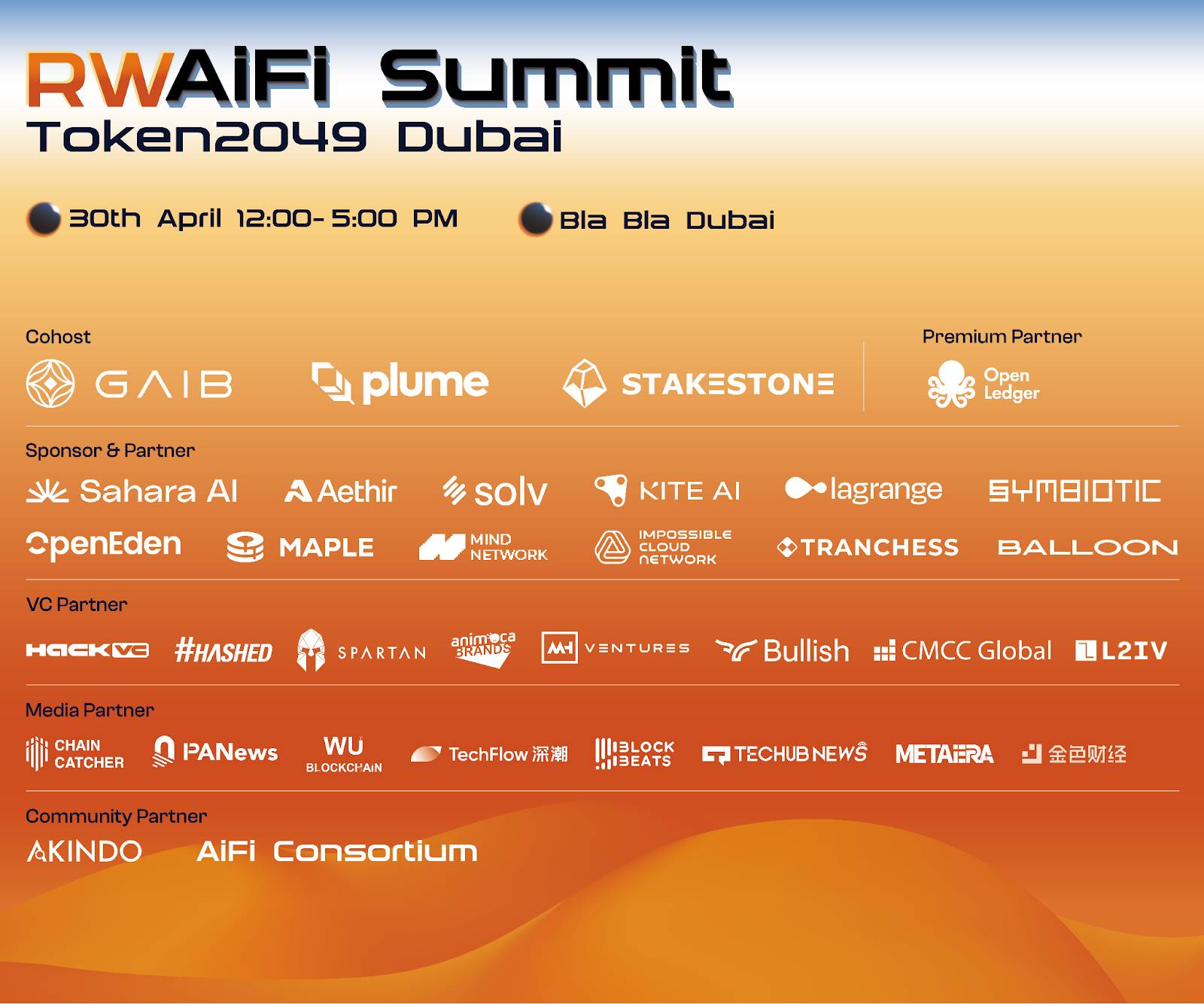
The RWAiFi Summit 2025, hosted by GAIB, Plume, and StakeStone, successfully concluded on April 30 during Dubai's Token2049.
The summit attracted over 1,900 registrants and more than 400 attendees, bringing together 17 leading projects including OpenLedger, Sahara AI, Aethir, Solv, Kite AI, Lagrange, Symbiotic, OpenEden, Maple Finance, Mind Network, ICN Protocol, Tranchess, and Balloon, along with top-tier investment firms such as Hack VC, Spartan Group, Animoca Brands, MH Ventures, Bullish, CMCC Global, and L2 Iterative Ventures. Together with numerous global AI experts and financial innovators, they explored the future of AI, RWA, and DeFi.
Event Highlights:
The summit featured four core panel discussions diving deep into cutting-edge industry topics. Below are key insights from select speakers:
Panel Discussion 1: AiFi: On-Chain Finance and Real Yield
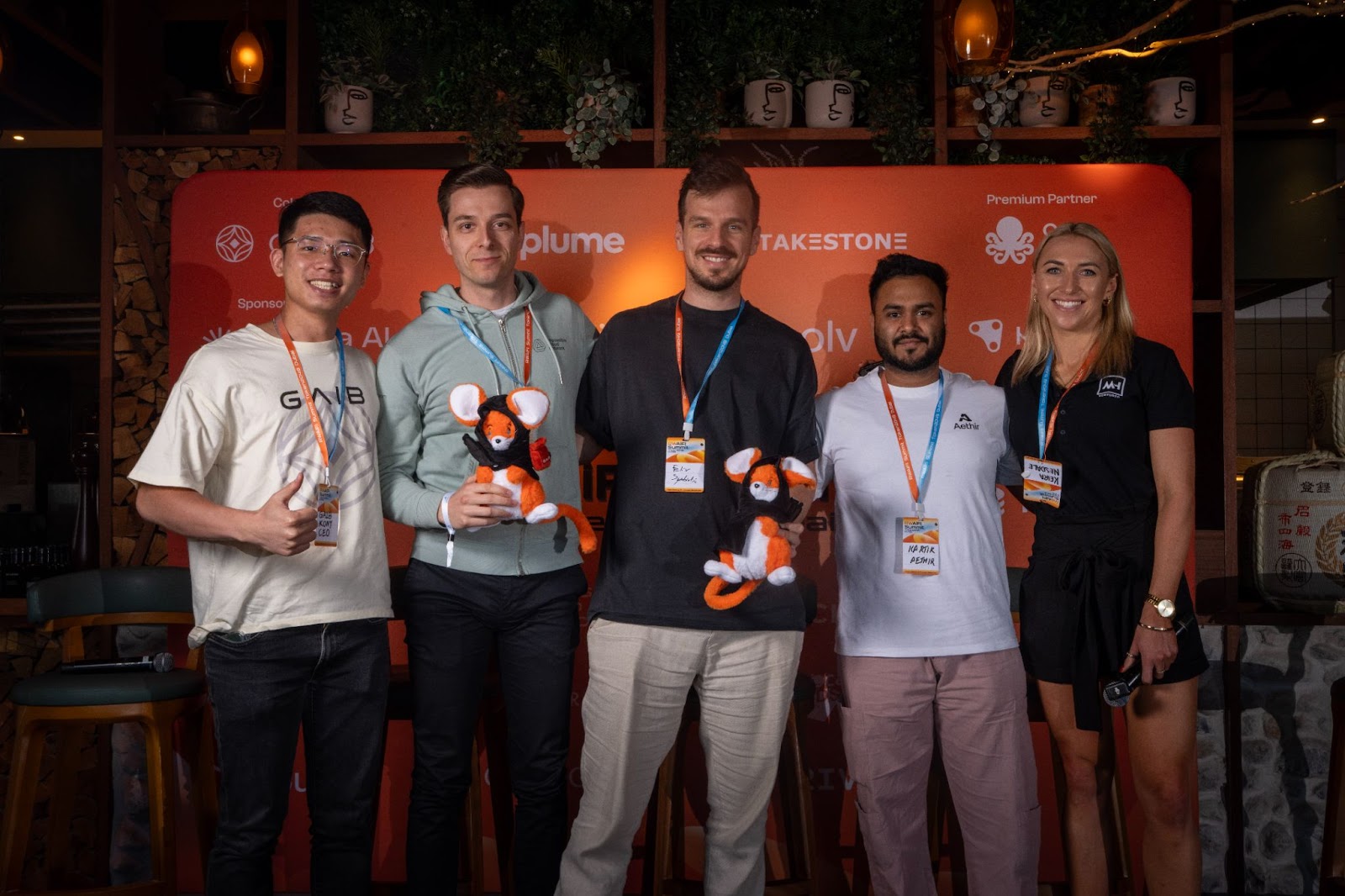
Moderator: Keira (MH Venture Portfolio Manager)
Speakers:
- Kony (GAIB CEO)noted that in the AI era, real yields primarily flow to underlying compute assets like cloud providers and data centers. Ordinary investors often lack direct access and typically participate indirectly through stocks such as Nvidia. GAIB is driving the financialization and tokenization of these computing assets, enabling investors to directly participate and share in the returns.
- Kartik (Aethir Strategy Lead)stated that Aethir’s compute marketplace uses computing resources as collateral, distributing actual income generated from GPU rentals proportionally among participants. This mechanism, built on real customers and transactions, naturally possesses a “real yield” characteristic, offering sustainable and low-cost support for projects requiring economic security.
- Felix (Symbiotic Head of Ecosystem)emphasized that "composability" is the key advantage of crypto systems over traditional centralized models. Through modular financial and incentive components, Symbiotic enables free combinations of new assets and protocols, helping RWAs and compute resources efficiently collaborate and accelerate adoption within the Web3 ecosystem.
- Seb (Impossible Cloud Network Managing Director)highlighted that ICN serves as a critical bridge between Web2 and Web3, establishing a "pay-as-you-go" model that ensures all ecosystem participants engage based on genuine demand, forming a sustainable compute network driven by enterprise clients with an on-chain revenue loop.
Panel Discussion 2: Unlocking RWA Value: The Innovation Path for On-Chain Assets
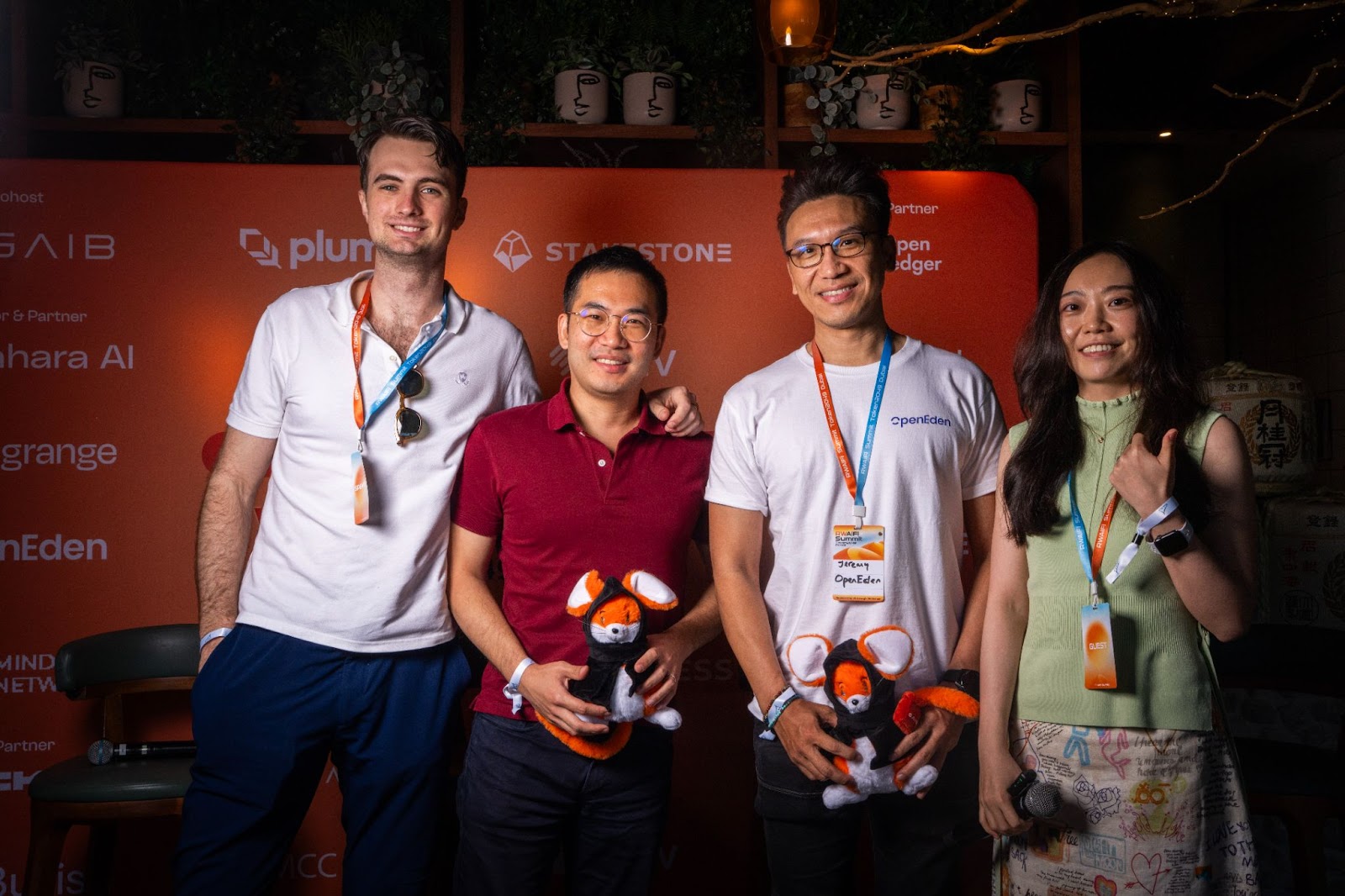
Moderator:Johanna (IDG Capital Web3 Investment)
Speakers:
- Jeremy (OpenEden CEO)proposed that OpenEden has launched stable assets backed by U.S. Treasury yields and plans to expand further into emerging markets, bridging access from crypto wallets to high-quality dollar-denominated assets.
- Jing (Solv CBO)stated that now is the best time to build RWAs, as global regulation is entering a critical framing period. The industry should actively shape financial rules for the next five to ten years, as both products and market demand have matured. Solv recently launched a product that even received Sharia compliance certification in Saudi Arabia, demonstrating RWA products’ localization capabilities and real user appeal in regional markets.
- Jack (Plume Ecosystem)emphasized that this is the golden age for bringing new asset types on-chain. As crypto markets gain stronger footing in the global financial system, more finance professionals without technical backgrounds want to leverage crypto technology to drive asset innovation. He envisions a future where crypto evolves into a "democratized capital market," merging public and private markets and breaking down investment barriers.
Panel Discussion 3: DeFi Liquidity and RWA Value: New Opportunities in On-Chain Finance
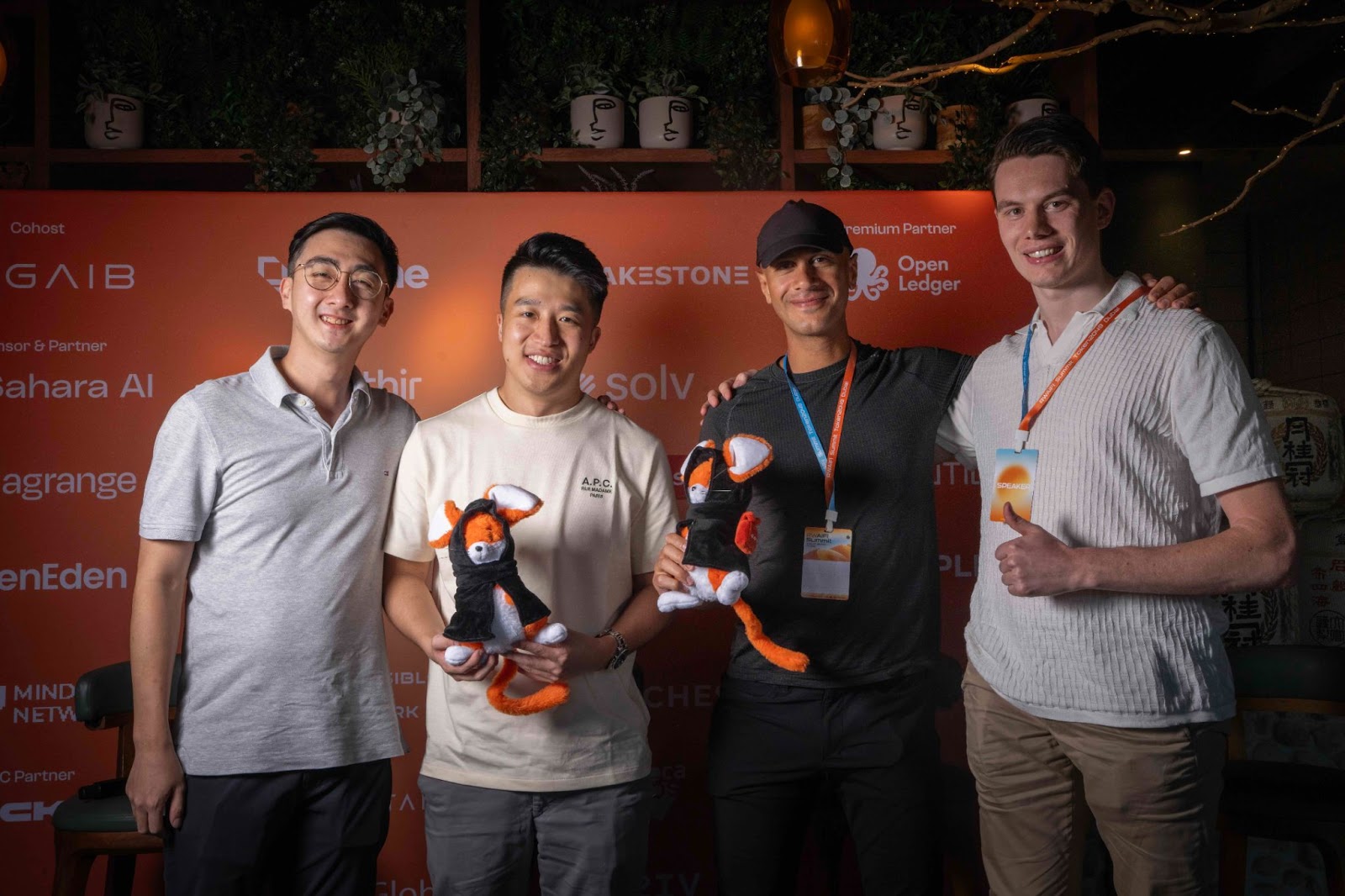
Moderator:Lionel Pek (Spartan Group Executive Director)
Speakers:
- Ivan (Stakestone CMO)pointed out that compared to traditional markets, DeFi offers more flexible "cost of capital." From an ETH perspective, users earn additional yield through staking; from a USD standpoint, however, they must account for capital volatility caused by ETH price fluctuations. To address this, Stakestone supports stablecoins as deposit assets, helping users hedge against ETH volatility and thereby reduce overall capital costs.
- Martin (Maple Head of Growth)called for the industry to establish unified risk management and asset pricing frameworks, advocating cross-asset and cross-chain margining mechanisms to unlock and scale RWA capital deployment.
- Omar (Lagrange CSO)emphasized that DeFi liquidity can essentially be viewed as a form of "new risk capital," capable of activating high-potential yet underfunded underlying assets. DeFi enables rapid mobilization of small capital amounts to activate use cases such as market making and warehouse leasing, while also reducing overall sector-wide capital volatility.
Panel Discussion 4: AI Ecosystem: Building the True Foundation for the Future
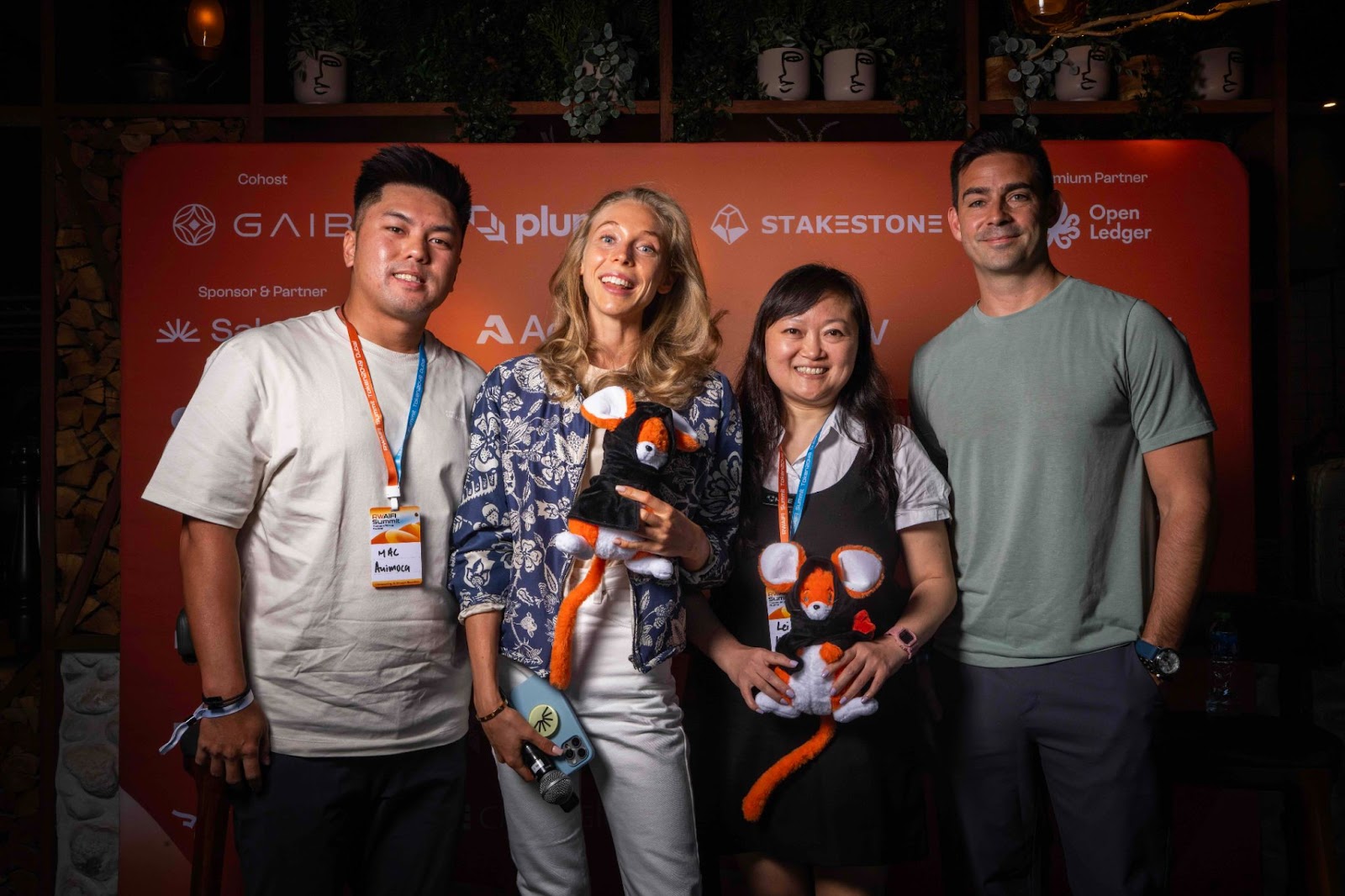
Moderator:Mackenzie (Animoca Brands Portfolio Manager)
Speakers:
- Katerina (Sahara Operations Lead)stated that Sahara focuses on addressing the current AI industry issue where large centralized companies dominate and data contributors receive little reward. They aim to break the status quo of "silent contributions," enabling developers, small teams, and individual users to fairly participate in value distribution across the AI lifecycle and promote a more open and equitable AI economy.
- Lei Lei (KiteAI VP)pointed out that blockchain and smart contracts can introduce governance and auditability into AI systems—such as service level agreements (SLAs), scoring mechanisms, dispute resolution processes, and even exploring "insurance and penalty mechanisms" based on performance. These mechanisms make AI agent behaviors more controllable, traceable, and verifiable, though privacy protection remains crucial, requiring a balance between verifiability of model training data and user privacy.
- Christian (Mind Network CEO)emphasized that blockchain inherently offers advantages of "open participation" and "economic accessibility," allowing individual users or non-institutional investors earlier access to AI-related protocols and projects, sharing in the economic benefits of technological growth. Unlike traditional AI giants such as OpenAI and Anthropic, Web3 projects achieve fairer investment opportunities through on-chain issuance.
As global discussions around RWA, AI, and DeFi continue to intensify, RWAiFi Summit 2025 has become a pivotal platform for advancing AI innovation. This event once again highlights GAIB’s commitment to integrating cutting-edge technologies and unlocking the future of decentralized finance.
Stay tuned for more exciting updates from GAIB and the AiFi ecosystem!
Hosts:
GAIB is the first economic layer for AI compute, transforming GPU assets into a new class of yield-generating assets. GAIB has introduced AID, a synthetic AI asset, enabling investors to seamlessly participate in the AI economy and earn real returns from AI compute yields. Investors can stake AID (sAID) to earn rewards while maintaining liquidity, further engaging in AI-driven financial markets. GAIB also provides capital solutions for cloud providers and data centers, optimizing their compute resources and accelerating AI infrastructure development. With broad integration across DeFi protocols—including lending, derivatives, and structured products—GAIB bridges AI and blockchain finance, unlocking new opportunities for technology and investment.
Plume is the first complete RWA chain and ecosystem designed specifically for RWAfi, accelerating the on-chain integration of real-world assets. Over 200 projects are already active on the Plume network, benefiting from an EVM-compatible composable environment that supports diverse asset management and onboarding. Plume’s end-to-end tokenization engine and network of financial partners streamline the asset-onboarding process, fostering deeper integration between RWAs and DeFi, enabling asset tokenization and global distribution.
StakeStone is a decentralized, omnichain liquidity infrastructure protocol revolutionizing how liquidity is distributed across blockchain networks. Built on an omnichain architecture, StakeStone enables efficient yield generation, liquidity provisioning, and flexible asset management, delivering sustainable liquidity solutions for the on-chain ecosystem.
Join TechFlow official community to stay tuned
Telegram:https://t.me/TechFlowDaily
X (Twitter):https://x.com/TechFlowPost
X (Twitter) EN:https://x.com/BlockFlow_News
 @gaib_ai