








OKX Pay: A New Era of Payments – How Crypto Payments Are Changing the Game?
TechFlow Selected TechFlow Selected
OKX Pay: A New Era of Payments – How Crypto Payments Are Changing the Game?
The new era of digital asset payments has officially begun—mass adoption is here!
 Navigating Web3 tides with focused insights
In the global wave of digitization and decentralization in the payments industry, traditional payment systems are facing unprecedented challenges. Against this backdrop, OKX Pay has emerged as a cryptocurrency payment gateway launched by OKX, dedicated to reshaping the payment experience through blockchain technology. OKX Pay not only enhances the convenience and security of digital asset payments but also opens the door to the Web3 world for users. This article will explore the transformation trends in the global payments industry and analyze how OKX Pay plays a pivotal role in this evolution.
Global Payment Industry Transformation and the Inevitable Rise of Cryptocurrency Payments
According to McKinsey's "2024 Global Payments Report," global payment revenue reached $2.4 trillion in 2023, with an average annual growth rate of 7% over the past five years. Notably, digital payment transaction volumes have grown at an average annual rate of 17%, far exceeding overall revenue growth, accelerating the shift toward cashless societies and instant payment systems as global mainstream models.
Driven by the pursuit of efficient and seamless financial experiences, the global payment system is undergoing profound transformation. At its core, this represents a reconfiguration of fund mobility—shifting from traditional architectures based on cash, bank cards, and bank accounts toward more real-time, low-cost, and disintermediated frameworks.
With the proliferation of digital infrastructure, widespread adoption of stablecoins, and the maturation of DeFi, cryptocurrency payment systems are transitioning from concept to reality. Whether in cash-reliant economies or developed nations with robust credit systems, crypto payments demonstrate the potential to break through limitations of traditional systems, fundamentally reshaping the payment experience.
Why Does the Traditional Payment System Need Restructuring?
The hierarchical structure of bank clearing systems and card networks imposes high economic and time costs on the traditional payment system.
Although systems like ACH and wire transfers support same-day settlement, they involve multiple barriers related to user identity and fund usage purposes. Everyday card payments rely on a complex multi-party collaboration framework—from issuing banks to acquiring banks, payment institutions to card networks—with fees levied at each stage.
Take credit cards as an example: merchants typically pay total processing fees ranging from 1.5% to 3.5%, with commissions taken by card networks, acquiring banks, and service providers. Cross-border payments are even more burdensome. Even within closed economies with mature centralized clearing systems where real-time, low-fee transfers are possible, cross-border transactions inevitably face cumbersome procedures, slow settlements, and high costs.
According to World Bank data, the average cost of SWIFT cross-border remittances is as high as 6.5% of the transfer amount, taking 2–5 business days. For businesses, 30%–40% of payment process costs stem from payment network and foreign exchange conversion fees—these stacked infrastructure-level costs constitute the primary profit source of the global payments industry.
Clearly, the traditional payment system is constrained by multiple intermediaries, fragmented systems, and outdated technologies, urgently requiring reinvention via blockchain-based cryptocurrency payment systems to unlock more efficient financial frontiers.
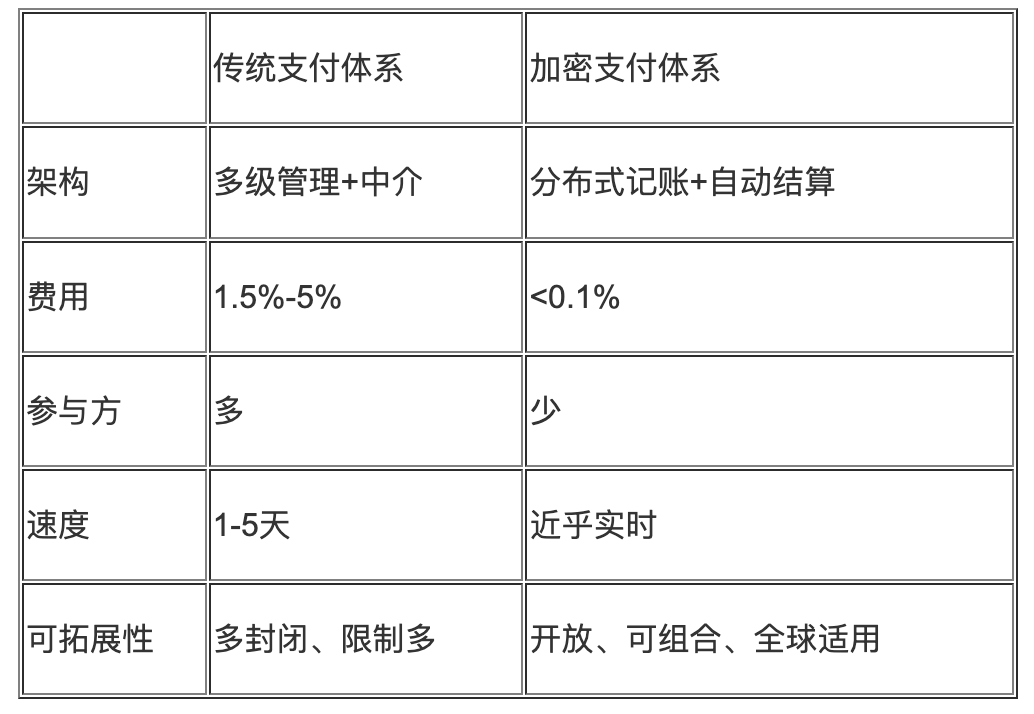
The Penetration Power of Cryptocurrency Payments Across Use Cases
Cryptocurrency payments inherently offer global interoperability, efficient settlement, and extremely low costs, demonstrating overwhelming competitiveness especially in multi-currency environments, cross-regional collaborations, and regions with weak financial infrastructure.
Leveraging blockchain’s single-ledger architecture, cross-border payments no longer require multiple intermediary banks—settlement and clearing happen simultaneously—overcoming the drawbacks of closed systems. This model flexibly supports needs ranging from small personal transfers to large corporate settlements. Moreover, the programmability of crypto assets unlocks greater possibilities in financial markets.
Daily Life Scenarios
For ordinary users, cryptocurrency payments significantly enhance efficiency and user experience, particularly beneficial for individuals frequently conducting cross-border payments burdened by high costs:
- Migrant workers, international students, freelancers, and others who frequently send remittances;
- Micropayment scenarios required by gig platforms and content creator economies;
- On-ramp and off-ramp scenarios that do not rely on bank accounts, such as converting off-chain to on-chain payments.
OKX Pay aims to bridge the gap between cryptocurrency payments and real-world spending, empowering every user with a global payment capability as simple as “sending a message,” truly realizing payment freedom.
Cross-Border Business Scenarios
Most cross-border transactions revolve around import payments to suppliers, typically with buyers located in the U.S., Latin America, or Europe and suppliers in Africa or Asia. These channels are particularly challenging due to underdeveloped local banking infrastructures, making it difficult for companies to collaborate with local banks. Cross-border payments may take weeks, with transfer fees exceeding 10%. Additionally, enterprises with global sales channels face numerous complications in fund disbursement and collection.
Cryptocurrency payment systems represent the optimal solution for these scenarios:
- Real-time settlement without waiting for intermediary clearing;
- Capable of handling large-scale capital flows;
- Supports multi-currency conversion, adapting to various local settlement currencies;
- On-chain programmability allows merchants to customize payment workflows or trigger conditions;
- Integration of compliant KYC + AML mechanisms further enhances security and traceability for B2B applications.
Therefore, whether expanding existing payment providers or adopting native cryptocurrency payment networks, merchants and institutions can achieve superior payment experiences. As recently demonstrated by Mastercard announcing its global stablecoin payment support system and partnering with OKX to issue the OKX Card in select regions, the goal is precisely to connect crypto transactions with everyday spending and promote merchant acceptance of stablecoin payments.
Financial Infrastructure Scenarios
From the perspective of financial institutions, once matured, cryptocurrency payment systems will serve as foundational infrastructure for core functions such as trading, custody, and liquidity management.
On-chain authentication mechanisms can effectively reduce counterparty risk; transparent and efficient payment logic enables hybrid product architectures between DeFi and TradFi, offering capabilities such as portfolio management, yield reinvestment, and automated settlement.
As a core payment module, OKX Pay is gradually integrating with DeFi, CEXs, and wallet systems, promoting diversified, composable, and low-barrier access to financial products.
Advantages and Vision of OKX Pay
Non-Custodial Security Assurance
At its essence, payment is about transferring trust, and security is fundamental. OKX Pay integrates compliance and risk control systems with multi-signature mechanisms—every transaction requires signatures from both the user and OKX. Without user authorization, assets cannot be moved.
Additionally, leveraging ZK Email recovery technology, users can easily recover their accounts while maintaining security, greatly reducing the barrier associated with traditional wallets.
Instant Transfers, Zero Fees—Payments as Simple as Sending a Message
Built on OKX's ZK Layer2—X Layer—OKX Pay enables anytime, anywhere, zero-fee digital asset transfers. This is highly favorable for users engaging in small, frequent transactions, meeting lightweight payment needs such as “sending red packets” or “group chat transfers.”
We understand that payment behaviors naturally arise within familiar social networks. With OKX Pay, users can add contacts as friends, make transfers as effortlessly as sending messages, or send/receive digital assets via QR codes. We are committed to embedding payment behaviors into daily life, building real-world consumption scenarios that people truly need, and unleashing the network effect of the OKX ecosystem.
A Fusion Paradigm of TradFi and PayFi
Unlike traditional DeFi wallets limited to asset management, OKX Pay serves as a unified gateway combining CEX, Wallet, and Pay. OKX’s persistent efforts in on-chain DeFi give us confidence in delivering best-in-class products. Our powerful trading system and open ecosystem partnerships enable users to integrate asset appreciation with payment use cases—not confined to individual products or strategies—but truly allowing assets to be composable, something traditional finance struggles to achieve.
User assets don’t just sit idle in wallets—they can automatically enter yield-generating pools, currently earning up to 5% APY (capped at 10,000 USDT), enabling funds to “flow when paying, grow when idle.”
Meanwhile, OKX Pay supports flexible integration with PSPs, card networks, Web3 DApps, and traditional institutions, enabling merchants to rapidly develop and customize their own payment experiences to reach their customer base.
We believe that building complete transaction loops is the core pathway for financial infrastructure in the Web3 world.
Conclusion
From enhancing individual efficiency to reshaping global business landscapes, cryptocurrency payment systems are becoming the next-generation infrastructure.
OKX Pay is dedicated to making digital asset payments a bridge connecting every on-chain and off-chain world, serving every user and every real-life application scenario.
The new era of digital asset payments has officially begun—mass adoption is here!
Disclaimer
This article reflects the author's views only. It does not constitute (i) investment advice or recommendation; (ii) an offer or solicitation to buy, sell, or hold digital assets; or (iii) financial, accounting, legal, or tax advice. We do not guarantee the accuracy, completeness, or usefulness of the information provided. Holding digital assets (including stablecoins and NFTs) involves high risks and may fluctuate significantly. You should carefully consider whether trading or holding digital assets is suitable for you based on your financial situation. Please consult your legal/tax/investment professionals regarding your specific circumstances. You are solely responsible for understanding and complying with applicable local laws and regulations.
Join TechFlow official community to stay tuned
Telegram:https://t.me/TechFlowDaily
X (Twitter):https://x.com/TechFlowPost
X (Twitter) EN:https://x.com/BlockFlow_News
 OKX
OKX






