








Looking Back at Llamas: When Bearish News Becomes a Temporary Wealth Code
TechFlow Selected TechFlow Selected
Looking Back at Llamas: When Bearish News Becomes a Temporary Wealth Code
ALPACA's "sinful" journey continues, but players who got liquidated need to take a break.
 Navigating Web3 tides with focused insights
By TechFlow
In recent days, $ALPACA—the so-called "alpaca coin"—has taken center stage in the market, stirring up hundreds of billions in trading volume despite having only a $30 million circulating market cap.
On April 24, Binance announced it would delist four tokens including Alpaca Finance ($ALPACA), with the removal scheduled for May 2.
For most projects, being "delisted from Binance" is typically a major negative—delisting means reduced liquidity, shrinking trading volume, and usually results in an immediate price drop, sometimes leading to permanent collapse.
But $ALPACA clearly didn't follow this script. After the announcement, $ALPACA briefly dropped around 30% (based on spot prices on Binance), but then surged nearly 12-fold within three days—from $0.029 to a peak of $0.3477. Meanwhile, open interest (OI) in $ALPACA futures contracts far exceeded its market capitalization by several times.
The brutal long-short battle surrounding $ALPACA had begun.
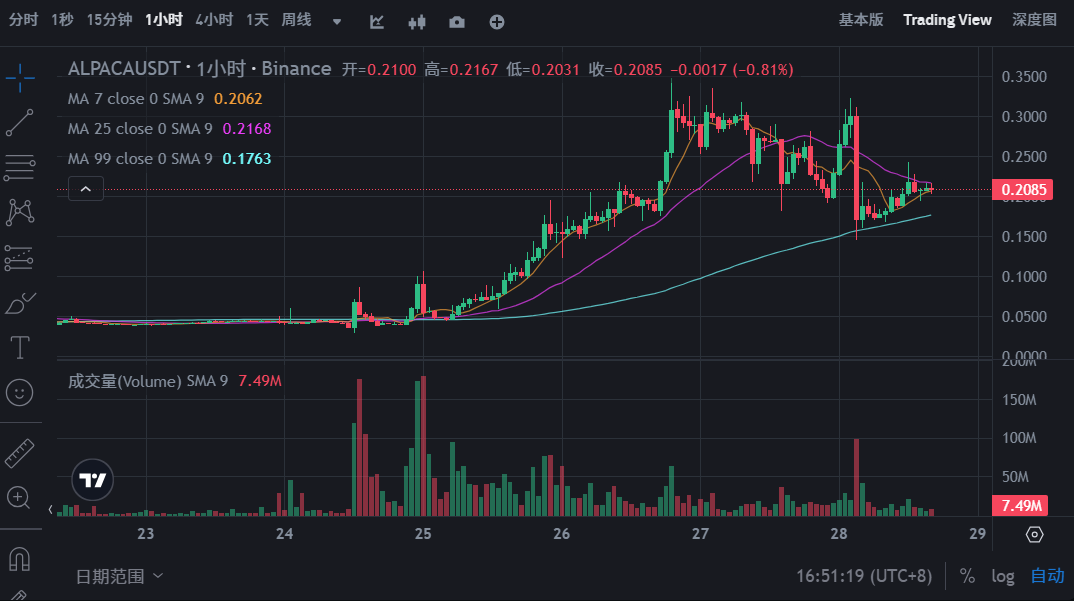
Accelerated Funding Rate Settlement Intensifies Long-Short Battle
One day after the delisting announcement, on April 25, Binance adjusted the funding rate settlement rules for $ALPACA, shortening the cap cycle to hourly settlements (maximum ±2%). This further intensified the ferocity of the long-short war.
Bullish traders not only profited from pumping the price, but also continuously collected high funding rates—“earning while holding”—allowing $ALPACA to remain locked in fierce high-price battles for nearly four days.
Short sellers, however, were not so lucky. An hourly -2% funding rate meant that even at 1x leverage, a short position would lose at least 48% of its principal in just one day. Yet despite these punishing costs, shorting capital kept pouring in relentlessly.
Amid the intense battle, some unusual behavior emerged: signal providers managing millions of dollars in follower funds kept aggressively shorting $ALPACA with high leverage, ultimately blowing up both their own and their followers’ accounts with massive liquidations.

On April 29, Binance raised the $ALPACA contract funding rate cap to ±4%. For shorts, this doubling of the maximum rate should have made shorting prohibitively expensive. Yet paradoxically, immediately after this rule change—which should have deterred shorting—the price of $ALPACA plunged sharply, falling from $0.27 to around $0.067.

The $ALPACA saga has been wildly unpredictable. Conventional trading logic keeps failing. One thing remains constant: change itself.
No Absolute Trading Rules
Looking back at this farce playing out at a billion-dollar scale, $ALPACA over these past few days might as well be considered a meme—its delisting-induced negative news attracted massive attention, taking the principle that “all publicity is good publicity” to extremes. Combined with certain alpaca-like traits—relatively low circulating supply (bottoming out below $4 million) on a top-tier exchange, highly concentrated holdings, extreme price volatility designed to trigger emotional responses, and even its visual branding—it checks all the boxes of a meme coin.
Cute as it may look, for those actually caught in the crossfire, these past days could only be described as “bloody.”
Price surging on bad news, smooth downside moves following apparent “short squeeze” signals—$ALPACA’s complex movements overturned the traditional “sell the news” logic and wrecked many traders’ positions.
Some suggest that behind signal providers recklessly shorting with followers’ money lies a predatory hunt targeting retail capital. As the famous movie quote goes: “The landlord's money will be returned in full; the common people's money will be split 70-30.” Whether true or not is hard to verify, but one thing is certain—even if reality isn’t this dark, ordinary users still won’t be the final winners in such manipulation games.
Yet duality defines everything. While some feel lost, others are thrilled. For skilled traders chasing volatility, the alpaca’s wild ride presented a rare opportunity to make big gains.
Clearly, the line between “bullish” and “bearish” is increasingly blurred. Traditional binary thinking no longer applies in today’s evolving markets. Instead, psychological warfare and brute-force manipulation now dominate, with ever-rising liquidation records grabbing headlines. Perhaps “brutal growth” best describes this evolutionary path.
As long as regulatory frameworks remain underdeveloped, $ALPACA won’t be the last instance of such market madness.
At the time of writing, $ALPACA had rebounded sharply after its plunge—perhaps more dramatic “performances” await before the official delisting.
But amid such turbulent price wars, there’s little safe ground for naive participants. Under the hunt for attention and liquidity, maybe the most +EV strategy for retail traders is to watch less and act more. After all, when you see big headlines paired with abnormal price action and think “opportunity,” remember—it’s not just retail who feel that hunger. Project teams do too.

Join TechFlow official community to stay tuned
Telegram:https://t.me/TechFlowDaily
X (Twitter):https://x.com/TechFlowPost
X (Twitter) EN:https://x.com/BlockFlow_News
 深潮TechFlow


