Bitcoin Perpetual Hedging New Paradigm: How Does Aegis Use Short Contracts to Build the Decentralized Stablecoin YUSD?
TechFlow Selected TechFlow Selected
Bitcoin Perpetual Hedging New Paradigm: How Does Aegis Use Short Contracts to Build the Decentralized Stablecoin YUSD?
Aegis is an early-stage project aiming to build a stablecoin that does not rely on fiat, oracles, or permissioned collateral.
 Navigating Web3 tides with focused insights
Author: Stacy Muur
Translation: Tim, PANews
We’ve seen fiat-backed stablecoins. We’ve seen crypto-collateralized stablecoins. Aegis takes a different approach: a Bitcoin-backed stablecoin.
Here’s why its design is bold—and why it might succeed.
Most stablecoins today rely on centralized systems—exactly the kind of infrastructure Bitcoin was designed to avoid:
-
Fiat custody
-
Bank settlements
-
Regulatory dependencies
Aegis chooses a different path—building around Bitcoin, not banks.
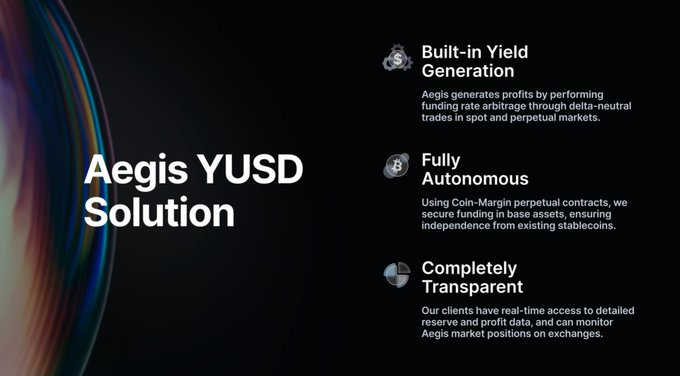
Aegis names its stablecoin YUSD:
-
Pegged to $1 USD
-
Backed by Bitcoin collateral
-
Stabilized via short perpetual contracts
No oracles, no fiat reserves, no third-party intermediaries.
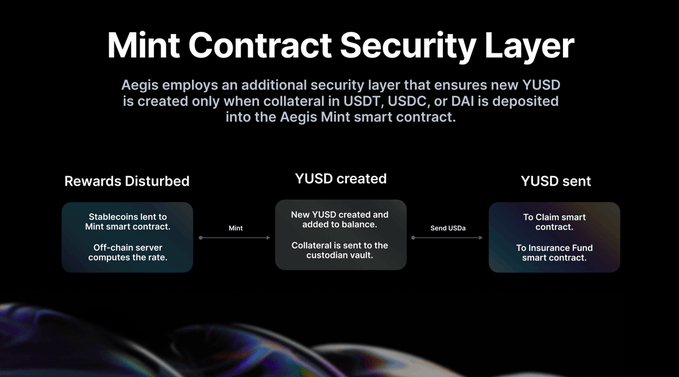
YUSD is only minted when stablecoins like USDT, USDC, or DAI are deposited into the Aegis Mint smart contract.
Once verified, YUSD is issued and the corresponding collateral is transferred to secure vaults.
No off-chain minting switches, no manual intervention—everything governed purely by smart contract logic.
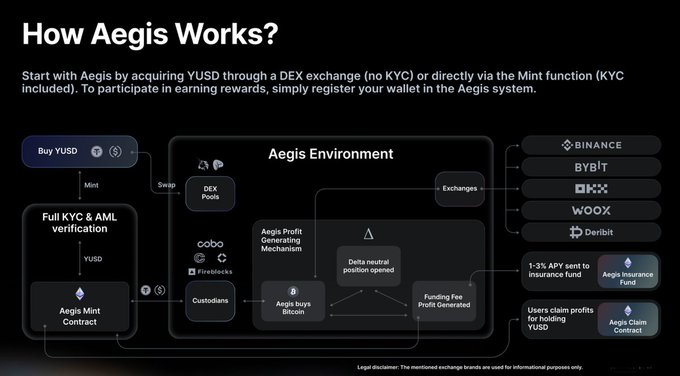
So, how does Aegis achieve end-to-end operation?
-
You deposit funds (on-chain or via decentralized exchanges) to mint or exchange for YUSD
-
Aegis uses these funds to purchase BTC
-
Hedges price volatility by opening short perpetual positions
-
The short position earns funding rate income
-
Distribution: part flows into an insurance pool, part goes to YUSD holders
This is the YUSD cycle.
But where do these profits come from?
When Aegis shorts Bitcoin perpetual contracts, it earns funding rates paid by traders with long positions.
As long as there's demand for long positions, these payments occur three times daily.
This isn't staking. It's not inflation.
This is turning counterparty pressure into yield.
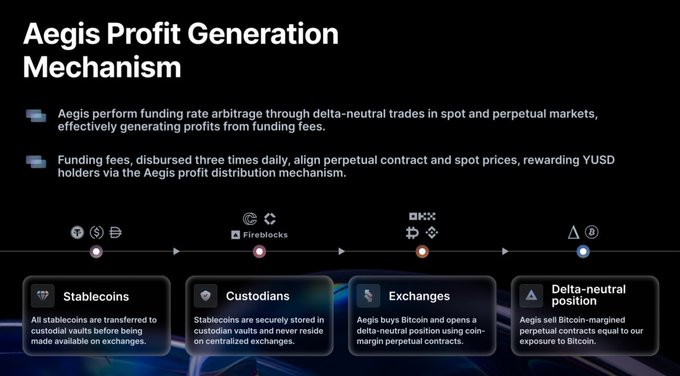
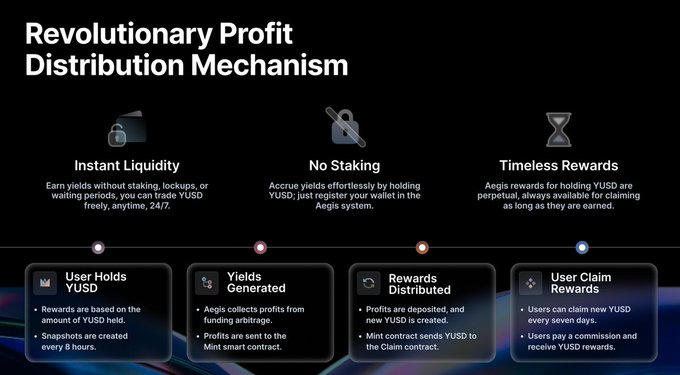
Aegis doesn’t require any extra actions from you.
Hold YUSD → Aegis earns fees → Snapshot records share → Rewards generated → Claim via app
See? The yield just blows in.
Aegis is built for security and reliability, avoiding centralization risks and common single points of failure:
-
No fiat backing
-
No USDC reserves
-
No reliance on oracles
Only Bitcoin, collateral hedging, off-exchange holdings, real-time monitoring.
No yield model is perfect—especially one tied to funding rates. So what happens if funding rates turn negative?
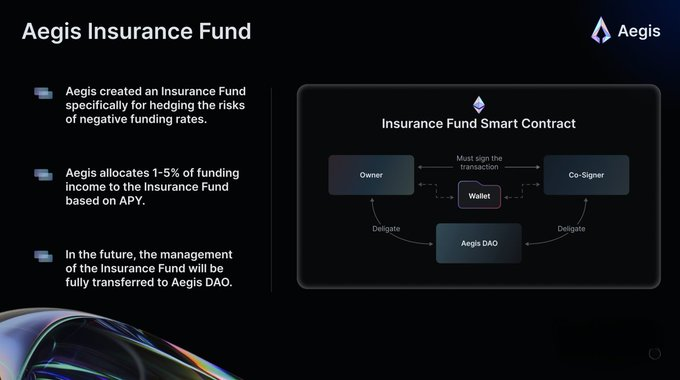
Aegis has established an insurance fund for exactly this scenario.
-
1–5% of earnings go into the insurance fund
-
Fund activates when funding rates turn negative and shorting costs rise
-
Managed by a multi-signature smart contract
-
Control will later transition to the Aegis DAO
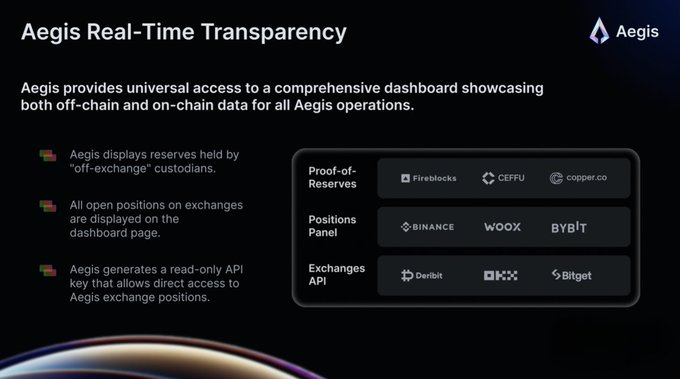
Transparency is clearly a priority for Aegis:
-
Verifiable custodial reserves
-
Public exchange positions
-
Read-only API exposing system status
You don’t have to guess how it works—you can observe results in real time.
The insurance fund manages risk; the Aegis points system drives growth. Users earn points daily through:
-
Holding YUSD (15 points per dollar per day)
-
Providing liquidity (30 points per dollar per day, 2x bonus)
-
Borrowing via Euler (45 points per day, 3x bonus)
-
Completing social tasks (50 points each, 5x bonus)
The product and service are now fully live on Ethereum and BNB Chain.
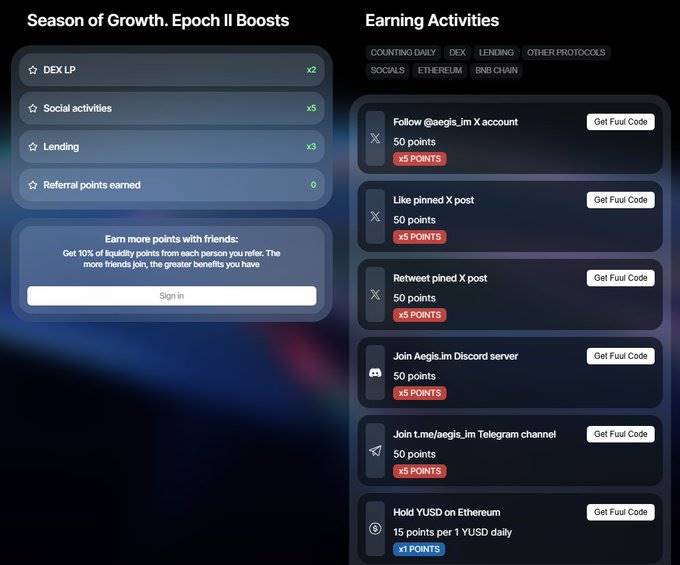
In Season 1, all point earnings receive a 50% bonus, allowing early users to claim a larger share of AEG token rewards.
Bonus boost: Euler integration unlocks a loop strategy—deposit YUSD → earn points → borrow stablecoins → repeat.
This maximizes returns and multiplies points.
Points aren’t just numbers. Each week, 0.2% of the total AEG supply is distributed proportionally based on your points share.
No worries about delayed airdrops or unclear allocation rules.
Everything is transparent, on schedule, and directly tied to protocol usage.
Aegis is an early-stage project aiming to build a stablecoin that doesn’t depend on fiat, oracles, or permissioned collateral.
It remains uncertain whether this model holds up during market turbulence or scales under real-world usage.
But it’s one of the clearest experiments yet in Bitcoin-based monetary design.
Join TechFlow official community to stay tuned
Telegram:https://t.me/TechFlowDaily
X (Twitter):https://x.com/TechFlowPost
X (Twitter) EN:https://x.com/BlockFlow_News
 @stacy_muur