What should Trump do if he really wants the Federal Reserve to cut interest rates?
TechFlow Selected TechFlow Selected
What should Trump do if he really wants the Federal Reserve to cut interest rates?
Destroy the job market!
 Navigating Web3 tides with focused insights
By Gao Zhimou
As market speculation swirls around the Federal Reserve's potential rate-cutting path, analyses from top investment banks and senior Fed officials are converging on an increasingly clear conclusion: the key to prompting the hesitant central bank into actual rate cuts may not lie in subtle fluctuations in inflation data or short-term noise from tariff policies, but rather in a more direct—and potentially harsher—signal: a significant deterioration in the labor market.
For those eager for lower interest rates—such as Donald Trump (or anyone holding a similar view)—a weakening job market might be the most effective catalyst to achieve that goal.
Goldman Sachs View: "Significant upward pressure" in unemployment is the trigger
Dominic Wilson, strategist at Goldman Sachs, explicitly stated in a recent report that a "sharp deterioration" in the labor market is the critical factor that would prompt a policy shift by the Fed. He emphasized: "Any significant upward pressure on the unemployment rate will see the Fed firmly move toward action (rate cuts)."
Wilson noted that although the April 9 pause in reciprocal tariffs briefly halted the economy’s slide toward recession, underlying risks remain unresolved. Heightened uncertainty caused by policy shifts, weak consumer and business confidence, and suppressed real income growth mean the U.S. economy "still has a high probability of slipping into recession."
Goldman projects that if a full-blown recession occurs, the S&P 500 could fall to around 4600, high-yield bond credit spreads might exceed 600 basis points, and short-term Treasury yields could drop below 3%.
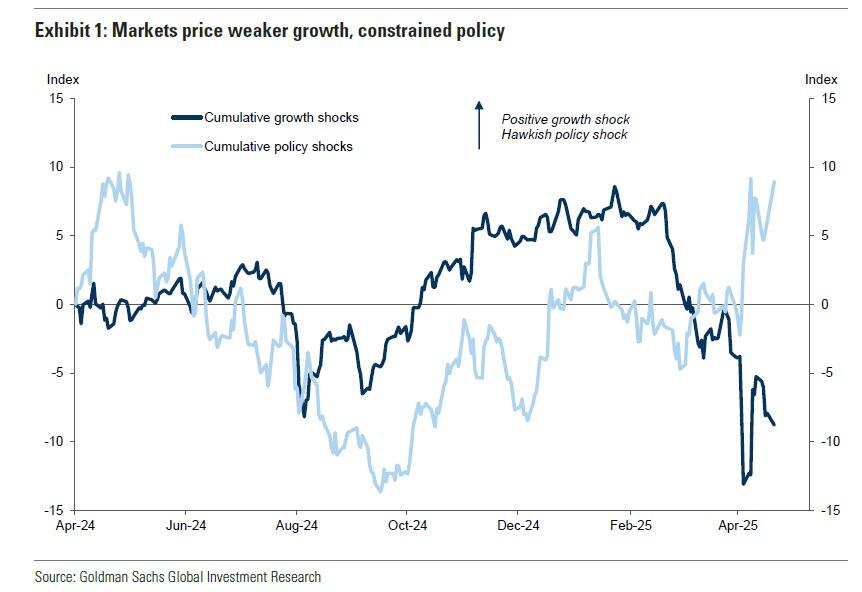
Meanwhile, financial vulnerabilities exposed by recent market turmoil—including in the Treasury market—remain a concern. The ultimate impact of tariffs on inflation and employment will take time to materialize, leaving the Fed likely in a "recession watch" mode over the next two to three months. Uncertainty over trade and fiscal policy, combined with the need to keep inflation expectations anchored, makes it difficult for the Fed to act decisively.
Given this, Goldman believes that even with short-term inflationary disruptions caused by tariffs, "any significant upward pressure on the unemployment rate will prompt the Fed to firmly take action."
The firm argues that a recession could easily lead the Fed to cut rates by about 200 basis points in a short period—a move "significantly beyond current market pricing." In other words, a sharp rise in unemployment and the resulting upward pressure on the jobless rate may be the key factor forcing Chair Jerome Powell’s hand.
Fed Official Confirms: Focus is on the "Speed" of Unemployment Rise
Recent comments from Christopher Waller, Vice Chair of the Federal Reserve, provide internal confirmation of this view from within the policymaking circle. He too identifies the labor market as a key variable.
Waller acknowledged that the full impact of tariffs may not become clear until the second half of 2025 and expressed a preference for viewing their effect as a "one-time price level effect"—i.e., transitory inflation.
He added, "It takes courage to face up to price increases caused by tariffs and treat them as temporary," suggesting the complexity of making such judgments in the current environment, particularly given potential political considerations.
So what could prompt the Fed to act swiftly? Waller’s answer aligns with Goldman’s: employment data. He said he would "not be surprised" if tariffs led to more layoffs and higher unemployment. More importantly, Waller stressed that the Fed’s focus will be on the "speed" of the unemployment rate’s rise, rather than its absolute level. He observed:
"Tariffs have the potential to quickly push up the unemployment rate."
This logic is also supported by Javier Bianchi, an economist at the Federal Reserve Bank of Minneapolis, who views tariffs as essentially a "negative demand shock" with deflationary effects. This further supports the argument that the Fed should "look through" short-term inflation and implement expansionary monetary policy (i.e., rate cuts) to avoid worse economic outcomes.
Waller concluded with a warning: the current data-dependent approach may leave the Fed at risk of falling behind the curve again—similar to 2021, but in the opposite direction. Once rising unemployment drives an economic downturn, "significant rate cuts could follow."
Join TechFlow official community to stay tuned
Telegram:https://t.me/TechFlowDaily
X (Twitter):https://x.com/TechFlowPost
X (Twitter) EN:https://x.com/BlockFlow_News