ERNIE 4.5 Turbo released, but Li Yanhong says applications are where true dominance lies
TechFlow Selected TechFlow Selected
ERNIE 4.5 Turbo released, but Li Yanhong says applications are where true dominance lies
Baidu launched two major new models and multiple AI applications to help developers fully embrace MCP.
 Navigating Web3 tides with focused insights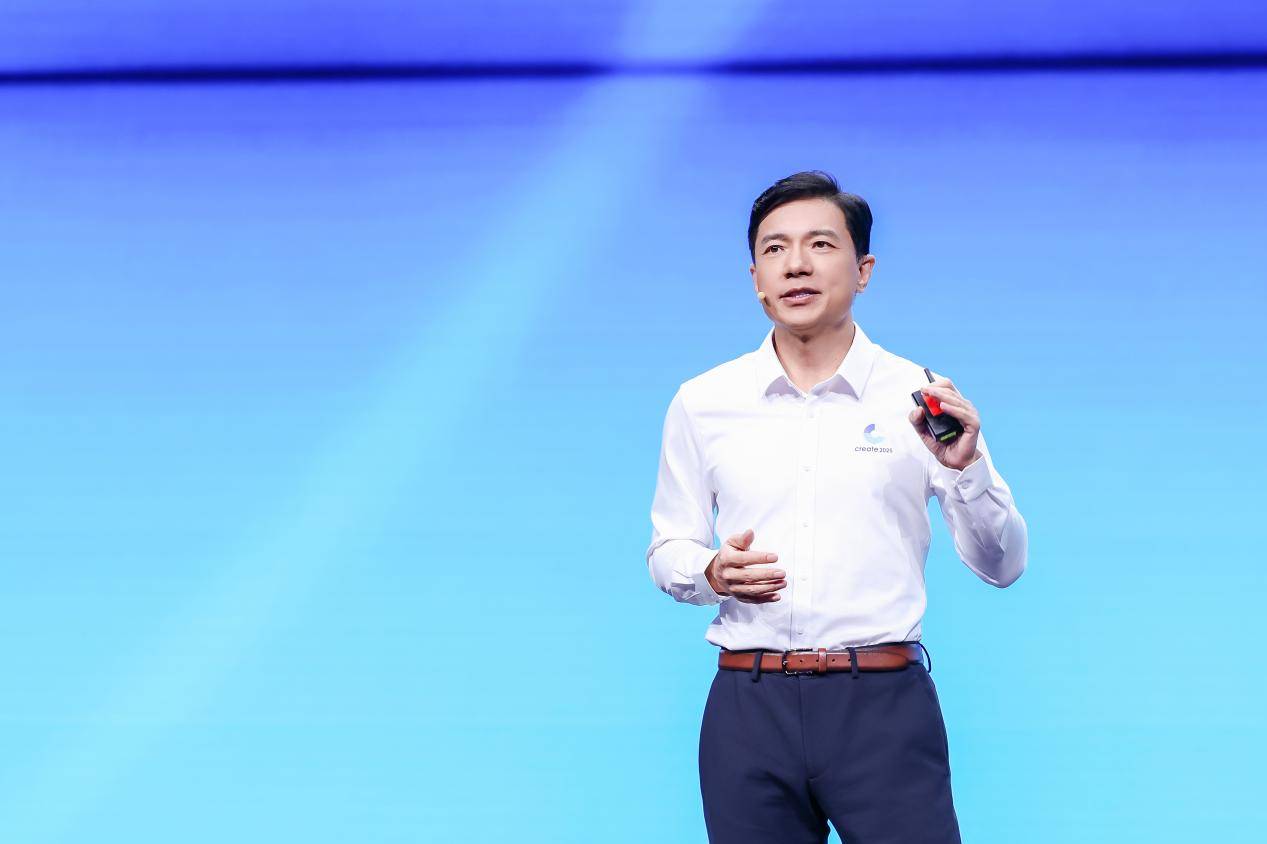
Header image source: Baidu
In 2025, as AI technology evolves faster than anticipated, developers and enterprises face a core challenge: how to prevent application value from being washed away by the tide of rapid model advancements?
Baidu provided an answer at its Create Developer Conference on April 25. At the event, the new Ernie 4.5 Turbo and X1 Turbo large models were unveiled, alongside Cangzhou OS—a domain-specific operating system for content—and the general-purpose super-agent app "Xinxiang," which has already launched. While showcasing technical breakthroughs, Baidu also responded to industry demand for practical AI value through scenario-driven applications and a comprehensive MCP (Model Context Protocol) ecosystem.
At the conference, Robin Li told developers: "As long as you pick the right scenario, choose the right base model, and learn some model tuning techniques, the applications you build won't become obsolete." He emphasized, "Without applications, chips and models are meaningless. There will be many models, but it's applications that will ultimately dominate the world—applications are king."
Ernie Large Model 4.5 Turbo: Multimodal, Low-Cost, Strong Reasoning
Today, competition in large AI models has reached a fever pitch, yet the industry still grapples with challenges such as limited modalities, reasoning hallucinations, and high operational costs. Addressing these pain points, Baidu introduced Ernie 4.5 Turbo and X1 Turbo, emphasizing multimodal capabilities, cost efficiency, and advanced reasoning—striking a balance between technological advancement and affordability.
The Ernie 4.5 Turbo pushes further in multimodal performance, delivering faster speeds at significantly reduced prices—just 0.8 yuan per million input tokens and 3.2 yuan for output, up to 40% cheaper than DeepSeek-V3. In multiple benchmark tests, 4.5 Turbo achieved an average score of 77.68, surpassing GPT-4o’s 72.76. The X1 Turbo goes even further, optimized for deep thinking based on 4.5 Turbo, priced at 1 yuan per million input tokens and 4 yuan for output—only 25% of DeepSeek-R1’s cost—leading in tasks like Q&A, content creation, logical reasoning, and tool usage.
"Models evolve quickly, but application value doesn’t get overwritten," said Robin Li. "By identifying the right scenarios, selecting the appropriate models, and mastering optimization techniques, AI applications can continuously create value." This perspective offers reassurance to developers: the true value of large models lies in their deep integration with real-world use cases.
If the Ernie models represent the "heart" of Baidu’s AI, then the newly launched Cangzhou OS serves as the "nervous system" connecting content and applications. As a content operating system, Cangzhou OS centers on Chatfile Plus, integrating three knowledge repositories—public domain, private domain, and memory databases—alongside three functional tools: reader, editor, and player. It leverages dynamic calls to large models to parse and process multimodal content.
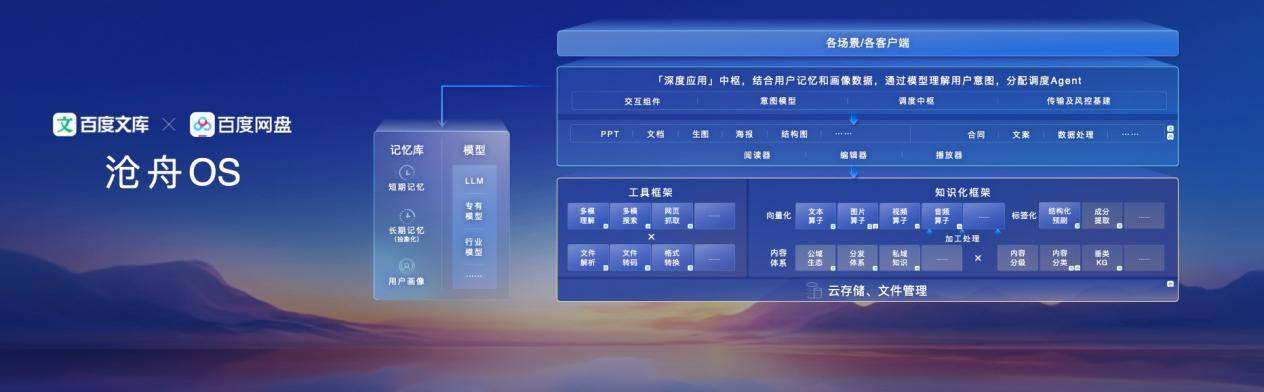
Cangzhou OS|Image source: Baidu
Leveraging Cangzhou OS, Baidu Wenku (document library) and Baidu Wangpan (cloud drive) jointly launched an "AI Notes" feature. When users watch videos stored in Baidu Wangpan, they can instantly generate structured notes, AI mind maps, or even quizzes based on video content—seamlessly linking video viewing with note-taking. To date, Baidu Wenku’s AI features have attracted over 40 million paying users, with 97 million monthly active AI users; Baidu Wangpan reports more than 80 million AI monthly active users. These figures not only highlight the productivity of Cangzhou OS but also signal the vast potential of AI-powered content applications.
Another application of multimodal capability is Baidu’s high-persuasion digital human. In e-commerce livestreaming, traditional digital avatars often suffer from dull scripts and robotic movements. Baidu’s advanced digital humans leverage multimodal large models to achieve hyper-realistic voice and appearance, professional content delivery, and flexible interaction. Its "script generation" function dynamically adjusts facial expressions, tone, and gestures in real time according to dialogue, while the "AI brain" dispatches supporting hosts or scene controllers based on live-stream engagement—truly enabling “one person to operate as a full team.” Through the Huiboxing platform, Baidu also introduced a "one-click cloning" feature: users upload just a two-minute video to create a personalized digital human, making “everyone a livestreamer” a reality.
Agents and MCP: Igniting the Engine of the AI Application Ecosystem
As AI agents become a major industry focus, Baidu has entered the arena with its new app, Xinxiang.
Centered on an "AI task completion engine," Xinxiang breaks down complex tasks via natural language interaction, executes them, and delivers results. Currently, Xinxiang supports over 200 tasks across ten major scenarios—including in-depth research, smart charts, and game development—with plans to expand to more than 100,000 tasks in the future.
Xinxiang enables a "multi-agent collaboration" mechanism. In health consultations, the system can coordinate multiple "AI doctor avatars" for joint diagnosis; in legal services, a "team of AI lawyers" collaborates to provide answers. This approach transcends traditional tool invocation, offering more efficient solutions for professional domains. By offering Xinxiang for free and launching it on Android (with iOS coming soon), Baidu is making AI agent capabilities accessible to a broader audience.
The potential of multi-agent collaboration is also evident in Miya," Baidu’s no-code programming tool launched last year. With just one sentence, Miya generates full applications by coordinating intelligent agents acting as product managers, architects, and designers, while invoking components like cloud storage, databases, and map navigation. Using Miya, a student team developed a marketing tool in minutes—a task that previously took a week—with only 5 yuan in model invocation fees.
"There are 8 billion people globally," said Robin Li. "When technical barriers disappear, everyone can possess programming capabilities." The public release of Miya further lowers the threshold for AI application development.
MCP (Model Context Protocol), an emerging force in the AI ecosystem, is reshaping how developers interact with large models. At this conference, Baidu announced full support for MCP, launching the world’s first e-commerce transaction MCP and search MCP services, while enhancing Ernie’s capabilities in MCP task planning and orchestration.
Meanwhile, Baidu AI Cloud’s Qianfan platform now natively supports MCP, enabling developers to create and publish MCP servers. Baidu Search has built an MCP server discovery platform to index high-quality services across the web. WinkCode has become China’s first intelligent coding assistant to support MCP servers. Additionally, Baidu Wenku, Wangpan, Maps, and other apps have fully opened their MCP server services. Baidu’s e-commerce division has rolled out MCP services covering product search, transactions, and parameter comparisons, becoming China’s first platform to support e-commerce transactions via MCP. This series of initiatives not only reduces developer onboarding complexity but also injects new momentum into the growth of the MCP ecosystem.
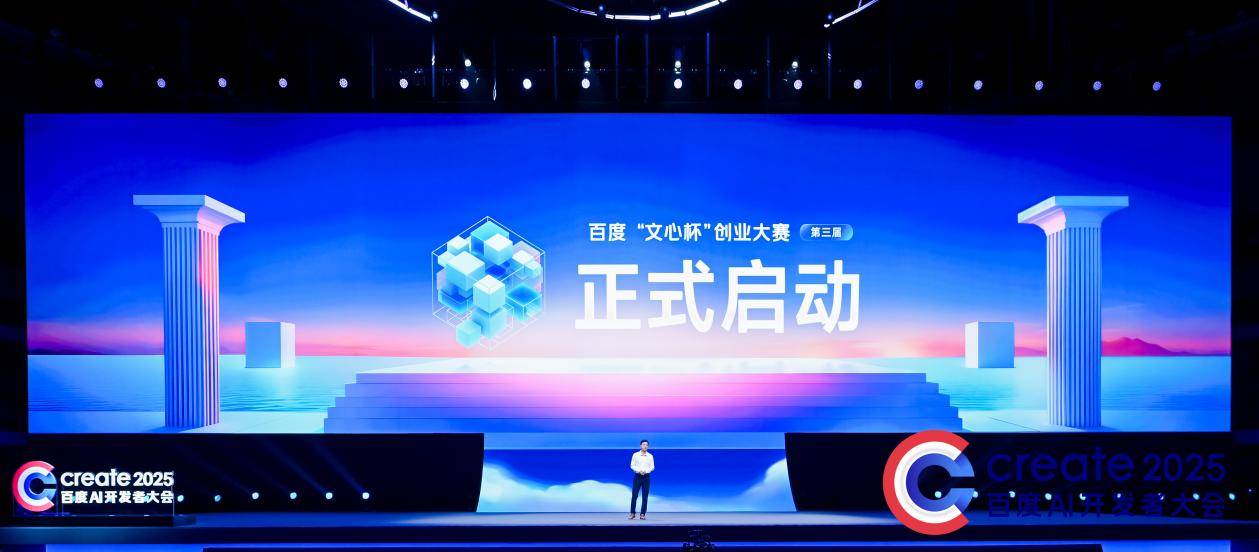
Launch of the Baidu "Ernie Cup" Startup Competition|Image source: Baidu
Beyond technological and product innovations, Baidu is heavily investing in AI talent development and startup support. Its five-year-old goal of cultivating 5 million AI talents was completed ahead of schedule. At the conference, Robin Li announced that Baidu will train another 10 million AI talents over the next five years. Furthermore, the third edition of the "Ernie Cup" Startup Competition has increased the maximum investment per project to 70 million yuan, providing stronger backing for entrepreneurs.
On the hardware front, Baidu powered up China’s first fully self-developed 30,000-GPU cluster. Capable of training multiple trillion-parameter large models simultaneously, it also supports fine-tuning of hundred-billion-parameter models for up to 1,000 clients. Equipped with a high-performance network and innovative cooling solutions, the cluster ensures stable and energy-efficient training operations.
Baidu’s latest technology suite reveals three key trends in AI development: multimodality as a foundational capability (Ernie models), agents redefining human-AI collaboration (Xinxiang App), and MCP standardizing service interfaces (Baidu’s MCP ecosystem). As model capabilities surpass critical thresholds, tool calling becomes standardized, and computing costs continue to fall, a new era of AI applications is dawning. As Robin Li put it: "The real opportunity for developers lies in AI applications that penetrate real scenarios and deliver tangible value."
"All these launches are designed so developers no longer need to worry about model capabilities, model costs, or development tools and platforms. They can focus entirely on building applications—and building the best ones," Li said at the event.
For China’s AI industry, Baidu’s moves represent not just a demonstration of technical strength, but also a profound understanding of scenario-based applications and ecosystem synergy. In this transformation, Baidu is paving a "highway" for developers—from models to real-world applications. As the Ernie models, Cangzhou OS, and Xinxiang continue to evolve, the "super productivity" of AI may soon become an integral part of everyone’s work and life.
Join TechFlow official community to stay tuned
Telegram:https://t.me/TechFlowDaily
X (Twitter):https://x.com/TechFlowPost
X (Twitter) EN:https://x.com/BlockFlow_News