Trump's "verbal barrage" lands him in trouble again—will global capital start collectively "abandoning America"?
TechFlow Selected TechFlow Selected
Trump's "verbal barrage" lands him in trouble again—will global capital start collectively "abandoning America"?
Short the dollar, long gold and Bitcoin.
 Navigating Web3 tides with focused insights
Written by: Mary Liu, BitpushNews
A wave of "sell U.S. assets" trades is unfolding as markets grow anxious over the prospect that President Donald Trump may follow through on his threats to fire Federal Reserve Chair Jerome Powell and implement policies that could trigger an economic recession.
Data shows the S&P 500 plunged 2.7% on Monday to 5,142.18, down 13% from its year-start level and 16% below its recent peak; the Dow Jones Industrial Average dropped 972 points, or 2.5%; the Nasdaq Composite entered bear market territory, falling more than 21% from its high.
Bond markets also weakened, with the 10-year Treasury yield rising 7 basis points to 4.41% and the 30-year yield surging 10 basis points to 4.91%. In foreign exchange, the dollar index fell 0.9%, depreciating over 5% against both the euro and yen, hitting a three-year low.
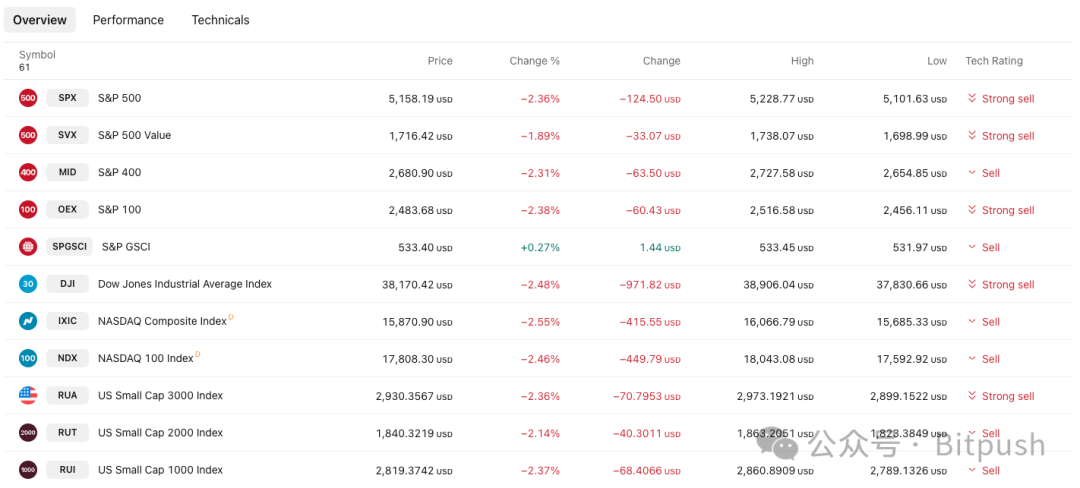
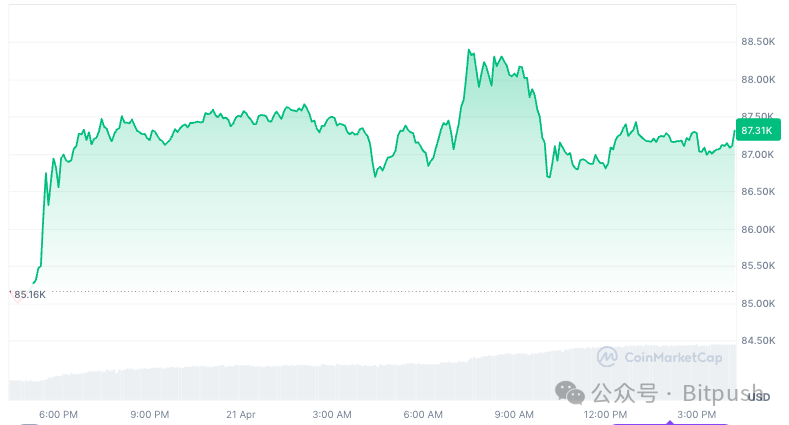
Investors are grappling with the risk that Powell could be removed (the White House said last week it was evaluating the possibility) and the potential impact of Trump’s policies on the world’s largest economy. A rush out of traditional U.S. safe-haven assets, combined with broader risk-off sentiment, sent gold soaring to a record high on Monday, while cryptocurrencies rose too—Bitcoin briefly touched $88,000 for the first time since March.
Recession + Fed Independence Fears = Compounding Risks
"With the current administration already injecting elevated levels of uncertainty into the economic outlook, any attempt to replace Powell would further intensify downward pressure on U.S. assets," said Ian Lyngen, head of U.S. rates strategy at BMO Capital Markets.
Trump used Truth Social on Monday to again call for Fed rate cuts, writing: "Many people are calling for 'preemptive rate cuts'."
Although legal scholars say it would be difficult for Trump to easily dismiss the Fed chair—and Powell has stated he wouldn’t resign even if asked—the speculation alone has dealt fresh blows to U.S. assets. Aggressive trade tariffs from Washington have already fueled concerns about a U.S. recession and raised questions about the status of U.S. Treasuries as the premier global safe-haven asset.
Multiple risks are amplifying market anxiety over growth and inflation trajectories—and how the Fed might balance them. While traders expect the Fed to cut rates at least three times this year, former New York Fed President Bill Dudley wrote in a Bloomberg Opinion column that policymakers may act more slowly than anticipated.
The Bloomberg Dollar Spot Index dipped as much as 1% on Monday, reaching its lowest level since the end of 2023 before paring some losses. The yen climbed to its highest level since September last year, while the euro surged to a more than three-year high.
The euro traded around $1.15, nearing the most optimistic year-end forecasts from strategists. According to Bloomberg data, the yen strengthened to approximately 140.50 per dollar, outperforming the median year-end forecast of 143.
"Trump’s comments about potentially firing Fed Chair Powell—even if these ideas don’t materialize—are seen internationally as a significant threat to the Fed’s independence, and by extension, to the dollar’s status as a safe-haven currency," said Helen Given, a foreign exchange trader at Monex.
"If the U.S. economy enters a recession and the central bank cannot or does not act independently, the downturn could deepen, creating further market concerns," she added.
Dollar bears in the options market are now positioned at their most extreme level since the onset of the Covid pandemic. The premium paid to hedge against a decline in the dollar versus a basket of currencies—relative to bets on gains—has reached its highest level since March 2020.
Selling intensified after Kevin Hassett, director of the National Economic Council, said Friday that Trump was looking into the matter. According to知情 traders, multiple hedge funds joined the dollar sell-off on Monday following Hassett’s remarks. These traders requested anonymity because they are not authorized to speak publicly.
Aggregated data from the Commodity Futures Trading Commission shows hedge fund bullishness on the dollar has fallen to its weakest level since October last year. While headlines about Powell certainly haven’t helped sentiment, others say escalating global trade wars may remain the dominant driver for dollar trading.
"Central bank independence is so valuable—not something to take for granted—and once lost, it's extremely hard to regain," said Will Compernolle, macro strategist at FHN Financial in Chicago. "Trump’s threats toward Powell do nothing to boost foreign investor confidence in U.S. assets, but I still believe tariff news remains the primary driver," he said.
The extra yield investors demand for holding 30-year Treasuries instead of two-year notes has risen for nine consecutive weeks—the second time this has occurred since Bloomberg began tracking the data in 1992. On Monday morning, strong front-end demand via block trades in two-year futures further pushed the yield curve to steepen.
Short the Dollar, Long Gold and Bitcoin
As Trump’s trade war undermines U.S. growth and earnings prospects, warnings from Wall Street equity strategists are growing louder.
Citigroup strategists downgraded U.S. equities last week, saying cracks in "American exceptionalism" will persist. They joined institutions including Bank of America and BlackRock in recently turning bearish on U.S. stocks.
"The latest catalyst for dollar selling may be the pressure on Powell, but the reality is that dollar selling no longer needs additional justification," said Gareth Berry, a strategist at Macquarie in Singapore. "Everything that’s happened over the past three months provides ample rationale for sustained dollar weakness, which could persist for months."
Meanwhile, Lawrence McDonald, former U.S. macro strategy head at Societe Generale, suggested it might now be time to sell gold and buy Bitcoin.
He commented on X: "With the VIX approaching 30, Bitcoin has never performed better. This is a strong signal of maturation in the Bitcoin market (good news), and powerful evidence of immense stress on fiat currencies like the dollar."
Join TechFlow official community to stay tuned
Telegram:https://t.me/TechFlowDaily
X (Twitter):https://x.com/TechFlowPost
X (Twitter) EN:https://x.com/BlockFlow_News
 比推 BitpushNews