WOO X Research: Raydium vs Pump Fun, Does LaunchLab Really Create Wealth?
TechFlow Selected TechFlow Selected
WOO X Research: Raydium vs Pump Fun, Does LaunchLab Really Create Wealth?
Raydium launches token issuance platform LaunchLab.
 Navigating Web3 tides with focused insights
Raydium is a leading DEX on Solana, while Pump Fun is the largest launchpad. Interestingly, despite operating in different sectors and business models, they are now competing aggressively to capture more revenue.
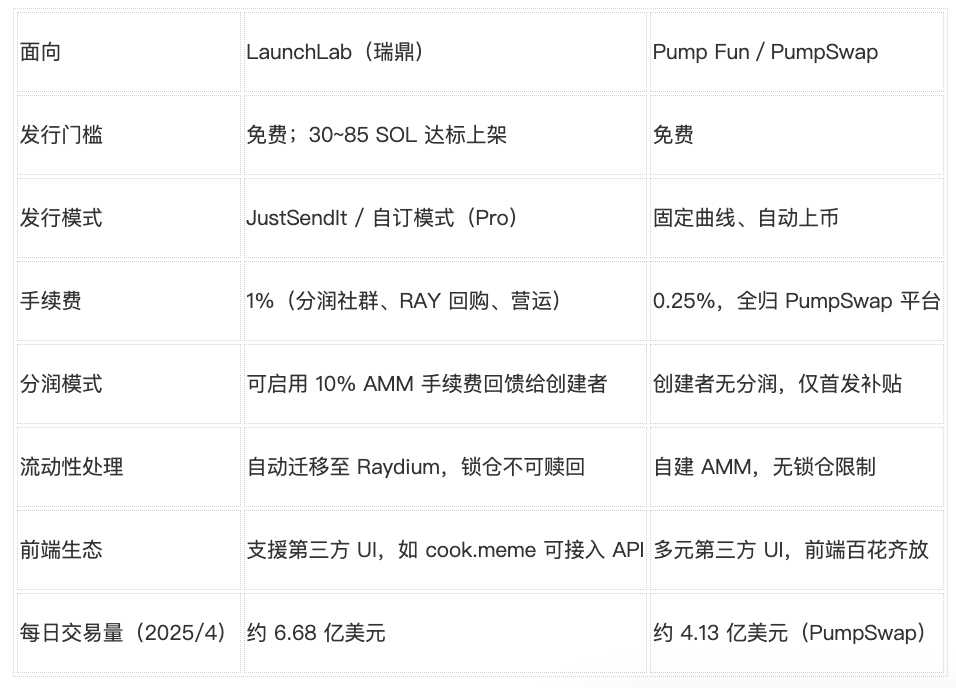
Pump Fun recently launched PumpSwap, which has stabilized its daily trading volume at around $400 million—approaching Raydium's $600 million. Raydium officially noted that Pump Fun previously contributed as much as 41% of its AMM income over the past month. However, after Pump Fun built its own PumpSwap, Raydium saw a significant drop in traffic and was forced to launch LaunchLab to "regain control of liquidity."
What exactly are the differences between LaunchLab and Pump Fun? And which projects are worth watching? Let WOO X Research break it down for you.
LaunchLab Overview
Raydium’s LaunchLab is essentially a “no-code token creation tool + automated liquidity migration service,” offering two primary modes:
-
JustSendIt Mode: Allows users to create tokens with one click. It defaults to raising 85 SOL; upon successful fundraising, liquidity is automatically migrated to Raydium’s AMM, and LP tokens are burned to lock liquidity permanently.
-
LaunchLab Pro Mode: Offers customizable total supply, minimum fundraising starting from 30 SOL, bonding curve slope, vesting conditions, and the option to enable AMM fee sharing (up to 10% of trading fees can be returned to project creators).
In terms of fee structure, Raydium charges a flat 1% base fee, distributed as follows: 50% goes to the “Community Pool,” 25% is used for $RAY buybacks, and 25% funds infrastructure and operations.
LaunchLab also allows third-party interfaces to integrate its backend services and build their own frontend launch platforms. The most notable example is cook.meme.
cook.meme is the first meme token platform to use LaunchLab’s contracts while building its own UX frontend. It emphasizes zero fees, instant tradability, and a clean UI. Since launch, it has attracted many developers and resembles Pump Fun in interface design—but anchors its liquidity to Raydium’s ecosystem.
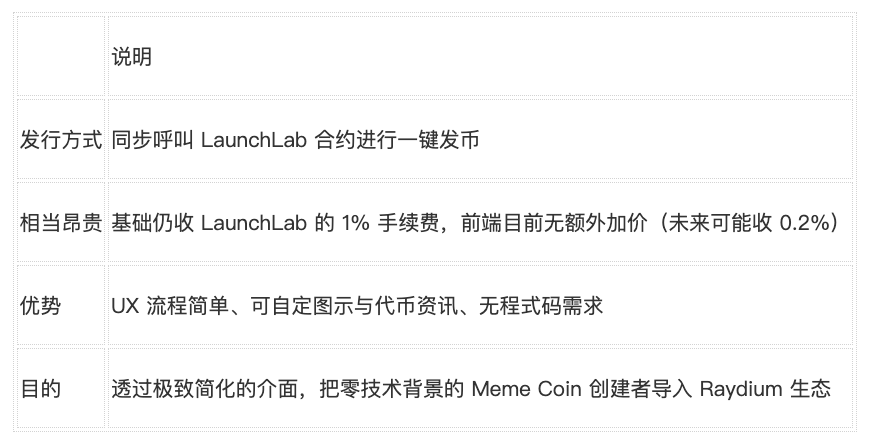
Raydium's open approach aims not just to redirect traffic but to replicate the content and ecosystem flywheel that Pump Fun once built through community-driven frontends.
LaunchLab vs Pump Fun
Featured Projects
The biggest direct beneficiary of LaunchLab’s launch is clearly $RAY (with 25% of fees going toward buybacks). After the announcement, $RAY rose approximately 8%. If LaunchLab sustains momentum, the buyback pressure on $RAY will increase further—potentially driving price growth when demand exceeds supply.
A launchpad’s lifecycle depends on how many “golden dogs” it produces. When wealth-generation effects continuously emerge on a platform, user assets naturally concentrate there. As asset density increases, the probability of birthing new golden dogs rises, eventually forming a positive feedback loop.
The first step in this flywheel is having a breakout success—but unfortunately, within 24 hours of LaunchLab going live, only $TIME surpassed a $1 million market cap among graduated tokens. Others like $ARUA and $Gaydium saw initial spikes in market cap, but the market ultimately rallied behind a single dominant token.
So what are the narratives behind $TIME, $ARUA, and $Gaydium?
As mentioned earlier, Raydium allows third parties to connect via its routing system to build platforms and issue tokens. Currently, Raydium collaborates with three main platforms: Raydium itself, Cook.meme, and Pump Fun Robinhood. $TIME is the first meme coin created on Cook.meme, while $ARUA is Raydium’s self-issued token—deployed earlier than $TIME but launched later.
$Gaydium plays on a pun and gained attention when a Raydium developer briefly posted its contract address on Raydium’s GitHub repository, only to delete it less than an hour later—causing the token’s value to plummet immediately afterward.
$TIME
-
Current Market Cap: $6 million
-
All-Time High Market Cap: $8.5 million
-
24-Hour Trading Volume: $30.2 million
-
Holders: 7,600
Conclusion
Raydium’s LaunchLab may seem like a “late counterattack,” but its overall design offers a systematic response to Pump Fun’s strengths. By providing customizable token creation options and expanding into an open frontend strategy exemplified by cook.meme, LaunchLab aims to bring traffic, fees, and narratives back to the Raydium ecosystem.
However, whether LaunchLab can truly generate wealth and reignite a meme boom hinges on three core factors:
-
Its ability to produce strong breakout projects;
-
Whether fee and liquidity designs are retail-friendly;
-
Whether the ecosystem can rapidly aggregate frontend tools and achieve network effects.
Currently, all three aspects still require improvement. But since LaunchLab has been live for less than a month, declaring failure would be premature. The crypto world evolves rapidly—perhaps the next 100x meme coin will emerge from LaunchLab. Stay tuned.
Join TechFlow official community to stay tuned
Telegram:https://t.me/TechFlowDaily
X (Twitter):https://x.com/TechFlowPost
X (Twitter) EN:https://x.com/BlockFlow_News
 @WOOXResearch