First Token Surges Over 10x: What Is Alkanes, the New Asset Protocol on Bitcoin?
TechFlow Selected TechFlow Selected
First Token Surges Over 10x: What Is Alkanes, the New Asset Protocol on Bitcoin?
How did Alkanes, a new asset protocol, emerge amid the prolonged downturn in the Bitcoin ecosystem?
 Navigating Web3 tides with focused insights
Author: BlockBeats
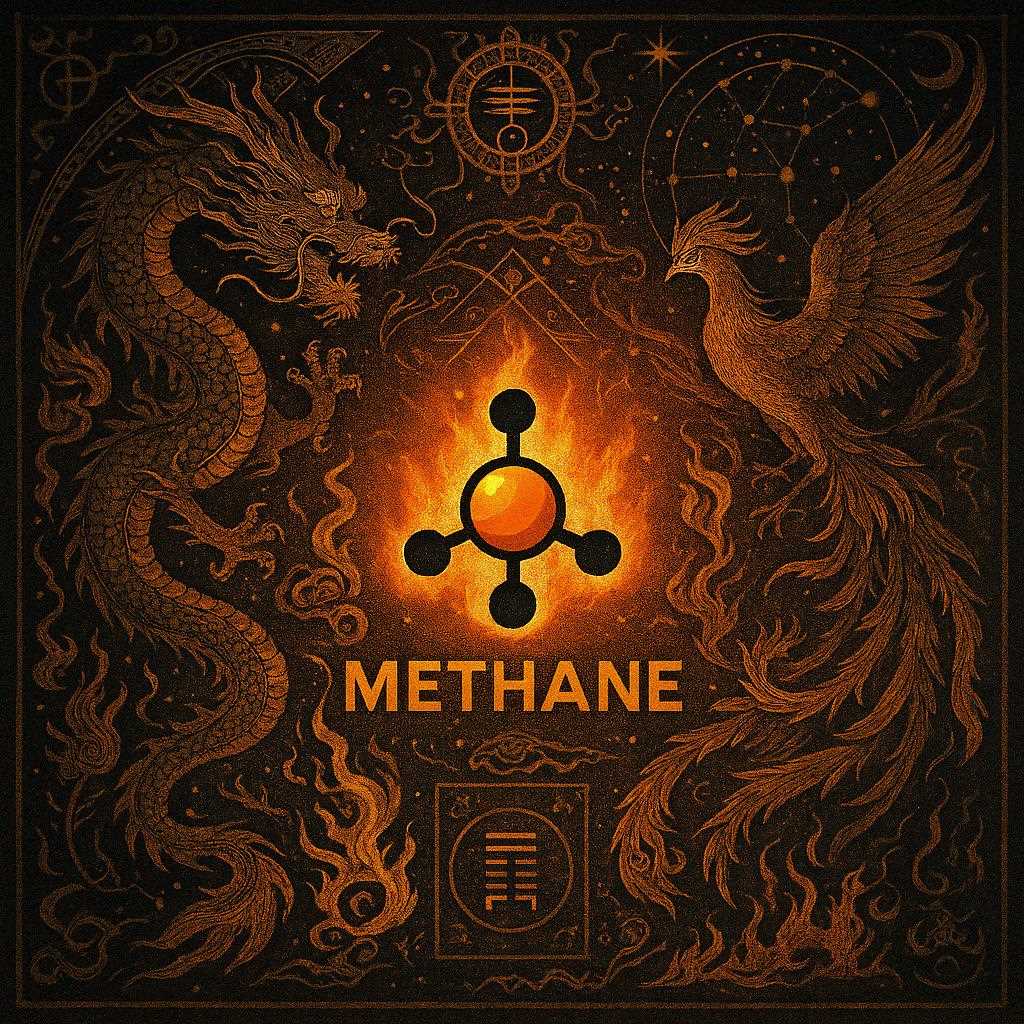
"Methane" has recently become the hottest term in the Bitcoin ecosystem. As the first fairly minted token under Alkanes, a new protocol on Bitcoin, METHANE's market cap has already surpassed $6 million—equivalent to over $60 per METHANE. I spoke with several Bitcoin ecosystem participants about their minting costs, which varied significantly. Taking a baseline cost of $5 per mint, the return on minting METHANE has exceeded 10x.

After a long period of stagnation in the Bitcoin ecosystem, how did this new asset protocol Alkanes manage to break through?
Protocol Background
The Alkanes protocol was formerly known as Protorunes—"Programmable Runes"—and shares the same founder. This concept briefly attracted attention in the Bitcoin ecosystem around mid-last year when runes were still trending.
The protocol’s founder, @judoflexchop, is the CTO of Oyl Wallet, a Bitcoin wallet. While its user base within the Bitcoin ecosystem may not be large, Oyl Wallet enjoys relatively high visibility. Its funding history explains why:
On March 8, 2024, Oyl, a Bitcoin infrastructure company, raised $3 million in a Pre-Seed round led by Arca, with participation from Foresight Ventures, Arthur Hayes’ family office Maelstrom, Domo, UTXO Management, Udi Werthheimer (CEO of Taproot Wizards), Kanosei, and FlamingoDAO.
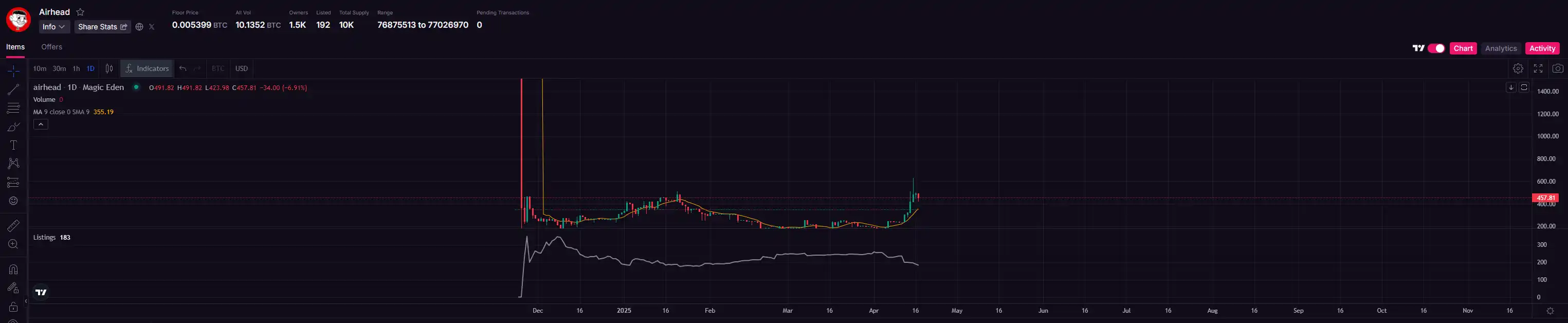
Thanks to Arthur Hayes' involvement, the wallet quickly gained recognition in the Bitcoin space. In mid-2024, Oyl launched a Bitcoin NFT project called "Airheads," which sparked controversy due to its relatively high mint price. In terms of price performance, it was considered a “failed” project—but recently, fueled by the popularity of the Alkanes protocol, its floor price has surged nearly 3x.
Although wallets are their core product, major players in the Bitcoin ecosystem rarely limit themselves strictly to wallet development. OKX, UniSat, Magic Eden, and now Oyl—all have expanded into various other Bitcoin-related services. Xverse stands out as one of the few more narrowly focused ones. Beyond its wallet, Oyl has developed "Sandshrew," a Bitcoin RPC service, and the Alkanes protocol.
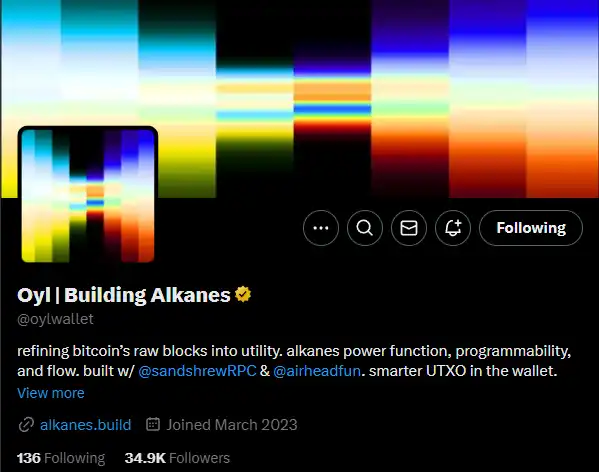
Oyl is now fully committed to promoting Alkanes—their official Twitter handle even includes “Alkanes”:
Reasons for Popularity
Alkanes is a new Bitcoin asset protocol. Overall, it borrows from the RuneStone structure used in the Runes protocol but offers greater extensibility and supports smart contracts. As mentioned earlier, its predecessor was Protorunes. Despite what the name suggests, Protorunes isn’t just a modified version of Runes—it represents a fundamentally different approach. To put it simply, the Runes protocol and its RuneStone structure resemble a closed iOS system, whereas Protorunes and Alkanes function more like an open-source Android platform.
Protorunes serves a similar role to RuneStone in the Runes protocol. Here, "RuneStone" doesn't refer to the early Runes NFT that created massive wealth, but rather to the "transaction data encapsulation" mechanism—a piece of information embedded within Bitcoin transactions that helps indexers determine whether a transaction involves a Runes operation.
When an indexer scans the OP_RETURN field of a transaction and detects the "RUNES" tag, it parses the subsequent data—such as etching, minting, or transferring. RuneStone acts like an instruction manual; indexers follow these instructions to produce accurate indexing results.
However, RuneStone is exclusive to the Runes protocol and operates on a one-to-one basis with it. Protorunes works differently. You can't simply ask a Runes indexer: "I’m a sub-asset protocol based on RuneStone—please index me too." But with Protorunes, you can. Anyone can create their own custom asset protocol using the Protorunes data format. Each such protocol gets assigned a unique "Protocol ID," allowing indexers to identify which set of rules to apply during parsing.
This model resembles Ethereum’s modular chain deployment, simplifying the process significantly. For developers, leveraging tools provided by Oyl eliminates the need to build their own indexer from scratch.
As for smart contract implementation, until OP_CAT is revived, most approaches—including this one—rely on storing contract data within transactions and executing logic off-chain via indexing, which remains the standard pattern.
Beyond technical merits, two key factors contributed to Alkanes’ rise. First, strong support from Chinese inscriptions enthusiasts. Currently, no group in the Bitcoin ecosystem has stronger purchasing power than Chinese inscription collectors. This community is unique—PvP dynamics common in Solana meme coins don’t quite apply here. Yet earning their approval is challenging. Once momentum builds, however, word spreads rapidly through WeChat groups, creating powerful network effects.
Searching “Alkanes” on Twitter reveals that most promotional content comes from Chinese users. The protocol’s founder even posted in Chinese thanking the Chinese-speaking community. iDclub, an early Bitcoin inscription tool founded by Chinese developers, built a trading marketplace specifically for Alkanes.
The second reason lies in the credibility of the team behind the project. According to their roadmap, they’re not merely launching an asset protocol to drive traffic to their wallet. They plan to develop an AMM, BTC staking, stablecoins, MEV tools, and a trustless ZK bridge—essentially building a full BTCFi ecosystem around Alkanes.
The narrative holds together well: a smart contract-enabled asset protocol serving as the foundation for various applications. Such a vision would be hard to believe if proposed by an unknown team. Given the lingering disappointment over Atomicals’ decline, users in the Bitcoin ecosystem remain cautious. Big initiatives require experienced teams—otherwise, uncertainty prevails.
Leading Tokens
- METHANE: The first fairly minted token on the Alkanes protocol, currently valued at approximately $6 million. “Alkanes” literally means “alkanes” in chemistry, and “METHANE” translates to “methane.” Naturally, tokens like BUTANE (“butane”) and HEXANE (“hexane”) have also been mentioned by the community. However, both currently sit around $250,000 in market cap.
- DIESEL: An official token and the first deployed token on Alkanes, now with a market cap of about $12.6 million. DIESEL has a unique mechanism: total supply capped at 1,562,500 tokens, with 28% reserved for the team and 72% distributed gradually with each Bitcoin block, halving according to Bitcoin’s block reward schedule. In every block, only the transaction with the highest miner fee claiming DIESEL minting rights will receive that block’s DIESEL output. In short, one DIESEL is issued per block, and only one person—the one who pays the highest miner fee—can mine it per block. Regular users are essentially priced out; specialized bots continuously monitor and escalate fees automatically.
Since METHANE was fairly minted, its holder distribution is much broader and healthier compared to DIESEL, and all tokens are in circulation. As a result, METHANE dominates social media discussions. Judging purely by online buzz (ignoring market cap), METHANE appears to be the leading token. DIESEL benefits from official backing and potential future utility, though details remain undisclosed. Thus, METHANE leads in community sentiment, while DIESEL holds advantages in official status and future expectations.
Conclusion
The protocol is still in its very early stages. Most wallets haven’t yet integrated support for Alkanes assets, so for security and compatibility, it’s best to use Oyl Wallet when interacting with Alkanes-based assets.
Alkanes’ success combines all essential ingredients for a new asset protocol in the Bitcoin ecosystem: “native asset,” “fair minting,” and “support from Chinese users,” further strengthened by the addition of “smart contract” capabilities and a compelling ecosystem narrative. Amid prolonged quietness in the Bitcoin ecosystem, Alkanes has managed to stand out. Hopefully, its ecosystem continues to grow and thrive in the long run.
Join TechFlow official community to stay tuned
Telegram:https://t.me/TechFlowDaily
X (Twitter):https://x.com/TechFlowPost
X (Twitter) EN:https://x.com/BlockFlow_News
 BlockBeats