








Crisis PR: The Law of Public Opinion Survival for Web3 Projects
TechFlow Selected TechFlow Selected
Crisis PR: The Law of Public Opinion Survival for Web3 Projects
Never waste a good crisis.
 Navigating Web3 tides with focused insights
Author: JE Labs
"It takes 20 years to build a reputation and five minutes to ruin it." – Warren Buffett
Recently, the market seems to be in an amplifier of FUD (fear, uncertainty, and doubt) — even minor technical flaws or internal community nuances can rapidly escalate into a "crisis" due to the high virality of social networks. As a result, many industry partners have reached out to us seeking advice on how to "turn crisis into opportunity."
In our view, effective crisis communication is never just about “explaining” — it’s about consistently conveying one key message to the community at every stage: "We are taking responsibility."
We’ve identified three common types of crises faced by Web3 projects and combined them with our proven 5S Principles to tailor specific response strategies for each. These approaches help project teams maintain trust amid uncertainty and transform pressure into opportunity. We hope these methods empower more Web3 builders to grow stronger through adversity.
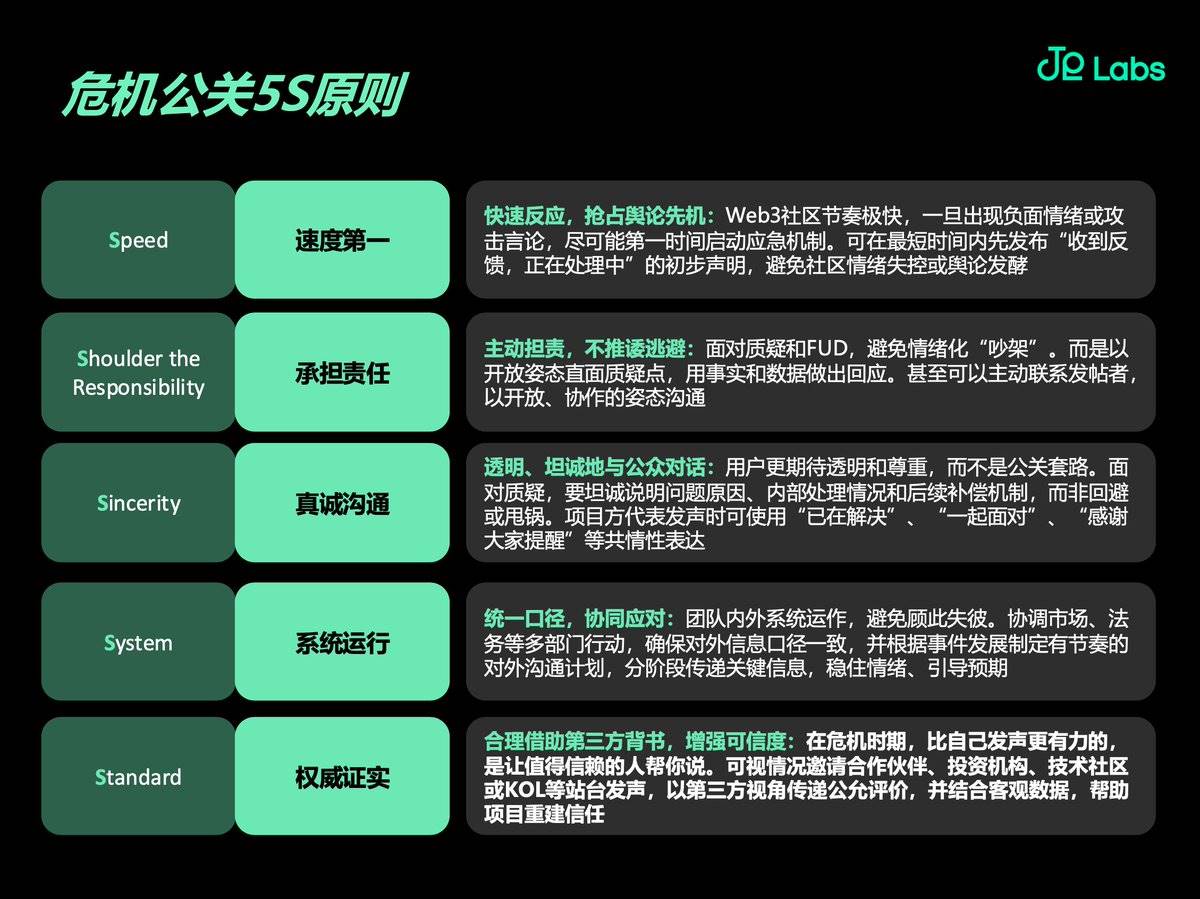
📖 Three Types of Crises and Response Strategies
1.1 Rumors & Misunderstandings: Trust crises caused by information gaps require efficient clarification and credible communication channels
Many crises don’t stem from actual project issues but arise when fragmented information gets misinterpreted during dissemination. Such crises often originate from out-of-context quotes, edited screenshots, or misunderstandings of rules. Once they spread, projects may quickly be labeled as "opaque" or even accused of "rug-pulling."
1️⃣ Respond quickly to seize narrative control: When dealing with rumor-driven sentiment, timing and tone are critical. The project should respond immediately—even with a brief statement like: “We’re aware of the discussion and currently verifying the facts.” This alone can significantly slow down emotional escalation within the community. An initial response doesn’t need to answer everything; its purpose is to show that “we’re watching, we’re acting,” demonstrating presence and accountability.
2️⃣ Counter with facts, avoid emotional reactions: Always anchor your response in facts. Don’t let attackers dictate the tone or draw you into arguments and blame games. If the project appears defensive or emotionally charged, it risks triggering secondary crises and losing further control. Only clear, factual, data-backed communication can truly dispel confusion and fear.
3️⃣ Leverage credible third-party voices: Projects shouldn’t face misunderstandings alone. A word of support from technical partners, ecosystem allies, or long-standing KOLs who back the project often carries far more weight than any self-defense. Strategically mobilizing external endorsements helps break cycles of suspicion and speculation. For technically complex misinterpretations, projects should also proactively use visual guides, Twitter threads, or explainer graphics to translate complex details into accessible, community-friendly language—bridging understanding and rebuilding trust.
1.2 Product Bugs: Chain reactions triggered by flaws — rebuild trust through execution and transparent fixes
When crises involve the product itself, community emotions run especially high. Whether it's a bug, asset anomaly, missing functionality, or launch delay, the ripple effects must not be underestimated. User trust hinges on perceptions of “Is your product safe?” and “Are your mechanisms trustworthy?” At this moment, what matters most isn't explanatory skill—but problem-solving capability.
1️⃣ Confirm status and show stance: The first step is letting users know you're aware and already acting. The team should issue an initial response within 3 hours of the issue emerging, confirming detection and investigation. Details aren’t needed yet, but the message must convey seriousness and commitment. This isn’t just disclosure—it’s confidence transmission. Indifference, evasion, or silence will only deepen community anxiety.
2️⃣ Publish plan and implementation roadmap: Within 24 hours after the initial response, the project should release a concrete fix explanation and action plan, including: root cause, responsibility assignment, repair timeline, expected rollout date, and whether user assets are affected along with compensation mechanisms. Involving governance processes—where the community participates in validating and overseeing the solution—greatly enhances transparency and credibility. The goal here is to demonstrate that “the problem is being systematically resolved.”
3️⃣ Handle aftermath and communicate compensation: Damage caused by product issues shouldn’t end with “fixed.” Thoughtful follow-up and compensation frameworks are essential. Over a 3–7 day period, provide regular progress updates (e.g., test screenshots, contract update logs) so the community can verify results. Clearly state whether impacted users will receive fair compensation—even symbolic gestures signal care for user experience and accountability.
Crisis management goes beyond fixing code. It’s a concentrated evaluation of your transparency, execution speed, and sense of responsibility. Handled well, such moments can actually become opportunities to rebuild and upgrade trust. More than whether the crisis was solved, the community cares deeply about how it was addressed—and this becomes part of the project’s long-term brand equity.
1.3 Team Turmoil: Return to the core — address challenges through governance and openness
In Web3 projects, human-related issues—such as founder statements, team conflicts, or management failures—can spark intense public backlash. These crises often involve clashes of values, power struggles, and fractures in foundational trust, making them the most difficult type to navigate. The key to managing them lies in shifting focus from the “individual” to the “project.”
1️⃣ Clarify position and express stance: The top priority is to clearly state the project’s official position—not only showing how the issue is being handled, but reinforcing its commitment to core values and governance structure. Whether it's personnel changes or controversial personal remarks, the project must respond promptly, abandoning any notion of “handling it internally.” Instead, openly demonstrate sound organizational governance logic. In cases of key departures, clarify transition plans and confirm whether roadmaps remain unaffected. Most importantly, release an official statement affirming that the project will not deviate from its mission due to individual members.
2️⃣ Refocus on the project, redirect conflict: At this point, shift attention back to the project itself. What the Web3 community truly cares about isn't drama around individuals, but the sustainability and integrity of the project. Public disputes or management controversies risk raising doubts about stability and susceptibility to infighting. Here, emphasize that the essence of a Web3 project lies in smart contracts, decentralized governance, and consensus mechanisms—not any single person or temporary team. Reaffirming vision and core principles is crucial to containing emotional fallout.
3️⃣ Official intervention and public apology: When the situation is severe, a timely public apology can help restore the project’s responsible image and ease negative sentiment. Apologizing isn’t merely ceremonial—it signals willingness to take ownership, reflect on team behavior, and commit to improvement. If real harm or violations occurred, sincere apologies paired with proactive remediation measures can effectively rebuild trust.
By leveraging transparent governance, defending core values, and responding swiftly to incidents, projects can shift public discourse away from individuals and back onto the project. This ensures community stability and strengthens long-term foundations amidst turbulence.
📅 Managing Crisis Timing: A Three-Stage Response Framework for Systematic Communication
No matter the crisis type, a standardized, executable timing framework is essential. We recommend adopting a “three-stage response mechanism”:
-
Initial Response (within 1–3 hours): Quickly acknowledge awareness and responsibility, seizing control of the narrative;
-
Detailed Statement (within 24 hours): Provide fix plans, clarify responsibilities, and outline compensation;
-
Follow-up Update (within 3–7 days): Deliver transparent outcomes, share preventive improvements, and invite community oversight.
This framework enables projects to stabilize emotions, gain breathing room, and convey sincerity before sentiment spirals—effectively preventing total loss of control.
🔐 Three-Layer Crisis PR Structure: From Firefighting to Transformation — Building Long-Term Resilience
Tactics may contain immediate damage, but only long-term systems create real resilience. Only with robust infrastructure can projects respond calmly, swiftly, and effectively when crises strike:
👀 Prevention Layer: Establish舆情 monitoring strategy
Web3 moves fast—the project must develop the ability to “see clouds forming.” Implement keyword tracking, routine community patrols, and sentiment trend analysis to establish continuous monitoring across platforms like Discord, Twitter, and Telegram.
The goal is simple: Be prepared before the storm hits.
✍️ Response Layer: Rapid reaction + multilingual coordination
Once a crisis erupts, activate emergency protocols immediately. Prepare a modular messaging library in advance—pre-written templates for various scenarios crafted by content, legal, and technical teams. Multilingual operators, partners, and KOLs should coordinate responses within 3 hours to cover major language regions and prevent information vacuums caused by silence.
📓 Aftermath Layer: Governance integration + narrative reconstruction
True PR success isn’t measured by putting out fires, but by restoring community confidence. After resolution, leverage improvement proposals, governance votes, and transparent upgrade roadmaps to turn the crisis into a trust-building moment. Use it as a catalyst to reshape the project’s narrative, transforming skeptics into co-builders—and potentially forging a new chapter in the brand story.
🔍 Crises Are Merely Magnifying Glasses; PR Is Just a Firewall
At their core, every crisis is a magnified reflection of a project’s accumulated practices. Does it have a stable community culture? Strong relationships with long-term KOLs? Genuine brand credibility? None of these can be faked or patched over with last-minute PR.
At JE Labs, we believe crisis management capability isn’t built on clever wording in a single tweet, but on whether the team has consistently cultivated long-term trust and demonstrated unwavering accountability. Before crises arrive, “taking responsibility” must already be embedded in the project’s DNA, with governance structures and multilingual response systems refined into standard operating procedures.
As Winston Churchill once said: “Never let a good crisis go to waste.” Handled wisely, a crisis can become a turning point—strengthening recognition and elevating trust.
Join TechFlow official community to stay tuned
Telegram:https://t.me/TechFlowDaily
X (Twitter):https://x.com/TechFlowPost
X (Twitter) EN:https://x.com/BlockFlow_News
 @JELabs2024











