Interpreting Bitcoin's Latest Soft Fork: What Opportunities Will Thunderbolt Bring?
TechFlow Selected TechFlow Selected
Interpreting Bitcoin's Latest Soft Fork: What Opportunities Will Thunderbolt Bring?
By comparing with existing scaling solutions, the native scaling approach demonstrates its unique advantages, not only resolving Bitcoin's scaling bottleneck but also preserving Bitcoin's security and trustless nature.
 Navigating Web3 tides with focused insights
Author: 527
This is a hardcore article, but I’ve noticed a massive narrative quietly brewing. Many people don’t yet realize that BTC has completed a significant soft fork called Bitcoin Thunderbolt—this means Bitcoin now has native programmability. Those who understand will immediately grasp what this implies; those who don’t will by the end of this piece. Something big is coming!
1. The Dilemma of Lacking Native Scalability Solutions
Bitcoin is globally renowned for its unparalleled security, yet its limitations in scalability have prevented on-chain assets from realizing their full value potential. The introduction of the Ordinals protocol reignited hopes for Bitcoin’s expansion and brought new development opportunities to its ecosystem. Against this backdrop, various scaling solutions have emerged, aiming to unlock the value of on-chain assets and drive ecological growth.
However, existing scaling solutions often sacrifice Bitcoin's native nature, introducing additional trust costs and security risks. Although these solutions attract a small user base through incentive mechanisms and briefly spark market enthusiasm, once incentives fade, participants lose interest and gradually leave. Take Babylon, which recently suffered a major setback: within just 24 hours of its token airdrop launch, over $21 million worth of BTC was withdrawn from the protocol. The root cause lies in Babylon’s design—users must lock BTC to obtain sidechain assets, making it impossible to use Bitcoin directly on the main chain. This approach weakens appeal to native Bitcoin users, leading participants to exit immediately after claiming their airdrops.
Another highly publicized project, Bitlayer, faces similar issues. Marketed as the “fastest-growing Bitcoin Layer2,” its boom vanished once aggressive incentives ended, because participants cared more about short-term gains than long-term ecosystem engagement. Bitlayer requires users to convert BTC into on-chain tokens via custodial bridges, creating strong reliance on third-party custody and associated risks. Once unprofitable, users swiftly move their BTC elsewhere.
In summary, evidence shows non-native scaling solutions hold limited appeal for Bitcoin users and are not true solutions.
2. Native Enhancement: The True Path Forward for Bitcoin Scaling
There is growing recognition that only changes made directly at the Bitcoin protocol level can truly break through current bottlenecks. Approaches exemplified by @nubit_org are gaining attention. Nubit is driving Bitcoin Thunderbolt—a base-layer soft fork of Bitcoin—that directly modifies the Bitcoin protocol to enable higher transaction throughput and programmability. For example, using UTXO Bundling technology, transaction speeds are 10x faster than traditional Bitcoin; reintroducing the OP_CAT opcode enables direct application development on Bitcoin, achieving native programmability; Goldinals integrates standards like BRC-20, Runes, and Ordinals, unifying asset protocols; and BitMM enables trustless on-chain trading.
This form of scaling happens “on the main chain,” meaning native BTC can directly participate in smart contracts and transactions without requiring wrapped cross-chain derivatives. Nubit’s native scaling solution eliminates the need for traditional cross-chain bridges, performs validation entirely on-chain, and removes third-party custody risk.
3. Comparison of Different Scaling Paths
To help readers better understand the differences between native and non-native scaling approaches, we’ve prepared the following comparison table:
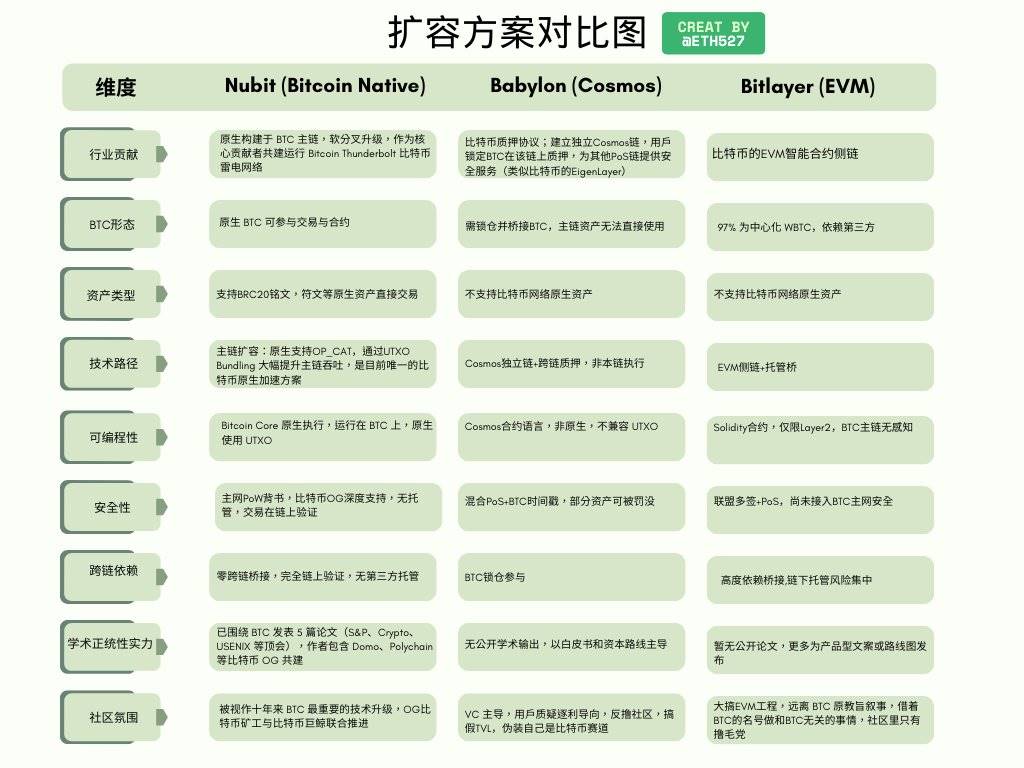
From this, we can see that “natively” built solutions offer comprehensive advantages: security without intermediaries, near-zero trust cost, efficient utilization of Bitcoin liquidity, and ecosystem growth aligned with Bitcoin’s own trajectory. Of course, the challenge with native solutions lies in higher implementation difficulty—they typically require broad consensus within the Bitcoin community (e.g., soft fork upgrades) to be realized. This may slow down progress, demanding robust technical justification and strong community coordination.
4. The Importance of "Nativity" for Bitcoin Value Capture
Beyond feasibility, nativity plays a crucial role in capturing long-term value for the Bitcoin ecosystem.
1. Security Spillover Effect:
Non-native scaling shifts most transactions and fees off the main chain. On Bitcoin’s mainnet, only occasional deposit/withdrawal transactions are visible. Bitcoin itself does not benefit from these Layer2 transaction fees, meaning long-term improvements to mainnet security and value support remain minimal. In contrast, native scaling keeps transaction activity on the Bitcoin main chain—every transaction generates fee revenue for miners, strengthening Bitcoin’s security budget and hash rate stability. This effect is especially critical for Bitcoin’s future post-halving eras, when network security will rely increasingly on transaction fees alone.
2. Value Ownership:
Both Babylon and Bitlayer have their own native tokens used for fees or governance. A portion of ecosystem value gets captured by these new tokens, diluting BTC’s status as the sole value carrier. For instance, Babylon users focus more on BABY token prices and yields than on BTC itself; DeFi applications on Bitlayer may boost the value of its native contract and governance tokens, while BTC remains merely a collateral asset. Over time, if Bitcoin’s innovation dividends are siphoned off by other tokens, this outcome is far from ideal for pure BTC investors. Native scaling, however, ensures all applications use BTC directly as the unit of account and settlement asset. Whether issuing tokens, NFTs, or running dApps, the underlying cost is paid in BTC. As applications thrive, demand for BTC rises—directly benefiting BTC holders from ecosystem growth.
In short, “nativity” means Bitcoin’s own value can actively participate in and amplify ecosystem growth, whereas non-native paths mean value leakage. For investors who believe in Bitcoin’s long-term value, native scaling solutions clearly align better with their interests.
5. One Final Thought
By comparing current scaling solutions, the native path reveals unique strengths—not only overcoming Bitcoin’s scalability bottleneck but also preserving its core principles of security and trustlessness. This transformative innovation is nurturing an explosive new narrative, well worth deep analysis and close monitoring by all investors. As the implementer of Bitcoin Thunderbolt, Nubit represents native scaling that brings a major upgrade to Bitcoin—earning recognition as the first Bitcoin project acknowledged by HSBC in its latest report.
Join TechFlow official community to stay tuned
Telegram:https://t.me/TechFlowDaily
X (Twitter):https://x.com/TechFlowPost
X (Twitter) EN:https://x.com/BlockFlow_News
 @Eth527