AWS Outage Disrupts Binance Services, Exposing Web3 Infrastructure as a "Shoddy Crew"?
TechFlow Selected TechFlow Selected
AWS Outage Disrupts Binance Services, Exposing Web3 Infrastructure as a "Shoddy Crew"?
Not the first time, nor will it be the last.
 Navigating Web3 tides with focused insights
Author: ChandlerZ, Foresight News
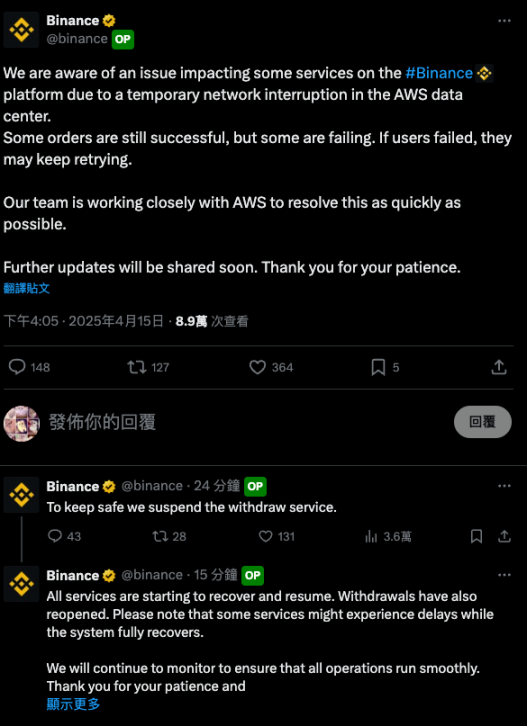
On April 15, Binance announced that due to a temporary network disruption at an AWS data center, some of its services experienced issues. While certain orders were still successful, others failed. All services are gradually being restored, and withdrawal functionality has already resumed. During the full system recovery, delays in some services may still occur.
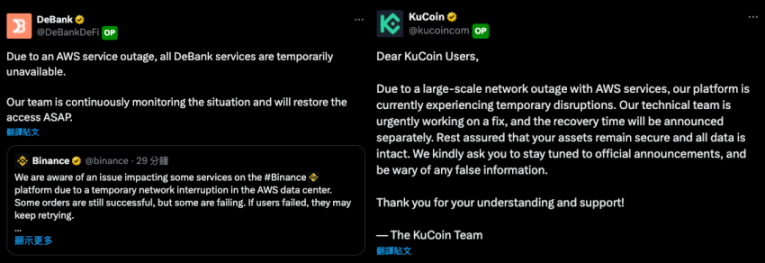
Binance was not the only one affected—platforms including DeBank and KuCoin also issued announcements stating that all DeBank services were temporarily unavailable due to the AWS service outage. Their team is actively monitoring the situation and will restore access as soon as possible.
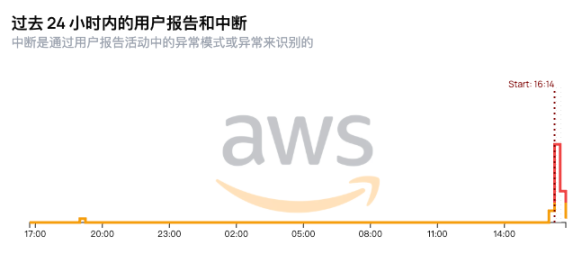
Amazon Web Services (AWS) is a comprehensive cloud computing platform offering a wide range of on-demand services, including computing power, storage, databases, and other functionalities. According to the outage.now website, the platform began experiencing issues at 16:14 and is now gradually returning to normal operations.
Although this incident did not trigger widespread on-chain asset risks or market volatility, it once again exposes a long-standing issue: while the crypto world claims decentralization, at the most critical infrastructure level, it remains deeply entrenched in centralized dependencies.
AWS is a comprehensive cloud computing platform providing various services including computing power, storage, databases, and network transmission. It hosts numerous core internet applications. Within the Web3 ecosystem, many exchanges, wallet services, dApp frontends and backends, oracle nodes, and on-chain indexing services are built upon AWS infrastructure. As such, every AWS outage is not merely a cloud service issue—it represents a substantial shock to the foundational logic of the entire crypto industry.
In this incident, both centralized exchanges like Binance and KuCoin, as well as Web3 wallets and asset tracking platforms such as DeBank and Zapper, were impacted to varying degrees following the AWS failure. Notably, DeBank directly announced "all services temporarily unavailable," indicating even lightweight Web3 tools can be brought to a standstill due to outages on centralized cloud platforms.
This Is Not the First Incident
Looking back, similar events are not unprecedented. In December 2021, a major outage in AWS’s US-East-1 region became one of the most severe incidents in recent years, affecting mainstream trading platforms including Coinbase, Binance.US, Kraken, and dYdX. At that time, Coinbase users encountered API connection failures, delayed trades, and incorrect asset readings, while dYdX temporarily suspended platform operations—even though as a DEX its contracts ran on-chain, its frontend and data interfaces still relied on AWS.
MetaMask was also affected; its default Ethereum RPC provider Infura, hosted on AWS, caused some users to fail in retrieving on-chain data or broadcasting transactions. Similarly, aggregators such as CoinMarketCap and CoinGecko, which rely on AWS for data processing capabilities, reported access delays and interrupted data updates.
Another notable event occurred in 2020 when AWS's Kinesis Data Streams service went down, impacting many platforms relying on real-time data stream processing. Coinbase was affected again, with degraded service performance. CoinGecko also reported delays in market data. This incident demonstrated that the crypto sector’s reliance on AWS extends beyond just web frontends or basic hosting—it penetrates deeply into real-time market data processing and internal transaction systems.
The common thread across these incidents is that when AWS fails, not only do centralized exchange services collapse, but even usage of certain decentralized protocols suffers serious disruptions. This phenomenon—where on-chain protocols remain stable while off-chain interfaces fail—is one of the most significant tensions in the current journey toward Web3 infrastructure decentralization.
Challenges Remain Immense
Although public blockchains like Ethereum and Bitcoin have globally distributed nodes and won’t completely collapse from localized service outages, the user access points, data synchronization paths, and frontend interfaces of many Web3 projects still depend heavily on AWS or other major cloud providers. Particularly for newer projects, node deployments are often concentrated within the same region, meaning a single cloud service failure could severely disrupt network accessibility.
As demand for cloud resources from AI, Web3, and data services rapidly increases, the global cloud market is becoming highly concentrated. According to Statista, by the end of 2024, AWS held a 31% market share, with Microsoft Azure and Google Cloud ranking second and third respectively. This heavy reliance on a few vendors means single-point infrastructure failures are no longer just individual company problems—they represent systemic risks for the entire ecosystem.
Some developers and project teams within the industry have begun exploring alternative approaches such as multi-cloud disaster recovery, IPFS-based frontend hosting, and independent Rollup node deployment to reduce dependence on Web2 infrastructure. However, these solutions often face practical challenges such as high development barriers, increased costs, and complex user experiences, resulting in very few projects actually implementing them.
This latest AWS outage may not have caused direct financial losses, but it sounds another crucial alarm. Between the ideal goal of decentralization and the reality of operational mechanisms, Web3 still needs to undergo a much deeper reconstruction of its infrastructure.
Join TechFlow official community to stay tuned
Telegram:https://t.me/TechFlowDaily
X (Twitter):https://x.com/TechFlowPost
X (Twitter) EN:https://x.com/BlockFlow_News
 Foresight News