








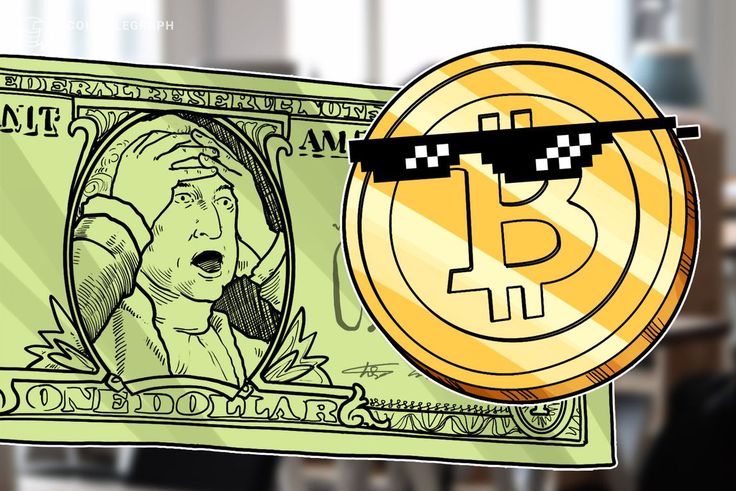
U.S. tariff war has no chance of winning, could be long-term bullish for BTC
TechFlow Selected TechFlow Selected
U.S. tariff war has no chance of winning, could be long-term bullish for BTC
The deeper the rift in the real world, the more precious the consensus in the crypto world becomes.
 Navigating Web3 tides with focused insights
Author: Liu Jiaolian
Yesterday was Black Monday. Under the挥 of tariff sticks, "Stock markets across multiple countries halted trading, BTC fell below $80K" (Apr 7 Jiaolian Insider), with BTC briefly spiking down to 74.5k. This morning, "Panic subsiding" (Apr 8 Jiaolian Insider), BTC rebounded back near the $80K level.
From America's perspective, this tariff war launched single-handedly by Emperor Trump appears utterly unwinnable. Unless his tariff campaign is merely a smokescreen, masking some other ulterior motive.
This kind of extreme extortion has only one path to victory: the entire world collectively kneeling in surrender and waving the white flag. As long as China firmly retaliates, even if all other nations capitulate completely, the objective of the tariff war itself becomes unattainable—goods and capital will naturally reroute along paths of least resistance to complete trade, rendering high tariff barriers effectively meaningless, making "victory" impossible. And if China’s resolute counterattack inspires other confused nations by setting a precedent, causing a dozen or more nations to rise up together, then this highway robber who hopped on board to hijack trade might well get beaten up.
Some weak-bourgeois bloggers have put forth a fallacy: they claim that since China produces and sells goods while the U.S. pays money to buy them, clearly the payer is the master. This reflects a deep poisoning by capitalist money-worship ideology. If dollars cannot buy goods, that green paper becomes too stiff even to wipe one's ass. In capitalism, production is oriented toward money (profit); products are merely byproducts of the profit-making process. The deeper one sinks into bourgeois thinking, the more one develops an almost phallic reverence for money.
The Eastern nation possesses bread machines and produces bread. The Western nation holds printing presses and prints green paper. The Eastern nation trades bread for the green paper of the West. Now the West initiates conflict, refusing to play with the East anymore. The East reciprocally counters, refusing to play with the West. So then, moving forward, which side will go hungry—Easterners or Westerners?
Even elementary school students know it won’t be the Easterners going hungry. However, middle schoolers understand there’s a prerequisite: the capitalists within the Eastern nation who control bread production must still be willing to continue producing bread, even when they can no longer earn greenbacks from it.
University students would further realize the first principle of trade: fair exchange occurs only when forceful plunder isn't possible—"when neighbors stockpile grain, I stockpile guns, because my neighbor becomes my粮仓." Thus, the above prerequisite rests upon an even more fundamental one: the Eastern nation must possess weapons, militarily undaunted by any attempt at robbery from the West.
There are also bloggers deeply devoted to free-exchange theory who unrealistically advocate that regardless of how the U.S. imposes tariffs on China, we should not retaliate symmetrically, but instead implement unilateral zero tariffs, thus maximizing our people's welfare. This is doctrinairism.
First, retaliation is a political tool, not merely an economic calculation. Retaliation causes pain to interest groups within the U.S., thereby forcing them to lobby politically, pushing the U.S. government toward calm and away from self-destructive folly.
Second, considerations for domestic public welfare must certainly be part of retaliatory planning. We should prioritize targeting goods categories where third-party alternatives exist—items previously imported from the U.S. out of mutual interest rather than necessity—for retaliation measures.
Third, the precondition for avoiding comprehensive retaliation is that the U.S. still holds unique, indispensable goods we cannot live without. Only under such circumstances is selective retaliation feasible, while full-scale retaliation remains impossible. But if, as described in the abstract story above, the only thing the Eastern nation itself doesn't produce and cannot source from third parties is the Western nation’s greenbacks, then the conditions for comprehensive retaliation become ripe.
To summarize, when these three conditions simultaneously hold true, comprehensive retaliation becomes inevitable:
A) Division of labor completed: The East produces all goods; the West merely prints USD.
B) Military parity: The East’s nuclear missiles, sixth-gen fighters, destroyers, and other military capabilities can effectively deter the West from entertaining thoughts of plunder.
C) Loss of value: Beyond the dollar, the West can no longer produce any product or resource essential to the East—nothing the East cannot produce itself nor import via third countries. In other words, from the East’s demand perspective, the West’s utility value has nearly vanished entirely.
Of course, real-world situations aren’t 100% pure or perfect—but once thresholds are crossed beyond critical levels, conditions can be considered mature.
When conditions aren't mature, silently endure and work diligently to make them more so. Even if timing emerges prematurely, one can only adopt second-best strategies. For example, during Trump’s previous term of trade war, we downgraded to selective retaliation and offset tariffs through currency devaluation—essentially gritting our teeth and absorbing the bullet wound. That was precisely enduring due to timing arriving before conditions were fully ready.
When conditions are mature, one must still patiently await the right moment. Before the timing arrives, even if conditions are ripe, rash actions must be avoided. Wang Yangming said: “The mind remains unmoved, acting only upon the ‘opportunity.’” This time, Trump, resembling Qing Dynasty arrogance, declaring war on all nations, has practically handed us a perfect opening. Hence, this time, swift, precise, and forceful—we responded head-on with full retaliation, momentarily stunning Trump into uttering absurdities like threatening another 50% tariff hike if you dare not kneel before him.
The turbulent winds of diversification and decoupling are fertile ground for hyper-sovereign, borderless cryptocurrencies like BTC to flourish wildly.
The deeper the fractures in the real world, the more precious consensus becomes in the crypto world.
In the short term, economic turmoil caused by tariff wars forces risk capital into safe-haven mode, scrambling for funds everywhere, draining liquidity from the crypto market and triggering sharp declines. Yet this反而 delivers discounted opportunities straight into the hands of steadfast believers who add positions on every dip.
In the medium term, high tariff barriers equate to the U.S. government forcibly skimming profits off global supply chains—increasing trade friction costs, inevitably driving up prices of goods exported to the U.S., fueling inflation, and depreciating the dollar. Originally, one crate of bread sold for $100; now, with $50 forcibly skimmed mid-chain, it becomes $150 per crate. Bread inflates. The dollar depreciates. Among all macroeconomic factors, what truly drives BTC prices over the long run is inflation—that is, persistent fiat devaluation.
In the long run, losing trade deficits means the U.S. can no longer export dollars globally, gradually eroding the dollar’s status as the world’s reserve currency. At that point, BTC naturally gains opportunity to replace it—at minimum claiming “one-third of the realm.” Moreover, if Trump refuses small nations earning trade surpluses with the U.S. and taking dollars from him, how else will these small nations obtain dollars needed for other purchases?
Jiaolian ventures a bold idea: these small nations should rush to accumulate BTC now. When someday the U.S. government itself begins buying BTC and pushes its price higher, they can slowly sell portions of their national BTC strategic reserves to “retire” on dollars earned.
This might be called the path for small nations to achieve financial freedom via strategic BTC reserves.
The future new dollar circulation loop could look like this: each year, small nations sell a small portion of BTC (less than 4% of strategic reserves, perpetually sustainable due to BTC’s continuous appreciation) into the crypto market—and ultimately, into the hands of the U.S. (Federal Reserve)—acquiring dollars to import American goods, achieving trade balance or even surplus with the U.S. The U.S. (government), earning endless dollars from trade surpluses with small nations worldwide, allocates part of those profits to purchase BTC, depositing it into a national strategic BTC reserve vault.
In my view, rather than calling this a new dollar cycle, it’s more accurate to call it a BTC cycle.
If that day comes, El Salvador—which囤 early—will surely stand tall first, leaping ahead as a financially free small nation.
Let me ask: at that time, what heights will BTC reach? Who dares imagine?
Join TechFlow official community to stay tuned
Telegram:https://t.me/TechFlowDaily
X (Twitter):https://x.com/TechFlowPost
X (Twitter) EN:https://x.com/BlockFlow_News






