








As the U.S. tariff iron curtain descends, where is the path forward for crypto mining?
TechFlow Selected TechFlow Selected
As the U.S. tariff iron curtain descends, where is the path forward for crypto mining?
Cryptocurrency mining machine manufacturers can research and leverage the "U.S. content" rule to produce mining machines eligible for tariff exemptions, and turn their attention to the secondhand mining machine market.
 Navigating Web3 tides with focused insights
Author: FinTax
1. Trump's New Tariff Policy: Content and Motivations
1.1 Policy Overview
On April 2, 2025, U.S. President Donald Trump signed two executive orders at the White House, announcing that the United States would impose a 10% "minimum base tariff" on trading partners and higher tariffs on certain countries. The rate chart presented by Trump showed reciprocal tariff rates ranging from 10% to 50% globally: 10% for the UK, Australia, and Singapore; 17% for the Philippines; 20% for the EU; 24% for Japan; 25% for South Korea; 34% for China; 46% for Vietnam; and 49% for Cambodia. Trump claimed these new measures aim to boost American manufacturing and “make America rich again.” The base tariff took effect on April 5, while the “reciprocal tariffs” became effective on April 9.
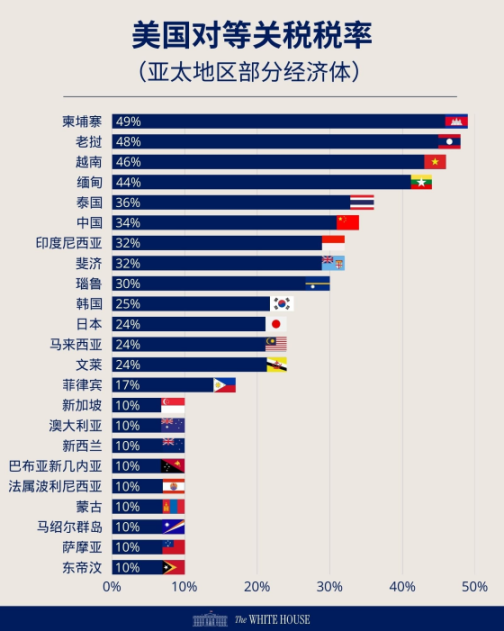
The core of this new tariff policy is the so-called “Reciprocal Tariff.” However, several exceptions apply, including but not limited to: (1) items subject to 50 USC 1702(b); (2) steel, aluminum products, automobiles, and auto parts already under Section 232 tariffs; (3) copper, pharmaceuticals, semiconductors and wood products, certain critical minerals, and energy or energy-related products listed in Appendix 2 of the executive order; (4) goods subject to the second column rates in the U.S. Harmonized Tariff Schedule (HTSUS); (5) all goods potentially subject to future Section 232 tariffs; (6) Canadian and Mexican goods compliant with USMCA rules of origin; and (7) goods containing U.S.-origin content valued at no less than 20% of the total value, where “U.S. content” refers to value attributable to components fully produced in the U.S. or resulting from substantial transformation.
1.2 Analysis of Motivations
The White House claims the new tariff directive aims to address long-standing U.S. trade deficits through significant tariff adjustments, creating a fairer competitive environment for American businesses and workers. In reality, while economic considerations are one factor, Trump’s aggressive tariff stance from the outset of his term reflects broader motivations:
First, economic factors. The U.S. has long run a trade deficit in international trade. According to the White House, this has led to the hollowing out of America’s manufacturing base, constrained its ability to expand advanced domestic production capacity, disrupted critical supply chains, and made the defense industrial base dependent on foreign adversaries. From an official standpoint, reducing trade imbalances and revitalizing American manufacturing represent the primary economic drivers behind the escalation of U.S. tariff policy.
Second, political factors. Trump and the Republican Party draw strong support from blue-collar and conservative voters—groups disproportionately affected by the decline of U.S. manufacturing. Using tariffs to fulfill the “Make America Great Again” agenda serves as a key strategy to appeal to voters, deliver on campaign promises, and consolidate core electoral support. Simultaneously, raising tariffs and erecting trade barriers is fundamentally about preserving America’s central position in the global political-economic system, using economic tools to achieve geopolitical objectives.
Third, leadership factors. From a certain perspective, the new tariff policy aligns closely with Trump’s background as a businessman. Rather than focusing on long-term economic planning, Trump tends to prioritize short-term gains during his tenure, shaping a “America First” political image. He is therefore inclined to use tariffs as bargaining chips in international negotiations.
2. How Tariffs Impact Cryptocurrency Mining
The announcement of this tariff policy triggered immediate market reactions. On April 2, U.S. stock futures plunged collectively, and the cryptocurrency market was similarly dragged down. Bitcoin dropped from $88,500 to around $82,000—a 3% decline—while major altcoins such as BNB, SOL, and XRP suffered even steeper losses. Beyond its broad impact on traditional financial and crypto markets, the specific implications of the new tariff policy for the cryptocurrency mining industry warrant special attention.
2.1 Direct Impact of the Tariff Policy on Crypto Mining
Thanks to abundant cheap energy, robust infrastructure, and strong financial capabilities, the United States has become the world’s most important crypto mining market. According to statistics from December 2024, the U.S. accounted for approximately 36% of global hash power, far ahead of other nations. Together with Russia (16%), China (14%), and the UAE (3.75%), it shaped the basic structure of the global cryptocurrency mining landscape. By early 2025, the U.S. share may have exceeded 40%, possibly nearing 50%.
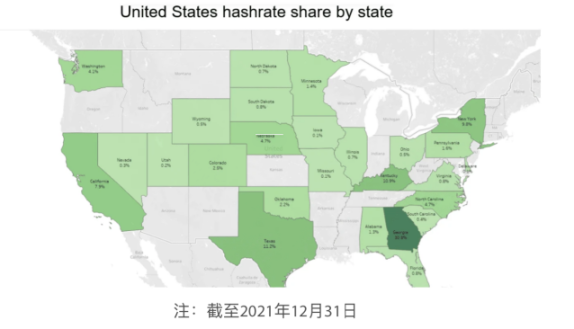
High hash power in the U.S. translates into high demand for mining hardware. However, the U.S. is not a major producer of mining rigs and relies primarily on imports. Therefore, within the cryptocurrency mining ecosystem, upstream and midstream players—such as raw material suppliers, mining rig assembly, and distribution—are directly impacted by the tariff policy. Raw materials include chips, components, and other parts. As the main component of mining rigs, chips are primarily sourced from Samsung in South Korea and TSMC in Taiwan, while other components come largely from Chinese and Southeast Asian manufacturers. Assembly work, due to labor costs, is predominantly carried out in China and Southeast Asia, which benefit from low-cost, abundant labor. Yet most of these countries and regions are included in the list subject to reciprocal tariffs, with Cambodia, Laos, and Vietnam facing near-50% tariffs. These steep tariffs create a lose-lose situation for both U.S. miners and mining equipment manufacturers: On one hand, tariffs directly raise import prices for mining rigs, squeezing manufacturers’ access to the U.S. market—their largest and most profitable—and further weakening profitability. For an industry already experiencing slowing growth, this represents another severe and prolonged blow. On the other hand, these added costs will be passed on to U.S.-based crypto miners, significantly increasing their operating burdens. Particularly concerning is that since Bitcoin’s price began declining from its $100,000 peak, profits across the crypto mining sector have already shrunk considerably. If mining rig prices rise further, some miners may face unprofitable operations and be forced to shut down their facilities. More broadly, if too many miners exit the network, blockchain processing efficiency and security could be compromised, undermining the entire cryptocurrency industry at a foundational level.
2.2 Exemptions and Uncertainties
The reciprocal tariff policy includes several exemptions, notably covering certain semiconductors and U.S.-made products. However, these provisions are unlikely to benefit the cryptocurrency mining hardware industry. First, the Trump administration uses the Harmonized Tariff Schedule (HTS) system to assign specific customs codes to different products, determining applicable tariffs. The announced list of exempted items includes only a small subset of HTS codes in the semiconductor category, none of which currently cover the chip models used in mainstream mining rigs. Second, under the “U.S. content” rule, if components manufactured in the U.S. account for more than 20% of a product’s total value, the product may qualify for exemption. But the U.S. has never been a major hub for mining rig production—neither chips, other components, nor final assembly typically occur domestically. Most production happens in regions now targeted by tariffs, making it extremely difficult for mining rig makers to meet the 20% threshold.
Beyond this, policy uncertainty remains significant. Several countries have signaled retaliatory measures in response to U.S. tariffs, including China, Australia, and Canada. For example, China’s Tariff Commission of the State Council announced that starting April 10, 2025, it would impose a 34% tariff on all goods originating from the U.S., implementing concrete countermeasures. Meanwhile, some countries have adopted conciliatory positions. Facing high U.S. tariffs, Vietnam proposed reducing its tariffs on U.S. goods to 0%, and Cambodia offered to lower them to 5%. Both sides agreed to continue bilateral negotiations on tariff-related agreements. After rounds of political negotiation, the final implementation of the tariff policy may shift. Under the logic of reciprocity, if certain countries—especially in Southeast Asia—lower their tariffs on U.S. imports, they might secure partial tariff relief, thereby mitigating the overall blow to the crypto mining industry. This offers a glimmer of hope amid an otherwise bleak outlook.
3. Pathways Forward: How the Crypto Mining Industry Can Respond
3.1 The Failure of Traditional Strategies
Traditional strategies for circumventing tariff barriers, such as trade diversion, may prove far less effective this time. During the 2018 U.S.-China trade war, Chinese companies bypassed tariffs by rerouting exports through Vietnam, Thailand, and other Southeast Asian nations or relocating production capacity—strategies also adopted by mining rig manufacturers. However, the current scope of the “reciprocal tariff” policy is unprecedented, amounting to a global tariff hike. Key alternative production hubs in the Asia-Pacific region have been almost entirely swept up, making it exceedingly difficult to reroute through unaffected jurisdictions. Other tactics, such as undervaluing mining rigs during customs declarations to reduce tariff payments, carry significant compliance risks. If discovered, companies could face heavy fines or even criminal penalties.
The U.S., as the world’s largest mining market, hosts numerous miners and substantial demand for mining equipment. Given that Trump’s new tariff policy increases production costs for U.S. miners, could avoiding U.S. purchases and mining operations altogether serve as a viable survival strategy? After all, before China’s 2021 mining ban, over two-thirds of global mining activity was concentrated in China. The subsequent migration of miners from China to the U.S. demonstrates that the crypto mining industry does not have absolute path dependency. In fact, deploying mining farms in other countries or regions presents both advantages and disadvantages. The most direct benefit is avoiding exposure to Trump’s tariff policies. However, drawbacks include: first, additional risks and uncertainties associated with relocating and rebuilding mining facilities; second, losing cost advantages, as non-U.S. locations often lack access to cheap electricity, forcing miners to rely on expensive power or costly alternatives like hash rate leasing; third, and most importantly, the U.S. offers a favorable regulatory environment, strong rule of law, and a vibrant crypto market—all of which enhance operational stability and sustainability while minimizing black swan risks arising from policy uncertainty.
3.2 Potentially Viable Response Measures
Besides hoping Trump reverses course on tariffs targeting specific regions, crypto miners and mining equipment manufacturers may explore the following two approaches:
First, miners can turn to the secondary market for used mining rigs. Since tariffs apply only to cross-border trade, domestic transactions of second-hand mining equipment in the U.S. do not incur tariffs. Miners can quickly deploy operations and meet growing hash power demands by purchasing used rigs. However, the second-hand market suffers from high price volatility, lack of standardization, and generally outdated performance, which may fail to meet modern mining requirements.
Second, mining hardware manufacturers can study and leverage the “U.S. content” rule to produce tariff-exempt equipment. As previously noted, given that Trump’s current term has just begun and the tariffs serve clear political purposes, these trade barriers could persist for years. Short-term evasion tactics may offer limited relief, necessitating longer-term compliance strategies. Unlike traditional rules of origin, the 20% “U.S. content” threshold is designed to lower the barrier for reshoring manufacturing, encouraging foreign firms to relocate high-value activities—such as R&D and core component production—to the U.S. Under this framework, disregarding other risks, mining rig manufacturers could seek U.S.-based alternatives for high-tariff components like chips, or separate IP and manufacturing entities to increase the proportion of U.S. content. For instance, foreign mining rig makers could collaborate with U.S. semiconductor firms to co-develop mining-specific chips, or source chip modules packaged and tested in the U.S. (e.g., TSMC’s Arizona facility), allowing those costs to count toward U.S. origin value and thus increase the overall U.S. content percentage to avoid tariffs. Alternatively, firms could establish a U.S.-based technology holding company to own core intellectual property—including chip designs and algorithms—and license them to overseas manufacturing units. However, this approach carries potential tax risks and requires careful legal and financial evaluation before implementation.
Join TechFlow official community to stay tuned
Telegram:https://t.me/TechFlowDaily
X (Twitter):https://x.com/TechFlowPost
X (Twitter) EN:https://x.com/BlockFlow_News
 TaxDAO






